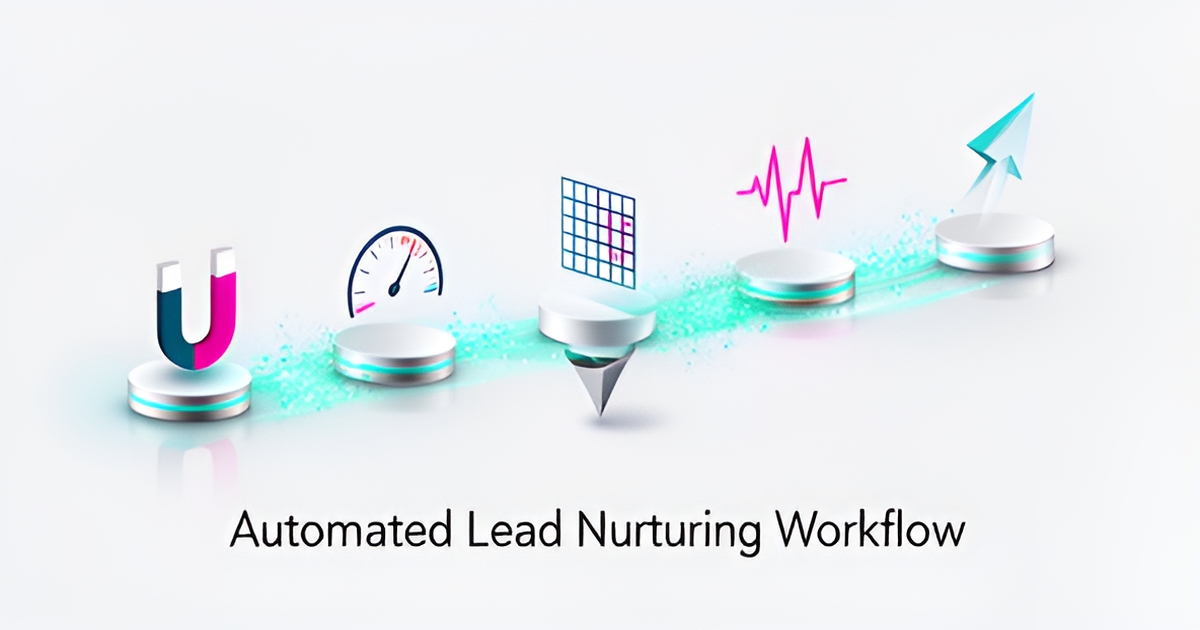
Automated Lead Nurturing AI Workflow Overview
Key Facts
- 80% of new leads never convert, making follow-up, not lead quality, the real revenue leak, according to industry benchmarks.
- Sales reps spend 60% of their week on nonselling work like data entry and CRM updates, per Salesforce's State of Sales research.
- AI-powered nurture delivers 45% higher engagement and 25% higher conversion rates than traditional drip campaigns, per 2026 B2B marketing benchmarks.
- A lead visiting your pricing page three times this week shows high intent, regardless of title or role.
- Leads inactive for 30+ days should exit main nurture sequences into win-back campaigns, per workflow automation best practices.
- Clean CRM data is critical because AI systems are only as good as the data they're trained on, Salesforce warns.
- AIQ Labs' custom workflow builds eliminate 20+ hours of weekly manual data entry, time that goes straight back into selling.
One AI employee doing one job, 24/7, for less than a part-time wage.
Receptionist, lead follow-up, intake or dispatch. Trained on your business and fully managed. From $700/mo.
The Cost of Missed Follow-Up
Most businesses don't have a lead problem. They have a follow-up problem, and it's quietly draining revenue every single week.
According to industry benchmarks, roughly 80% of new leads never convert into sales. That's not because the leads were bad. It's because manual processes can't keep pace: someone downloads your guide, fills out a form, or calls after hours, and the follow-up that should happen within hours slips to days, or never happens at all.
The deeper issue is where a rep's time actually goes. Salesforce's State of Sales research found that sales reps spend 60% of their average week on nonselling work: data entry, scheduling, CRM updates, chasing internal details. As Salesforce puts it, the greatest challenge for reps isn't a lack of skill or drive to win. It's a lack of time.
The manual follow-up bottleneck shows up in a few predictable places:
- Data entry eats selling time. One solopreneur with roughly 3,000 actionable leads described manual CRM entry in a small business forum as the thing consuming the hours that should go to calls and meetings.
- Timing slips. A lead that gets a response two days late is often a lead your competitor already called.
- Stale leads pile up. Without exit conditions and re-engagement logic, inactive leads either get spammed with irrelevant messaging or silently go cold.
There's also a compounding effect. When reps are buried in administrative work, follow-up quality drops first. Personalization becomes copy-paste, high-intent signals like a pricing page visit go unnoticed, and the leads closest to buying get the least attention.
This is the gap that automated lead nurturing workflows exist to close. When capture, scoring, sequencing, and handoff run as a connected system instead of a stack of manual tasks, reps get their week back and leads get responses while intent is still hot. AIQ Labs builds exactly this kind of end-to-end workflow, moving prospects from first touch to conversion without the manual drag in between. The company reports its custom workflow and integration builds eliminate 20+ hours of weekly manual data entry, time that goes straight back into selling.
The math is uncomfortable but simple: if four out of five leads never convert and most of that loss traces back to slow, manual follow-up, the fix isn't more headcount. It's removing the bottleneck.
How AI Replaces Static Drip Campaigns
Here's the section:
A lead that downloaded your whitepaper three weeks ago and a lead that just visited your pricing page twice today are not the same prospect, yet static drip campaigns treat them identically. That mismatch is expensive: according to Zendesk's lead nurturing research, 80% of new leads never convert into sales.
Traditional nurture runs on a calendar. A prospect downloads a guide, lands in Sequence A, and receives the same five emails on the same schedule as everyone else who took that action. AI flips the logic: instead of time triggering the next message, real-time behavior does. Salesforce's breakdown of AI lead nurturing describes the shift as moving from fixed sequences to fluid ones that respond to what a prospect actually does and anticipate their next move.
Here's what changes in practice:
- Scoring becomes dynamic. Explicit data like job title gets weighted alongside implicit signals like pricing-page visits, with scores updated continuously rather than set once.
- Segments update themselves. As OrbitForms' workflow guide puts it, a lead who visited your pricing page three times this week shows high intent regardless of their title.
- Content and timing adapt per person, from generated email copy to recommended case studies and send times.
- Next-best-action alerts flag prospects who need attention now, such as a hot lead going quiet after weeks of engagement.
- Exit conditions fire on conversion or prolonged inactivity, so buyers stop receiving nurture emails the moment they purchase.
The payoff shows up in the pipeline. AI-powered nurture delivers 45% higher engagement and 25% higher conversion rates than traditional drip campaigns, per 2026 B2B marketing automation benchmarks. For a small business, that difference compounds: sales reps already spend 60% of their week on nonselling work, according to Salesforce's State of Sales data.
That's the workflow AIQ Labs builds end to end, from capture through scoring, qualification, and handoff. The behavior-driven logic isn't a bolt-on to a drip sequence. It's the sequence.
If your follow-up still runs on a fixed timer, start with the two-minute Fit Check at aiqlabs.ai/apply, then book a free 30-minute strategy call to map your biggest bottleneck.
The AIQ Labs Lead Nurturing Workflow
Most leads die from neglect, not rejection. With roughly 80% of new leads never converting into sales, the gap between capture and conversion is where revenue quietly leaks out.
AIQ Labs' lead nurturing workflow closes that gap by treating every prospect as a moving target rather than a static record. Built on the same multi-agent architecture the company runs across its own production portfolio, the workflow orchestrates four specialized agent roles across the full lifecycle: a Capture Agent that ingests touchpoint data from forms, ads, and chat; a Scoring Agent that updates lead priority in real time; a Segmentation Agent that routes prospects into behavior-defined cohorts; and an Outreach Agent that handles personalized email, SMS, and voice follow-up. Each agent connects to CRMs, calendars, and payment systems through the Model Context Protocol, so a demo booking or a payment event triggers downstream actions without manual handoffs.
The scoring layer is where the workflow earns its edge. Rather than relying on a static point system, the Scoring Agent weighs explicit signals (job title, company size) against implicit behavior (pricing page visits, repeat content downloads, email reply sentiment). A prospect who reads three case studies in a week jumps tiers automatically, while a lead who goes quiet for 30 days exits the active sequence into a win-back track. This dynamic re-ranking means the SDR AI Employee only sees prospects whose score has crossed a configurable threshold, which frees sales reps from the 60% of their week typically lost to nonselling work.
Personalization runs through the Outreach Agent, which generates email copy, call talking points, and channel recommendations based on each prospect's engagement history. The agent adjusts cadence by segment: cold leads receive 4-6 emails spaced 5-7 days apart, while warm leads see touchpoints every 3-4 days. When a lead converts (books a meeting, requests a quote, completes a payment), the workflow automatically exits them from nurture sequences and routes the deal data to the appropriate downstream system, preventing the credibility damage that comes from post-conversion spam.
The handoff to sales is where most workflows break down. Here, the AI SDR or Lead Qualifier AI Employee takes over conversational qualification, running natural-language discovery calls, booking meetings directly into calendars, and logging structured notes back to the CRM. Human reps enter the loop only when deal value, complexity, or sentiment signals exceed the AI's configured authority, a boundary the system enforces through validation layers and human-in-the-loop escalation paths.
Continuous optimization closes the loop. Every sequence, subject line, and send time feeds performance data back into the Scoring and Outreach Agents, which A/B test variations and adjust weights without manual intervention. The result is a workflow that gets sharper with every cycle, not one that decays the way static drip campaigns do.
Want to see how this maps to your specific pipeline? Start with the two-minute Fit Check to find out where your biggest leak is, or book a free 30-minute strategy call with an AI engineer who'll map the rebuild against your actual CRM data.
Deployment and Integration Strategy
Deployment succeeds or fails before a single agent goes live. Salesforce puts it plainly: AI systems are only as good as the data they're trained on, so having clean, accurate CRM data is critical. That means deduplicating contacts, standardizing fields, and agreeing on lead scoring criteria with your sales team before the workflow ever touches a record. Dirty or outdated CRM data is one of the top reasons automated nurturing programs stall.
Integration is the second pillar. A nurturing workflow that lives in a disconnected tool creates more manual work than it removes, and reps already spend 60% of their average week on nonselling tasks according to Salesforce's State of Sales Report. The fix is native, two-way API connections: when a lead visits the pricing page or requests a demo, the CRM updates instantly, scores change in real time, and the right sequence triggers without anyone copying data between systems. This is how AIQ Labs approaches deployment, connecting its agents directly into CRMs, calendars, and payment platforms so every touchpoint writes back to a single source of truth.
The third pillar is deciding, in writing, what the AI does autonomously and where humans take over. Salesforce recommends clear boundaries between automated actions like follow-up emails and human judgment calls like objection handling and deal negotiation. OrbitForms echoes this: automation should enhance human connection, not replace it entirely. A practical boundary set looks like this:
- AI handles behavioral scoring, segmentation, and behavior-triggered sequences on its own.
- Hot leads with high-intent signals get surfaced to a rep for immediate attention.
- Objection handling, pricing conversations, and contract negotiation stay with humans.
- Converted leads exit all sequences immediately, and leads inactive for 30 or more days move into win-back campaigns.
That last point matters more than most teams realize. Post-conversion emails and stale sequences damage credibility with buyers who are paying attention.
Finally, sequence the rollout itself. Map the buyer journey and define measurable goals first, connect and test your tools second, then launch, monitor, and optimize continuously. Campaign Creators notes that implementation complexity and over-reliance on automation are the key challenges, so a phased build with validation layers and human escalation paths built in from day one beats a big-bang launch every time.
If you want to see how this deployment sequence would map onto your CRM and sales process, start the two-minute Fit Check at aiqlabs.ai/apply and book a free 30-minute strategy call. You'll walk away with a clear picture of where automation fits and where it doesn't.
Still paying for 10+ subscriptions that don’t talk to each other?
We build connected AI systems you own. Pay upfront or on a payment plan; the code is yours once it’s paid off.
Frequently Asked Questions
Why do most leads never turn into customers?
How is AI lead nurturing different from a traditional drip campaign?
Will AI automation replace my sales reps?
What happens when a lead converts or goes cold, will they keep getting emails?
What do I need to have in place before deploying an AI nurturing workflow?
How do I know if automated lead nurturing is worth it for my business?
From Leaky Pipeline to Closed Loop: Where the Real Win Lives
The pattern across every section is the same: leads don't fail because they're bad, they fail because the system around them is. Manual follow-up costs reps 60% of their selling week, static drip campaigns treat a pricing-page visitor the same as a three-week-old download, and post-conversion spam quietly erodes the credibility you've worked to build. The fix isn't more effort, it's a connected workflow where capture, scoring, segmentation, personalization, and handoff run as one system, not a stack of disconnected tasks. That's the architecture AIQ Labs delivers end to end, from the first form fill through AI SDR qualification to the moment a deal closes, with continuous optimization built in so the workflow sharpens instead of decaying. If your pipeline is leaking, the fastest way to find where is the two-minute Fit Check at aiqlabs.ai/apply, followed by a free 30-minute strategy call with an AI engineer who'll map the rebuild against your actual CRM data. No pitch, just clarity on where your biggest bottleneck lives.
See what AI would actually do in your business, in 60 seconds.
The planner shows which step fits, the agents we’d build and the published price. No email needed.