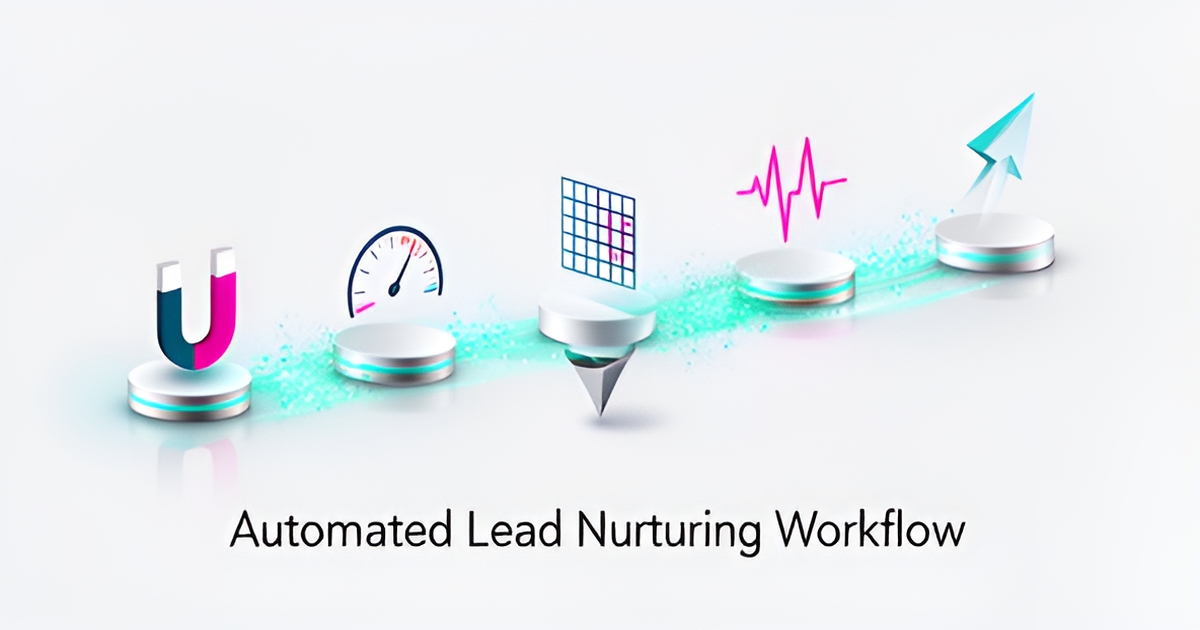
Automated Lead Nurturing AI Workflow Overview
Key Facts
- Top-quartile programs route leads to sales in a median of 11 minutes, while bottom-quartile programs take 4.8 hours per marketing automation benchmarks.
- 84% of businesses name MQL-to-SQL conversion as their single biggest lead generation challenge according to lead generation research.
- 79% of marketing leads never convert into sales, with weak nurturing cited as a common cause per lead nurturing statistics.
- Companies that excel at lead nurturing generate 50% more sales-ready leads at 33% lower cost research finds.
- Behavioral triggers lift click-through rates by 41%, and segmented nurture generates 760% more revenue than broadcast sends per automation benchmark data.
- Data waterfalls can push contact coverage from roughly 30% to over 80% according to Clay's AI nurturing breakdown.
- 47% of lead scoring models are now partially or fully AI-generated, up from just 11% in 2024 industry data shows.
One AI employee doing one job, 24/7, for less than a part-time wage.
Receptionist, lead follow-up, intake or dispatch. Trained on your business and fully managed. From $700/mo.
Where Your Pipeline Actually Leaks: The Handoff, Not the Copy
Most teams assume a weak nurture sequence is what kills their pipeline. The data points somewhere less comfortable: the handoff.
Routing latency separates top performers from the rest by a wide margin. Top-quartile programs move a lead from capture to first sales touch in a median of 11 minutes, while bottom-quartile programs take 4.8 hours, according to marketing automation benchmarks. That gap is measured in days of selling time, and it compounds across every lead you capture.
The conversion bottleneck sits right where marketing hands off to sales. Lead generation research finds 84% of businesses name MQL-to-SQL conversion as their single biggest challenge, and the median financial services program converts just 31.7% of MQLs to SQLs. Meanwhile, lead nurturing statistics show 79% of marketing leads never convert at all, with weak nurturing cited as a common cause. Qualified prospects go cold in the gap between "marketing is done" and "a rep is talking to them."
Three failure points show up again and again:
- Routing waits on a human to notice a form fill or a score change.
- Lead scores go stale because nothing re-evaluates them in real time.
- Enrichment happens after assignment, so reps work incomplete records.
- Sequences fire on fixed schedules instead of buyer behavior.
- No one owns the moment between MQL and SQL, so nobody fixes it.
The fix isn't better copy. It's an end-to-end workflow where capture, enrichment, scoring, sequencing, and routing run as one system, with AI taking action at each stage instead of waiting for someone to click. That's the model AIQ Labs builds for finance and payment teams: leads enriched, scored, and routed within minutes, then worked through behavior-triggered sequences rather than a static drip. If your MQL-to-SQL rate sits under 20%, the highest-leverage change is almost never the content. It's the handoff.
What an AI Nurturing Workflow Actually Looks Like, Stage by Stage
Most teams lose pipeline to slow handoffs, not weak content. The industry has quietly converged on a six-stage pipeline that fixes that: capture, enrichment, AI scoring, personalized behavioral sequences, fast routing, and conversion.
Capture is where AI lead generation and enrichment begins. Instead of waiting on form fills, custom generation engines scrape for ideal customer profiles, then verify and enrich every record. Data waterfalls can push contact coverage from roughly 30% to over 80%, according to Clay's breakdown of AI nurturing systems, which matters because 79% of marketing leads never convert, often for lack of nurturing, per Salesgenie's lead nurturing statistics.
AI scoring turns that enriched data into priority. A bespoke model trained on your own sales history scores fit, engagement, and contract value, then updates in real time as behavior changes. Demandbase's guide to AI lead scoring describes the standard five-phase workflow: collection, cleaning, modeling, scoring on a 0 to 100 scale, and continuous learning. Be honest about the tradeoff: models can bake in bias and degrade without retraining on fresh win/loss data, which is why human-in-the-loop controls matter.
Personalized behavioral sequences replace the old time-based drip. Behavioral triggers lift click-through rates by 41%, and segmented nurture generates 760% more revenue than broadcast sends, according to Digital Applied's marketing automation data. This is where AI-powered sales outreach intelligence earns its keep:
- Research each prospect automatically and generate personalized messages
- Recommend optimal send timing based on engagement signals
- Supply objection-handling scripts drawn from your own win data
- Sequence across email, SMS, and LinkedIn, where DMs see a 10.3% response rate
Routing is the stage most teams get wrong. Top-quartile programs route leads in a median of 11 minutes; bottom-quartile programs take 4.8 hours, per the same Digital Applied dataset. AI-powered features cut time to service an inbound lead by 31%, per Default's study of 88,000+ inbound leads. Speed of handoff is where deals are won or lost.
AIQ Labs maps its workflow directly onto this pipeline: bespoke AI lead scoring, lead generation and enrichment, and sales outreach intelligence, delivered as one connected system rather than three disconnected tools. For finance and payment automation teams, the benchmark is steep. Financial services posts the highest MQL-to-SQL median at 31.7%, so scoring threshold calibration and routing latency are usually the highest-leverage fixes, not another platform. Start with the two-minute Fit Check at aiqlabs.ai/apply, then a free 30-minute strategy call at aiqlabs.ai/book.
The Honest Limits of AI Scoring (and How to Design Around Them)
AI scoring sounds objective, but objectivity isn't the same thing as accuracy. The tool inherits whatever patterns sit in your historical data, including the bad ones.
Start with what AI scoring genuinely fixes. Manual scoring drowns in fatigue and emotional bias, and models don't get tired at 4 p.m. on a Friday. But the same revenue-operations research that documents those gains warns that AI scoring can bake bias into the funnel, suffer confirmation bias, and miss qualitative nuance a human reviewer would catch. A model trained on deals your team already won learns your team's blind spots, then applies them at scale.
The stakes are high because scoring drives everything downstream. In finance, the median MQL-to-SQL conversion sits at 31.7%, and industry benchmark data shows 47% of scoring models are now partially or fully AI-generated, up from 11% in 2024. A biased threshold doesn't just misrank one lead. It starves the pipeline quietly for months.
Design around the limits instead of pretending they don't exist:
- Retrain continuously with win/loss data. Models degrade without fresh outcomes, so feed every closed deal back into the model.
- Keep humans in the loop on threshold changes and edge cases the model flags as uncertain.
- Demand explainability. If you can't see why a lead scored 82, you can't trust the number.
- Track click rate and lead-to-opportunity rate rather than open rate, which privacy features inflate.
- Audit scores against outcomes quarterly to catch drift before it compounds.
This is where AIQ Labs takes a deliberately unhyped position. The firm builds bespoke lead scoring, enrichment, and outreach systems with human-in-the-loop controls and continuous optimization built in, the same architecture it runs in its own production platforms, including voice AI deployed in regulated financial collections work. A score is a hypothesis. The win/loss data is the verdict.
If your funnel runs on scores nobody can explain, start with the two-minute Fit Check at aiqlabs.ai/apply, then a free 30-minute strategy call at aiqlabs.ai/book.
Building Your Workflow: Start With the One That Costs You Most
Don't try to automate everything at once. The businesses that see results fastest pick the single workflow that's bleeding the most money and rebuild that one first. For most companies, that's lead follow-up, intake, or routing, and the numbers explain why: teams without automation lose qualified pipeline at an average 14% gap in opportunity creation velocity, and 79% of marketing leads never convert into sales, with lack of nurturing cited as a common cause.
The reason to start narrow is practical. Industry benchmark data shows top-quartile programs route leads in a median of 11 minutes while bottom-quartile programs take 4.8 hours, and that speed of handoff, not content quality, is where most pipeline is lost. Fixing one workflow end to end gets you that speed win in weeks, while a sprawling multi-process project often stalls before it ships anything.
So how do you pay for it? AIQ Labs structures engagements three ways, matched to scope:
- Start Monthly: one AI employee with setup plus a flat monthly plan that costs less than a part-time hire, including the build, training, integrations, monitoring, and improvements. Pause or adjust anytime.
- Build in Milestones: one workflow or department system split into phases. You approve and pay per phase as it ships, and you can stop anytime while keeping everything built so far.
- Own It Outright: a full AI operating system at one project price or via a monthly Build Partnership, with full ownership of the code, agents, and data when complete.
For a first lead nurturing workflow, the Start Monthly or Build in Milestones models fit best. You're proving the concept on one process before committing to a larger system, which is exactly how the economics work in your favor: lead nurturing research finds companies that excel at nurturing generate 50% more sales-ready leads at 33% lower cost, so even a single rebuilt workflow can carry its own weight quickly.
Once the first workflow is live and measurably working, expansion becomes straightforward. Add the next highest-cost process, then the next, until the pieces connect into a full operating layer. AIQ Labs takes this phased approach across its build scope tiers, from a single workflow fix up to a complete multi-department AI system, and clients own what's built at every stage.
If you're not sure which workflow costs you most, that's the right question to bring to the table. Start with the two-minute Fit Check at aiqlabs.ai/apply, then book a free 30-minute strategy call at aiqlabs.ai/book to map your biggest bottleneck and identify the highest-ROI automation opportunity. If there isn't a clear win, they'll tell you that too.
Still paying for 10+ subscriptions that don’t talk to each other?
We build connected AI systems you own. Pay upfront or on a payment plan; the code is yours once it’s paid off.
Frequently Asked Questions
Why does my pipeline leak even when my nurture emails look good?
What does an AI lead nurturing workflow actually look like stage by stage?
Is AI lead scoring actually more accurate than manual scoring?
How much faster is AI-powered routing compared to doing it manually?
Do behavior-based nurture sequences really outperform traditional drip campaigns?
Which workflow should I automate first if I want results fast?
Fix the Handoff, Not the Copy: Your Next Step Is Smaller Than You Think
The pipeline leak isn't in your nurture copy, it's in the handoff. Top-quartile programs route leads in a median of 11 minutes; bottom-quartile programs take 4.8 hours, and that gap compounds across every lead you capture. The six-stage workflow covered here, capture, enrichment, AI scoring, behavioral sequences, fast routing, conversion, works as one connected system, not three disconnected tools. AI scoring helps, but it inherits your historical blind spots, so continuous retraining on win/loss data and human-in-the-loop controls aren't optional. For finance and payment teams, where the median MQL-to-SQL conversion sits at 31.7%, scoring threshold calibration and routing latency are usually the highest-leverage fixes. You don't need to automate everything at once. Pick the single workflow costing you most, usually lead follow-up, intake, or routing, and rebuild that one first. That's the model AIQ Labs builds, and it's how companies that excel at nurturing generate 50% more sales-ready leads at 33% lower cost. Start with the two-minute Fit Check at aiqlabs.ai/apply, then book a free 30-minute strategy call at aiqlabs.ai/book. If there isn't a clear win, they'll tell you that too.
See what AI would actually do in your business, in 60 seconds.
The planner shows which step fits, the agents we’d build and the published price. No email needed.