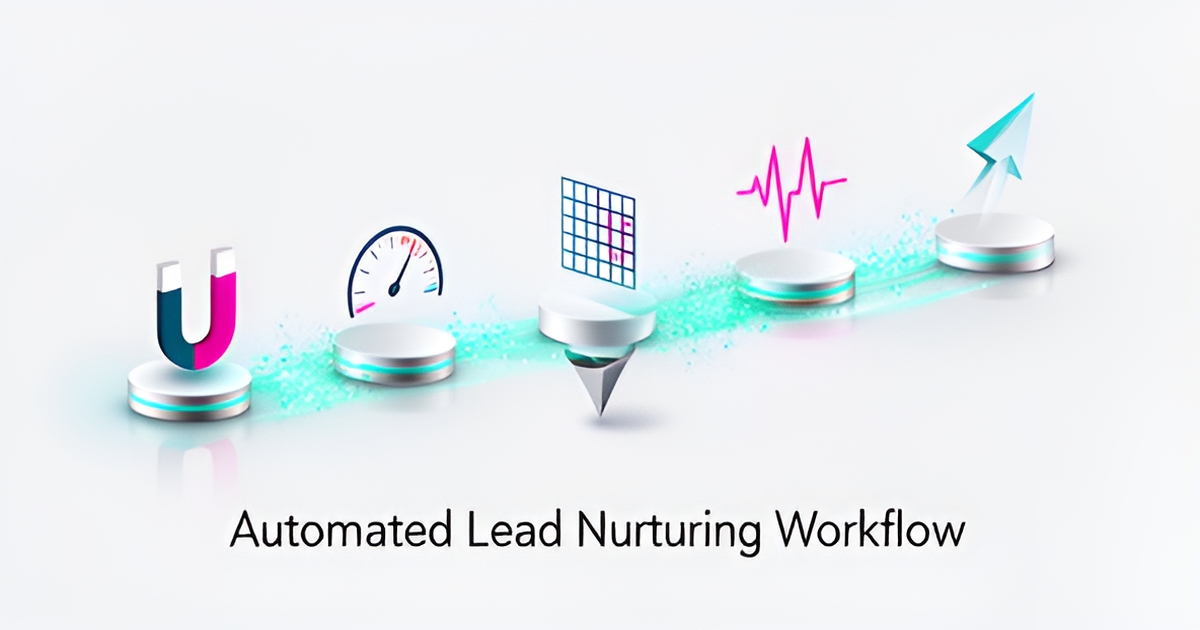
Automated Lead Nurturing AI Workflow Overview
Key Facts
- Leads contacted within five minutes convert significantly higher than those waiting hours per automated follow-up research.
- Top-quartile programs route leads in 11 minutes, while bottom-quartile teams wait 4.8 hours according to 2026 benchmarks.
- Companies excelling at nurturing generate 50% more sales-ready leads at 33% lower cost based on industry statistics.
- Behavioral trigger emails achieve 3x higher open rates than standard scheduled drip sequences per AI nurturing analysis.
- Automated lead programs cost $18.40 per qualified lead versus $26.10 for manual efforts according to automation data.
- The AI-to-human handoff is the most-cited failure point in B2B nurturing programs according to workflow experts.
- Clay found most of 6,346 companies never responded to demo form submissions at all per their system analysis.
One AI employee doing one job, 24/7, for less than a part-time wage.
Receptionist, lead follow-up, intake or dispatch. Trained on your business and fully managed. From $700/mo.
The Speed-to-Lead Problem Killing Your Pipeline
A prospect fills out your demo form. Then they wait. And in that window, they're checking out your competitors, second-guessing the decision, or simply going cold. Most businesses lose the deal right there, before a single human ever hits "reply."
The data on response speed is blunt. Leads contacted within five minutes of an inquiry convert at significantly higher rates than those contacted hours or days later, according to research on automated lead follow-up. Five minutes. That's roughly the time it takes to finish the meeting you were already in.
Most teams can't hit that window, and the gap between top and bottom performers shows it. Median lead-routing latency sits at 11 minutes for top-quartile programs and 4.8 hours for bottom-quartile ones, per 2026 marketing automation benchmarks. Automated routing alone cuts the time from lead capture to first sales touch by 43%.
It gets worse. In a test of 6,346 companies, Clay found that most never responded to demo or contact form submissions at all, as documented in their analysis of AI lead nurturing systems. Not slow responses. No responses. These businesses paid to generate demand, then left the leads sitting in an inbox.
The cumulative cost is enormous. Roughly 79% of marketing leads never convert into sales, and lack of nurturing is a common cause, according to lead nurturing statistics. The same research notes that teams "lose more pipeline to slow handoffs than to weak nurture content." That reframes the problem for most organizations. They invest in better email sequences and smarter messaging when the actual leak is upstream: nobody got back to the lead fast enough.
Here's what slow response typically costs you:
- Leads that go cold before a rep ever sees them, because routing took hours instead of minutes
- Demo requests answered by competitors who replied first
- After-hours and weekend inquiries that sit untouched until Monday
- Qualified buyers who fill out forms expecting a fast reply and get silence
This is why speed-to-lead is the first problem any serious nurturing workflow has to solve, and why it's where AI earns its keep. An AI system can respond in under 30 seconds, qualify the lead, and book a meeting while your team sleeps. It's the approach we build around at AIQ Labs, where AI Employees handle first response and qualification around the clock, then hand off to your team with full context.
The 5-minute window isn't a nice-to-have. It's the difference between a pipeline that converts and one that quietly leaks 79% of its leads.
The Workflow Pattern the Market Has Converged On
The market has stopped debating whether AI belongs in lead nurturing. It's now a question of which pattern actually works, and the answer has converged fast.
Across IBM, Salesforce, and the benchmark data, the same six-stage workflow keeps showing up: capture, instant AI response, AI scoring and qualification, behavior-triggered multi-channel nurture, human handoff with full context, and cold-lead re-engagement. IBM describes AI SDRs as autonomous agents that decide and act toward a goal, not rule-followers. Salesforce frames the same shift as people and AI working together rather than AI replacing roles.
The reason this pattern wins comes down to timing. Leads contacted within five minutes of an inquiry convert at significantly higher rates, and top-quartile programs route leads in about 11 minutes versus 4.8 hours for bottom performers, according to 2026 marketing automation benchmarks. Most teams lose more pipeline to slow handoffs than to weak content.
Behavior triggers beat fixed drips. A day-three email fires whether or not anyone is interested. A trigger fires on a pricing page visit or a second demo request, and behavioral trigger emails see roughly 3x higher open rates than scheduled sequences, with 41% higher click-through rates.
Multi-channel isn't optional anymore. B2B buyers move through about ten channels, and the payoff varies by channel:
- SMS click rates run nearly 2x higher than email, and SMS drives 45.2% of SMS revenue on 7.6% of sends
- LinkedIn DMs earn a 10.3% response rate against 5.1% for cold email
- 60% of leads still prefer email above any other channel
The stage teams most often get wrong is the handoff. Losing conversation context and failing to write data back to the CRM are the most-cited failure points in B2B nurturing programs. A handoff that passes full context, removes the lead from active sequences, and logs every touchpoint is what separates a working system from an expensive one. That's the gap AIQ Labs builds against with human-in-the-loop controls and MCP-based CRM integration, so an AI SDR or Lead Qualifier hands off to a human with the whole conversation attached.
If your MQL-to-SQL conversion sits under 20%, the highest-leverage fix usually isn't a new platform. It's scoring calibration and routing latency. Start the two-minute Fit Check at aiqlabs.ai/apply and map your biggest bottleneck on a free 30-minute strategy call.
The Business Case: What Nurturing Automation Actually Returns
The numbers behind lead nurturing automation are strong enough that they deserve a hard look before you commit budget. Companies that excel at nurturing generate 50% more sales-ready leads at 33% lower cost, and nurtured leads go on to make purchases that are 47% larger than those from un-nurtured leads, according to lead nurturing statistics compiled by Salesgenie. Those figures line up with the broader pattern: 79% of marketing leads never convert, and lack of nurturing is a common cause.
The conversion math gets better when you add scoring and behavioral triggers. Marketing automation benchmark data shows that nurture workflows combining lead scoring with behavior-based triggers lift MQL-to-SQL conversion by 30 to 50%, with a median lift of 38%. When AI intent signals are layered on top, that lift reaches 62%. That matters because 84% of businesses cite converting MQLs to SQLs as one of their most significant lead generation challenges.
Cost per qualified lead tells a similar story. Automated programs run $18.40 per qualified lead versus $26.10 for manual efforts, and the median marketing automation return is $5.44 per $1 spent. Top-quartile programs hit $8.71, while bottom-quartile programs still return $1.92. Even the worst performers come out ahead.
A few honest caveats before you build a forecast on these numbers:
- Most of these figures come from vendor-compiled roundups aggregating unnamed primary sources, so treat them as directional benchmarks rather than guarantees.
- The median $5.44 return assumes a functioning program. Bottom-quartile results show execution quality swings the outcome by more than 4x.
- Conflicting benchmarks exist across sources, such as open-rate data that varies widely and is inflated by privacy features.
- No independent, audited case studies of end-to-end AI nurturing workflows are publicly available, so validate against your own baseline.
What the data does support is a clear pattern: automation pays when it fixes the two things manual nurturing gets wrong, namely slow response times and generic follow-up. This is the problem AIQ Labs designs its end-to-end nurturing workflows around, pairing AI Employees that respond and qualify leads around the clock with behavioral triggers and CRM-integrated handoffs. If your MQL-to-SQL conversion sits under 20%, the highest-leverage fix is usually scoring calibration and routing speed, not a new platform.
The practical move is to measure your current cost per qualified lead and MQL-to-SQL rate first. Then you'll know whether the benchmark returns above are realistic for your business or just someone else's averages.
Where AI Nurturing Programs Fail (and How to Avoid It)
Most nurturing programs don't fail because the AI can't write a follow-up email. They fail at the moment a real buyer raises their hand and the system quietly drops the ball.
The AI-to-human handoff is the most-cited failure point in B2B nurturing programs, and the pattern is painfully consistent: a lead shows hot intent, a rep never hears about it in time, and the conversation context vanishes into a black box. Meanwhile, nurture activity that never writes back to the CRM leaves sales staring at a record that tells them nothing. Generic Zapier-style connections make it worse, stitching tools together without passing real data between them.
What good looks like is specific:
- Real-time rep notification when a lead signals buying intent
- Full conversation context passed to the human, not a summary stripped of nuance
- Automatic removal from nurture sequences the moment a rep engages
- Native, two-way CRM integration so every touchpoint writes back to the record
That last point matters more than most teams realize. AI SDR effectiveness depends on deep integration with CRM data, both to personalize outreach and to log every interaction automatically, according to Salesforce's guidance on AI SDRs. When that loop breaks, you get the worst of both worlds: automation running at full speed and a sales team flying blind.
Speed compounds the problem. Median lead-routing latency sits at 11 minutes for top-quartile programs versus 4.8 hours for bottom-quartile ones, and many teams lose more pipeline to slow handoffs than to weak nurture content, per marketing automation benchmark data. A handoff that arrives four hours late is not a handoff. It's a missed call.
This is where human-in-the-loop design stops being a buzzword and becomes the difference between a working system and an expensive one. AIQ Labs builds validation layers that check every action before it executes, configurable escalation when a situation exceeds the AI's authority, and audit trails that log the full chain of events. An AI Employee that qualifies a lead, books the meeting, and then hands your rep the entire conversation is useful. One that books the meeting and tells nobody is a liability.
The fix isn't a better chatbot. It's a workflow where the AI knows when to act, when to escalate, and how to make sure the human on the other end has everything they need the second they step in.
Building Your Workflow: Staged Rollout with AI Employees
Most businesses lose pipeline to slow handoffs, not weak content. Industry data shows top-quartile programs route leads in 11 minutes, while bottom-quartile teams wait 4.8 hours.
You need a staged rollout that fixes this latency first. Start by deploying AI Employees to handle initial capture and response. This ensures no lead sits idle while your team processes the queue.
Once response times stabilize, layer in structured sequences. Move from static drip campaigns to behavior-based triggers that fire on specific actions. This approach yields significantly higher engagement than generic timing.
As your data matures, introduce AI scoring and personalization. This final stage allows the system to prioritize high-value prospects automatically. It ensures your human team only focuses on leads ready to buy.
AIQ Labs maps this progression to specific capabilities. You start with AI Lead Qualifiers and AI SDRs working around the clock. These agents integrate directly with your CRM via MCP, ensuring every touchpoint is logged.
The workflow relies on deep integration with tools like HubSpot, Salesforce, and Pipedrive. This connection allows the AI to update records in real time. It prevents the data silos that typically break nurturing programs.
When a lead reaches a high-intent threshold, the system executes a clean handoff. It passes full conversation context to your sales rep. This solves the most-cited failure point in B2B nurturing, which is losing context during transfer.
You have three payment models to fit your budget and risk tolerance. Each option supports the same underlying technology and integration depth.
- Start Monthly: A flat plan for one AI employee, including build, training, and monitoring.
- Build in Milestones: Phased delivery for a specific workflow, with approval required at each stage.
- Own It Outright: Full ownership of the code and data for a complete AI operating system.
The goal is pipeline defense, not just tool acquisition. Research indicates that speed and scoring calibration drive the highest ROI.
Start with a two-minute Fit Check to identify your biggest bottleneck. Then book a free 30-minute strategy call to map your implementation plan. We take on a handful of new builds at a time, so clarity is key.
Still paying for 10+ subscriptions that don’t talk to each other?
We build connected AI systems you own. Pay upfront or on a payment plan; the code is yours once it’s paid off.
Frequently Asked Questions
How fast do we actually need to respond to a new lead before it goes cold?
What's the biggest reason lead nurturing programs fail?
Do automated lead nurturing systems actually pay for themselves?
Are behavior-based triggers really better than a standard drip email sequence?
Which channels should a nurture workflow actually cover, isn't email enough?
Can AI really qualify and book meetings on its own, or does it just pass leads along?
Stop Leaking Pipeline. Start Defending It.
Speed-to-lead is the leak. Behavior triggers beat fixed drips. Multi-channel orchestration is no longer optional. The AI-to-human handoff is where most programs quietly die. These are the four levers that separate a nurturing workflow that converts from one that quietly loses 79% of its leads, and they're exactly what an end-to-end AI system is built to solve. The business case is hard to argue with: companies that excel at nurturing generate 50% more sales-ready leads at 33% lower cost, and nurtured leads go on to make purchases that are 47% larger than those from un-nurtured leads, according to lead nurturing statistics. The real question isn't whether to automate, it's where the leak is in your current pipeline. If your MQL-to-SQL conversion sits under 20%, the highest-leverage fix is almost never a new platform; it's scoring calibration and routing latency. Start with the two-minute Fit Check at aiqlabs.ai/apply to identify your biggest bottleneck, then book a free 30-minute strategy call at aiqlabs.ai/book to map your rollout. We take on a handful of new builds at a time, and if there isn't a clear win, we'll tell you that too.
See what AI would actually do in your business, in 60 seconds.
The planner shows which step fits, the agents we’d build and the published price. No email needed.