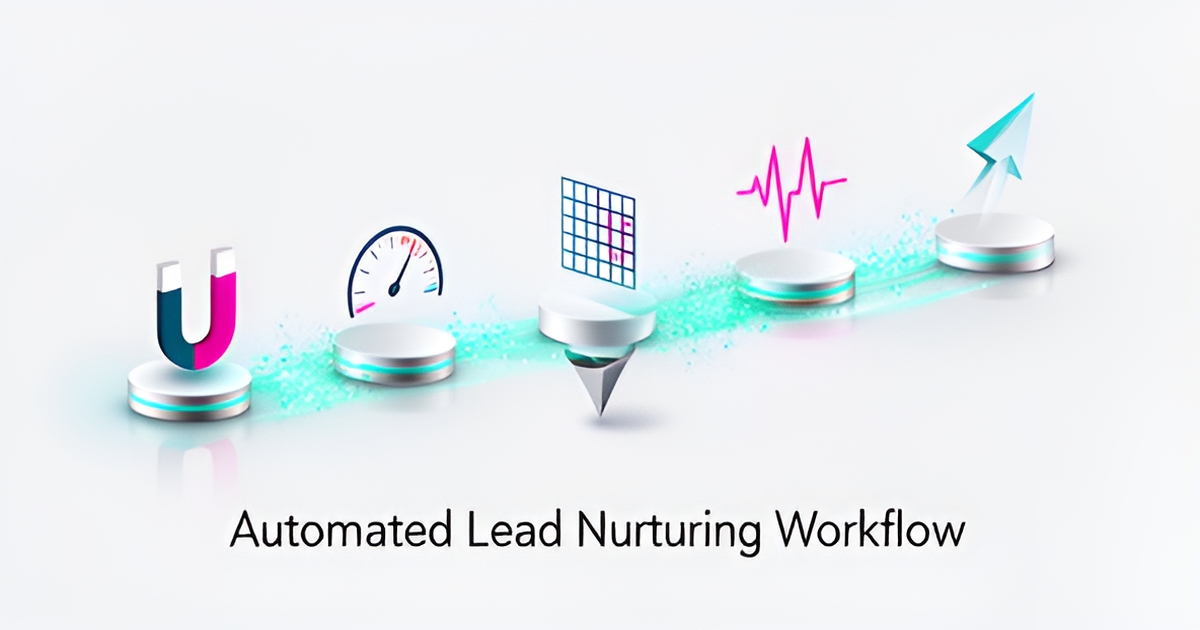
Automated Lead Nurturing AI Workflow Overview
Key Facts
- Lead contact success rates drop more than tenfold within the first hour after interest is shown, according to sales outreach research.
- Businesses lose qualified leads in a 3-10 minute gap between a prospect's initial chat and first email follow-up, per ActiveCampaign's research.
- Roughly 39% of prospect conversations happen outside normal business hours, when manual teams are structurally absent, per lead behavior research.
- AI-powered nurturing produces 45% higher engagement and 25% higher conversion rates than traditional drip sequences, per industry benchmarks.
- Progressive Insurance generated $2 billion in new premiums in one year from an ML feature with 90% accuracy identifying hot leads, per AI scoring case studies.
- Companies using AI lead scoring see a 30% increase in sales productivity and 25% shorter sales cycles, per IBM's analysis.
- HES FinTech issued 40% more loans weekly after training a predictive model on three years of HubSpot data, per documented case studies.
One AI employee doing one job, 24/7, for less than a part-time wage.
Receptionist, lead follow-up, intake or dispatch. Trained on your business and fully managed. From $700/mo.
The Lead Follow-Up Gap That's Costing You Revenue
Every inquiry that lands in your inbox represents someone actively looking for a solution. Yet most businesses lose a meaningful share of those leads not to competitors with better products, but to slow, generic follow-up.
The damage happens in a specific window. Research on lead behavior shows that businesses lose qualified leads in a 3-10 minute gap between a prospect's initial chat interaction and the first email follow-up. And the odds don't just dip after that window closes; the success rate of contacting a lead drops more than tenfold within the first hour after interest is shown, according to sales outreach research. A rep who clears their inbox at 4:45 PM is often calling someone who went cold at 10 AM.
Off-hours inquiries compound the problem. Roughly 39% of all prospect conversations happen outside normal business hours, which means a manual team is structurally absent for a huge slice of demand. A prospect who fills out a form at 9 PM on a Tuesday gets nothing until the next morning, by which point their intent has cooled and, often, their business has gone elsewhere.
Then there's the sameness problem. Traditional drip campaigns treat every lead identically, ignoring differences in industry context, buyer role, account stage, and real-time engagement signals. The hot prospect asking for pricing and the casual browser who downloaded one PDF receive the same email sequence on the same schedule. That flat approach shows up in the numbers: AI-powered nurturing produces 45% higher engagement and 25% higher conversion rates than traditional drip sequences, per industry benchmarks.
The math on what this costs is uncomfortable. One illustrative calculation found that if a business loses half its leads in the chat-to-email handoff (100 monthly inquiries at a $2,000 average value), that's $100,000 in lost revenue per month, or $1.2 million annually.
- The 3-10 minute window after initial contact, where response speed determines whether the conversation continues or dies
- The first hour, where contact success rates fall more than tenfold
- Off-hours demand, where 39% of conversations happen with no human available
- Generic sequences that send identical content to leads at wildly different stages of intent
This is the gap AI-driven lead nurturing is built to close. Systems that read intent signals in real time, respond within minutes regardless of the hour, and score leads dynamically can hold prospects inside that window instead of leaking them. It's the core problem we look at first with clients at AIQ Labs, because rebuilding lead follow-up is often the single highest-ROI workflow fix available. If you're unsure how much of your pipeline is evaporating in these gaps, a two-minute Fit Check at aiqlabs.ai/apply followed by a free 30-minute strategy call will map where your leads are actually going.
How AI Nurturing Works: Intent Signals, Predictive Scoring, and Omnichannel Orchestration
The moment a prospect shows interest, a clock starts. Contact a lead within the first hour and your odds are solid; wait longer and the success rate drops more than tenfold, according to Artisan's analysis of AI lead nurturing. Worse, businesses lose qualified leads in a "3-10 minute window" between an initial chat and the first email follow-up, per ActiveCampaign's research. AI nurturing exists to close that gap.
It works through three connected layers. The first is real-time intent analysis. Modern systems evaluate semantic meaning, sentiment shifts, hesitation patterns, and intent signals like comparison requests to identify the exact moment a lead is ready to move from casual chat to structured conversation. That's a long way from the old drip campaign that treats every lead identically regardless of what they just did.
The second layer is predictive scoring. Static, rule-based point systems are giving way to machine learning models that are, as IBM puts it, always learning from new data. These models analyze thousands of data points at once: behavioral patterns, firmographics, engagement history, demographics. They self-optimize by comparing their predictions to actual outcomes and adjusting criteria weights, so they get more accurate with every interaction. The payoff is measurable. Companies using AI lead scoring see a 30% increase in sales productivity and a 25% shorter sales cycle, and 75% of businesses have already adopted AI scoring, with an average conversion improvement of 25%.
The third layer is omnichannel orchestration. Leads move between platforms, so effective workflows coordinate email, SMS, chat, and voice rather than firing seven emails in a row. As Artisan frames it: seven cold emails across seven days is borderline stalking, but seven messages spread across email, text, and chat is just persistent, high-quality nurturing. Event tracking (clicks, visits, downloads) triggers branching logic, and content is adapted per channel rather than reinvented.
For finance and payment automation specifically, the results are compelling:
- HES FinTech issued 40% more loans weekly after training a predictive model on three years of HubSpot data.
- Progressive Insurance generated $2 billion in new premiums in one year from an ML-driven feature, hitting 90% accuracy in identifying hot leads.
- A Fortune 100 financial services organization improved target conversions by 3-5% through AI-driven segmentation and personalization.
- Across sectors, AI-powered nurturing yields 45% higher engagement and 30% faster pipeline velocity than traditional drip campaigns.
One caveat worth respecting: AI chat-based nurturing isn't right for every scenario. Highly regulated interactions and single-conversation sales may still need human judgment, which is why well-designed workflows define clear handoff rules where the AI passes full context, transcripts, and intent tags to a human rep.
This is the architecture we build at AIQ Labs: intent-triggered capture, scoring models that improve with use, and coordinated outreach across every channel your prospects actually use. If you want to see how it maps to your funnel, start with the two-minute Fit Check at aiqlabs.ai/apply, then book a free 30-minute strategy call. If there isn't a clear win, we'll tell you that too.
What AIQ Labs Builds: End-to-End Lead Nurturing Workflows
AIQ Labs approaches lead nurturing as an engineering problem, not a marketing one. Through AI Workflow Builds and AI Employees, the company rebuilds the entire capture-to-conversion pipeline so prospects move from first contact to booked appointment without a human chasing them. The starting point is the window most businesses lose leads in: follow-up success drops more than tenfold within the first hour after interest is shown, according to Artisan's analysis of lead response timing. AIQ Labs' systems respond in seconds, not hours, and they keep working after hours, when 39% of conversations actually happen.
A typical build connects four stages:
- Capture: AI Receptionists and chat agents answer every call, form, and message, then qualify intent in real time.
- Nurture: AI SDRs run follow-up across email, SMS, and voice, adapting the sequence to how each lead behaves.
- Conversion: qualified prospects get booked directly onto the calendar, with context handed to your team.
- Sync: every touchpoint writes back to your CRM and payment systems, so nothing depends on manual data entry.
That last stage matters more than it sounds. AIQ Labs integrates natively with CRMs, calendars, and payment processors, which means your existing stack stays in place and simply stops leaking. Industry research backs the payoff: companies using AI-powered lead nurture report 45% higher engagement rates and 30% faster pipeline velocity than traditional drip campaigns. In finance and payment contexts, where qualification accuracy directly drives revenue, that speed compounds.
The ownership question separates AIQ Labs from the subscription economy. Most lead nurturing tools rent you access to a platform, and you lose everything the day you stop paying. AIQ Labs builds the system on your infrastructure and transfers full ownership of the code, agents, and data when the build completes. You can start monthly with a single AI Employee, build in milestones and pay per phase, or own the whole operating system outright. Three payment paths, one principle: the asset ends up on your balance sheet, not someone else's.
Implementation: What to Fix First and How to Start
Automation amplifies whatever it touches. Clean data produces compounding returns; messy data produces faster mistakes at scale. Fix the foundation first.
Before you automate anything, audit your CRM. Duplicate records, stale contacts, and missing fields derail even the best AI systems. Salesforce identifies clean data and strategic segmentation as the two prerequisites that determine whether lead nurturing automation works at all. Spend a week deduplicating and standardizing fields before you configure a single workflow.
Then pick one workflow and make it count. Don't try to automate your entire funnel at once. Identify the process that costs you the most money or the most lost opportunities right now, and rebuild that one first. In finance and payment automation, that's often the gap between initial inquiry and first follow-up. ActiveCampaign's analysis shows lead success rates drop more than tenfold within the first hour of shown interest, and 39% of conversations happen outside business hours. That's where the revenue leaks.
Start with these steps in order:
- Clean and standardize your CRM data before touching any automation tool
- Map your highest-cost workflow end to end and find where leads currently drop off
- Set up real-time intent triggers instead of time-based drip schedules
- Define human-in-the-loop handoff rules before you go live
- Train your scoring model on at least a year of historical CRM data
Human-in-the-loop protocols matter more than most teams expect. AI handles qualification and initial engagement well, but you need clear rules for when a lead transfers to a human rep. Tag the context (competitor comparison, pricing question, objection raised) so the person picking up the thread knows exactly where the conversation stands. Complex deals and regulated interactions still require human judgment.
AIQ Labs structures this as an AI Workflow Build: one process, fixed price, phased delivery. You identify the workflow that costs the most, and the team rebuilds it with custom AI systems rather than no-code patches. The Build in Milestones payment model lets you approve and pay per phase, so you can stop anytime and keep everything built so far. The Start Monthly model works if you'd rather deploy a single AI employee (an SDR or lead qualifier) and prove the concept before scaling. Either way, real pricing comes in writing after a free strategy call, not from a published rate card.
Still paying for 10+ subscriptions that don’t talk to each other?
We build connected AI systems you own. Pay upfront or on a payment plan; the code is yours once it’s paid off.
Frequently Asked Questions
How quickly do I need to respond to a lead before they go cold?
Why do traditional drip campaigns often fail to convert?
Can AI handle leads that come in outside of business hours?
What is predictive lead scoring and how does it differ from manual scoring?
Is AI lead nurturing suitable for highly regulated industries like finance?
What steps should I take before implementing an AI lead nurturing workflow?
The Follow-Up Window Is Closing, Here's How to Stop Losing Revenue in It
The pattern is consistent across every section of this article: leads don't go cold because your product is wrong. They go cold because your follow-up is slow, generic, or absent when it matters most. The 3-10 minute window after initial contact, the tenfold drop in contact success within the first hour, the 39% of conversations happening outside business hours, and the flat drip sequences that treat a pricing-ready prospect like a casual browser, these are the specific leaks where revenue quietly drains out of your pipeline. The fix isn't more tools or another subscription. It's rebuilding the workflow itself: real-time intent triggers, scoring models that learn from your own data, and coordinated outreach across every channel your prospects actually use. Start by cleaning your CRM, then rebuild the single workflow that's costing you the most. If you want to know exactly where your leads are going, the two-minute Fit Check at aiqlabs.ai/apply followed by a free 30-minute strategy call will map it out, and if there isn't a clear win, we'll tell you that too.
See what AI would actually do in your business, in 60 seconds.
The planner shows which step fits, the agents we’d build and the published price. No email needed.