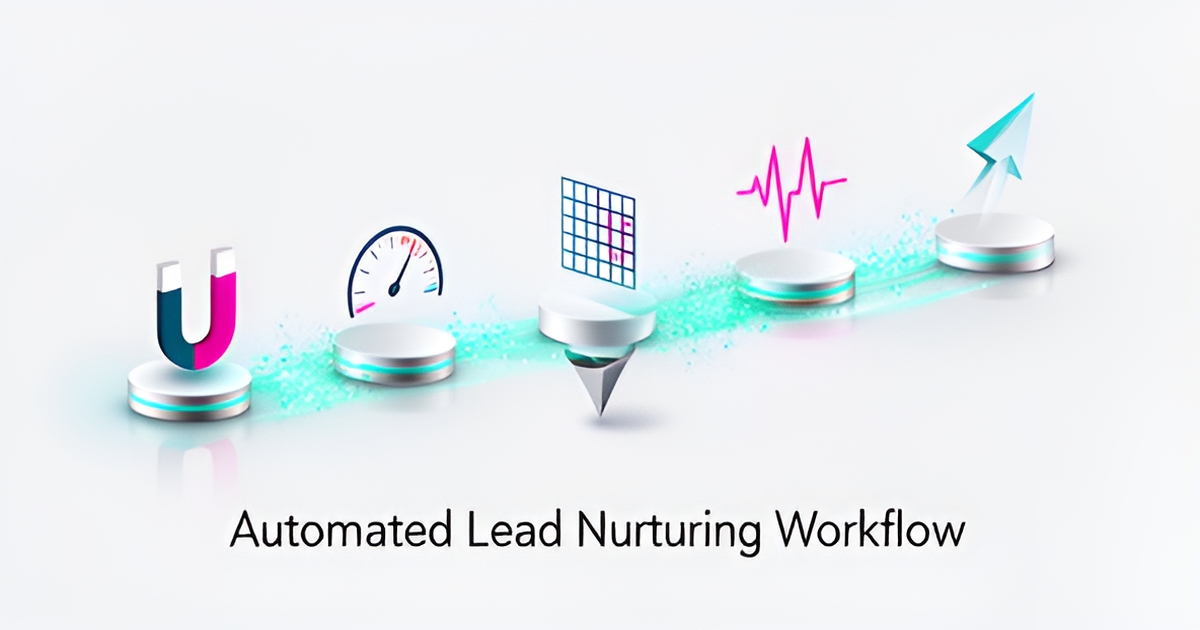
Automated Lead Nurturing AI Workflow Overview
Key Facts
- 79% of leads never convert into sales, according to industry research.
- Half of all sales happen only after the fifth contact, yet most reps give up after two attempts, research shows.
- Responding to leads within minutes instead of hours can make a hundred-fold difference in conversion likelihood, per lead generation research.
- A Clay study of 6,346 companies found most never wrote back to demo requests at all, according to Clay's research.
- Sales reps spend 60% of their average week on non-selling work, per Salesforce.
- AI agents now handle up to 80% of SDR tasks, from prospecting to scheduling, per AI sales automation research.
- MIT Sloan research found a single AI-unsuitable task can undermine an entire automated workflow chain, according to MIT Sloan.
One AI employee doing one job, 24/7, for less than a part-time wage.
Receptionist, lead follow-up, intake or dispatch. Trained on your business and fully managed. From $700/mo.
Why Your Lead Follow-Up Is Leaking Revenue
Most businesses don't have a lead problem. They have a follow-up problem, and it quietly drains revenue every single day.
Consider the math. Industry research shows that 79% of leads never convert into sales, and half of all sales only happen after the fifth contact. Most sales reps quit after two attempts. You're paying to generate interest, then walking away before the conversation gets interesting.
Speed makes it worse. Responding within minutes instead of hours can swing conversion likelihood by a hundredfold, according to the same research. Yet the gap between capture and response is where most revenue dies. A Clay study of 6,346 companies found that most never wrote back to demo requests at all. Leads didn't say no. Nobody asked twice.
Manual nurturing fails at scale for predictable reasons:
- Follow-up depends on someone remembering, and someone is busy
- Reps spend 60% of their week on non-selling work, per Salesforce
- Sequences stop after two touches, right before most deals start
- After-hours inquiries sit untouched until morning, when intent has cooled
- Each lead gets identical timing and messaging, regardless of behavior
This is why AIQ Labs treats lead nurturing as one connected workflow rather than a stack of disconnected tools. MIT Sloan research found that AI's biggest value comes from reshaping entire workflows end to end, and that a single weak step can undermine the whole chain. Capture, enrichment, scoring, outreach, booking, and follow-up have to run as one system, working around the clock, with humans stepping in where judgment matters.
The fix isn't more leads. It's a workflow that never forgets, never sleeps, and never gives up after two tries.
The Five Stages of an AI-Native Nurturing Workflow
A lead nurturing workflow only works when the stages connect. MIT Sloan research makes the case clearly: AI's biggest value comes from reshaping entire workflows rather than automating isolated tasks, and a single AI-unsuitable step can undermine the whole chain. That's why AIQ Labs treats lead nurturing as one connected system from capture to conversion, not a stack of disconnected tools.
The stages converge across most industry models, including Salesforce's five-step framework. Here's how the end-to-end flow works:
- Capture: Every inquiry, form fill, call, and chat lands in one place, feeding clean data into the CRM. Speed matters here; responding within minutes instead of hours can make a hundred-fold difference in conversion likelihood.
- Enrichment: The system fills in the gaps with firmographics, engagement history, and intent signals, so scoring and outreach run on complete records instead of half-empty ones.
- Scoring: AI weighs explicit data like job title and company size against implicit signals like email opens and page visits, prioritizing leads in real time so sellers stop guessing who to call first.
- Personalized outreach: Segmented leads move into tailored sequences across email, SMS, and phone, with timing and channel optimized per prospect. Personalized emails see 29% higher open rates and 41% higher click-through rates.
- Conversion and follow-up: Hot prospects get surfaced for immediate human attention, while the rest stay in persistent follow-up until they're ready.
That last stage deserves emphasis. Half of sales happen only after the fifth contact, yet most reps give up after two attempts. A study of 6,346 companies by Clay found most never wrote back to demo requests at all. An automated workflow fixes this by design, because it never forgets, never gets busy, and never lets a lead go cold by accident.
The design principle running through all five stages is hybrid: AI handles high-volume work like data entry, scoring, and initial follow-up, while humans handle trust-building and final decisions. Buyers still value human experts at the decision stage, so clear boundaries between automated and human touchpoints are a feature, not a compromise.
Data quality underpins everything. As Salesforce puts it, AI systems are only as good as the data they're trained on, so clean, accurate CRM data is critical before any of this runs. That's also why AIQ Labs builds deep two-way integrations with CRMs, calendars, and payment systems rather than layering another point solution on top. When the stages share one data spine, each handoff strengthens the next instead of leaking leads between them.
Where AI Fits and Where Humans Still Win
The most effective AI lead nurturing systems aren't the ones that remove humans. They're the ones that know exactly where to hand off. Sales reps spend 60% of their week on nonselling work, according to Salesforce, and that's precisely the territory where automation earns its keep: data entry, initial follow-ups, scheduling, and scoring. These are high-volume, repetitive tasks where speed and consistency matter more than judgment.
The consensus across research is a hybrid human-in-the-loop model. AI handles the volume; humans handle the trust. Martal's analysis of AI sales automation notes that AI agents now handle up to 80% of SDR tasks, from prospecting to scheduling, while humans provide oversight and final approval on complex deals (source). That division isn't a limitation. It's the design.
Where AI wins in the nurturing workflow:
- Data entry and CRM enrichment, eliminating the manual work that bogs down small teams
- Initial follow-ups and persistent outreach, since half of sales happen only after the 5th contact and most reps give up after 2 attempts (Martal)
- Lead scoring and qualification, improving accuracy by roughly 40%
- Scheduling and appointment setting, responding within minutes rather than hours
Here's the tension, though. Forrester data cited by Martal shows buyers increasingly value human expert interactions over AI-driven exchanges, especially at final decision stages, and 19% of B2B buyers say AI-generated information is actually making decisions harder (source). Buyers want a machine that never forgets to follow up, and a person who can negotiate the deal.
HubSpot frames the same tension plainly: automation can scale execution, but human insight builds connection (State of Marketing). MIT Sloan research adds a design principle worth remembering: one AI-unsuitable task in a chain can undermine the entire operation, so the boundaries between automated and human touchpoints need to be deliberate (source).
That's why AIQ Labs builds its lead nurturing workflows with configurable human-in-the-loop escalation baked in. An AI Lead Qualifier can work a prospect around the clock, but the moment a conversation turns into negotiation, a human takes over with full context from every prior touchpoint. The system's value comes from knowing which side of that line each task belongs on.
What You Need Before You Automate Anything
Automating lead nurturing before your foundation is ready is like building a house on sand. Salesforce puts it bluntly: AI systems are only as good as the data they're trained on, so clean, accurate CRM data is critical. If your CRM is full of duplicate contacts, stale job titles, and half-filled records, your AI will confidently nurture the wrong people with the wrong message at the wrong time.
That's not a hypothetical problem. Martal's research identifies data quality as the critical dependency for AI sales automation, and the industry's shift toward unified platforms exists precisely because scattered point solutions create data silos that undermine everything downstream. When your scoring model can't see engagement history because it lives in a separate tool, the whole chain breaks. MIT Sloan researchers found that a single AI-unsuitable task can undermine an entire automated operation, which is why workflow design matters as much as the AI itself.
Before you automate anything, audit three things:
- CRM data hygiene. Deduplicate records, verify contact fields, and confirm your explicit data (job title, company size) and implicit signals (email opens, page visits) are actually captured in one place.
- Integration depth. Surface-level connections that sync once a day won't cut it. Your nurturing engine needs two-way, real-time access to your CRM, calendar, and communication tools so it can act on fresh signals.
- Automated versus human boundaries. Decide now which touchpoints AI owns and which require a person. Forrester research shows buyers still value human expert interactions, especially at final decision stages.
That last point deserves emphasis. The consensus across Salesforce, Martal, and HubSpot is that AI should handle high-volume work like data entry, initial follow-ups, and scheduling, while humans handle trust-building and negotiation. HubSpot frames the tension well: automation can scale execution, but human insight builds connection. Design your workflow with explicit handoff points where a hot lead moves from AI follow-up to a human conversation.
Speed matters too, and it's a prerequisite you can't fake. Responding within minutes rather than hours can make a hundred-fold difference in conversion likelihood, according to lead generation research. Your integrations need to be fast enough to trigger that response automatically.
This is the approach AIQ Labs takes with its workflow builds: deep API integrations and defined human-in-the-loop controls are part of the architecture from day one, because retrofitting clean data and clear boundaries after deployment rarely works. Get these prerequisites right, and the automation built on top of them will actually convert.
From Manual to Automated: A Practical Path Forward
Knowing the workflow is one thing. Committing to it is another, and the research suggests most businesses stall right at that point: only about a third of B2B organizations have actually scaled agentic AI, even though 92% of companies plan to increase AI investment over the next three years. The gap between intent and execution is where most automation projects die.
The practical fix is to stop thinking about "AI adoption" as one big decision and break it into engagement paths that match your risk tolerance and budget. AIQ Labs structures this as three ways in, and each maps to a different stage of readiness.
- Start Monthly: one AI employee, like a Lead Qualifier or Appointment Setter, on a flat monthly plan that costs less than a part-time hire. Build, training, integrations, and monitoring are included, and you can pause or adjust anytime. Lowest commitment, fastest proof.
- Build in Milestones: one workflow or department system, split into phases. You approve and pay per phase, and if you stop, you keep everything built so far. This suits businesses that want a full capture-to-conversion pipeline but want to see it working before going deeper.
- Own It Outright: a full AI operating system, delivered at one project price or through a monthly Build Partnership, with full ownership of the code, agents, and data when complete. This is the path for businesses that want the workflow to become a permanent asset, not a subscription.
Whichever path fits, the starting point should be the same: pick your single highest-pain workflow and automate that one first. For most businesses, that's lead follow-up, and the numbers explain why. Half of sales happen only after the fifth contact, yet most reps give up after two attempts, and 79% of leads never convert at all. A Clay study of 6,346 companies found most never even wrote back to demo requests. Speed and persistence are exactly what an automated workflow fixes, and they're exactly what manual teams fail at.
There's also a structural reason to start narrow. MIT Sloan research on AI and workflows found that one AI-unsuitable task can undermine an entire automated chain, which is why redesigning a single workflow end-to-end beats plugging AI into ten disconnected tools. Get one pipeline right, measure it, then scale.
The entry point is deliberately low-friction: a two-minute Fit Check, then a free 30-minute strategy call where an AI engineer maps your biggest bottleneck and identifies the highest-ROI opportunity. Real numbers come in writing after that call, and if there isn't a clear win, they'll say so. That's a reasonable standard to hold any AI partner to, and a reasonable first step for your first workflow.
Still paying for 10+ subscriptions that don’t talk to each other?
We build connected AI systems you own. Pay upfront or on a payment plan; the code is yours once it’s paid off.
Frequently Asked Questions
How quickly does an AI system need to respond to a lead to actually convert?
Why do most sales teams fail to close leads that show interest?
Does automating lead nurturing mean I have to remove human sales reps from the process?
What happens if my CRM data is messy before I implement AI?
Is it better to buy a standalone AI tool or build a connected workflow?
How do I start with AI lead nurturing without a massive upfront investment?
Stop Letting Leads Go Cold: Your Next Step
The gap between lead capture and conversion isn't a mystery; it’s a workflow failure. As we’ve seen, 79% of leads never convert, not because they aren’t interested, but because the follow-up process is too slow, too manual, and too inconsistent to sustain momentum. The solution isn’t to buy more leads, but to build a system that never forgets, never sleeps, and never gives up after two attempts. By treating lead nurturing as one connected AI-native workflow, from capture to conversion, you eliminate the friction that currently drains revenue. This approach leverages AI for high-volume persistence while reserving human judgment for the trust-building moments that close deals. If you are ready to stop guessing and start scaling, the first step is identifying your highest-pain workflow. Start with the two-minute Fit Check to map your specific bottlenecks. It’s a free, no-obligation session where an AI engineer helps you identify the highest-ROI opportunity. If there isn’t a clear win, we’ll tell you. But if there is, you’ll have a clear path to a workflow that actually converts.
See what AI would actually do in your business, in 60 seconds.
The planner shows which step fits, the agents we’d build and the published price. No email needed.