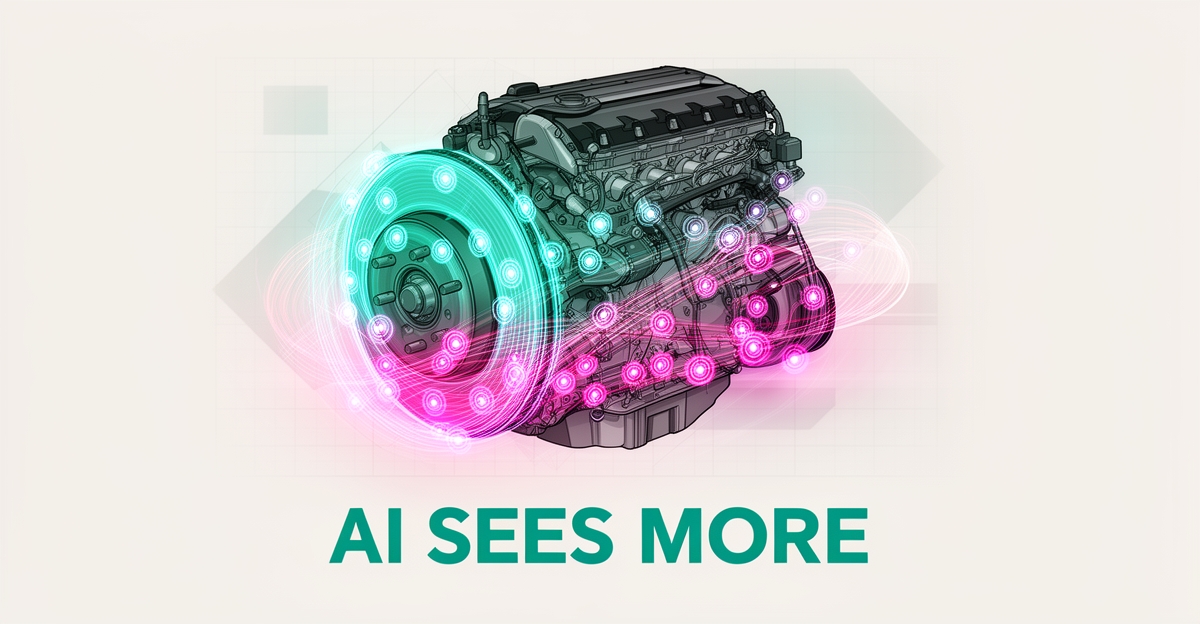
Can AI Detect Hidden Engine or Brake Issues Better Than a Human?
Key Facts
- The average age of US light vehicles has climbed past 12 years as of late 2026, meaning more wear, deferred maintenance, and layered software updates masking early symptoms
- Machine learning models can predict brake pad wear before failure occurs, per automotive engineering research
- Vibration-based real-time health monitoring systems can catch brake anomalies during operation that human senses miss
- AI has demonstrated the ability to find decades-old defects in legacy systems that conventional analysis tools missed
- AI also introduces more errors than human work in adjacent domains, which is why it works best as an assistant—not a replacement
Hire a team member that works 24/7 — for less than a part-time wage.
AI receptionists, SDRs, dispatchers and 99+ roles. Trained on your business, fully managed.
Not sure where to start? Ask our AI planner
Why Traditional Diagnostics Miss Hidden Vehicle Problems
Hidden problems don't announce themselves—they accumulate. As vehicles age and systems grow more complex, conventional checks increasingly miss the subtle failures that lead to costly engine and brake repairs.
The average age of US light vehicles has been climbing steadily and now sits well past 12 years as of late 2026. Older fleets mean more wear, deferred maintenance, and layered software updates that mask early symptoms. Human technicians face time pressure, inconsistent inspection practices, and the limits of what a visual or code-only scan can reveal.
Modern brake and engine systems generate data that is too noisy and intermittent for routine checks to catch. Automotive engineering research on friction brakes indicates that data-based methods and AI hold significant potential for the future of brake development and operation. Increasing regulatory requirements on particulate emissions and ongoing electrification create new challenges that traditional diagnostics were not built to address.
Pattern recognition remains the core gap. A basic tool can read and clear codes, but a bidirectional scanner can command components. That is the difference between suspecting a cooling fan relay and proving the fan circuit responds to a command. Without that proof, intermittent faults and early degradation slip through.
Human error and variability compound the problem. Inspections differ by technician, shop, and day. Subtle anomalies in vibration, pressure, or thermal behavior are easy to miss without continuous monitoring. AI methods are increasingly being applied to friction brake development and operation, including noise detection, wear prediction, and real-time health monitoring.
Traditional diagnostics tend to miss hidden issues because they rely on:
- Snapshot scans instead of trend analysis over time and mileage
- Human interpretation of codes without context from thousands of similar vehicles
- Limited testing of components under load, temperature, and real-world conditions
- Inconsistent inspection depth as vehicle age and complexity increase
While AI can't physically inspect a vehicle, it can analyze patterns from thousands of past inspections to flag high-risk components. This is where AI complements human technicians by identifying trends and recommending deeper inspections—a capability AIQ Labs builds into AI Workflow Builds for automotive dealerships and repair shops.
The complement matters because AI is not a flawless replacement. Studies in adjacent domains, such as software development, have found AI-generated work introduces more defects than human work. In diagnostics, that reinforces the need for human oversight and validation.
With an aging fleet and rising system complexity, pattern recognition at scale becomes essential to catch engine and brake issues before they become failures.
How AI Identifies What Humans Overlook in Brake and Engine Systems
Human technicians excel at hands-on diagnosis, but they face a fundamental limitation: they can only inspect one vehicle at a time using the data immediately available. AI operates differently, analyzing patterns across thousands of past inspections, sensor readings, and operational histories to flag anomalies that remain invisible to even the most experienced eyes.
This capability proves particularly valuable in brake system diagnostics, where recent research highlights how data-based methods and artificial intelligence address new challenges in friction brake development. Rather than relying solely on physical inspection, AI systems now employ sophisticated detection methods:
- Deep learning algorithms for brake squeal detection, characterization, and prediction
- Machine learning models that predict brake pad wear before failure occurs
- Vibration-based real-time health monitoring systems that catch anomalies during operation
- Machine learning-based state maps for complex dynamical systems
These applications identify subtle irregularities in vibration patterns or acoustic signatures that human senses might miss or misinterpret—particularly in aging fleets with complex, intermittent issues.
The depth of AI's pattern recognition extends beyond mechanical systems into software and legacy code. Publicly reported demonstrations in 2026 showed large AI models analyzing decades-old assembly code and surfacing subtle logic errors—such as a routine failing to check the carry flag after an arithmetic operation—that had remained dormant for roughly 40 years. Unlike traditional tools that ask "Does this line violate rule X?", the AI asked "Given what this system is supposed to do, where are the failure modes?", allowing it to reason about low-level control flow and identify real defects that conventional analysis missed.
This capability translates directly to automotive diagnostics through pattern-based risk assessment. AI cannot physically inspect a brake caliper or engine mount, but it can analyze historical data from thousands of similar vehicles to flag high-risk components before they fail. AIQ Labs builds these industry-specific AI systems to complement human expertise, identifying trends across vast datasets and recommending deeper inspections when statistical anomalies suggest hidden problems.
The result transforms diagnostics from reactive to predictive. AI serves as a powerful assistant that surfaces correlations invisible to human observation—whether analyzing vibration signatures from brake rotors or logic flows in legacy code—while skilled technicians provide the contextual judgment and physical verification that AI cannot replicate.
AI as a Diagnostic Assistant: Enhancing, Not Replacing, Human Technicians
AI excels at pattern recognition across vast datasets, enabling it to flag high-risk components and subtle anomalies that human technicians might overlook. In braking systems, AI methods are being applied to friction brake development and operation, including noise detection, wear prediction, and real-time health monitoring. AI has also proven effective at finding hidden defects in legacy systems, with reported cases of models identifying decades-old logic errors that conventional analysis had missed.
However, the technology carries significant caveats. Research in adjacent domains suggests AI-generated work introduces more defects than human work, including critical issues. This means while AI excels at reasoning about failure modes and pointing out real defects, it also introduces more errors than humans—making it ideal for augmenting technician expertise rather than replacing it. AI, in the right hands, makes a great assistant, but it is not ready to operate autonomously as a final authority on safety-critical systems.
For dealership service departments, this positions AI as a diagnostic assistant that flags potential issues and recommends deeper inspections. Specific applications include deep learning for brake squeal detection, machine learning for wear prediction, vibration-based health monitoring, and machine learning-based state maps for complex dynamical systems. These data-based methods hold significant potential for the future of brake development, though the field is still maturing.
AIQ Labs builds these capabilities into industry-specific AI systems—whether as a standalone AI Workflow Build for your inspection process or as part of a broader AI Operating System connecting your whole service department. By handling the initial pattern analysis and trend identification, AI allows human technicians to focus their expertise on verification, complex problem-solving, and customer communication—creating a more efficient and accurate diagnostic workflow. This collaborative approach leverages the strengths of both AI and human intelligence, ensuring hidden issues are caught early without overwhelming technicians with false positives or missing nuanced contextual factors that only experienced professionals can interpret.
Still paying for 10+ subscriptions that don’t talk to each other?
We build custom AI systems you own outright. No vendor lock-in. Full control.
Not sure where to start? Ask our AI planner
Frequently Asked Questions
Can AI actually detect hidden engine or brake problems better than a human technician?
How does AI identify brake issues that traditional diagnostics miss?
Is AI reliable enough to trust for vehicle diagnostics without human verification?
What specific AI capabilities are being used in modern automotive diagnostic tools?
Does AI pose security risks when used in vehicle systems or legacy code analysis?
How does AIQ Labs use AI to support automotive dealerships specifically?
Why the Future of Vehicle Diagnostics Is a Partnership, Not a Replacement
AI won't replace your skilled technicians—but it can make them far more effective. As vehicles age and systems grow more complex, hidden engine and brake issues slip through traditional checks that rely on snapshot scans and limited real-world testing. AI excels at spotting patterns across thousands of past inspections, flagging subtle anomalies in vibration, wear, or even legacy code that humans might miss. But AI also introduces more errors than human work in adjacent domains, which is why it works best as an assistant: highlighting risks, recommending deeper inspections, and letting your team focus on verification and complex problem-solving. This is exactly how AIQ Labs builds industry-specific AI systems—for dealerships and repair shops that want to catch failures early without overwhelming their staff. To see how this approach could reduce costly comebacks and improve first-time fix rates in your service department, take the 2-minute Fit Check and book a free 30-minute strategy call to map your biggest bottleneck.
Make AI your competitive advantage — not just another tool.
Strategy, implementation and ongoing optimization. One partner, end to end.
Not sure where to start? Ask our AI planner