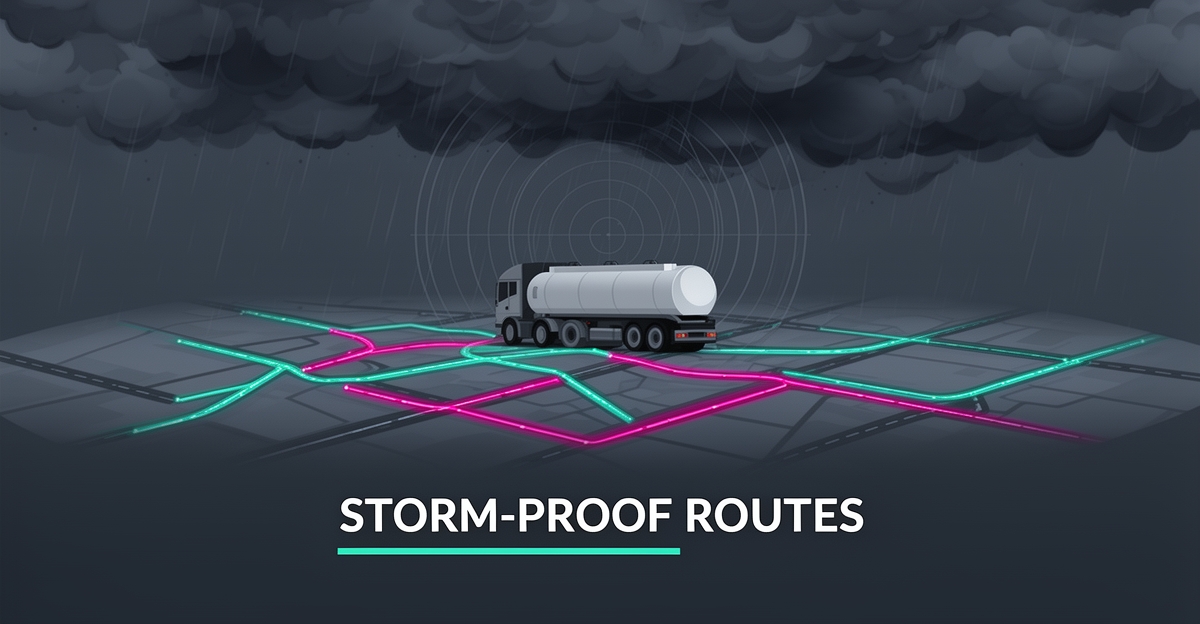
Can AI Handle Emergency Rerouting During Weather Disruptions? What the Research Shows for Tanker Operations
Key Facts
- A 2025 study on AI-driven logistics reported that weather-aware AI delivered a 107.3% productivity improvement over traditional operations — a striking figure, though results will vary by operation and should be validated against your own baseline
- The same study found route-optimization AI alone achieved only a 14% average productivity gain
- That's roughly a 7.7-fold performance gap in favour of systems that factor weather into routing decisions
- The study attributed an additional ¥13.8 million in annual earnings per driver to weather-aware routing — a China-based figure that won't transfer directly to North American operations, but signals the order of magnitude at stake
- Industry platforms such as DHL's Resilience360 have reported 90–95% accuracy predicting shipment arrival times, per Maersk insights
- AI's core strength in logistics is processing vast amounts of data to simplify complex decisions, as Altana AI co-founder Peter Swartz has noted
Hire a team member that works 24/7 — for less than a part-time wage.
AI receptionists, SDRs, dispatchers and 99+ roles. Trained on your business, fully managed.
Not sure where to start? Ask our AI planner
The High Cost of Weather-Induced Delays in Tanker Logistics
When a storm front closes a highway or port approach, tanker dispatchers face a brutal equation: every hour of delay cascades into missed delivery windows, idle assets, and eroding customer trust. The financial stakes are higher than most logistics operators realize.
Traditional routing systems compound the problem because they react rather than anticipate. A 2025 research paper on AI-driven logistics reported that weather-aware AI systems delivered a 107.3% productivity improvement over traditional operations. Treat that number as a research finding rather than a guarantee — your own baseline, fleet mix and region will determine what's actually achievable — but the direction is clear: conventional approaches leave serious money on the table when conditions deteriorate.
The gap between routing approaches is what matters most. In the same study, route-optimization AI alone achieved only a 14% productivity gain, meaning weather-aware systems outperformed them by a factor of roughly 7.7. The study also attributed an additional ¥13.8 million in annual earnings per driver to weather-aware routing. That figure comes from a China-based research context, so it won't map one-to-one onto a North American tanker operation — but it signals the order of magnitude that proactive rerouting can unlock.
When traditional systems fail to adapt in real time, the costs accumulate across multiple dimensions:
- Missed delivery windows that trigger penalty clauses and damage client relationships
- Idle tanker capacity as vehicles sit stranded or take circuitous detours
- Increased fuel consumption from inefficient rerouting decisions made under pressure
- Higher driver overtime costs and hours-of-service compliance risks
- Customer churn as shippers shift to more reliable carriers
The prediction gap matters enormously here. DHL's Resilience360 platform demonstrates what becomes possible when AI processes weather data at scale, reportedly achieving 90–95% accuracy in predicting shipment arrival times. Without that foresight, dispatchers operate blind, making reactive decisions that sacrifice efficiency for expediency.
As Peter Swartz, Co-Founder of Altana AI, observes, AI's strength lies in processing vast amounts of data to simplify complex decisions. For tanker companies, that capability isn't a luxury — it's the difference between profit and loss when weather disrupts carefully planned routes. AIQ Labs builds this kind of intelligence directly into dispatch workflows — whether as an AI dispatcher that handles rerouting calls around the clock, or as a targeted workflow rebuild of your most expensive routing process.
How Weather-Aware AI Systems Outperform Traditional and Route-Only Optimization
Weather-aware AI systems transform emergency rerouting by integrating real-time meteorological data with dynamic routing algorithms, delivering outcomes far beyond what traditional or route-only optimization can achieve. The 2025 research cited above reported a 107.3% productivity improvement over conventional operations, directly addressing the costly delays and safety risks tankers face during storms or road closures. In contrast, route-only AI systems delivered just a 14% average productivity gain in the same study, highlighting the critical limitation of ignoring weather variables in routing decisions. That's roughly a 7.7-fold performance advantage for weather-aware AI in volatile conditions where split-second decisions prevent cascading disruptions.
The business impact extends beyond efficiency gains to measurable financial outcomes. In the study's context, weather-aware AI generated ¥13.8 million in additional annual earnings per driver through reduced idle time, optimized fuel consumption, and fewer missed delivery windows. These results stem from the system's ability to continuously ingest and analyze hyperlocal weather forecasts, traffic incidents, and vehicle performance data to propose reroutes that balance speed, safety, and fuel efficiency. Unlike basic optimization tools that react only to congestion or distance, weather-aware AI anticipates disruptions before they occur, enabling proactive adjustments that keep tankers moving even as conditions deteriorate.
For logistics providers managing time-sensitive cargo, this capability translates into fewer customer complaints, lower demurrage costs, and stronger service-level agreement compliance during extreme weather events. The system's resilience comes from its multi-layered decision framework, which evaluates not just the fastest path but the safest and most operationally viable one under changing environmental constraints. This level of foresight is impossible with static routing or basic AI that lacks environmental awareness, especially when sudden storms or flooding render primary corridors impassable.
AIQ Labs applies this same principle of context-aware intelligence across its service lineup. AI Employees such as dispatchers and logistics agents come enhanced with real-time data integration to make proactive, informed decisions across the supply chain, while Workflow Builds rebuild the one routing workflow that costs you the most. By embedding weather awareness directly into operational workflows, organizations shift from reactive crisis management to predictive resilience — turning weather disruptions from operational threats into manageable variables. The result is a logistics network that maintains continuity, protects assets, and sustains service quality when it matters most.
Implementing AI-Powered Emergency Rerouting: From Data to Decision
When severe weather threatens tanker operations, traditional rerouting methods often fall short due to slow decision-making and fragmented data. AI-powered emergency rerouting systems address this gap by continuously analyzing real-time weather, traffic, and vehicle performance to dynamically adjust routes before disruptions escalate. This proactive approach transforms reactive crisis management into a streamlined, data-driven process.
AIQ Labs implements these systems through a structured methodology that begins with comprehensive data integration. Weather forecasts, traffic updates, port conditions, and historical fleet performance are aggregated into a unified operational picture. This foundation enables AI models to detect emerging risks hours in advance, calculating optimal detours that balance safety, fuel efficiency, and delivery timelines. A multi-agent architecture allows specialized AI agents to collaborate on route analysis, risk assessment, and communication tasks simultaneously — an approach AIQ Labs has refined across 200+ deployed multi-agent systems.
Configuration focuses on aligning AI decision logic with company-specific constraints such as cargo sensitivity, crew rest requirements, and regulatory compliance. Guardrails are established to ensure AI recommendations remain within operational boundaries, with human-in-the-loop controls for high-stakes scenarios like rerouting near environmentally sensitive zones. Employee training emphasizes interpreting AI-generated alerts and understanding when to override system suggestions based on local expertise — a critical balance highlighted by industry research showing humans excel at identifying structural changes AI may miss.
Performance monitoring tracks key metrics including delay reduction, fuel consumption variance, and on-time delivery rates post-implementation. Continuous feedback loops refine model accuracy, particularly in regions with volatile weather patterns where initial predictions may require adjustment. The research figures cited above — a 107.3% productivity improvement over traditional operations and a 7.7-fold advantage over route-only optimization — should be treated as evidence of what's possible, not a promise. The right way to size the opportunity for your fleet is to measure it against your own delay and idle-time data. These outcomes demonstrate how embedded AI capabilities turn disruption response from a liability into a competitive strength.
Still paying for 10+ subscriptions that don’t talk to each other?
We build custom AI systems you own outright. No vendor lock-in. Full control.
Not sure where to start? Ask our AI planner
Frequently Asked Questions
Can AI actually reroute tankers in real time when a storm hits?
How much better is weather-aware AI than regular route optimization software?
What's the financial return on adding weather-aware AI to tanker dispatch?
How accurate is AI at predicting delays before they happen?
Will AI replace our dispatchers during weather emergencies?
What does it take to implement AI-powered emergency rerouting in our operations?
From Storm Disruption to Competitive Advantage
Weather disruptions will keep happening, but the cost of reacting late is a choice. The research on weather-aware AI shows the equation can shift from emergency firefighting to proactive resilience — a reported 107.3% productivity improvement over traditional operations and a 7.7-fold advantage over route-only optimization, driven by anticipating closures before they cascade into missed windows, idle assets, and customer churn. Validate those numbers against your own fleet's delay data before committing, but don't mistake the direction of the evidence. That shift comes from real-time integration of meteorological, traffic and fleet data into dispatch workflows, with guardrails and human-in-the-loop controls that keep decisions safe and compliant. For operators, the business value is continuity, protected margins and stronger SLAs when conditions deteriorate. If you want to see where predictive rerouting could fit your network, start with the two-minute Fit Check at aiqlabs.ai/apply — it leads to a free 30-minute strategy call where we'll map your biggest bottleneck and identify where automation pays for itself fastest. You can also reach the team directly at [email protected].
Make AI your competitive advantage — not just another tool.
Strategy, implementation and ongoing optimization. One partner, end to end.
Not sure where to start? Ask our AI planner