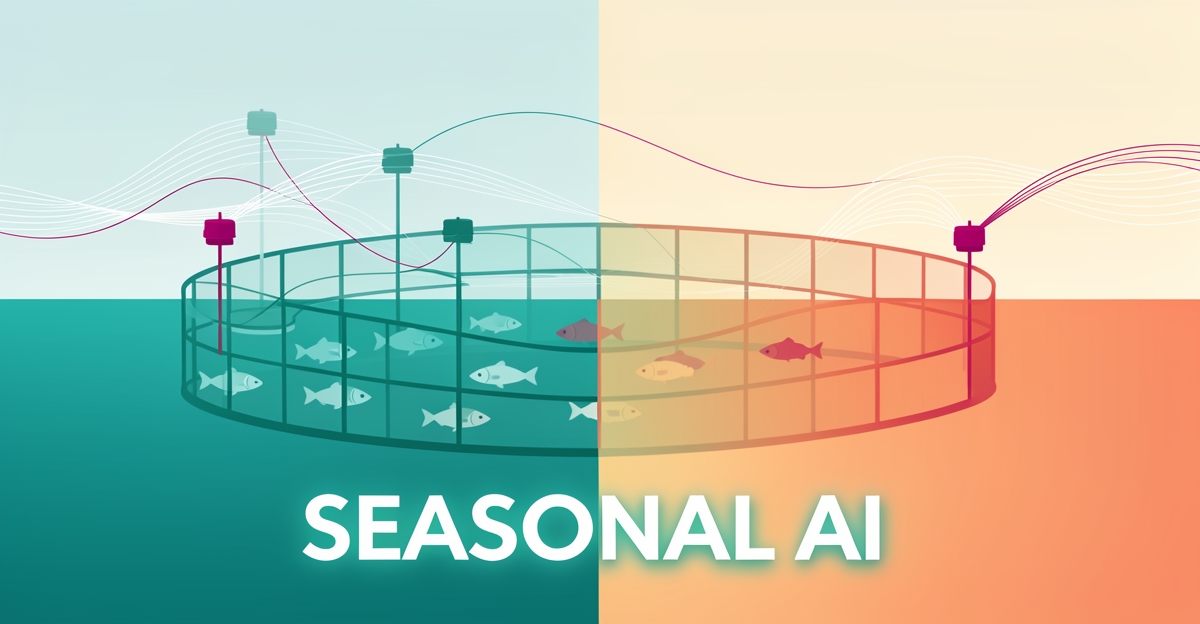
Can AI Handle Seasonal Variations in Fish Farming? How It Works
Key Facts
- A single degree of temperature drift can quietly rewrite a fish farm's entire feeding schedule, often unnoticed until growth stalls or mortality climbs.
- AI systems now track temperature, dissolved oxygen, pH, and ammonia in real time because these variables interact in ways manual sampling cannot match according to Aquaculture Magazine.
- A comprehensive review of 215 research papers published between 2012 and 2024 confirms AIoT applications span ten core aquaculture areas according to Responsible Seafood Advocate.
- No single generalized AI model currently exists that can perform all essential aquaculture activities across diverse, heterogeneous ponds according to Aquaculture International.
- Traditional manual monitoring techniques struggle to identify early indicators of stress and illness as production intensity rises and margins narrow according to InsightAce research.
- Aquaculture supplies roughly 15% of global animal protein, making seasonal inefficiencies compound at massive scale per FAO data cited in industry coverage.
- AI-driven feeding optimization can meaningfully cut waste during seasonal transitions by adjusting rations to actual fish behavior rather than calendar assumptions per market analysis.
Hire a team member that works 24/7 — for less than a part-time wage.
AI receptionists, SDRs, dispatchers and 99+ roles. Trained on your business, fully managed.
Not sure where to start? Ask our AI planner
Why Seasonal Shifts Break Traditional Fish Farm Management
A single degree of temperature drift can quietly rewrite a fish farm's entire feeding schedule, and most operators won't notice until growth stalls or mortality climbs. Seasonal transitions in aquaculture are not gradual inconveniences — they are compounding operational stressors that expose the limits of manual oversight and fixed-rule automation.
Water temperature swings drive the cascade. As water warms or cools, fish metabolism shifts, dissolved oxygen levels fluctuate, and ammonia dynamics change — all at once. According to Aquaculture Magazine, AI systems now track temperature, dissolved oxygen, pH, and ammonia in real time precisely because these variables interact in ways that manual sampling cannot keep pace with. A farm manager checking water twice daily is working with snapshots; the pond is a continuous system.
Feed demand compounds the problem. Fish eat less in cold water and more in warm water, but the relationship isn't linear — it varies by species, age class, and pond conditions. Static feeding schedules built on seasonal averages inevitably overfeed during cool spells and underfeed during warm ones, wasting money in one direction and sacrificing growth in the other. Research into AIoT aquaculture applications identifies smart feeding as one of ten core areas where sensor-driven AI outperforms conventional practice, largely because it adjusts ration size to actual fish behavior rather than calendar assumptions.
The operational blind spots that emerge from seasonal variability tend to cluster in predictable places:
- Missed early-warning signals: stress behavior, reduced feeding response, and subtle swimming pattern changes often precede visible illness by days
- Feed conversion losses: rations calibrated to last month's temperatures become wrong the moment a cold front or heat wave arrives
- Growth rate miscalculation: biomass projections based on fixed growth curves drift from reality as seasonal conditions deviate from historical norms
- Harvest timing errors: without accurate, continuously updated biomass estimates, farms miss optimal market windows or harvest undersized fish
The scale of these blind spots grows with farm intensity. Industry analysis from InsightAce notes that traditional manual monitoring techniques struggle to identify early indicators of stress, illness, or unfavorable environmental conditions as production intensity rises and margins narrow. In other words, the same seasonal variability that a small operation might absorb through experience and intuition becomes a systematic liability at commercial scale.
Even well-instrumented farms hit a ceiling with static automation. Fixed threshold alarms — the kind that trigger when dissolved oxygen drops below a setpoint — react to problems rather than anticipating them. They don't account for the fact that a safe oxygen level in August differs from a safe level in January, or that a feeding rate appropriate for spring growth becomes wasteful in autumn. Research published in Aquaculture International confirms that no single generalized model currently handles all essential aquaculture activities across diverse, heterogeneous environments — underscoring why adaptive, continuously learning systems matter more than rigid rule-based ones.
This is precisely the gap that adaptive AI is built to close. Rather than applying fixed seasonal rules, machine learning models trained on a farm's own historical data learn how that specific operation responds to temperature shifts, changing day length, and seasonal feed conversion patterns. AIQ Labs builds these adaptive systems as AI Workflow Builds — models that learn from each season's data and adjust feeding, monitoring sensitivity, and growth projections dynamically, rather than forcing operators to manually recalibrate every few months.
The farms that struggle most with seasonal variation aren't the ones lacking data. They're the ones whose data sits in disconnected systems, whose feeding schedules run on autopilot, and whose growth models assume last year's patterns will repeat. Seasonal change is predictable in direction but unpredictable in magnitude — and that gap between direction and magnitude is exactly where traditional management breaks down.
How Adaptive AI Models Learn and Respond to Seasonal Patterns
Seasonal shifts in temperature, feed demand and growth rates make static farm rules obsolete within weeks. Adaptive systems learn those cycles instead of fighting them.
An AIoT architecture combines IoT sensors, underwater cameras and adaptive ML models to continuously ingest real-time environmental and behavioral data. A review of 215 research papers published between 2012 and 2024 shows AIoT applications span smart feeding, water quality management, disease detection, biomass estimation and behavior monitoring. The integration merges real-time sensor collection with AI-driven analytics for decision-making.
Sensors track temperature, dissolved oxygen, pH and ammonia while cameras capture swimming patterns, appearance and feeding response. Industry research notes AI enhances monitoring by analyzing real-time sensor data to detect anomalies and predict issues. That data stream feeds models that learn seasonal baselines and flag deviations before mortality risk rises.
Adaptive models adjust operations dynamically across the year. Adaptive AI models such as LSTM, CNN and NARNET are explicitly named for aquaculture use. Models like NARNET, LSTM, SVM, and K-NN have proven effective in predicting and classifying water quality. LSTM networks handle time-series temperature and feed data, CNNs estimate biomass from images, and NARNET captures nonlinear seasonal dependencies.
The technology stack behind intelligent monitoring includes:
- IoT-based water quality sensors for continuous environmental telemetry
- Computer vision systems and underwater cameras for behavior and biomass analytics
- Machine learning and predictive analytics for feeding, growth and welfare decisions
- Edge computing and cloud platforms for real-time ingestion and model updating
In practice, the system learns that cooler months reduce metabolism and feed conversion, then dials back rations and adjusts oxygen setpoints. In warmer months it anticipates higher demand and stress, tightening welfare monitoring. AI can forecast water quality changes using historical data, weather and feeding patterns, enabling species-specific tailoring.
Aquaculture supplies roughly 15% of global animal protein, according to FAO data cited in aquaculture coverage. At that scale, seasonal inefficiencies compound quickly. AIQ Labs deploys adaptive AI models that learn from seasonal trends and dynamically manage farm operations — whether as a single AI Employee handling monitoring, or a full AI Operating System connecting the whole farm.
The result is continuous learning across cycles rather than manual rule changes. Feeding schedules, biomass estimates and welfare alerts evolve with the season, reducing waste and supporting more sustainable, data-driven production.
From Static Schedules to Dynamic Operations: AI-Driven Seasonal Workflows
Static operating schedules fail to account for seasonal shifts in temperature, feed demand, and growth rates, leading to inefficiencies that impact both yield and sustainability. AI-driven workflows transform aquaculture operations by enabling dynamic responses to environmental and biological changes throughout the production cycle. By integrating historical data, real-time sensor inputs, and predictive modeling, these systems continuously adjust key parameters to align with seasonal variations.
Predictive water quality management leverages AI models such as LSTM and NARNET to forecast changes in temperature, dissolved oxygen, pH, and ammonia using historical trends and weather patterns, allowing preemptive interventions that reduce stress and mortality risks according to industry research. Computer vision-based biomass tracking replaces invasive manual sampling by analyzing underwater images to estimate fish weight and count non-intrusively, improving welfare while maintaining accuracy as demonstrated in recent studies. Automated feeding optimization further enhances efficiency by adjusting feed rates in response to metabolic shifts, cutting waste during seasonal transitions per market analysis.
- Real-time sensor fusion enables adaptive control of aeration and flow rates
- Feeding schedules adjust automatically based on predicted growth curves
- Anomaly detection alerts operators to emerging water quality risks
- Historical data trains models to recognize seasonal behavioral patterns
- Edge computing reduces latency for time-critical adjustments
AIQ Labs implements these adaptive workflows through fixed-price AI Workflow Builds, rebuilding the one workflow that costs the farm the most — typically seasonal feed management or water quality monitoring — and integrating with existing farm infrastructure to deliver measurable improvements in resource efficiency and fish welfare. These solutions support SMBs in transitioning from reactive to proactive operations without requiring in-house AI expertise.
Overcoming the Generalization Gap: Scalable AI Across Diverse Farm Environments
According to a recent analysis in Aquaculture International, no single generalized AI model currently exists that can perform all essential aquaculture activities using continuous time-series data from diverse, heterogeneous ponds across wide geographical areas. This represents the fundamental bottleneck for seasonal AI: a model trained on one farm's winter feeding patterns may fail completely when applied to another pond with different water chemistry, species, or local climate conditions.
The solution lies in federated learning architectures that allow AI models to learn from distributed data sources without centralizing sensitive farm data. The same Springer research recommends a 5G-enabled framework using Unmanned Aerial Vehicles (UAVs) for cooperative data collection and model training across multiple sites. This approach enables the AI to recognize seasonal patterns that hold true across different environments while adapting to local variations.
Edge computing complements this by processing data locally at the pond site, reducing latency for real-time decisions during critical seasonal transitions. As noted in market research from InsightAce, the technology stack for intelligent monitoring already includes edge computing alongside IoT sensors and cloud platforms. This hybrid infrastructure allows farms to maintain operations even when connectivity fluctuates, a common challenge in remote aquaculture locations.
Key components enabling scalable seasonal intelligence include:
- 5G-enabled UAVs for rapid, wide-area data collection across dispersed ponds
- Federated learning models that improve from collective data without compromising proprietary farm information
- Edge computing devices that process time-series data locally for immediate feeding and aeration adjustments
- Adaptive algorithms that recalibrate based on local seasonal indicators rather than relying solely on historical averages
According to a comprehensive review of AIoT applications analyzing 215 research papers, the industry requires exactly these kinds of scalable and adaptable models. The research emphasizes that future systems must handle the heterogeneity of real-world farming environments rather than performing well only in controlled research settings.
For individual farms, this means seasonal AI is moving from theoretical possibility to practical reality. AIQ Labs applies these architectural principles across 200+ multi-agent systems deployed to date, building adaptive models that learn from broad seasonal trends while continuously adjusting to the specific conditions of your operation. The result is AI that doesn't just react to calendar dates but genuinely understands how your fish behave as water temperatures shift, daylight hours change, and growth rates fluctuate throughout the year.
Deploying Seasonal AI Without Rebuilding Your Entire Operation
Deploying seasonal AI in fish farming doesn't require a complete overhaul of your operation. SMB farms can start with a single AI Employee — such as a monitoring or dispatching agent — to address immediate seasonal pain points like fluctuating feed demand or temperature-driven stress indicators. These managed AI staff integrate with existing sensors and ERP systems, enabling real-time data exchange without replacing legacy infrastructure, at roughly 80% less cost than a human hire.
This phased approach aligns with AIQ Labs' Start Monthly or Build in Milestones payment models, allowing farms to validate ROI early while retaining full code ownership and avoiding vendor lock-in. For example, a feed optimization workflow can dynamically adjust rations based on seasonal growth patterns and water temperature, directly improving feed conversion ratios — a critical factor since AI-driven feeding systems have been shown to reduce waste and improve growth rates by analyzing real-time sensor data industry research identifies as central to operational efficiency. Similarly, welfare monitoring workflows leverage computer vision and behavioral analytics to detect early signs of stress or illness, supporting proactive health management studies confirm as essential for reducing mortality in intensive farming environments.
Scaling incrementally ensures each phase delivers measurable value before expanding to adjacent workflows like biomass estimation or automated harvesting. With 215 research papers analyzed between 2012 and 2024 highlighting the need for scalable and adaptable AI models comprehensive reviews emphasize, this modular path lets SMBs build confidence and capability without overcommitting resources. Over time, these workflows can grow into a full AI Operating System — one connected layer, built in phases and owned outright by the farm itself.
Still paying for 10+ subscriptions that don’t talk to each other?
We build custom AI systems you own outright. No vendor lock-in. Full control.
Not sure where to start? Ask our AI planner
Frequently Asked Questions
How does AI actually handle seasonal changes in fish farming compared to traditional methods?
Can AI really reduce feed waste during seasonal transitions?
What happens if I don't have a fully automated farm — can I still use seasonal AI?
Will an AI model trained on another farm's data work for my operation?
How does AI detect fish stress earlier than manual monitoring during seasonal shifts?
What kind of infrastructure do I need to deploy seasonal AI on my farm?
From Seasonal Guesswork to Data-Driven Confidence
Seasonal shifts in temperature, feed demand, and growth rates don't just disrupt fish farming — they erode profitability through wasted feed, missed growth windows, and preventable stress. Adaptive AI closes this gap by learning from a farm's own data to dynamically adjust feeding, monitoring, and biomass estimates in real time, turning unpredictable variability into a managed advantage. The result isn't just better yields — it's more sustainable operations, lower operational risk, and a foundation for scaling without constant recalibration. For aquaculture producers ready to move beyond static schedules and reactive fixes, the path forward starts with a clear view of where AI can deliver the earliest impact. Take the 2-minute Fit Check to see if adaptive AI fits your operation, then book a free 30-minute strategy call to map it out — no overhaul required, just measurable progress, one season at a time.
Make AI your competitive advantage — not just another tool.
Strategy, implementation and ongoing optimization. One partner, end to end.
Not sure where to start? Ask our AI planner