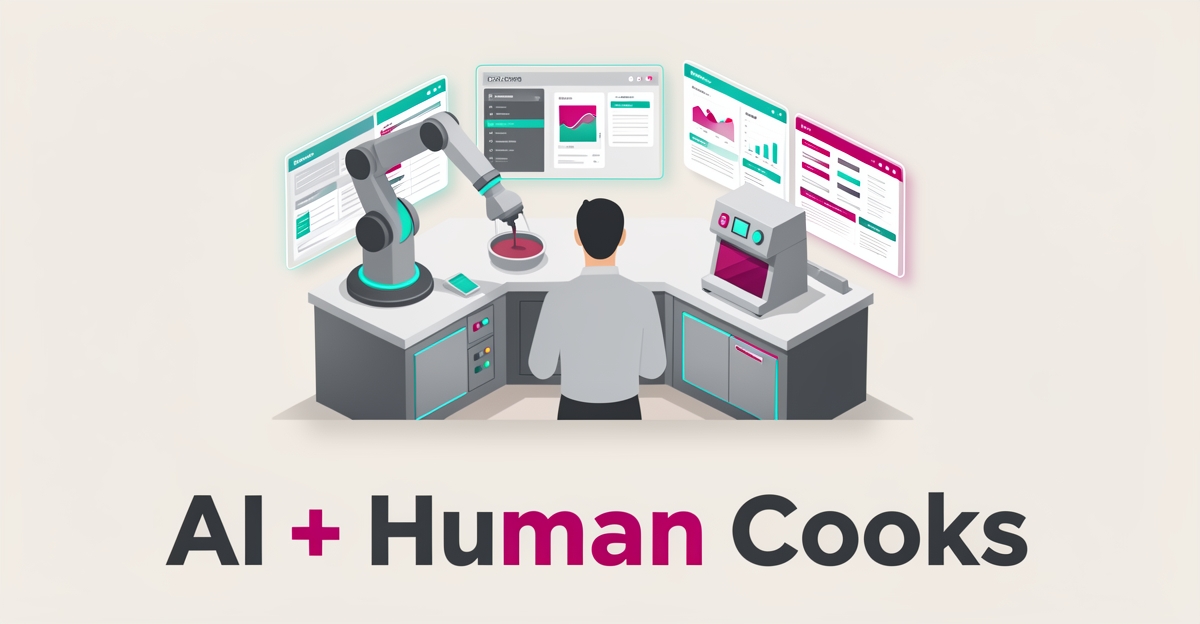
Can AI Replace Human Cooks in Ghost Kitchens? The Real Answer
Key Facts
- Recruiting and retaining employees is consistently cited as a top challenge by restaurant operators in National Restaurant Association industry reporting as of late 2026.
- Labor costs typically represent roughly a third or more of average restaurant revenue, squeezing already-thin ghost kitchen margins.
- Chef Robotics has reported completing large-scale serving volumes across facilities in the United States, Canada, and Europe.
- Mezli operates a fully automated restaurant in San Francisco with zero human cooks.
- Robotic fry-station units like Flippy have been reported at roughly $30,000 upfront or $3,000-5,000 monthly on a lease model.
- AI-powered inventory tracking and demand forecasting help ghost kitchens minimize food waste and prevent stockouts.
- AI is built to augment cooks, handling order prep and scheduling while humans retain control over taste, safety, and quality.
Hire a team member that works 24/7 — for less than a part-time wage.
AI receptionists, SDRs, dispatchers and 99+ roles. Trained on your business, fully managed.
Not sure where to start? Ask our AI planner
The Labor Crisis Driving Ghost Kitchen Automation
Ghost kitchens are feeling the squeeze from both sides of the line. Demand is climbing while the people needed to meet it are harder to find, forcing operators to rethink how work gets done without losing quality.
Recruiting and retaining employees remains the dominant pressure point for restaurant operators, according to National Restaurant Association industry reporting as of late 2026. Labor costs typically represent roughly a third or more of average restaurant revenue, leaving thin margins for high-volume, low-margin ghost kitchen models.
The strain shows up in missed prep windows, inconsistent ticket times, and higher turnover during peak delivery hours. Operators are being pushed to automate repetitive, high-volume tasks so kitchen teams can focus on food safety, quality control, and complex preparation that AI cannot replicate.
AI is not positioned to replace cooks. It is being deployed to enhance kitchen operations by handling order prep, inventory checks, and scheduling. AIQ Labs builds AI systems that support kitchen teams, not replace them, ensuring safety and quality remain human-led.
The automation wave is already visible in commercial kitchens. Chef Robotics has reported large-scale serving volumes across facilities in the United States, Canada, and Europe, according to industry coverage of robotic kitchen deployment. Mezli operates a fully automated restaurant in San Francisco with zero human cooks, while Miso Robotics' Flippy handles fry stations at chain locations.
These systems illustrate where automation fits best today:
- Order management and smart routing to reduce errors and bottlenecks
- Inventory tracking and demand forecasting to minimize waste
- Scheduling and prep support to stabilize labor deployment
High upfront costs remain a barrier. Robotic units like Flippy have been reported at roughly $30,000 as a one-time purchase or $3,000-5,000 per month on a lease model, per market reporting on robotic kitchen pricing. That investment is easier to justify when labor availability is volatile and labor costs approach or exceed one-third of revenue.
For ghost kitchens, the practical path is augmentation, not replacement. AI workflow builds can take on repetitive coordination work while cooks maintain control over execution, taste, and safety. This approach preserves the human skill that customers value while relieving the staffing pressure that is driving the industry toward automation.
Where AI Excels: Augmenting, Not Replacing, Human Cooks
AI is not here to take over the kitchen but to make the cook's job easier and more efficient. In ghost kitchens, where speed and consistency are critical, AI excels at handling repetitive, time-consuming tasks that free up human staff for higher-value work like recipe development, quality control, and customer experience. Rather than replacing cooks, AI acts as a force multiplier, automating order prep, inventory tracking, and scheduling so teams can focus on what machines cannot replicate: creativity, judgment, and adaptability.
Chef Robotics has demonstrated this synergy at scale, automating assembly-line tasks like portioning and plating across facilities in the United States, Canada, and Europe according to industry reports. Similarly, Miso Robotics' Flippy manages fry stations at chain locations, supporting consistent cooking times and reducing burnout on high-heat stations as documented in operational deployments. These systems don't eliminate the need for human oversight, they enhance it by minimizing errors and physical strain.
AI-powered order management integrates incoming orders from third-party delivery apps, enabling automated prioritization and smart routing to reduce bottlenecks as noted in operational best practices. Smart inventory systems track ingredient usage in real time, predict demand, and trigger reorder alerts to minimize waste and prevent stockouts per industry case studies. Predictive analytics further refine preparation by forecasting customer demand, helping kitchens avoid overproduction or under-preparation based on real-world implementations.
- Automates repetitive tasks like portioning, frying, and order sorting
- Reduces food waste through real-time inventory tracking and demand forecasting
- Improves order accuracy and timing across delivery platforms
- Decreases physical strain on staff by handling high-heat or high-volume stations
- Enables human cooks to focus on food innovation and quality assurance
AIQ Labs builds systems that follow this same philosophy, designing AI not to replace human talent but to augment it, ensuring kitchen teams remain central to operations while gaining relief from mundane, repetitive workloads. By automating the predictable, AI lets cooks do what they do best: create, adapt, and deliver exceptional food with consistency and care. This approach supports safer, more sustainable kitchens where technology serves people, not the other way around.
Practical AI Integration for Ghost Kitchen Operators
Ghost kitchens are under pressure from rising labor costs and staffing shortages, and operators are looking for ways to keep service fast without burning out teams. The answer isn't replacing cooks with robots, it's using AI to handle the repetitive, high-volume work around them.
With labor costs typically representing a third or more of average restaurant revenue, and recruiting and retention consistently ranked as a top operator challenge, efficiency gains matter more than ever. AI supports kitchen teams by taking on order prep, inventory checks, and scheduling so cooks can focus on quality and safety.
Practical integration starts with order management. AI-powered order management systems integrate all incoming orders from third-party delivery apps, ensuring automated order prioritization, smart order routing, and error reduction. This reduces bottlenecks during peak rushes and improves accuracy across the line.
Smart inventory tracking is the next lever. AI-powered inventory tracking systems help ghost kitchens minimize food waste and optimize stock levels by tracking ingredient usage and predicting demand. Predictive analytics for demand forecasting lets teams prep the right amount, not too much and not too little.
Robotic arms are moving from pilots to commercial deployment. Chef Robotics has reported large-scale serving volumes across facilities in the United States, Canada, and Europe, while recent coverage notes Mezli operates a fully automated restaurant in San Francisco with zero human cooks. Miso Robotics' Flippy handles fry stations at chain locations, with units reported at roughly $30,000 as a one-time purchase or $3,000-5,000 per month on a lease model.
For most operators, a phased approach delivers faster ROI than full automation. AIQ Labs' AI Workflow Builds rebuild the one workflow that costs you the most, fixed price, delivered in phases, while AI Employees can take on roles like order dispatch and scheduling support at a fraction of the cost of a human hire. Safety and quality stay human-led throughout.
Operators can start with three practical moves:
- Implement AI-powered order management to integrate delivery apps for automated prioritization and smart routing
- Use AI-powered inventory tracking to monitor ingredient usage and predict demand to cut waste
- Leverage predictive analytics to forecast customer demand for better prep and efficiency
These steps align with how AI is actually being adopted in ghost kitchens today: enhancing efficiency, accuracy, and customer satisfaction without removing the human touch from cooking.
Still paying for 10+ subscriptions that don’t talk to each other?
We build custom AI systems you own outright. No vendor lock-in. Full control.
Not sure where to start? Ask our AI planner
Frequently Asked Questions
Can AI actually replace human cooks in a ghost kitchen?
Why are ghost kitchens looking at AI right now?
What tasks can AI and robots realistically do in a ghost kitchen?
Is there a fully automated ghost kitchen with no cooks?
How much does kitchen automation cost?
What's the practical way to start with AI in my ghost kitchen?
Where AI Meets the Kitchen: Smarter Operations, Stronger Teams
Ghost kitchens aren't choosing between humans and machines, they're learning to make both work better together. As labor shortages persist and costs climb, AI is proving its value not by replacing cooks, but by taking over repetitive tasks like order routing, inventory tracking, and demand forecasting so kitchen teams can focus on quality, safety, and innovation. The real opportunity lies in augmentation: using AI to reduce waste, improve accuracy, and ease the strain on staff during peak hours. For operators ready to move beyond manual workflows, the first step is identifying where automation can deliver the fastest relief. Take the 2-minute Fit Check at aiqlabs.ai/apply, then book a free 30-minute strategy call to see how an AI Workflow Build or an AI Employee can strengthen your kitchen without losing the human touch that makes your food stand out.
Make AI your competitive advantage — not just another tool.
Strategy, implementation and ongoing optimization. One partner, end to end.
Not sure where to start? Ask our AI planner