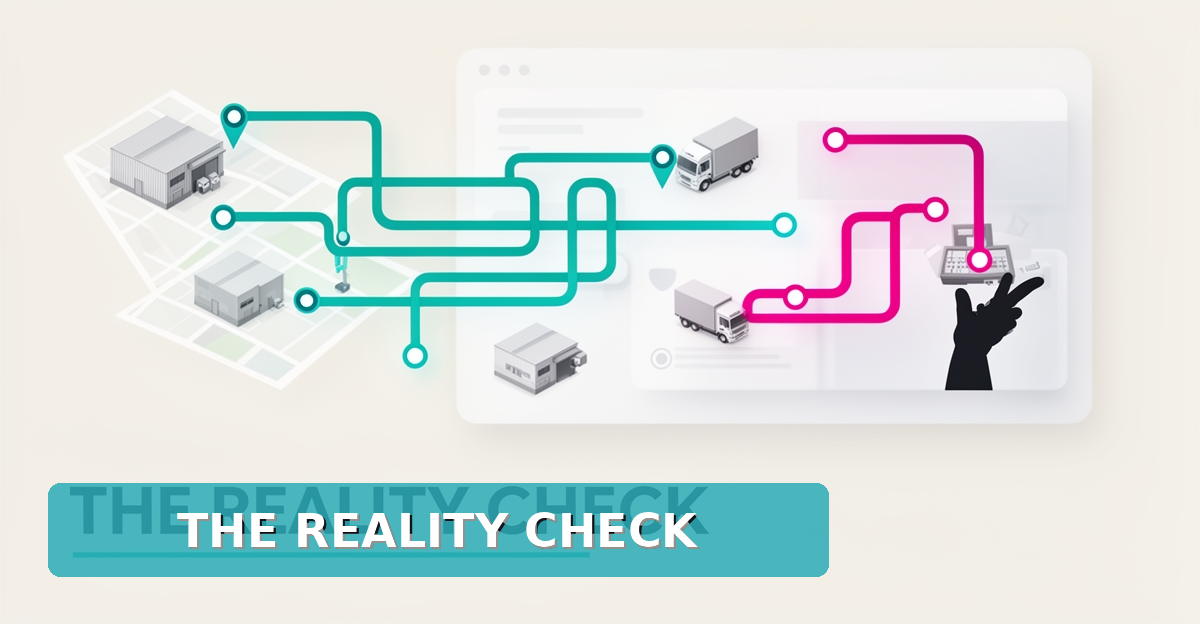
Can AI Replace Human Dispatchers in Hardware Distribution? The Reality Check
Key Facts
- Industry research suggests AI can automate roughly 80% of route planning and vehicle assignment according to recent analysis.
- Service request processing is commonly reported at around 75% automation in industry studies.
- Emergency situations and customer escalations automate only a small fraction—often cited near 18%—of dispatch tasks.
- Larger fleets (20+ vehicles) are typically reported to save tens of thousands of dollars annually with AI fleet management.
- AI dispatch can cut daily planning time from hours to minutes per industry research.
- Manual dispatch is often cited as carrying roughly 25% higher operating costs than AI-assisted alternatives per industry analysis.
Hire a team member that works 24/7 — for less than a part-time wage.
AI receptionists, SDRs, dispatchers and 99+ roles. Trained on your business, fully managed.
Not sure where to start? Ask our AI planner
The Dispatcher Dilemma: Rising Costs Meet Rising Volume
Hardware distributors face mounting pressure as operational costs rise while delivery volumes increase. Dispatchers, who coordinate the flow of goods from warehouse to job site, typically command annual salaries in the $40,000 to $75,000+ range depending on experience and location, according to industry wage data. Each human dispatcher typically manages only 10 to 15 drivers, creating a scalability bottleneck as fleets grow. Manual dispatch processes carry hidden inefficiencies that compound these challenges—industry analyses often put operating costs roughly 25% higher than AI-assisted alternatives, with fuel consumption increased by 15-30% due to suboptimal routing decisions. These inefficiencies directly impact the bottom line, especially for distributors handling time-sensitive hardware deliveries where every mile and minute matters.
The core dilemma lies in balancing human expertise with operational scale. While dispatchers excel at handling unexpected situations—like rerouting around sudden road closures or managing customer escalations—their capacity is inherently limited by human bandwidth. AI systems, by contrast, can process thousands of routing variables simultaneously, optimizing delivery sequences in minutes rather than hours. For hardware distribution specifically, this means AI can automate routine tasks such as job routing, delivery scheduling, and status updates efficiently, freeing human dispatchers to focus on complex exceptions that require judgment and relationship management. Industry analysis suggests larger fleets often recover AI dispatch software costs quickly, with annual savings frequently reported in the tens of thousands of dollars through reduced fuel burn, lower overtime, and administrative time savings. This financial upside raises a critical question: can AI effectively replace human dispatchers for routine operations, or does the irreplaceable value of human judgment in hardware logistics demand a hybrid approach? Research indicates that while AI handles the large majority of route planning and service request processing automatically, emergency situations and customer escalations remain largely human-driven at roughly 18% automation—highlighting where expertise still matters most.
What AI Actually Handles Well: The 82% Problem
AI dispatch systems excel at the predictable, data-heavy work that consumes hours of human time each day. According to industry research, AI can automate roughly 82% of route planning and vehicle assignment, processing thousands of variables like traffic, capacity, and delivery windows in seconds rather than the 2-4 hours typically required manually. This capability extends to about 75% of service request processing, where incoming jobs are automatically categorized, prioritized, and converted into work orders without human intervention.
For hardware distribution operations, this means the bulk of daily dispatching—scheduling deliveries, assigning vehicles, and updating job statuses—can be handled with minimal human oversight. Real-time status monitoring reaches roughly 48% automation through GPS and IoT integration, though interpreting contextual nuances still benefits from human judgment. As a result, daily planning time can collapse from hours to minutes, freeing dispatchers to focus on exceptions rather than routine calculations.
- AI handles the bulk of route planning automation—often cited around 82%
- Service request processing achieves roughly 75% automation rates
- Daily planning time drops from hours to minutes
The financial impact is equally significant for operations at scale. Larger fleets are frequently reported to see annual savings in the tens of thousands of dollars from AI-driven efficiencies, with break-even occurring within the first few months for many operations. These gains come from reduced fuel consumption (10-15% fewer miles in typical reports), lower overtime costs, and eliminated administrative bottlenecks. For hardware distributors managing regular routes, this transforms dispatching from a time-intensive chore into a streamlined, exception-based workflow where AI handles the volume and humans manage the complexity. AIQ Labs' AI Employees model for dispatchers embodies this balance—automating routine tasks at a fraction of the cost of a human hire while preserving human oversight for critical decisions.
Where Humans Stay Irreplaceable: The 18% That Matters Most
The most telling limitation of AI in dispatching surfaces during crises and customer emergencies—areas where automation drops to roughly 18% in industry studies. This stark contrast with AI's strong performance in route planning and service request processing reveals where human judgment remains indispensable. When a delivery truck breaks down mid-route with time-sensitive hardware or a key client threatens to walk over a missed deadline, algorithms lack the situational awareness to navigate these high-stakes moments effectively.
Human dispatchers bring irreplaceable contextual intelligence to these scenarios—knowing which driver stays calm under pressure, which customer accepts a delay with a personal apology call, or which backstreet shortcut avoids rush-hour gridlock. This relationship-based expertise, built through years of field experience, allows humans to make nuanced calls that pure data optimization cannot replicate. As one industry analysis notes, veteran dispatchers leverage this tacit knowledge to turn potential disasters into managed outcomes, a capability current AI systems fundamentally lack.
This reality is driving the industry toward a hybrid model where AI handles routine optimization while humans focus on exception management. Forward-thinking operations use AI to process thousands of routing variables overnight, then rely on human oversight to adjust assignments based on unquantifiable factors like driver morale or client temperament. For businesses exploring this balance, AIQ Labs offers AI dispatcher roles that manage logistics automation while preserving critical human judgment for the moments that truly matter.
The Hybrid Dispatch Model: AI Does the Volume, Humans Do the Judgment
The most successful hardware distributors aren't replacing dispatchers with AI—they're redefining what dispatchers do. Instead of spending hours building routes, these professionals now manage by exception, focusing their expertise where algorithms fall short.
This shift represents a fundamental evolution from route builder to operations manager. AI systems handle the bulk of route planning and vehicle assignment that follows predictable patterns, processing thousands of variables overnight to optimize for traffic, capacity, and delivery windows. By morning, the system has already made the routine decisions.
Human dispatchers then step into a supervisory role. They review the AI-generated schedules, applying contextual knowledge that algorithms lack—like knowing a specific driver handles stress poorly, or that a key customer accepts delays if you call personally. During operational hours, they focus exclusively on exceptions: emergency rerouting, customer escalations, and the complex negotiations that require human judgment and relationship leverage.
The right balance depends entirely on fleet size. According to industry analysis, operations with 1-5 vehicles often find manual dispatch sufficient, while fleets of 6-15 vehicles benefit from a hybrid approach. Companies running 15+ vehicles typically see the strongest returns by deploying AI dispatch with human oversight.
Implementing this model requires deliberate steps:
- Assess whether your operation runs 10+ vehicles on regular routes, the threshold where AI typically delivers maximum value
- Identify which layer is missing—route optimization or exception management—and deploy AI to fill that specific gap
- Integrate AI gradually, starting with overnight route optimization while maintaining human review protocols
- Train dispatchers to transition from builders to supervisors, focusing on override authority and exception handling
- Monitor performance metrics for 1-2 weeks as teams adapt to new workflows
AIQ Labs builds these hybrid dispatch systems to handle the volume while preserving human authority. Our AI Employees in dispatcher roles process routine scheduling and status updates automatically, escalating only the complex scenarios that require experienced judgment.
The result captures the best of both worlds: AI's tireless optimization capabilities combined with human wisdom for the unpredictable moments that define hardware distribution.
Making the Move: Your AI Dispatcher Action Plan
Hardware distributors looking to modernize their dispatch operations can start with a focused, practical approach that leverages AI for routine tasks while preserving human expertise for complex situations. Begin by implementing AI for route optimization and automated status updates—functions with high reported automation rates—allowing your team to cut daily planning time from hours to minutes while reducing mileage. This initial phase handles the volume of routine decisions that consume dispatcher bandwidth without requiring immediate organizational overhaul.
Maintain human oversight for exceptions where judgment and relationship management are critical, as AI systems currently automate only a small fraction of emergency situations and customer escalations. Your dispatchers should review AI-generated routes and assignments, flagging assignments based on contextual knowledge they possess—such as driver availability constraints or customer-specific preferences—that algorithms may miss. This hybrid model lets AI manage optimization while humans focus on high-stakes exceptions like traffic accidents, driver no-shows, or urgent customer demands requiring improvisation and relationship leverage.
Expect a 1-2 week learning curve for your team to adapt to new workflows, after which you'll begin tracking measurable returns through reduced fuel consumption, lower overtime costs, and administrative time savings. For fleets of 10+ vehicles running regular routes, these efficiency gains typically exceed software costs quickly. Monitor key metrics like miles driven, planning time reduction, and customer support call volume—which can drop meaningfully with real-time tracking—to validate your investment and refine the balance between AI automation and human intervention.
AIQ Labs' AI Dispatcher functions as a managed AI employee that handles logistics 24/7 with built-in human-in-the-loop controls, ensuring routine tasks run continuously while critical exceptions route to your team. The system integrates with your existing tools and learns your specific distribution patterns over time, becoming more effective as it processes your operational data. To explore how this approach fits your hardware distribution business, start with the free 2-minute Fit Check, then schedule a free 30-minute strategy call at aiqlabs.ai/book to assess your current systems and identify high-ROI automation opportunities tailored to your operation's scale and complexity.
Still paying for 10+ subscriptions that don’t talk to each other?
We build custom AI systems you own outright. No vendor lock-in. Full control.
Not sure where to start? Ask our AI planner
Frequently Asked Questions
Can AI completely replace human dispatchers in hardware distribution?
What specific dispatching tasks does AI handle best in hardware distribution?
When should hardware distributors still rely on human dispatchers instead of AI?
What ROI can hardware distributors expect from implementing AI dispatch systems?
Is AI dispatch only worthwhile for large hardware distribution fleets?
How does AI dispatch affect the day-to-day role of human dispatchers in hardware distribution?
The Future of Dispatch Isn't Human vs. Machine—It's Both
The question isn't whether AI can replace human dispatchers, but how quickly hardware distributors can redeploy human expertise where it matters most. While AI handles the heavy lifting of route optimization and scheduling—often delivering strong first-year returns for larger fleets—the slice of operations involving emergencies and customer escalations still demands human judgment and relationship intelligence. The winning strategy is hybrid: let AI process thousands of routing variables overnight while your dispatchers focus on exception management and client relationships. AIQ Labs builds these balanced systems through managed AI Employees in dispatcher roles that handle logistics 24/7 with built-in human oversight, ensuring you capture efficiency gains without sacrificing the contextual wisdom that keeps customers loyal. Ready to see how this fits your operation? Start with the free 2-minute Fit Check, then book a free 30-minute strategy call at aiqlabs.ai/book to map your specific dispatch challenges and identify your highest-ROI automation opportunities.
Make AI your competitive advantage — not just another tool.
Strategy, implementation and ongoing optimization. One partner, end to end.
Not sure where to start? Ask our AI planner