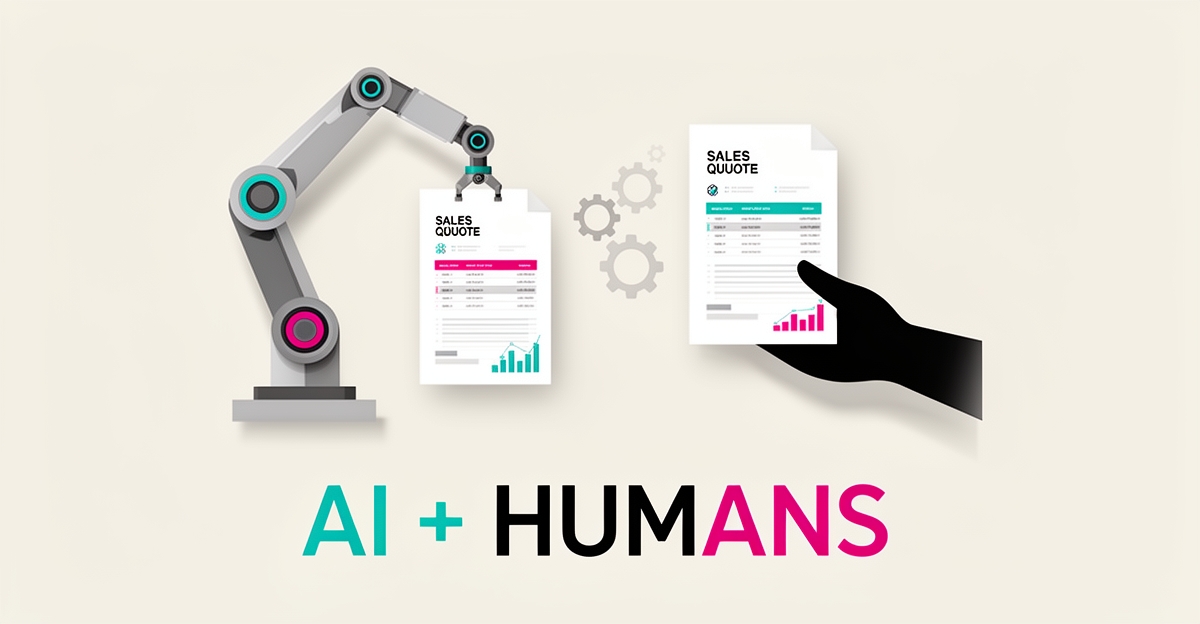
Can AI Replace Your Sales Team for Estimating and Quote Generation? A Real-World Look
Key Facts
- As of late 2026, a large majority of sales professionals use AI in some capacity for tasks like lead scoring and outreach, according to widely cited industry research
- Industry surveys consistently find that sellers who exceed their targets are more likely to use AI daily than those who fall short
- Sales teams typically lose several hours per week to manual CRM updates and data entry—time AI can reclaim
- By reducing errors and automating updates, AI-assisted quoting can meaningfully shorten the sales cycle
- Analysts including Gartner have projected that the overwhelming majority of seller research workflows will begin with AI by the late 2020s
- AI adoption among B2B sales teams has surged, with most professionals incorporating it into their weekly routines as of 2026
- AI can analyze historical sales data to support pipeline forecasting and quote accuracy
Hire a team member that works 24/7 — for less than a part-time wage.
AI receptionists, SDRs, dispatchers and 99+ roles. Trained on your business, fully managed.
Not sure where to start? Ask our AI planner
The Estimating Bottleneck Sales Teams Face Today
Sales teams today face a significant bottleneck in estimating and quote generation, where manual processes drain valuable time and slow down revenue cycles. The average sales representative spends hours every week on manual CRM updates and data entry alone—time that could be redirected toward high-value activities like relationship building and deal closing. This inefficiency doesn't just add friction; it directly impacts scalability, with manual estimating and quote generation often stretching the sales cycle by days. For SMBs operating with limited resources, this delay compounds quickly, turning promising leads into missed opportunities.
The consequences extend beyond lost time. Manual estimating increases the risk of human error, from miscalculated material costs to outdated pricing data, which can erode customer trust and lead to costly rework. When sales teams are bogged down by repetitive data entry and spreadsheet management, they have less capacity to pursue new prospects or nurture existing accounts. This creates a scalability ceiling: as lead volume grows, the estimating process becomes a choke point rather than an enabler. Without intervention, SMBs risk falling behind competitors who leverage automation to respond faster and more accurately.
AI-powered estimating tools address these pain points by automating data capture, calculations, and quote generation while maintaining accuracy and consistency. By reducing manual updates and minimizing errors, these tools help sales teams reclaim time and shorten sales cycles—critical advantages in competitive markets. However, the most effective implementations don't replace human judgment; they augment it. Sales professionals remain essential for interpreting customer needs, navigating complex negotiations, and building the trust that closes deals. AIQ Labs supports this balance through AI Workflow Builds that rebuild your quoting workflow and integrate with your existing systems, giving SMBs the speed of automation without sacrificing the human touch that drives long-term success. To explore how AI can alleviate your team's estimating bottleneck, start with the two-minute Fit Check at aiqlabs.ai/apply.
What AI Can Actually Do for Estimating and Quote Generation
AI is already reshaping how sales teams handle estimating and quoting, not by replacing humans but by automating the repetitive tasks that slow them down. As of late 2026, industry research suggests a large majority of sales professionals use AI in some capacity, with applications ranging from lead scoring to initial customer interactions. This widespread adoption shows AI's growing role as a force multiplier in sales operations, particularly in the early stages of the buyer journey.
One of AI's most proven capabilities lies in automating lead qualification and scoring, allowing teams to focus on high-intent prospects. AI systems analyze historical data, behavioral signals, and firmographic details to prioritize leads with greater accuracy than manual methods. Additionally, AI can personalize outreach at scale, generating tailored messages that resonate with individual customer needs—something that would take hours for a human to replicate across dozens of prospects. These functions are especially valuable in estimating workflows, where speed and precision directly impact quote turnaround time.
AI also excels at handling initial customer interactions through chat and voice agents, answering common questions about pricing, timelines, and service scope before a human rep ever gets involved. Looking ahead, analysts including Gartner have projected that the overwhelming majority of seller research workflows will begin with AI by the late 2020s—signaling a fundamental shift in how sales preparation gets done.
- Automates lead qualification and scoring using historical and behavioral data
- Personalizes outreach messages based on customer profiles and needs
- Handles initial inquiries via chat or voice agents, reducing response time
- Supports quote accuracy and win probability by analyzing past estimating data
- Cuts manual data entry and CRM update time by several hours per week
By taking on these tasks, AI creates space for human sellers to do what they do best: understand complex requirements, build trust, and negotiate value. For businesses in trades, construction, or field services—where site-specific variables make estimating nuanced—AI works best as a support tool that accelerates data gathering and preliminary calculations. The final quote still benefits from human judgment, especially when interpreting unique customer constraints or adjusting for unforeseen site conditions.
AIQ Labs helps businesses implement these capabilities through custom AI workflows that integrate with existing CRM and estimating tools, ensuring accuracy without overpromising automation. Rather than replacing your sales team, AI becomes a force multiplier—handling the groundwork so your reps can focus on closing deals with confidence. The result isn't fewer salespeople, but more effective ones, equipped with faster insights and fewer administrative distractions.
Where Human Sales Still Outperform AI in Quotes and Closing
While AI excels at processing data and generating initial estimates, human sales teams continue to outperform in areas where nuance and trust are critical. Relationship building remains a cornerstone of complex sales, particularly in industries requiring site-specific assessments or customized solutions. Industry surveys consistently find that sellers who exceed their targets are more likely to use AI daily compared to those who fall short, indicating that top performers leverage AI as a tool rather than a replacement for human interaction. This suggests that the most effective sales strategies combine AI's efficiency with human emotional intelligence.
Human sales professionals excel at interpreting subtle cues during conversations—such as hesitation, enthusiasm, or unspoken concerns—that AI systems often miss. They can adapt their approach in real time based on a customer's tone, body language, or evolving needs, especially when dealing with ambiguous requirements or unexpected site conditions. AI-powered tools, while strong at automating lead qualification and scoring, personalizing outreach, and handling initial interactions, still struggle with the contextual depth needed for high-stakes negotiations. In these moments, human judgment becomes indispensable for aligning solutions with both stated and latent customer priorities.
- Navigating complex objections that require empathy and creative problem-solving
- Building long-term trust through consistent, personalized follow-up
- Adjusting quotes dynamically based on evolving project scope or budget constraints
- Reading non-verbal signals during in-person or video consultations
- Leveraging institutional knowledge to anticipate unspoken customer needs
Beyond relationship dynamics, human teams also provide critical oversight on data accuracy—a persistent challenge in AI-driven estimating. Since AI models are only as good as the data they're trained on, inaccuracies in site measurements, material costs, or historical pricing can propagate through automated quote generation. Human estimators can cross-check outputs against real-world conditions, flag inconsistencies, and apply contextual corrections that automated systems might overlook. This is particularly valuable in trades like construction or electrical work, where small miscalculations can lead to significant cost overruns or safety issues.
AIQ Labs supports this hybrid approach with AI-powered estimating tools designed to augment—not replace—human expertise. These tools accelerate data gathering and preliminary calculations, freeing sales teams to focus on high-value activities like consultation and negotiation. By integrating AI into existing workflows, businesses can reduce manual effort while preserving the human touch that drives closing success. The goal isn't to eliminate sales roles but to elevate them, allowing professionals to spend less time on repetitive tasks and more time on strategic engagement. This balance ensures that technology enhances, rather than erodes, the core strengths of a skilled sales team.
A Hybrid Model: AI Support Tools That Accelerate Your Sales Team
The most successful AI adoption story in estimating isn't replacement—it's reinforcement. The data backs this up: industry surveys consistently show that sellers who exceed their targets are more likely to use AI daily than those who fall short. The top performers aren't handing their jobs to machines; they're arming themselves with them.
The hybrid model works because it assigns each side what it does best. AI handles the repetitive, data-heavy work—pulling historical pricing, calculating material costs, generating draft quotes, and updating records. Humans handle what machines can't: walking a job site, reading a customer's hesitation, and negotiating the final number. This division of labor matters when you consider that sales teams typically lose several hours per week to manual CRM updates alone—time that could go toward actually closing work.
For trades, field services, and construction businesses, the practical applications look like this:
- An AI estimator assistant assembles draft quotes from site photos, job specs, and historical pricing while the estimator reviews and adjusts.
- Automated follow-up keeps quotes from going cold, with the AI tracking responses and flagging when a prospect needs a human touch.
- Lead qualification runs instantly, so estimators spend their site visits on serious prospects instead of tire-kickers.
- Quote turnaround drops from days to hours, because the admin work no longer waits for someone to free up.
The results of this approach are measurable. Teams using AI to reduce errors and automate updates have reported meaningfully shorter sales cycles—a significant edge when a homeowner is collecting three bids and the fastest responder often wins. And adoption is clearly heading in this direction: analysts project that the overwhelming majority of seller research workflows will begin with AI within the next few years.
This is the philosophy behind how AIQ Labs approaches estimating automation: build AI-powered tools that work alongside your sales team, not instead of it. An AI estimator assistant can gather job details, prepare draft pricing, and keep quotes moving, while your estimator makes the final judgment call on every number that leaves the office. The human stays in the loop where judgment matters most.
The hybrid model also sidesteps the biggest risks of full automation. Pricing errors, tone-deaf customer interactions, and missed nuances in complex jobs all shrink when a qualified human reviews AI output before it reaches the customer. You get the speed of automation with the accountability of experience.
If you're wondering where AI estimating tools could fit in your own sales process, start with AIQ Labs' two-minute Fit Check at aiqlabs.ai/apply, followed by a free 30-minute strategy call to map your biggest quoting bottleneck and identify where automation delivers a clear win.
How to Implement AI-Assisted Estimating Without Disrupting Sales
Many sales teams find themselves bogged down by repetitive estimating tasks that eat up valuable time better spent on relationship-building and closing deals. Sales teams typically lose several hours per week to manual CRM updates and data entry—a clear indicator of process inefficiencies that AI can help alleviate. AI-assisted quoting reduces errors and automates those updates, which in turn shortens the sales cycle.
To implement AI-assisted estimating without disruption, start by identifying the most repetitive and time-consuming steps in your current workflow. Document tasks like data entry from site surveys, material cost calculations, or template-based quote generation that follow predictable patterns. These pain points are prime candidates for AI augmentation, allowing your team to focus on higher-value activities. Aligning these AI goals with broader business objectives—such as improving response times or increasing quote accuracy—ensures the technology supports strategic growth rather than creating isolated automation.
Next, audit your existing tech infrastructure to understand how AI tools will integrate with your CRM, accounting, and project management systems. Evaluate current capabilities and limitations, gathering input from IT, sales, and operations teams to uncover hidden bottlenecks. Prioritizing data quality is essential; inaccurate or inconsistent inputs will undermine AI reliability, so establish controls to maintain clean, standardized data for training and operation. This foundational work minimizes risk and sets the stage for sustainable adoption.
AIQ Labs supports this phased approach through three entry points: AI Workflow Builds rebuild the one quoting workflow that costs you the most at a fixed price, AI Employees add managed AI staff at roughly 80% less cost than a human hire, and AI Operating Systems connect everything into one operating layer you own outright. Payment models—Start Monthly, Build in Milestones, and Own It Outright—let you begin small, validate results, and scale confidently without overhauling your sales operations overnight. By treating AI as a support tool that handles the grunt work of estimating, sales teams gain back hours each week to engage more deeply with prospects—where human insight still drives the best outcomes. Industry data reinforces this, showing that sellers who exceed targets are more likely to use AI daily, highlighting its role as a performance enhancer, not a replacement.
Still paying for 10+ subscriptions that don’t talk to each other?
We build custom AI systems you own outright. No vendor lock-in. Full control.
Not sure where to start? Ask our AI planner
Frequently Asked Questions
Can AI really replace my sales team for estimating and quotes?
How much time can AI actually save my sales team on quoting?
What estimating tasks should I automate versus keep human?
Will using AI hurt the customer relationships my sales team has built?
How accurate are AI-generated quotes compared to human estimates?
Is AI estimating worth it for a small business or just enterprise companies?
The Smart Play Is Augmentation, Not Automation
AI won't replace your sales team for estimating and quote generation, but it can remove the bottleneck that slows them down. AI excels at automating lead qualification, drafting quotes from site data and historical pricing, handling initial inquiries, and cutting the manual CRM work that currently eats up your team's week. Humans remain essential for reading hesitation, navigating complex objections, adjusting quotes for evolving scope, and building the trust that closes deals. The real business value is a hybrid model where AI handles the repetitive data work and your reps focus on judgment, negotiation, and relationship building. That balance shortens sales cycles and reduces errors without losing the human touch. If you're evaluating where AI fits in your quoting process, start with a focused assessment of your most time-consuming estimating steps. AIQ Labs can help map those bottlenecks to high-ROI automation through a free 30-minute strategy call after a two-minute Fit Check at aiqlabs.ai/apply — a practical first look at how much time your team is currently losing to manual updates and data entry.
Make AI your competitive advantage — not just another tool.
Strategy, implementation and ongoing optimization. One partner, end to end.
Not sure where to start? Ask our AI planner