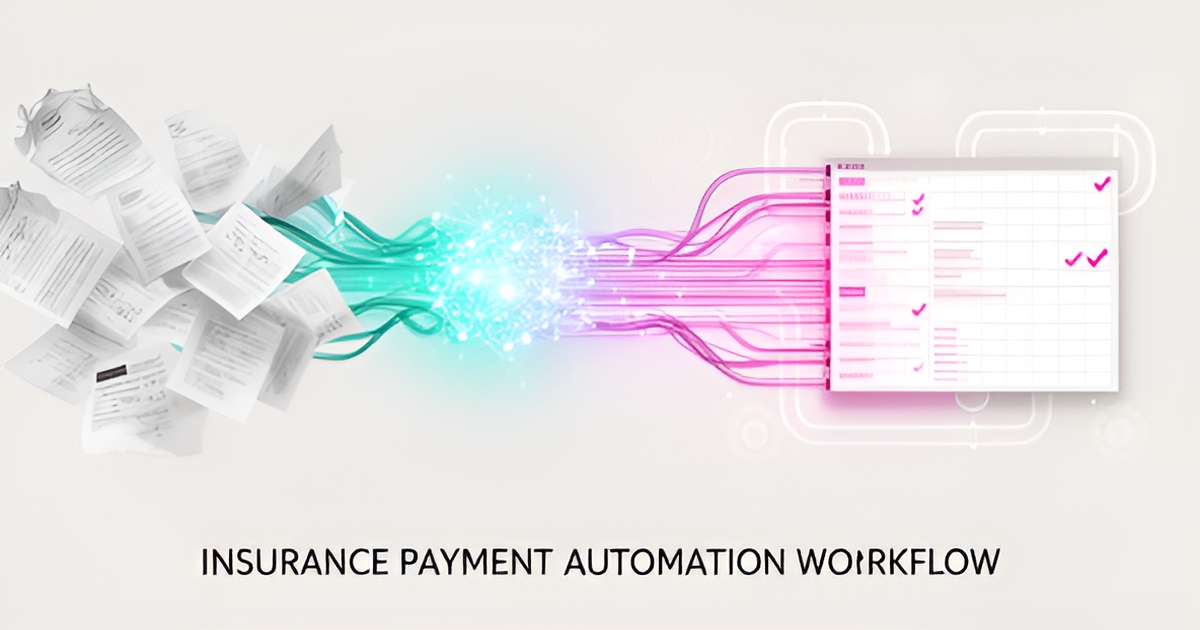
Finance Payment Automation for Insurance Accounting Processes
Key Facts
- Aviva deployed 80+ AI models and saved over £60M ($82M) in motor claims during 2024, according to industry statistics.
- Only 7% of insurers have brought AI systems to scale, with about two-thirds still stuck in piloting per adoption data.
- CMS reported a 6.55% improper-payment rate for Medicare fee-for-service in FY 2025, totaling $28.83 billion per industry analysis.
- Gen AI applied to SQL reporting can speed up report creation by up to 90%, industry statistics show.
- Non-life gross claims payments grew 7.5% in nominal terms in 2024, OECD market data reveals.
- 91% of carriers above $10B in revenue are deploying AI, versus just 58% in the $100M–$500M segment per industry statistics.
- Allianz's Project Nemo requires a person to approve every payout, per industry guidance on AI deployments.
One AI employee doing one job, 24/7, for less than a part-time wage.
Receptionist, lead follow-up, intake or dispatch. Trained on your business and fully managed. From $700/mo.
Why Claims Payment and Reconciliation Break Down
Claims payment and accounting reconciliation don't fail at the matching step. They fail before matching even starts, because the source data arrives as unstructured documents, fragmented formats, and manual comparisons that no spreadsheet was built to handle.
Industry analysis of insurance reconciliation puts it plainly: most reconciliation problems "start before matching begins." A missing claim number, a mis-captured premium amount, or a payment reference trapped inside an unprocessed PDF means the reconciliation system begins with incomplete data. Garbage in, unresolved differences out.
The volume compounds the problem. OECD market data shows non-life gross claims payments grew 7.5% in nominal terms in 2024, and life claims payouts grew at the same rate. Every one of those transactions needs to be matched across claims, premium, bank, and ERA/EOB files before the books can close.
When matching relies on manual comparison, the cost shows up as improper payments and revenue leakage. CMS reported a 6.55% improper-payment rate for Medicare fee-for-service in FY 2025, totaling $28.83 billion. Medicaid's rate hit 6.12%, or $37.39 billion. A missed premium adjustment or a duplicate payment can sit unnoticed for months if records are compared late.
Here's what breaks down in practice when claims payment and reconciliation run on manual workflows:
- Fragmented document formats force staff to re-key data from PDFs, emails, and faxes before any matching can begin
- Manual record comparison across claims, premium, bank, and ERA/EOB files slows month-end close and hides duplicates
- Exceptions pile up without a clear routing path, so unresolved differences carry forward into the next period
- Improper payments and underpayments compound because no one catches them until a late audit or a carrier dispute
- Regulatory reporting under NAIC statutory principles, Solvency II, and IFRS 17 demands traceable records that manual processes can't consistently produce
The industry recognizes this. AI is best suited for high-volume, repetitive tasks with limited subjectivity, which describes claim payment processing and reconciliation almost exactly. Yet industry adoption data shows only 7% of insurers have successfully brought AI systems to scale, with about two-thirds still stuck in piloting. Adoption correlates with size too: 91% of carriers above $10B in revenue are deploying AI, versus 58% in the $100M to $500M segment.
The cost of doing nothing isn't just slow close cycles. It's improper payments eroding margin, unresolved differences surfacing at audit, and compliance exposure under statutory reporting rules that demand traceability your current process can't guarantee. AIQ Labs builds custom automation that addresses both layers of the problem: structured document capture before data enters finance systems, and transaction matching with exception routing after it does.
Where AI Actually Fits in Claims Finance
Not every insurance workflow deserves AI. Claims payment and reconciliation do, and the reason comes down to the shape of the work itself.
Industry guidance on AI applicability in insurance is explicit: AI should be prioritized where there's a large set of transactions and content, feedback loops, and repetitive tasks with limited subjectivity. Claim payment processing and accounting reconciliation fit that profile almost exactly. High volume, strict timelines, cost sensitivity, and very little room for creative interpretation.
Claims operations also generate enormous amounts of unstructured input. Medical reports, repair estimates, invoices, ERA/EOB files, payment references buried in PDFs. AI excels at extracting and classifying this kind of data at scale, which is why claims processing has emerged as the first area where AI investments link directly to tangible business outcomes.
That makes the finance side of claims a two-layer problem, and both layers matter.
- Document data readiness (IDP): capturing accurate, structured data from source documents before or during entry, so claim numbers, premium amounts, and payment references don't arrive incomplete
- Transaction matching: reconciling records across claims, premium, bank, and ERA/EOB systems to identify financial differences
- Exception routing: flagging unmatched or disputed items for human review instead of burying them in a queue
- Audit-ready reporting: closing the books with traceable documentation tied to NAIC, Solvency II, or IFRS 17 requirements
Most reconciliation problems start before matching begins. If a claim number is missing or a premium amount is captured incorrectly, the reconciliation system starts with incomplete data and you spend hours chasing ghosts. Clean document data improves match rates; reconciliation automation then catches the remaining differences at the transaction level.
The adoption-versus-scaling gap here is worth noting. While 76% of U.S. insurer executives report implementing generative AI in at least one function, only 7% have brought AI systems to scale globally, with about two-thirds still in piloting. Smaller carriers lag further: just 58% in the $100M–$500M revenue segment are adopting AI versus 91% of carriers above $10B. That gap is where custom-built, owner-operated systems like the ones AIQ Labs builds make a practical difference for mid-market insurance operations.
One boundary holds firm across the industry: humans keep authority over payouts and denials. AI prepares and routes the claim file, flags exceptions, and reconciles the ledger, but an adjuster or claims professional approves consequential decisions. Allianz's Project Nemo, for instance, requires a person to approve every payout. The guidance from industry analysis of AI agent deployments is consistent: deploy agents for claim status and billing only when they can route coverage or payment exceptions to a person. That's the line. Cross it and you inherit compliance and reputational risk, as the UnitedHealthcare class-action proceedings made painfully clear.
What a Working System Looks Like
Picture a claim payment workflow where documents read themselves, transactions match themselves, and the only things landing on a human's desk are genuine exceptions. That's what a working system looks like, and the insurance industry's own case studies show it's achievable.
The architecture starts with document intake. Most reconciliation failures happen before matching ever begins, because claim numbers go missing, premium amounts get captured incorrectly, or payment references stay trapped inside unprocessed PDFs. So the first layer uses AI agents for intelligent document processing: extracting and validating structured data from claims documents, invoices, medical reports, and payment files before anything reaches the finance system.
The second layer is transaction matching across four distinct record types: claims, premium, bank, and ERA/EOB files. Each reconciliation type (premium, commission and broker, reinsurance and ceded risk, reserve and regulatory reporting) needs its own source records and matching rules. The system matches transactions across these systems, flags the discrepancies, and routes exceptions to a person. Human review stays reserved for exceptions; running it on every record slows processing down and increases the odds of missed duplicates and unresolved differences at close.
The results at major carriers show what this capability is worth. Aviva deployed 80+ AI models in claims and saved over £60M ($82M) in motor claims during 2024, cutting liability assessment time on complex cases by 23 days and reducing customer complaints by 65%, according to industry statistics. Zurich's underwriting platform cut manual triage from 75 minutes to 15 minutes. AIG improved underwriting data accuracy from roughly 75% to over 90%. And on the reporting side, gen AI applied to SQL reporting can speed up report creation by up to 90%, which matters enormously for month-end close and statutory reporting tied to NAIC, Solvency II, and IFRS 17 requirements.
The critical design principle is the human-in-the-loop boundary. Claims professionals retain authority over coverage, pricing, payouts, and denials. AI agents prepare and route the work; a person approves every consequential decision. Allianz's Project Nemo, for example, requires a person to approve every payout, as industry guidance notes. That boundary isn't optional: the UnitedHealthcare class-action lawsuit and a Senate subcommittee investigation show what happens when AI touches claim determination without adequate oversight.
This is the architecture AIQ Labs builds: multi-agent systems that extract, validate, match, and flag, with configurable escalation and complete audit trails for regulated environments. It's a design proven in production. AIQ Labs has deployed more than 200 multi-agent systems and operates voice AI in regulated collections, where compliance-first architecture is a requirement, not a feature. The same pattern applies here: automate the high-volume, repetitive, low-subjectivity work, and keep consequential decisions with people who are accountable for them.
That's the whole system in one sentence: clean data in, matched transactions out, exceptions routed to humans, and every action logged.
How to Scope, Fund, and Roll It Out
Claims payment automation fails for the same reason most finance projects fail: teams try to fix everything at once. Pick the single most expensive workflow first, in your case that's almost always claim payment processing and the reconciliation that follows it, and build outward from there.
Start by mapping where money actually leaks. A missed premium adjustment, an incorrect commission, or a duplicate payment sits unnoticed when records are compared late, according to research on insurance reconciliation. Treat document data readiness and transaction matching as one problem, not two, because clean data from claims documents improves match rates before reconciliation even begins.
Then run a phased build. AIQ Labs delivers this through three payment models that map directly to risk tolerance:
- Start Monthly: one AI employee or one workflow, with build, training, integrations, and monitoring included. Pause or adjust anytime.
- Build in Milestones: one workflow or department system split into phases. Approve and pay per phase, stop anytime, keep everything built.
- Own It Outright: a full AI operating system, one project price or a monthly Build Partnership, with full ownership of the code, agents, and data when complete.
Whichever model you choose, keep humans on the consequential decisions. Claims professionals retain authority over coverage, pricing, payouts, and denials, and guidance is clear that AI agents should handle claim status and billing only when they can route coverage or payment exceptions to a person. That boundary matters more in insurance than in most industries, where AI applied to claim determination has already drawn regulatory scrutiny.
The payoff is concrete. Gen AI applied to SQL reporting can speed report creation by up to 90%, which compresses the reconciliation and close cycle directly. Start with the Fit Check, a two-minute assessment at aiqlabs.ai/apply, then a free 30-minute strategy call where we map your most expensive workflow and tell you honestly whether there's a clear win.
Still paying for 10+ subscriptions that don’t talk to each other?
We build connected AI systems you own. Pay upfront or on a payment plan; the code is yours once it’s paid off.
Frequently Asked Questions
Why do insurance reconciliation processes usually fail before they even start?
Is AI actually effective for high-volume insurance claims and payments?
What is the difference between adopting AI and actually scaling it in insurance?
Does AI replace human decision-making in claim payouts and denials?
How much can AI automation actually save insurance companies?
How do I start automating my insurance payment and reconciliation workflows?
Clean Data In, Matched Transactions Out: Your Next Move
Claims payment and reconciliation break down before matching even begins, and the fix is a two-layer system: intelligent document processing that captures clean data upfront, and transaction matching that routes genuine exceptions to humans while keeping every consequential decision with your claims professionals. The industry's own results prove the payoff, from Aviva's $82M in motor claims savings to reporting cycles compressed by up to 90%. Yet most insurers remain stuck in piloting, and mid-market carriers feel that gap hardest. You don't need to fix everything at once. Map where money actually leaks, duplicate payments, missed premium adjustments, unresolved differences at close, then automate that single most expensive workflow first, with audit trails and human-in-the-loop controls built in from day one. AIQ Labs builds exactly these systems, with 200+ multi-agent deployments in production and payment models that let you start with one workflow, build in phases, or own the whole system outright. Start with the two-minute Fit Check at aiqlabs.ai/apply, then a free 30-minute strategy call where we map your most expensive workflow, and tell you honestly if there's a clear win.
See what AI would actually do in your business, in 60 seconds.
The planner shows which step fits, the agents we’d build and the published price. No email needed.