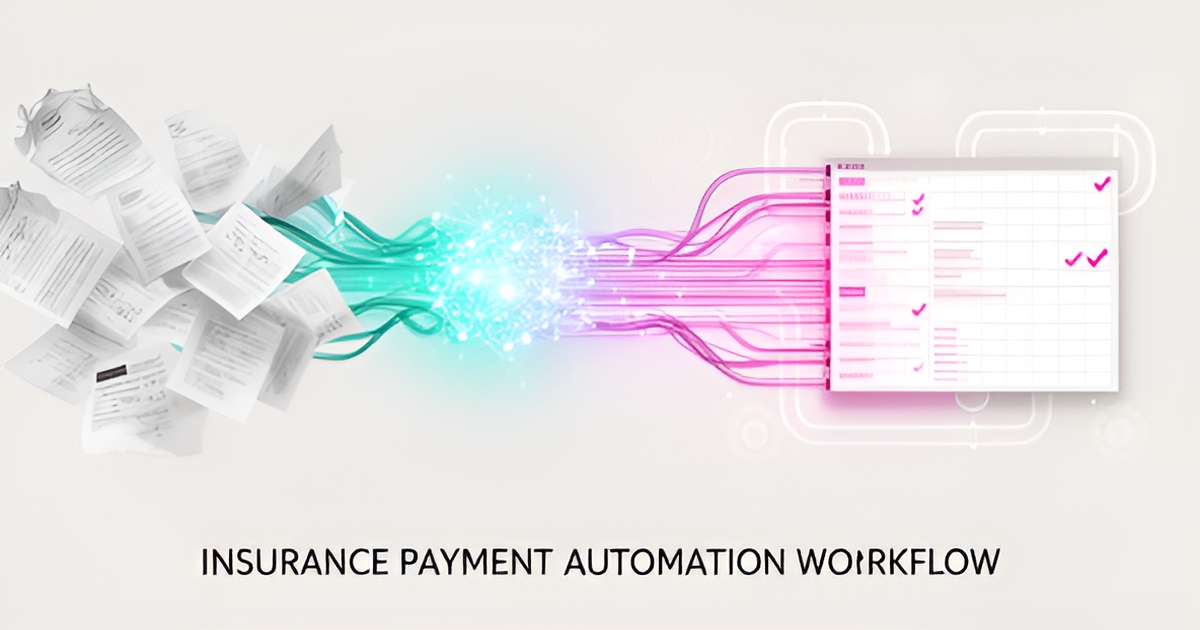
Finance Payment Automation for Insurance Accounting Processes
Key Facts
- Fewer than 30% of key financial controls are automated at insurers according to PwC's 2025 survey.
- AI-powered payment orchestration delivers 45% faster reconciliation than manual clearing according to market research.
- Pan-American Life improved auto-match rates from 20–30% to over 96% after modernizing per Trintech data.
- Over 45% of mid-sized insurers still run core systems built 15+ years ago according to Congruence Market Insights.
- Real-time payment rails cut claims payout cycles from five days to under three days according to industry analysis.
- Automated payment systems reduce reconciliation errors by approximately 35% while cutting manual workload by 40% according to recent data.
- Layering modern payment rails over legacy infrastructure is insufficient without process redesign according to Duck Creek.
One AI employee doing one job, 24/7, for less than a part-time wage.
Receptionist, lead follow-up, intake or dispatch. Trained on your business and fully managed. From $700/mo.
Why Insurance Accounting Is Stuck in a Manual Loop
Ask an insurance accounting team what reconciliation looks like on any given day, and you'll hear the same story: three systems that should agree, and don't. Trintech's illustrative example captures it well. The claims system shows $12.4M in payments issued. The general ledger shows $12.35M posted. The bank shows $12.31M settled. Analysts then have to manually sort out what was issued but never posted, what was posted but never cleared, which differences are timing, and which are duplicates. That's very common in insurance, where nearly every account requires matching across multiple systems.
The structural problem is that these three record types were never designed to sync. Claims systems, GLs, and bank feeds each capture different data at different times, with different identifiers. Most reconciliation failures start small: a payment hits the bank but doesn't match the ledger, a claim number is missing, or a payment reference sits inside an unprocessed PDF where no matching system can see it. Reconciliation logic can only match what it can reliably identify, so incomplete inputs guarantee incomplete output, as reconciliation research notes.
The consequences show up in the numbers. Processing delays of 60, 90, or even 120+ days are common in insurance payment operations, and skilled finance staff spend much of that time on repetitive data entry, matching, and claim tracking rather than actual accounting work. Meanwhile, fewer than 30% of key financial controls are automated at insurers, according to PwC's 2025 survey data cited by Trintech. That means the majority of the controls your auditors and regulators care about still depend on someone remembering to check a spreadsheet.
The scale of the mismatch gets worse with volume. Insurance reconciliation isn't one process, it's several: premium, commission and broker, reinsurance, and reserve reconciliation, each with its own source records and matching rules. Layer on statutory requirements from NAIC, Solvency II, and IFRS 17, and the manual loop tightens further. As Trintech's Lindsay Rose puts it, without standardization, reconciliation becomes "a recurring data-wrangling exercise rather than true accounting work," and the real risk hides in what nobody can see: aging unreconciled items, unresolved exceptions, and bottlenecks that only surface at period end.
Legacy core systems make all of this harder, not easier. According to Congruence Market Insights, over 45% of mid-sized insurers still run core systems built 15+ years ago, and those platforms were designed for batch processing and one-to-one matching, not the multi-source, high-volume reality of modern insurance accounting. Pan-American Life Insurance Group's experience is telling: their legacy ERP bank rec module could only make one-to-one matches, producing a 20-30% auto-match rate.
- Three-source matching (claims vs. GL vs. bank) is the daily norm, not an edge case
- Processing delays routinely stretch past 60 days, sometimes past 120
- Fewer than 30% of key financial controls are automated
- Over 45% of mid-sized insurers are anchored to 15+ year old core systems
This is the gap AIQ Labs focuses on: rebuilding the payment and reconciliation workflow itself, with document processing that structures the data before matching and multi-agent systems that handle three-source reconciliation continuously, rather than bolting another tool onto a broken process.
What AI-Driven Payment and Reconciliation Actually Delivers
Reconciliation at most insurers still runs on spreadsheets, email threads, and a bank rec module bolted onto a 15-year-old ERP. The result is predictable: claims payments that take 60 to 120+ days to clear, and fewer than 30% of key financial controls automated, per PwC's 2025 Insurance Finance Transformation Survey.
The numbers shift sharply once AI takes over the matching layer. AI-powered payment orchestration runs reconciliation 45% faster than manual clearing, cuts reconciliation errors by roughly 35%, and trims manual administrative workload by around 40%. The headline benchmark comes from Pan-American Life Insurance Group, which moved from a 20–30% auto-match rate on its legacy ERP bank rec module to over 96% after modernizing, far past its internal 75% target.
What makes the lift possible is two layers working together:
- Intelligent document processing pulls claim numbers, payment references, and policy IDs out of PDFs, email attachments, and scanned remittance advice before any matching begins, fixing the "missing reference" problem that breaks most legacy rec.
- Multi-agent matching then runs the three-way reconciliation across claims, GL, and bank in parallel, flagging issued-but-not-posted items, timing differences, and duplicates that a human analyst would spend hours untangling.
- Exception routing sends only the genuine mismatches to a human reviewer with full context attached, rather than dumping the whole ledger on someone's desk.
A 2024 U.S. insurer that deployed AI-based claims disbursement automation saw 38% faster payouts alongside a 22% drop in fraudulent payouts, and a separate carrier cut operational overhead by 32% after wiring real-time payments into an automated reconciliation engine. Both cases treat reconciliation as a workflow, not a reporting chore.
This is the gap AIQ Labs targets with its AI Workflow Builds: one broken process rebuilt end to end, with the client owning the system outright. For insurance accounting teams buried in three-system matching, that ownership model matters as much as the speed gain, because it removes the perpetual-license trap that keeps legacy rec modules in place long after they've stopped working.
If your team is still chasing unmatched claim payments across three systems, the two-minute Fit Check is the fastest way to see where an AI workflow rebuild would actually move the needle.
Why Layering Modern Rails Over Legacy Systems Falls Short
The insurance industry has spent the last several years chasing a simple fix: bolt a real-time payment rail onto an existing core system and call it modernization. That approach is failing. Duck Creek's analysis of what 2025 taught insurance carriers is blunt about it: simply layering modern payment rails over legacy infrastructure is not sufficient. The carriers that saw real gains paired the technology with process redesign and organizational alignment.
The legacy problem is not abstract. Over 45% of mid-sized insurers still operate on core systems built 15 or more years ago, according to Congruence Market Insights. These systems were designed for batch processing, not the instant settlement expectations that now define competitive insurance products. Dropping RTP or instant ACH onto a platform that still posts payments overnight creates a different kind of bottleneck: money moves in seconds, but the ledger catches up in days. The result is the kind of structural mismatch that reconciliation teams spend their weeks untangling.
This is where the point-tool trap becomes visible. A payment rail is infrastructure, not a solution. Trintech's analysis of insurance reconciliation priorities highlights that fewer than 30% of key financial controls are automated at insurers. The gap isn't the payment rail; it's everything around it. Three-source matching across claims systems, general ledgers, and bank feeds remains the norm, and most reconciliation failures start upstream with incomplete data: claim numbers missing, payment references trapped in unprocessed PDFs, duplicate broker commissions that nobody catches until month-end.
AIQ Labs treats insurance payment automation as a workflow rebuild rather than a technology drop-in. The distinction matters. A payment rail solves one step in a multi-step process. A workflow rebuild addresses the data standardization, matching logic, exception handling, and approval routing that determine whether the rail actually delivers value.
What separates a workflow rebuild from a point tool:
- Data standardization before matching: cleaning claim references, normalizing broker IDs, structuring payment metadata so reconciliation logic has something reliable to work with
- Exception routing built into the process, not bolted on after exceptions pile up at month-end
- Human-in-the-loop checkpoints for high-value or anomalous transactions, aligned with regulatory expectations under NAIC, Solvency II, and IFRS 17
- Audit trails and guardrails embedded from day one, so the automation meets compliance standards without retrofitting
The research consensus is consistent. Piers Williams at AutoRek frames AI as a supplementary technology rather than a solution to all problems, with adoption challenges around data privacy and ethical use. The synthesis across Duck Creek, Adyen, and Trintech is the same: technology works when paired with process redesign and clean data. A payment rail without that foundation just moves the manual work downstream.
For insurers and insurance-adjacent businesses evaluating automation, the test is simple. If the proposed solution starts with the rail, it's a point tool. If it starts with the workflow, it's a rebuild. The difference shows up in whether you get a 96% auto-match rate or the same 20–30% you started with, just processed faster into a mess.
Governance, Compliance, and the Human-in-the-Loop Question
Nothing in insurance finance gets audited more aggressively than money that moved. Yet the regulatory environment around payments and reconciliation is tightening faster than most insurers' automation plans can keep up with, and that gap is where the real risk now lives.
The statutory pressure is explicit. Reconciliation rigor is driven by NAIC statutory accounting in the U.S., Solvency II in Europe, and IFRS 17, each demanding that premium, claims, commission, and reserve balances tie out across systems with documented evidence. In the UK, the FCA's safeguarding rules for payment and e-money firms take effect in 2026, and the Bank of England mandated ISO 20022 for certain large-value payments such as CHAPS from May 2025. ISO 20022 also carries a benefit: it lets systems exchange far richer payment detail, which makes automated matching easier when the plumbing supports it.
Here's the uncomfortable part. According to PwC's 2025 survey, fewer than 30% of key financial controls are automated at insurers. That means most firms are asking skilled finance staff to manually evidence compliance across three-source reconciliations, like claims system versus general ledger versus bank, at volumes that keep growing. When matching fails, it usually starts with incomplete data: a missing claim number, or a payment reference sitting in an unprocessed PDF. The system can only match what it can reliably identify.
So how does AI fit in without creating new regulatory exposure? The industry's own voices are candid on this. Piers Williams at AutoRek positions AI as a supplementary technology, not a solution to every problem, with real adoption challenges around data privacy and ethical use. Celent notes that agentic AI must be balanced against evolving regulations on fairness, accountability, and transparency. The consensus: AI works, but only inside guardrails.
That's the design philosophy behind how AIQ Labs builds payment and reconciliation automation. The architecture runs on LangGraph multi-agent workflows with validation layers that check every action before execution, configurable human-in-the-loop escalation when a transaction exceeds AI authority, and complete audit trails logged for compliance review. In practice, that means the AI matches the routine 95% of items and escalates the exceptions, with every decision traceable. A human signs off where policy requires it, and the audit trail shows exactly why.
What good governance looks like in an automated insurance finance workflow:
- Every automated payment or journal entry validated against source data before execution
- Hard guardrails defining what the AI can approve on its own, set per role
- Automatic escalation to a human reviewer for exceptions, large values, or ambiguous matches
- Complete, timestamped audit trails covering every match, adjustment, and approval
The goal is trustworthy automation, not unsupervised automation. When the Pan-American Life Insurance Group modernized reconciliation, it moved from a 20–30% auto-match rate to over 96%, but that result came from pairing technology with process discipline. Firms that treat AI as a compliance shortcut will fail audits. Firms that treat it as a well-governed matching engine with human oversight will close faster, rest easier at period end, and have the evidence trail to prove it.
How AIQ Labs Rebuilds the Payment and Reconciliation Workflow
The fastest path to fixing insurance reconciliation isn't buying another point tool. It's rebuilding the workflow itself, because the research is clear that layering new technology over broken processes doesn't work. Duck Creek's 2025 analysis found that simply adding modern payment rails on top of legacy infrastructure "is not sufficient", the carriers seeing real gains paired technology with process redesign.
That's the lens AIQ Labs brings to payment automation. Rather than selling a subscription widget, the team builds custom systems the client owns outright, and the starting point depends on where the pain is concentrated.
The right engagement model depends on how deep the problem runs:
- AI Workflow Fix: One broken pipeline, rebuilt. For most insurers and insurance-adjacent businesses, that's the three-source reconciliation between the claims system, the general ledger, and the bank. Trintech notes this type of matching is "very common" and that analysts spend their days hunting issued-but-not-posted items, timing differences, and duplicates.
- Department Automation: A full overhaul of the finance function, covering premium, commission, and claims reconciliation together with invoice processing and month-end close. This fits when manual work is spread across multiple accounts rather than trapped in one pipeline.
- Complete Business AI System: A multi-department operating layer with a custom interface, built for organizations ready to make automation the core of how finance, operations, and reporting work together.
The technical approach matters. Most reconciliation failures start with bad inputs: a claim number missing from a payment record, or a reference number sitting in an unprocessed PDF. Infrrd's analysis of insurance reconciliation makes the point that matching logic can only work with data it can reliably identify. So an effective build pairs intelligent document processing, which cleans and structures data before entry, with multi-agent matching that handles the three-way comparison automatically.
The results are documented. According to Congruence Market Insights, AI-powered payment orchestration delivers 45% faster reconciliation than manual clearing, with roughly 35% fewer errors and a 40% reduction in manual administrative workload. And the ceiling is high: Pan-American Life Insurance Group moved from a 20–30% auto-match rate on its legacy ERP to over 96% after modernizing, according to Trintech.
Because this touches financial controls and regulatory reporting under frameworks like NAIC statutory accounting, governance can't be an afterthought. AIQ Labs builds with validation layers, hard guardrails, human-in-the-loop escalation for edge cases, and complete audit trails, which lines up with the responsible-AI principles Celent says insurers must balance against automation gains.
You don't need to guess which model fits. The starting point is a two-minute Fit Check at aiqlabs.ai/apply, followed by a free 30-minute strategy call with an AI engineer. It's a working session, not a sales pitch: you'll map your current reconciliation flow, identify the bottleneck costing the most hours, and get a realistic picture of what automation would return. If there isn't a clear win, they'll tell you that too. Real pricing comes in writing after the call, with the cheapest path to the result you need.
Still paying for 10+ subscriptions that don’t talk to each other?
We build connected AI systems you own. Pay upfront or on a payment plan; the code is yours once it’s paid off.
Frequently Asked Questions
Why is insurance reconciliation still so manual when we have modern accounting software?
What kind of auto-match rate can we realistically expect from AI-powered reconciliation?
Can't we just add real-time payments or instant ACH on top of our existing core system?
How do we keep AI-driven reconciliation compliant with NAIC, Solvency II, and IFRS 17?
How long do insurance claim payments actually take to clear today, and how much does AI speed that up?
Where do most reconciliation failures actually start, is it the matching logic or the data going in?
Stop Reconciling. Start Closing.
The pattern across this article is consistent: three systems that should agree but don't, 60-to-120-day payment delays, and fewer than 30% of key financial controls automated at insurers. Layering a modern payment rail over a 15-year-old core system doesn't fix that, Duck Creek is blunt that it "is not sufficient." What works is rebuilding the workflow itself: structuring payment data before matching begins, running three-source reconciliation across claims, GL, and bank continuously, and routing only genuine exceptions to a human with full context attached. The documented ceiling is high, Pan-American Life moved from a 20–30% auto-match rate to over 96%, but only when technology is paired with process discipline and governed by validation layers, guardrails, and audit trails. That's the model AIQ Labs builds toward: systems clients own outright, not another subscription bolted onto a broken process. If your team is still chasing unmatched claim payments across three systems, the two-minute Fit Check at aiqlabs.ai/apply is the fastest way to see where a workflow rebuild would actually move the needle.
See what AI would actually do in your business, in 60 seconds.
The planner shows which step fits, the agents we’d build and the published price. No email needed.