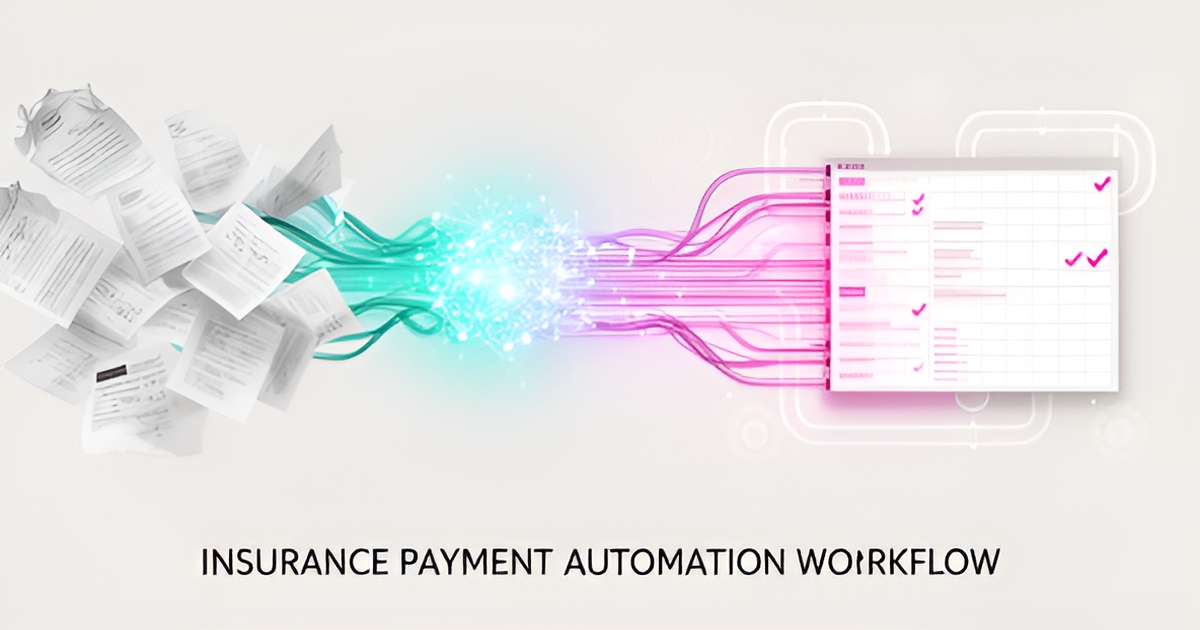
Finance Payment Automation for Insurance Accounting Processes
Key Facts
- 76% of US insurer executives implemented generative AI, yet only 7% successfully scaled it.
- Digital payment solutions can save up to one hour of manual reconciliation effort per transaction.
- 65% of organizations experienced check fraud attacks or attempts, making checks the most vulnerable payment method.
- Only 10% of P&C carriers successfully scaled AI, leaving roughly two-thirds stuck piloting.
- 42% of insurers have never measured AI outcomes, making ROI claims unprovable.
- The NAIC Model Bulletin on AI now covers 25 states plus Washington, D.C..
- Heffernan Group saved $600,000 in hard savings in one year by offsetting BPO costs via automation.
One AI employee doing one job, 24/7, for less than a part-time wage.
Receptionist, lead follow-up, intake or dispatch. Trained on your business and fully managed. From $700/mo.
The Reconciliation Bottleneck Eating Your Finance Team
Here's a number that should bother every insurance finance leader: 76% of US insurer executives have put generative AI into at least one function, yet only 7% have scaled it successfully. The technology arrived. The transformation didn't, and the gap shows up most painfully at the payment layer.
Walk through what happens after a claim gets approved. Someone still has to cut the payment, match it against the claim file, post it to the ledger, and reconcile it against the bank. That work stays stubbornly manual at most carriers. Payments industry analysis estimates that some digital payment solutions save up to a full hour of manual reconciliation effort per transaction. Multiply an hour across thousands of monthly claim payments and you're looking at entire headcount's worth of effort spent matching numbers that a system could match in seconds.
The math gets worse when you look at payment methods. AFP survey data shows 65% of organizations experienced check fraud attacks or attempts, and checks remain the most vulnerable payment method in circulation. Every manual, paper-based claim payment is an exposed transaction sitting in your treasury workflow.
So why does this bottleneck persist when AI budgets keep growing? The industry's own adoption research points to roughly two-thirds of insurers stuck in piloting, with only 10% of P&C carriers successfully scaling AI at all. Most AI initiatives target the visible, glamorous parts of the claim lifecycle: intake, document reading, damage assessment. The payment and reconciliation layer gets left behind because it's unglamorous, compliance-heavy, and touches the general ledger, where a mistake is far more expensive than a misread document.
That's precisely why it's the highest-leverage place to automate. Reconciliation is high-volume, rule-based, and repetitive, which is exactly where Wolters Kluwer's decision-science leadership says application AI belongs: transactions with limited subjectivity and clear feedback loops. The work doesn't need judgment. It needs accuracy, audit trails, and speed.
This is the gap AIQ Labs builds against. Rather than stopping at document extraction, their approach routes approved financial data directly into accounting systems like QuickBooks and Xero to complete the reconciliation cycle, with validation layers and human-in-the-loop escalation for anything judgment-adjacent. Their own AP automation work reports 80% reductions in invoice processing time and month-end closes accelerated by three to five days.
The takeaway for finance teams: the AI you already funded isn't touching the hour-per-transaction tax on your treasury operations. Fix that layer first, and the ROI conversation stops being about "time saved" and starts being about hard dollars.
What End-to-End Payment Automation Actually Looks Like
Straight-through processing sounds like a buzzword until you see what it replaces: a claim that's approved on Tuesday but not posted to the ERP until the following week because someone has to re-key the payment, reconcile the bank file, and chase the mismatch by hand. The modern target state removes that gap entirely. Once a claim is approved, payment execution, bank transmission, and ERP posting happen in one continuous, auditable flow with no human touching the data in between.
What makes this achievable now is a clear division of labor between machines and people. AI handles the high-volume, rule-based work: extracting payment data, matching invoices against policy and claim records, flagging duplicates and fraud signals before posting, and routing approved financial data directly into systems like Oracle Fusion to complete the accounting cycle. That last step is where most "automation" efforts quietly fail. Reading documents is easy; closing the loop into the ERP is what actually produces reconciled books.
The judgment calls stay with humans, by design and increasingly by law. As industry guidance puts it, AI agents can prepare and route the claim file, but an adjuster should retain payout and denial decisions. Allianz's Project Nemo followed exactly this model, shortening food-spoilage claim resolution while a person approved every payout. Aviva runs 80+ AI models across its claims operation and still saved £60M+ in 2024 motor claims alone, proof that scale and human accountability aren't in tension.
Regulators are codifying this architecture rather than leaving it to good intentions:
- The EU AI Act classifies insurance AI as high-risk, requiring documented decision logic, human oversight, and audit trails. Black-box models that can't expose their reasoning simply can't be deployed in regulated insurance workflows.
- The NAIC Model Bulletin on AI has been adopted across 25 states plus Washington, D.C., extending similar oversight expectations to US carriers.
- Validation stages must cross-reference payments against source records in real time to catch errors, duplicate payments, and fraud before posting.
This matters financially as much as it matters legally. Some digital payment solutions save up to an hour of manual reconciliation effort per transaction, which compounds quickly across thousands of claim payments. Deterministic decisioning with human-in-the-loop payout controls is the only architecture that satisfies both the auditors and the finance team.
When AIQ Labs builds these pipelines, the pattern is the same one regulators expect: validation layers before execution, configurable escalation when a decision exceeds the system's authority, and complete audit trails on every action. Compliance-first architecture isn't a constraint on automation; it's the specification for it. The insurers scaling successfully, the roughly 10% of P&C carriers that have moved past pilots, are the ones that treated the compliance requirements as the design brief from day one rather than retrofitting them later.
Why Most Insurance AI Pilots Never Reach Finance
Most insurance AI projects stall in the pilot phase. The technology works in the demo, but it fails to deliver value in production.
The data reveals a stark disconnect. While 76% of US insurer executives have implemented generative AI, only 7% report successfully scaling it globally. A recent study of property and casualty insurers found that just 10% achieved scale, leaving the majority stuck in exploration.
This gap is not a technology failure. It is a measurement failure. Capgemini reports that 42% of insurers have never measured AI outcomes. Without rigorous baselines, you cannot prove value. You cannot justify the budget.
The bottleneck is ownership and discipline. Teams launch pilots without defined success metrics. They lack a clear path from experiment to enterprise workflow.
Consider the standard now demanded by finance leaders. Kate Grasman, CIO at Heffernan Group, rejects vague efficiency claims. She requires hard savings. Her organization saved $600,000 in one year by offsetting BPO costs through automation. Jennifer Kessel, COO at USG Insurance Services, asks the same question: "What are we doing with that gained time?"
You must shift from tracking hours saved to tracking dollars earned.
- Establish pre-implementation baselines for every workflow
- Define success in hard-dollar terms, not time saved
- Assign a single owner accountable for ROI
- Integrate automation directly into finance systems
This approach turns AI from a cost center into a profit driver. It aligns with the reality of insurance finance operations today.
AIQ Labs builds solutions with this discipline in mind. Our architecture includes validation layers and audit trails. We ensure every automated payment decision is traceable and compliant.
We go beyond deploying tools. We structure the workflow for measurable impact. This means connecting AI agents to your ERP and payment processors. The result is a system that proves its value in your ledger.
Start with a clear baseline. Define the hard-dollar target. Then automate the process to hit it.
Closing the Gap With a Phased, Owned Build
The scaling gap in insurance AI is well documented: 76% of surveyed US insurer executives have implemented generative AI in at least one function, yet only 7% globally report scaling it successfully. The gap isn't vision. It's delivery, and it's why a phased, owned approach matters more than another pilot.
That's the approach AIQ Labs takes with insurance payment automation. Rather than a bolt-on tool, the model deploys AI systems that handle the full cycle: payment processing, invoice capture, approval routing, and reconciliation posting back into the accounting system. The design reflects what the industry itself demands, where end-to-end automation from intake through ERP posting is now the emerging standard, with deterministic, auditable logic required for compliance-heavy payment decisions.
The measurable outcomes are concrete. AIQ Labs' AI-Powered Invoice & AP Automation delivers an 80% reduction in invoice processing time, accelerates month-end close by 3–5 days, and achieves 99%+ accuracy in AI data extraction. Those numbers matter because digital payment solutions can save up to an hour of manual reconciliation effort per transaction, which compounds fast when you're processing thousands of payments across claims and premium flows.
Compliance is built in, not bolted on. The AIQ Labs AI Collections & Voice Platform already operates in a regulated financial context, handling payment arrangement negotiation and processing with full compliance tracking and audit trails. That matters because the NAIC Model Bulletin on AI has been adopted across 25 states plus Washington, D.C., and the EU AI Act classifies insurance AI as high-risk, mandating documented decision logic and human oversight. Human-in-the-loop escalation is configurable, so payout and denial decisions stay with an adjuster while AI handles preparation and routing, consistent with the industry norm that AI agents should not own payout decisions.
For finance teams that prefer role-based coverage, AIQ Labs offers Finance & Accounting AI Employees across four functions:
- AI Bookkeeper, handling recurring reconciliation and categorization work around the clock
- AI Accounts Payable Clerk, managing invoice capture, approval routing, and payment scheduling
- AI Invoice Processor, extracting data with 99%+ accuracy across multiple intake channels
- AI Payment Agent, executing payment processing with validation layers before every action
Deployment follows one of three payment models, each designed to avoid the pilot purgatory that traps roughly two-thirds of insurers: Start Monthly, which gets a single role live on a flat monthly plan; Build in Milestones, which phases a department-level system so you approve and pay as each phase ships; or Own It Outright, which delivers a full AI operating system with complete ownership of code, agents, and data.
There's also insurance-specific proof beyond general capability. AIQ Labs designed and proposed an AI voice platform for a workers' compensation audit business, automating a previously fully manual, labor-intensive audit and intake process. That engagement reflects the same principle practitioners like Kate Grasman, CIO at Heffernan Group, apply when evaluating AI: hard savings and pre-implementation baselines, not vague "time saved" claims. It's the discipline that separates systems that scale from pilots that stall.
What to Measure Before You Automate a Single Payment
Before you sign off on any payment automation build, you need numbers on paper. Leading insurers are explicit about this: 42% of insurers have never measured AI outcomes, and most who did couldn't show clear ROI, according to Capgemini's World P&C Insurance Report. If you don't baseline your current state, you'll never know whether the system you paid for actually moved anything.
The discipline is already showing up in practice. As Jennifer Kessel, COO of USG Insurance Services, put it in an industry roundtable on tech ROI, "I hear a lot of we're saving X amount of time... For us, that's not in our ROI." Heffernan Group's CIO took the same approach and found $600,000 in hard savings in one year, because she demanded hard-dollar baselines before and after.
Here's the pre-implementation checklist worth working through:
- Reconciliation hours per transaction. Digital payment solutions can save up to an hour of manual reconciliation effort per transaction, per One Inc's payments trends analysis. Multiply that by your claim volume and you have your single biggest lever.
- Duplicate-payment and fraud-incident rates. Checks remain the most vulnerable payment method: 65% of organizations experienced fraud attacks or attempts via checks, per AFP data. Count your incidents and your exposure before automating.
- Month-end close days. If close currently runs 10+ days, that's a measurable target. AIQ Labs' own AP automation work points to month-end close accelerating by 3–5 days when the reconciliation cycle is automated end to end.
- Exception-handling volume. How many payments per month break the standard flow and require a human touch? This number determines where human-in-the-loop escalation actually needs to sit.
There's a practical reason to write these down now rather than after a vendor demo. Once a build is underway, every stakeholder remembers the "before" differently. A written baseline keeps the ROI conversation honest, and it maps cleanly onto phased delivery models where you approve and measure each milestone as it ships.
This is also why the entry point matters. AIQ Labs routes every engagement through a two-minute Fit Check followed by a free 30-minute strategy call, with real numbers provided in writing afterward. That sequence exists precisely so finance leaders get their baseline metrics and a costed scope on paper before committing to anything. If the numbers don't show a clear win, they'll say so.
One caution from the research: don't baseline only the happy path. The U.S. Senate Permanent Subcommittee on Investigations documented UHC's denial rates climbing from 10.9% to 22.7% while it explored AI automation for judgment-heavy decisions. Measure your payment operations, and keep payout authority with humans where accountability belongs.
Still paying for 10+ subscriptions that don’t talk to each other?
We build connected AI systems you own. Pay upfront or on a payment plan; the code is yours once it’s paid off.
Frequently Asked Questions
Why does insurance payment reconciliation take so long if AI is already deployed?
Is AI allowed to approve claim payouts without a human?
How do you actually measure ROI on insurance payment automation?
What metrics should I baseline before automating claim payments?
Why do most insurance AI pilots never scale?
See what AI would actually do in your business, in 60 seconds.
The planner shows which step fits, the agents we’d build and the published price. No email needed.
What would AI do for your business?
Pick what eats your week. In about a minute you'll see which step fits, the agents we'd build and the published price. You don't need to give an email to see it.
AI agents from $700/mo · AI departments from $15K · company systems from $50K. Or book 30 minutes
Related Resources
insurance payment reconciliation with AI
Automate insurance payment reconciliation with AI to cut manual posting and catch 5-10% underpayments.
reduce claims leakage with payment automation
Cut insurance claims leakage using AI payment automation for reconciliation and payment posting.