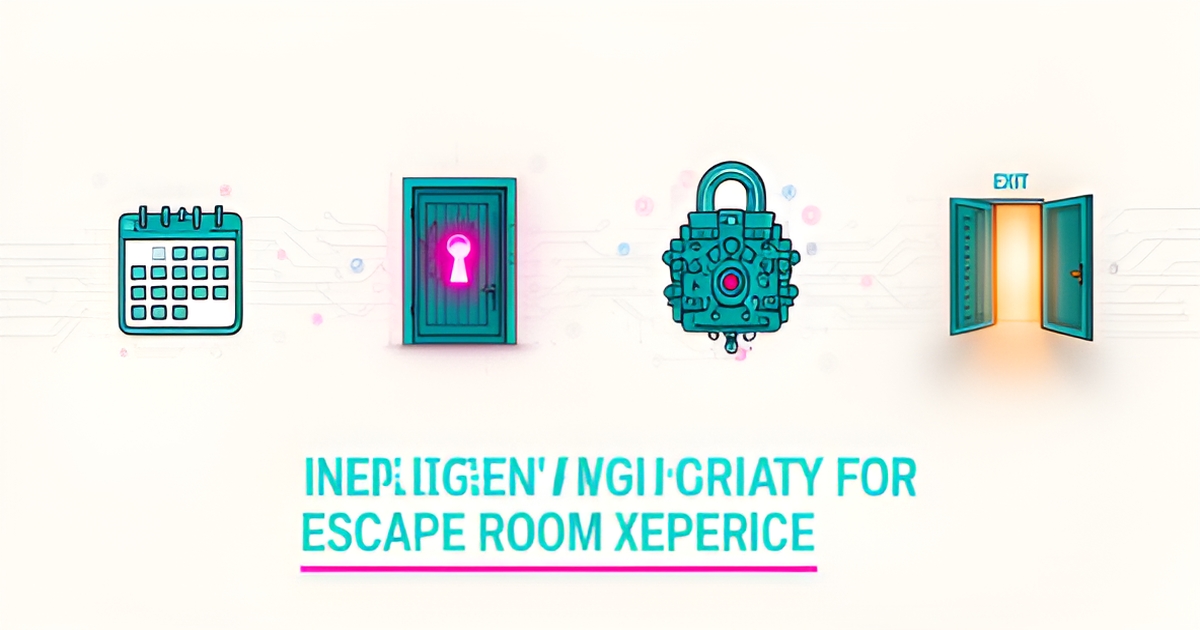
From Booking to Exit: How AI Can Optimize Every Step of the Escape Room Journey
Key Facts
- A randomized trial with 52 undergraduate students found AI-facilitated escape rooms significantly improved AI knowledge and game experience according to the study
- Smart reminders in intelligent booking systems are commonly reported to cut no-show rates substantially—some vendors cite reductions of up to 60% as demonstrated by WorkInSync
- Escape room booking software such as Checkfront has historically started around $99 per month plus a percentage booking fee based on their published rates—confirm current pricing directly before committing
- AI narrative engines can enforce hard caps per interaction on character stats like trust or suspicion, preventing story-breaking jumps per the Escape-the-room-AI-stats-game framework
- Portsmouth Escape Room once promoted an AI-driven team performance report with a 10% discount reward—revealed as an April Fools' prank as stated in their announcement
- Checkfront advertises 20k+ resellers and OTA integrations for channel management per their escape room industry page
Hire a team member that works 24/7 — for less than a part-time wage.
AI receptionists, SDRs, dispatchers and 99+ roles. Trained on your business, fully managed.
Not sure where to start? Ask our AI planner
The Fragmented Journey: Where Escape Rooms Lose Revenue and Efficiency
Most escape rooms run the same leaky funnel. An inquiry comes in by phone at 7pm when nobody's there to answer it. A booking sits in one system, waivers in another, staffing in a spreadsheet, and post-game feedback in an inbox nobody reads. Each handoff is a place where revenue quietly disappears: the missed call that books with a competitor, the no-show that leaves a room dark on a Saturday night, the review that never gets answered.
The pattern is familiar across small service businesses, and it's why AIQ Labs starts most engagements by rebuilding the single workflow that costs the most. For an escape room, that workflow is almost always the booking-to-arrival funnel: inquiry, reservation, confirmation, reminders, waiver, and check-in. Fix that one chain and the downstream problems—no-shows, double-bookings, unanswered leads—shrink on their own. You can see how this works on the Workflow Builds page.
Automating the Funnel: From Conversational Booking to Smart Operations
The first place AI pays for itself is the front desk. A managed AI receptionist answers every call and web chat instantly, checks real-time availability, answers questions about difficulty and group size, and completes the booking—24/7, at roughly 80% less cost than a human hire. These are the kinds of roles AIQ Labs deploys through its AI Employees offering: receptionists, SDRs, dispatchers, and 99+ other roles, delivered as managed AI staff on a flat monthly model.
Once the booking is made, the automation chain continues:
- Smart reminders. Automated SMS and email sequences confirm the booking, send directions and parking info, and nudge guests the day before. Vendors in this space commonly report meaningful no-show reductions—some cite figures as high as 60%—though your results will depend on your audience and cadence.
- Waivers and pre-arrival. Digital waiver links, safety briefings, and room rules go out automatically, so check-in takes two minutes instead of ten.
- Channel management. Booking platforms like Checkfront connect escape rooms to thousands of resellers and OTAs, keeping inventory in sync across every sales channel without manual reconciliation.
The point isn't to remove humans from the operation. It's to remove the repetitive coordination work so your game masters can focus on the show.
The Intelligent Game: Dynamic Narratives and Controlled AI Gameplay
Beyond operations, AI is changing the games themselves. The naive approach—dropping a raw language model into a room—fails quickly: the model hallucinates clues, contradicts the story, or hands players the answer. What works instead is a hybrid architecture. A causal graph or state engine locks the story's critical path, and the AI fills in the gaps: dynamic NPC dialogue, contextual hint delivery, and evaluation of player actions against a predefined set of valid moves.
Open-source frameworks like the Escape-the-room-AI-stats-game project demonstrate the pattern: character stats such as trust or suspicion are capped per interaction so the narrative can flex without breaking. Players get the feeling of infinite choice; the operator keeps a guaranteed story arc and a solvable game.
There's also a cost discipline here worth naming. Multi-agent gameplay is far more token-intensive than a simple chatbot, so teams building this kind of experience typically pair frontier models for key moments with cheaper, self-hosted models for background interactions. Budget for that before you build, not after.
Closing the Loop: Performance Analytics and Continuous Optimization
After the exit photo, most operators know three things: whether the team escaped, roughly how long it took, and whatever the review says. AI closes the rest of the loop. Post-game surveys can be analyzed for sentiment automatically, hint-usage and escape-rate data can be correlated with room, time slot, and team composition, and pricing and staffing can be adjusted based on demand patterns rather than gut feel.
Even the gimmicky ideas have real substance underneath. When Portsmouth Escape Room announced an AI-driven team performance report as an April Fools' prank, the joke worked precisely because the concept is plausible: granular metrics like puzzle contribution, communication under pressure, and hint efficiency are all trackable today. Operators who use that data well can balance room difficulty, coach their game masters, and market to the teams most likely to return.
Implementation Roadmap: Building Your AI-Powered Escape Room Operation
You don't rip out everything at once. A phased rollout looks like this:
- Phase 1 — Front desk. Deploy an AI receptionist to answer calls and chats, capture bookings, and handle reminders. This is the fastest payback and requires no changes to your rooms.
- Phase 2 — The costly workflow. Rebuild the booking-to-arrival chain end to end: booking, waivers, reminders, check-in, and feedback collection, connected in one system.
- Phase 3 — The operating layer. Connect booking, staffing, analytics, and marketing into one AI operating system your business owns outright, so the intelligence compounds instead of living in disconnected SaaS tools.
AIQ Labs structures this work around three ways to pay: Start Monthly for AI Employees, Build in Milestones for a fixed-price workflow rebuild, or Own It Outright for a full operating system built in phases. No fake prices, no invented case-study numbers—just a two-minute Fit Check followed by a free 30-minute strategy call to find the highest-leverage starting point for your venue.
Still paying for 10+ subscriptions that don’t talk to each other?
We build custom AI systems you own outright. No vendor lock-in. Full control.
Not sure where to start? Ask our AI planner
Frequently Asked Questions
How can AI actually improve the booking process for escape rooms beyond just automated reminders?
Will using AI in gameplay make escape rooms feel less authentic or break the story?
Is AI-driven performance tracking in escape rooms just a gimmick, or does it provide real value?
How do AI escape rooms support educational or training goals compared to traditional ones?
What are the main risks or downsides of implementing AI in escape room operations?
Can small escape room businesses afford to implement AI, or is it only for big chains?
The Next Room Awaits
From the first inquiry to the final debrief, AI is turning the escape room playbook from a set of disconnected manual steps into one adaptive, data-rich operation. AI Employees answer every call and book every room 24/7. Workflow builds connect booking, waivers, reminders, and check-in into a single chain that stops revenue leaks. Controlled narrative engines give players genuine agency without sacrificing story integrity, and post-game analytics replace guesswork with signal. AIQ Labs builds exactly this: managed AI Employees, fixed-price Workflow Builds, and full AI Operating Systems you own outright—with 200+ multi-agent systems deployed behind the work. Ready to find the highest-leverage automation in your venue? Take the two-minute Fit Check at aiqlabs.ai/apply, then book a free 30-minute strategy call to map your next move.
Make AI your competitive advantage — not just another tool.
Strategy, implementation and ongoing optimization. One partner, end to end.
Not sure where to start? Ask our AI planner