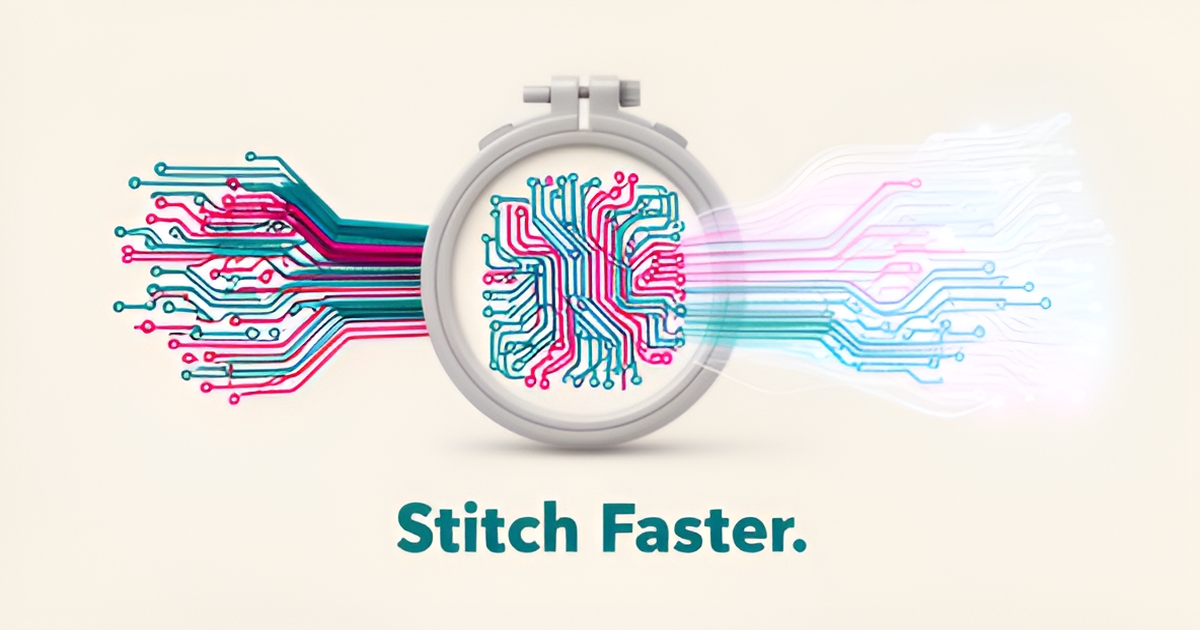
From Design to Delivery: How AI Can Optimize the Embroidery Workflow End-to-End
Key Facts
- AI can compress embroidery digitization from hours to minutes for complex patterns, according to industry research.
- Automation typically delivers faster turnaround and lower labor costs for high-volume shops, according to a developer case study.
- Outsourcing digitizing typically costs $5–10 per design, while AI-assisted in-house conversion removes these recurring fees according to a workflow guide.
- AI-assisted prepress can cut preparation time substantially through automated stitch mapping according to industry analysis.
- AI can detect fabric thickness and texture to auto-adjust stitches for cotton, silk, and denim according to technology research.Well-integrated AI workflows can sharply reduce operational errors in custom production according to automation data.
Hire a team member that works 24/7 — for less than a part-time wage.
AI receptionists, SDRs, dispatchers and 99+ roles. Trained on your business, fully managed.
Not sure where to start? Ask our AI planner
The Digitizing Bottleneck: Why Traditional Workflows Fail
Embroidery shops face a critical bottleneck at the digitizing stage, where skilled labor shortages and manual processes create operational gridlock. Traditional workflows can take hours or days to convert designs into stitch files, with outsourcing costs typically running $5 to $10 per design, according to industry analysis. This slow, expensive process prevents businesses from scaling as demand grows in a multi-billion-dollar global market.
The complexity of manual digitizing overwhelms many users, and intricate patterns are especially slow to produce with conventional tools. As highlighted in recent research, AI-driven vector pattern creation is valued by many users for its ability to accelerate design workflows—yet shops relying on manual methods cannot leverage this advantage. Without automation, even simple design requests become bottlenecks that delay production and increase costs.
- Manual digitizing takes hours for complex patterns that AI can process in minutes
- Outsourcing digitizing typically adds $5–10 per design in recurring costs
- Complex pattern creation is slow and skill-intensive without AI assistance
- The global embroidery market continues to grow, raising the stakes for throughput
- AI can reduce digitization time from hours to minutes for intricate designs
This operational friction forces shops to choose between turning away work, absorbing unpredictable costs, or sacrificing quality to meet deadlines. In AIQ Labs' experience with AI Workflow Builds, eliminating exactly this kind of bottleneck is usually the highest-ROI first move. The digitizing stage, once a gatekeeper of speed and cost, must evolve to keep pace with market growth and customer expectations.
AI-Powered Design and Vector Conversion
The journey from concept to stitched product begins long before the needle touches fabric—it starts with a vision transformed into a machine-readable design. For embroidery businesses, this initial phase has traditionally been the most time-consuming and skill-intensive step, requiring expert digitizers to manually trace artwork and assign stitch properties. Today, AI is reshaping this foundation by enabling rapid generation of embroidery-ready concepts that align with technical constraints from the outset. By leveraging generative AI tools with precise prompt engineering—specifying flat design styles, bold outlines, and a restrained palette of 5–8 colors—businesses can produce vector-compatible artwork in seconds that avoids gradients and excessive detail incompatible with thread translation. This approach directly addresses the "blank canvas" syndrome while ensuring the output is inherently digitizable, significantly reducing the creative-to-technical handoff friction.
Once generated, these AI-created vectors flow into professional embroidery software such as DRAWings PRO or Wilcom Embroidery Studio, where automated conversion transforms clean geometry into optimized stitch data. Unlike legacy workflows demanding manual tracing and stitch-type assignment, these platforms analyze vector paths to intelligently apply satin stitches for narrow columns, step fills for broader areas, and appropriate underlay—all while preserving dynamic scalability. Resizing the design for different products—from a left-chest logo to a full-back jacket design—triggers automatic recalculation of stitch counts and density, maintaining quality across scales without manual rework. This eliminates hours of repetitive preparation, allowing designers to focus on refinement rather than reconstruction. For businesses aiming to streamline their creative pipeline, integrating AI-assisted design with vector-based digitization represents a foundational shift toward end-to-end automation, where speed, consistency, and scalability are built into the first stitch. AIQ Labs supports this transformation by helping embroidery businesses architect custom workflows that connect AI-generated concepts directly to production systems—built in phases, owned outright, with no subscription lock-in.
Automated Digitizing and Production Optimization
Digitizing has long been the bottleneck between a creative concept and a stitch-ready file. AI is removing that friction by turning geometry analysis into automated stitch decisions, so designers spend less time tracing and more time refining.
Auto-conversion tools like Hatch Embroidery and Wilcom Embroidery Studio ingest vector artwork and read shape geometry to assign appropriate stitch types automatically. A vector-based engine can read an AI-generated file and assign Satin for thin columns and Step stitches for large areas, matching construction to form without manual tracing. According to a practical workflow guide, this dynamic system recalculates stitch counts and density when artwork is resized, preserving quality across sizes.
The shift is measurable. Complex patterns that once took hours to digitize can now typically be generated in minutes using AI-powered tools, significantly reducing time and costs. Industry research on AI design tools notes that AI reduces digitization time from hours to minutes for complex patterns, and many users value AI-driven vector pattern creation for intricate and modern designs.
Beyond conversion, AI optimizes production readiness at the file level. AI-assisted digitizing uses algorithms to detect object outlines, assign suitable stitch types, and adjust stitch density, while also optimizing stitch paths for efficient machine operation and adding underlay stitching to stabilize the design. A digitizing specialist overview explains that these steps save time and reduce costs, especially for high-volume workflows.
Production error reduction comes from predictive adjustments. AI algorithms can analyze stitch quality metrics to predict thread tension and optimize stitch sequences, directly reducing production errors and improving finished product consistency. Pattern creation research highlights this predictive quality optimization as a core benefit of AI integration across the workflow.
Fabric awareness further tightens consistency. AI can detect the fabric's thickness, texture, and type, and adjust stitches accordingly to provide smooth and high-quality embroidery. An embroidery technology overview states that this detection enables smooth results across cotton, silk, and denim without manual rework.
For businesses mapping automation end-to-end, these digitizing gains compound with downstream tracking and delivery updates. AIQ Labs approaches embroidery automation as a phased journey from file intake to production monitoring—rebuild the one workflow that costs the most, at a fixed price, and own the result outright—ensuring consistency, speed, and transparency for customers and staff.
Key optimization capabilities now common in AI digitizing include:
- Automatic stitch-type mapping from vector geometry, such as Satin for columns and Step for fills
- Stitch path sequencing and predictive thread tension adjustment based on quality metrics
- Automatic underlay generation and fabric-specific density tuning
As the embroidery market keeps expanding, embracing these tools gives both newcomers and seasoned shops a competitive edge.
End-to-End Integration: From Stitch Files to Delivery
From the moment a design file is received to the final delivery notification, AI can orchestrate every step of the embroidery workflow with precision. Modern systems enable wireless transfer directly to compatible machines like Brother Innov-is and Janome Memory Craft, eliminating manual file handling and reducing setup delays. Orders from platforms such as Shopify or Etsy can sync automatically via API into production queues, enabling real-time prioritization based on deadlines and machine availability.
Once in production, AI-powered monitoring can continuously analyze stitch quality metrics—thread tension, density, and sequencing—to detect anomalies before they become defects. As noted in industry research, this predictive quality control reduces errors by automatically identifying and correcting issues, maintaining consistency across high-volume runs. Simultaneously, AI-assisted digitizing converts artwork into stitch-ready files in minutes rather than hours, removing per-design fees and accelerating throughput.
The business impact is real: shops integrating these workflows typically report faster turnaround and lower manual labor costs, particularly at volume. AI can also optimize resource use by minimizing fabric waste through intelligent nesting and predicting efficient stitch paths. While AI handles repetitive tasks like file conversion, queue management, and basic quality checks, human oversight remains essential for complex artistic designs requiring nuanced stitch direction, texture interpretation, or creative judgment—particularly for specialty items like embroidered shoes or multi-layered logos.
This end-to-end integration creates a transparent, scalable workflow where customers receive automated status updates from design approval to shipment, and staff focus on high-value tasks like client consultation and creative refinement. For businesses seeking to implement such a system, AIQ Labs builds the technical foundation to connect design software, production machinery, and e-commerce platforms into a unified, owned AI operating layer—no subscription dependencies, full control over workflow logic and data. You can start monthly, build in milestones, or own it outright. As embroidery markets keep growing into the late 2020s, this level of automation turns operational efficiency into a sustainable competitive advantage.
Still paying for 10+ subscriptions that don’t talk to each other?
We build custom AI systems you own outright. No vendor lock-in. Full control.
Not sure where to start? Ask our AI planner
Frequently Asked Questions
How much faster is AI digitizing compared to manual digitizing?
What does outsourcing digitizing cost, and can AI help reduce it?
Do designers actually want AI for intricate embroidery work?
What design rules should I follow for AI-generated embroidery artwork?
Can AI automatically choose the right stitch types for a design?
Does AI handle different fabrics and reduce production errors?
Weaving Efficiency into Every Stitch
From initial concept to final delivery, AI is transforming the embroidery workflow by eliminating the digitizing bottleneck that has long constrained growth. As explored, AI-powered design tools accelerate vector creation, automated stitch mapping reduces hours of manual work to minutes, and end-to-end integration enables seamless file transfer, production monitoring, and customer updates. These advancements position shops to scale in a growing market without proportional increases in labor or cost. For embroidery businesses ready to move beyond manual constraints, the path forward begins with identifying where automation delivers the highest impact. AIQ Labs helps small and mid-sized businesses build custom, owned AI systems that connect design, production, and delivery into a unified workflow—whether that starts with a single AI Workflow Build or grows into a full AI Operating System for your business. To explore how this applies to your operations, take the 2-minute Fit Check and then book a free 30-minute strategy call to map your biggest bottleneck. Industry research confirms that AI reduces digitization time from hours to minutes for complex patterns, making now the right time to evaluate your workflow's readiness for automation.
Make AI your competitive advantage — not just another tool.
Strategy, implementation and ongoing optimization. One partner, end to end.
Not sure where to start? Ask our AI planner