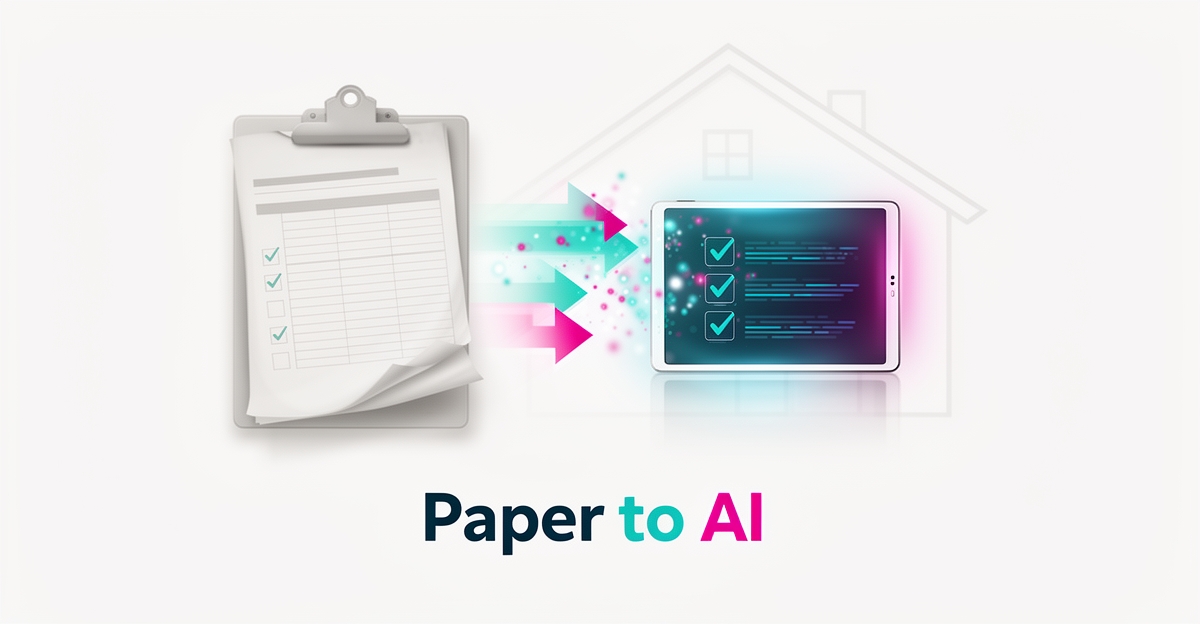
From Manual Forms to AI: Modernizing Pre-Purchase Inspection Documentation
Key Facts
- Manual inspection reports typically take 2-4 hours to write; AI-assisted drafting commonly brings that down to under an hour per report
- For inspectors doing several jobs weekly, that difference often adds up to 10+ hours of paperwork time reclaimed per week
- Manual data entry typically carries an error rate around 1% — roughly 10 errors per 1,000 records in inspection documentation
- Modern intelligent document processing can reach extraction accuracy well above manual entry, often cited near 99% on structured forms
- Hours spent on paperwork represent real opportunity cost: time that could go to additional inspections, marketing, or client follow-up
- AI-assisted reports enable same-day delivery versus the typical 24-48 hour manual turnaround, which supports agent and client referrals
Hire a team member that works 24/7 — for less than a part-time wage.
AI receptionists, SDRs, dispatchers and 99+ roles. Trained on your business, fully managed.
Not sure where to start? Ask our AI planner
The Hidden Costs of Paper-Based Inspection Workflows
Paper-based inspection workflows look cheap until you measure the time they steal. Manual documentation turns inspectors into clerks after the inspection is done, and the cost compounds across every job.
Report writing is the single biggest time drain in an inspector's day. Manual reports typically take 2-4 hours each to complete, compared to under an hour with AI-assisted drafting. For an inspector doing five inspections per week, that is easily 10 or more hours lost to paperwork instead of revenue-generating work.
The drain is not just time. Manual data entry typically carries an error rate around 1%, meaning roughly 10 errors for every 1,000 records. In automotive documentation, that translates to costly delays, payment issues, and compliance risk. Many automotive operations still rely on manual processes for critical quality and documentation tasks, and scattered forms create operational drag and siloed information.
The opportunity cost is the hardest to see on a P&L. For an inspector earning $100,000 per year, spending 15 hours per week on manual reports represents a substantial share of their working time redirected away from billable work, marketing, or simply not working late. Industry benchmarks consistently frame this as lost capacity, not just lost evenings.
Paper workflows also hurt client experience and referrals. Manual reports are typically delivered in 24-48 hours, while AI-assisted reports can be delivered same-day or on-site. Report delivery speed is consistently cited as one of the top factors in real estate agent referrals, behind only thoroughness. Late-night manual reports often skip details and vary in quality depending on when they were written.
The hidden costs accumulate in predictable ways:
- 2-4 hours per report for manual writing versus under an hour assisted
- Roughly 1% manual data entry error rate versus far higher extraction accuracy with AI
- Significant annual opportunity cost for inspectors spending 10-15 hours weekly on paperwork
- Delayed delivery of 24-48 hours versus same-day delivery with digital validation
These frictions are why inspection services are a natural fit for AI document processing and management. AI can digitize, validate, and store inspection reports automatically, reducing errors and improving compliance without replacing inspector judgment. AIQ Labs builds custom document processing systems to replace outdated workflows in the automotive inspection space, turning paperwork from a bottleneck into a background process. For teams that want a single workflow rebuilt first, a phased [Workflow Build](/workflow-builds) is often the right entry point.
The real cost isn't the software. It's the revenue lost by not using it.
How AI Document Processing Transforms Inspection Data
The shift from manual forms to AI-powered documentation begins with understanding how data extraction has evolved. Traditional optical character recognition (OCR) merely converts images of text into machine-readable characters, often failing with handwriting, smudges, or complex layouts common in inspection forms. In contrast, Intelligent Document Processing (IDP) combines OCR with natural language processing (NLP) and machine learning to not only read text but also understand context, classify document types, and extract structured data with high precision. This integrated approach enables systems to interpret inspection reports, repair orders, and warranty forms the way a human would—recognizing that a VIN in a specific field relates to vehicle identification, or that a checked box indicates a passed safety test.
AIQ Labs applies this technology to transform inspection workflows by replacing error-prone manual entry with automated data capture that routinely reaches accuracy well above manual typing. This precision matters because even a 1% manual error rate—ten mistakes per thousand records—can trigger compliance risks, payment delays, or incorrect assessments. By leveraging IDP, inspection businesses eliminate the need for staff to spend hours transcribing handwritten notes or cross-referencing scattered PDFs, freeing them to focus on the physical inspection and client consultation—activities that directly drive revenue and satisfaction.
The technical foundation of modern IDP relies on continuous learning. Unlike static OCR engines that apply fixed rules, machine learning models in IDP systems improve over time as they process more document variations, adapting to new formats, inconsistent handwriting, or industry-specific terminology. This self-optimizing capability ensures that accuracy doesn't just meet initial benchmarks but tends to increase with use, reducing the need for constant reprogramming or template adjustments. For automotive dealerships, repair shops, and mobile inspectors handling diverse document types daily, this adaptability is critical to maintaining throughput without sacrificing data integrity.
Beyond extraction, IDP adds layers of validation and structuring that turn raw data into actionable intelligence. The system doesn't just pull a VIN or odometer reading—it cross-checks it against known formats, flags anomalies (like a 1990s vehicle showing 500,000 miles), and routes the validated data directly into CRM, dealer management, or accounting systems. This end-to-end automation creates a single source of truth, eliminates duplicate entry, and supports real-time reporting. For inspection services drowning in paper trails, the result is faster turnaround, fewer errors, and a scalable workflow that grows with the business—without adding headcount or complicating operations.
The Hybrid Model: AI Efficiency Meets Inspector Expertise
The industry has moved past asking whether AI belongs in inspection workflows. The question now is how to design the handoff between machine speed and human judgment. The most effective systems don't replace the inspector; they remove the administrative ceiling that limits how many inspections a professional can deliver without sacrificing quality.
In this hybrid model, the inspector owns every finding, every safety call, and every nuanced observation that only field experience can produce. AI handles the writing labor: turning rough voice notes and photo sets into structured, grammatically consistent narratives, organizing images into the correct report sections, and applying uniform formatting across every page. This division of labor typically cuts report generation from 2-4 hours down to well under an hour per inspection — a reduction that translates directly into same-day delivery instead of the traditional 24-48 hour wait.
- Inspector conducts the physical assessment and dictates findings on-site
- AI drafts the narrative, categorizes photos, and formats the document
- Inspector reviews, edits, and approves every section before release
- Final report ships same day with zero formatting inconsistencies
The economics are stark. For an inspector completing five jobs a week, manual reporting commonly consumes 10-16 hours that could be redirected toward additional inspections. At a typical inspection fee of several hundred dollars, that represents thousands of dollars in monthly revenue left on the table — and the software investment required to capture it is a fraction of one extra job.
AI does not replace inspector judgment. It polishes the delivery. This principle guides every implementation we design at AIQ Labs, where custom document processing systems are built to slot into existing workflows rather than force inspectors into rigid new paradigms. The result is a process that scales with the professional, not against them.
Calculating the ROI of Automated Inspection Documentation
The financial impact of moving from manual to AI-powered inspection documentation is substantial and measurable. For an inspector conducting five inspections weekly, switching to AI-assisted report writing typically saves 10-16 hours per week by cutting report generation time from 2-4 hours down to under an hour. This time savings directly translates into increased capacity, enabling inspectors to take on additional inspections each week.
At typical inspection fees, even two or three extra jobs per week compounds into tens of thousands of dollars in additional annual revenue. Because modern AI tools and custom systems cost far less than the value of a single reclaimed job, the return on investment is usually realized within the first month. The true cost of manual documentation isn't software fees—it's the lost opportunity from hours spent on repetitive writing instead of revenue-generating field work.
- Eliminate 10-16 hours of weekly report writing time
- Gain capacity for additional inspections per week
- Recover tens of thousands in annual revenue potential
- Recoup software investment with a single extra job
- Reduce time-to-report from 24-48 hours to same-day delivery
For inspection businesses looking to modernize, AIQ Labs offers custom document processing systems that automate data capture, validation, and storage—turning administrative burden into scalable growth. By replacing paper-based workflows with intelligent automation, companies not only save time but also improve accuracy, accelerate client delivery, and unlock new revenue potential without adding headcount. The shift isn't just about efficiency—it's about capturing the value that manual processes leave on the table.
Implementing AI Document Processing in Your Inspection Business
The gap between knowing AI works and actually implementing it stops many inspection businesses cold. The good news: transitioning from paper forms to intelligent document processing follows a clear, manageable path.
Start with a single workflow rather than overhauling everything at once. Most businesses begin with their highest-volume document type—repair orders, intake forms, or inspection reports—and expand from there. This phased approach mirrors what works across automotive operations, where AI document processing integrates with existing Dealer Management Systems and ERPs to extract, classify, and validate data without disrupting daily operations.
Integration with your current management software is the critical piece. Modern Intelligent Document Processing combines OCR, natural language processing, and machine learning to handle handwritten forms, varied layouts, and complex tables—capabilities that traditional OCR simply cannot match. The system should push validated data directly into your scheduling, invoicing, and CRM tools, eliminating the manual re-entry that introduces errors. Given that manual data entry typically carries an error rate around 1%—roughly 10 errors per 1,000 records—even modest automation delivers immediate accuracy gains.
Compliance requirements demand equal attention. Your system needs complete audit trails, traceable records, and human-in-the-loop controls for critical decisions. The hybrid model works best here: AI handles extraction and formatting while your inspectors review every output before it reaches clients. This preserves the professional judgment that defines your service while capturing the efficiency gains.
When evaluating solutions, consider how they scale to your specific workflows:
- Does the system adapt to your form templates, or force you into rigid structures?
- Can it learn from your historical documents to improve accuracy over time?
- Does it support same-day report delivery, which consistently drives referral business?
- Who owns the system and data when the engagement ends?
Custom-built solutions address these questions differently than off-the-shelf software. AIQ Labs builds document processing systems that inspection businesses own outright—no vendor lock-in, complete control over customization, and architecture designed around your existing workflows rather than forcing you to adapt to someone else's assumptions. With a Build in Milestones approach, you approve each phase as it ships and keep everything built so far. If you'd rather have managed capacity than another system to run, [AI Employees](/ai-employees) can handle intake, scheduling, and follow-up around your inspection workflow.
The financial case strengthens with scale. While a basic AI tool can pay for itself with one additional inspection, custom systems deliver compounding returns as they absorb more document types and workflows. Businesses processing high volumes see the largest gains—reclaiming the significant share of employee time typically lost to manual data entry and redirecting it toward revenue-generating work. For businesses ready to connect inspection data, scheduling, invoicing, and reporting into one layer, an [AI Operating System](/ai-operating-systems) approach ties it together in phases you own outright.
Implementation timelines vary by complexity, but meaningful results typically arrive in weeks, not months. The key is starting with clear success metrics: time saved per report, error rates, delivery speed, and capacity for additional inspections.
Still paying for 10+ subscriptions that don’t talk to each other?
We build custom AI systems you own outright. No vendor lock-in. Full control.
Not sure where to start? Ask our AI planner
Frequently Asked Questions
How much time can AI-assisted reporting actually save me per inspection?
Will using AI to write reports replace my professional judgment or make me liable for errors?
What is the real ROI of switching from manual to AI-assisted inspection reports?
How accurate is AI data extraction compared to manual entry for automotive inspection documents?
Can AI document processing handle my messy, handwritten inspection forms and varied layouts?
How do I implement AI document processing without disrupting my current workflow or getting locked into a vendor?
Turn Paperwork Into Profit, Not a Bottleneck
Paper-based pre-purchase inspection workflows quietly drain revenue through lost hours, errors, and slow delivery. Manual reports consume 2-4 hours each, carry a roughly 1% error rate, and push delivery to 24-48 hours, while AI-assisted documentation cuts writing to under an hour and enables same-day delivery with far higher extraction accuracy. The winning approach is hybrid: inspectors keep full control of findings and safety calls while AI handles drafting, photo organization, and formatting, freeing 10-16 hours per week for more inspections and better client experience. The real cost isn't software, it's the inspections you're not able to take. If you're ready to map your highest-volume workflow and see where automation fits, start with a focused assessment rather than a full overhaul. Start the 2-minute Fit Check at aiqlabs.ai/apply for a free 30-minute strategy call with AIQ Labs to identify high-ROI automation opportunities for your inspection business — and we'll be direct if there isn't a clear win. Questions first? Reach us at [email protected].
Make AI your competitive advantage — not just another tool.
Strategy, implementation and ongoing optimization. One partner, end to end.
Not sure where to start? Ask our AI planner