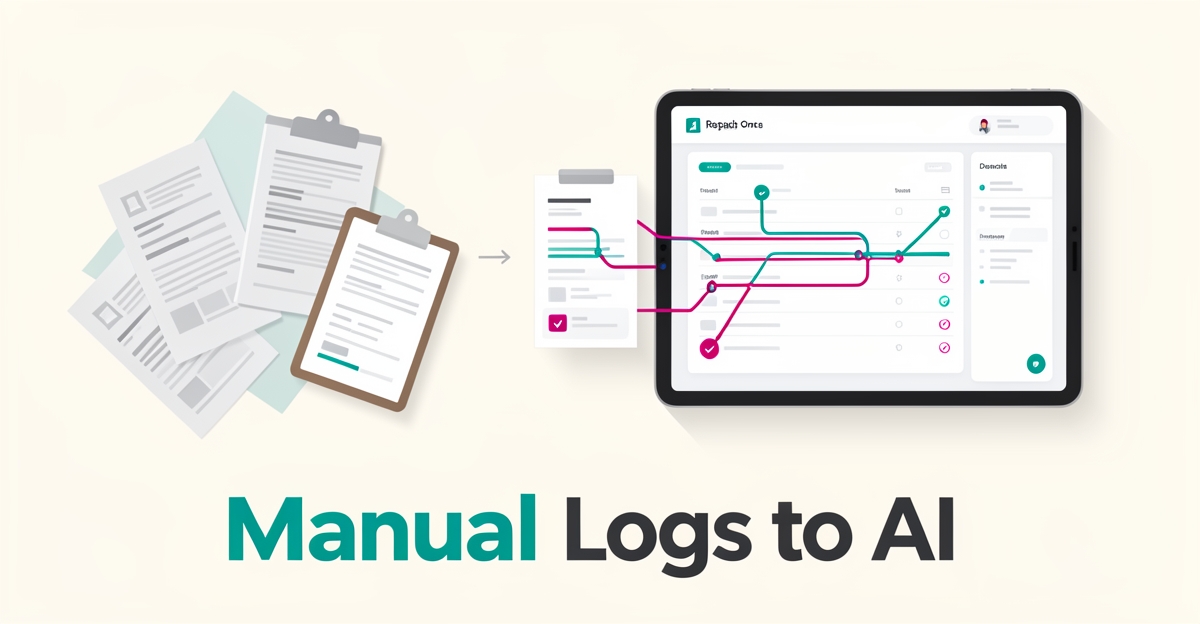
# From Manual Logs to AI: How Appliance Repair Companies Can Automate Repair Work Orders
**Quick Answer:** Manual work orders leave a meaningful share of job slots unfilled every day. AI automation tackles intake, dispatch, routing, and invoicing automatically—so jobs get completed faster and invoices go out the moment work closes.
## Key Facts
- Manual scheduling typically runs well below full capacity, leaving job slots unfilled due to coordination delays and scheduling conflicts.
- Dispatchers commonly spend 2-3 hours a day on routing decisions that automated systems handle in minutes.
- Repair companies that automate dispatch and invoicing generally see more daily job completions within the first quarter.
- Automated invoicing shortens payment cycles—often by two to three days—because invoices go out the moment a job closes.
- AIQ Labs' payment models are straightforward: Start Monthly, Build in Milestones, or Own It Outright. No invented case-study numbers.
- Consistent, proactive communication tends to improve customer retention and referral flow.
## Table of Contents
- [The Hidden Cost of Manual Work Orders](#the-hidden-cost-of-manual-work-orders)
- [Why Basic Software Isn't Enough Anymore](#why-basic-software-isnt-enough-anymore)
- [The AI Work Order Workflow: From Request to Invoice](#the-ai-work-order-workflow-from-request-to-invoice)
- [Implementation Reality: Timeline, Costs, and Change Management](#implementation-reality-timeline-costs-and-change-management)
- [Your First 90 Days: A Phased Migration Plan](#your-first-90-days-a-phased-migration-plan)
## The Hidden Cost of Manual Work Orders
Most appliance repair companies don't realize how much money walks out the door every time a dispatcher picks up the phone to coordinate a schedule. Paper calendars, whiteboard assignments, and spreadsheet tracking create a silent drain that compounds with every missed appointment and delayed invoice.
Manual scheduling typically runs well below full capacity, with a meaningful share of potential job slots left unfilled due to coordination delays and scheduling conflicts. For a company doing $2 million a year, even a 10% gap in daily capacity is real money—hundreds of thousands in revenue you're already paying trucks, technicians, and insurance to earn but never collecting. The problem extends beyond scheduling: inconsistent service quality erodes referral networks and online reputation, which raises what you pay to acquire each new customer.
The operational toll shows up in ways that don't hit the balance sheet until it's too late:
- Dispatchers spend 2-3 hours daily on routing decisions that automated systems resolve in minutes
- Technicians wait for assignments while office staff manually prepare invoices
- Payment cycles stretch days longer than necessary because invoices go out late
- Customer follow-up falls through the cracks without automated reminders
These inefficiencies create a ceiling that no amount of hustle can break through. AIQ Labs works with repair operations that have hit this wall—where adding another truck or technician only amplifies the chaos rather than growing revenue. The pattern is consistent: businesses operating at scale with manual processes aren't just leaving money on the table; they're actively subsidizing their competitors' efficiency with every job they can't fit into the day.
The math becomes unavoidable when you add up a dedicated dispatcher's salary, technician downtime, and administrative overhead for a mid-sized operation. Those numbers don't account for the customer lifetime value lost when a homeowner waits four hours for a callback that never comes.
## Why Basic Software Isn't Enough Anymore
Traditional field service apps like ServiceTitan, Housecall Pro, and Jobber digitize basic tasks but still leave dispatchers spending hours a day on routing decisions that AI systems can handle in minutes. These platforms support your current manual workflows rather than transforming them—creating a gap between digitization and true operational intelligence.
AI systems automate complex dispatching by analyzing technician skills, location, traffic patterns, and job complexity to make optimal assignments automatically. This shifts the dispatcher's role from manual coordination to exception handling, freeing significant time for higher-value work like customer relationships and strategic planning.
Within the first quarter of implementation, companies typically see more daily job completions as the AI optimizes schedules and reduces idle time between appointments. Automated invoicing further accelerates cash flow: invoices are generated and delivered in real time when a job closes, eliminating delays from manual data entry and approval routing.
- AI systems cut dispatcher routing time from hours a day to minutes
- Companies generally complete more jobs per day within 90 days of implementation
- Invoice processing time drops because there's no manual data entry step
This progression from basic software to AI-powered decision-making is the difference between simply recording work orders and intelligently orchestrating the entire service delivery process. For appliance repair companies ready to move beyond digitization, [AIQ Labs' AI Operating Systems](/ai-operating-systems) build one connected operating layer—owned
AI Employees
Hire a team member that works 24/7 — for less than a part-time wage.
AI receptionists, SDRs, dispatchers and 99+ roles. Trained on your business, fully managed.
See If You’re a Fit — AI Employees from $700/mo
Not sure where to start? Ask our AI planner
outright—that turns dispatch from a time-consuming chore into a competitive advantage.
## The AI Work Order Workflow: From Request to Invoice
The work order that starts as a phone call ends as a paid invoice, and every manual hand-off in between leaks time, revenue, and trust. An AI-powered workflow collapses those hand-offs into one owned system that captures, routes, executes, and closes the job without paper or spreadsheets.
AI captures service requests the moment they arrive. Voice agents handle inbound calls, chat and email intake parses problem descriptions and equipment details, and the request is structured into a work order automatically. That eliminates the hours dispatchers spend daily on routing decisions that AI systems can handle in minutes. If you want to see what an AI receptionist or dispatcher actually sounds like in practice, [AIQ Labs' AI Employees](/ai-employees) cover 99+ roles—including dispatch—at roughly 80% less cost than a human hire.
Matching and routing happen in real time. The system evaluates technician skills, certifications, current location, and workload against job complexity and customer preferences. Dynamic route optimization reduces drive time and fuel cost while increasing completions. For appliance repair, that means more jobs per day without adding headcount.
In the field, the technician receives a complete, mobile work order with customer history, parts needed, and prior notes. Job status updates flow back to the office automatically, so managers have real-time visibility instead of chasing calls. On completion, the system generates the invoice instantly and triggers payment options.
The end-to-end flow replaces manual handoffs with:
- AI intake via phone, chat, or email that creates structured work orders from unstructured requests
- Real-time technician matching by skill, location, and workload with dynamic route optimization
- Automated customer communications for confirmations, ETAs, and arrival notifications
- Instant invoice generation on job close and automated follow-up for payment and reviews
Cash flow improves as a direct result. Automated invoicing shortens payment cycles—often by two to three days—because the invoice exists the moment the job closes, not the next business day. Proactive follow-up also lifts retention: consistent communication and fewer missed appointments tend to keep customers coming back.
This is the kind of workflow AIQ Labs builds. If dispatch is the single workflow costing you the most, a fixed-price [AI Workflow Build](/workflow-builds) rebuilds just that piece, in phases, without asking you to replace everything at once.
## Implementation Reality: Timeline, Costs, and Change Management
The spreadsheet on the wall stops working the moment you grow. Moving from manual logs to an AI-powered work order system is a real operational change, not just a software install.
A comprehensive implementation typically spans a few months for full deployment. The first weeks are discovery and data integration, then custom build and integration with dispatch, routing, and invoicing tools, followed by training and go-live. Performance often dips briefly as teams adapt to automated workflows.
Budget planning needs to be honest up front. AIQ Labs doesn't publish fake prices or invented case-study numbers. Instead, there are three clear payment models: **Start Monthly** for a low-commitment start, **Build in Milestones** for a fixed-price phased build, and **Own It Outright** if you want to own the system with no ongoing subscription. You can see the full breakdown on the [pricing page](/pricing). For appliance repair firms handling 20+ jobs daily, the cost is offset by more daily job completions and faster payment cycles—but you should verify that against your own numbers, not a vendor's benchmark.
Proficiency takes longer than a software login. While a competent dispatcher can become effective on manual processes in 2-4 weeks, real fluency with an AI system typically takes 2-3 months of learning and optimization. That curve matters for companies with seasonal staffing or high turnover, and it should be built into rollout plans and KPI expectations.
The human and data hurdles tend to be the most underestimated. Even with a strong technical build, adoption stalls without deliberate change management.
Common implementation hurdles include:
- Data cleanup: AI systems need clean, consistent customer, technician, and service history records; incomplete records add weeks before optimal performance
- Dispatcher resistance: experienced dispatchers may resist automation of expertise built around territory intuition and manual routing
- Technician adoption: new mobile interfaces and automated assignments require hands-on training and feedback loops during the first 2-3 months
Change management is critical because manual scheduling leaves significant capacity unfilled. Leaders who plan for temporary productivity dips, role redefinition, and clear success metrics see smoother transitions.
AIQ Labs approaches this as a production system build, not a point solution. The work involves mapping existing paper or spreadsheet workflows, loading and cleaning historical data, and deploying custom AI agents that handle dispatch, routing, and follow-up in real time. The goal is a system the business o
AI Development
Still paying for 10+ subscriptions that don’t talk to each other?
We build custom AI systems you own outright. No vendor lock-in. Full control.
See If You’re a Fit — AI Employees from $700/mo
Not sure where to start? Ask our AI planner
wns and can evolve.
Set expectations early, resource the training window, and treat the first quarter as a learning phase. With realistic timelines and honest resourcing, the move from manual logs to AI becomes a sustainable competitive advantage rather than a disruptive experiment.
## Your First 90 Days: A Phased Migration Plan
Manual logs and spreadsheets quietly cap growth long before a repair company feels the pain. A phased 90-day migration turns that risk into measurable lift by building on existing workflows instead of replacing them overnight.
Start with a clear audit of current workflows. Map how service requests arrive, how dispatchers assign jobs, and where invoices stall. Companies that skip this step often migrate messy data and inherit the same bottlenecks. Documenting the real process creates the baseline for improvement.
Clean migration comes next. Load customer records and service history into the new system before any automation runs. Clean data lets AI dispatch make reliable assignments from day one.
Pilot AI dispatch on a single crew. Limit scope to one team, one territory, and one workflow—intake to invoice for that crew only. A tight pilot proves the system on real jobs before you bet the whole schedule on it.
Train the crew on scheduling and mobile app usage. Teams change rapidly when they witness improvements in their own daily operations. Focus on job acceptance, real-time updates, and mobile completion.
Measure the two metrics that matter first: job-completion lift and invoice speed. Track them daily during the pilot rather than waiting for a quarterly review.
Use the pilot results to expand. Review dispatcher time saved, missed appointment reduction, and technician utilization before rolling out to additional crews.
A practical 90-day sequence looks like this:
- Days 1-14: Audit workflows and export clean customer and service history
- Days 15-30: Migrate data, configure dispatch rules, and train pilot crew
- Days 31-60: Run AI dispatch pilot, monitor job completion and invoice speed daily
- Days 61-90: Review lift, refine rules, and plan phased rollout across teams
Manual scheduling typically runs well below full capacity, leaving significant job capacity unfilled. **AI systems automate dispatching, routing, and customer follow-up in minutes versus hours.** For repair operations moving from paper to AI, that efficiency gain is the foundation for scalable growth.
AIQ Labs supports this transition with production-ready systems that capture service requests, assign technicians, and generate invoices in real time—built in phases and owned by you.
## Frequently Asked Questions
**How much revenue are appliance repair companies losing with manual scheduling?**
It depends on your capacity gap, but the math is simple: take your daily job capacity, multiply by the slots that go unfilled from coordination delays and scheduling conflicts, and multiply by average ticket value. For a $2M-revenue company, even a 10% daily capacity gap compounds to serious money over a year.
**How long does it take to see improvements in daily job completions after implementing an AI system?**
Most companies see measurable lift within the first quarter as automated dispatching and routing reduce idle time between appointments. Your pilot crew's numbers in the first 60 days are the best predictor.
**What is the typical timeline for full deployment of an AI-powered work order system?**
A comprehensive implementation typically spans a few months, including discovery, data integration, custom build, training, and go-live phases. A single-workflow pilot can move much faster.
**How much time do dispatchers save each day when switching from manual routing to AI-powered dispatching?**
AI systems typically reduce dispatcher routing time from 2-3 hours daily to minutes by automating assignments based on technician skills, location, traffic patterns, and job complexity.
**What does an AI work order system cost?**
AIQ Labs offers three payment models: Start Monthly, Build in Milestones (fixed price, phased), and Own It Outright. No fake prices or invented case-study numbers—see the [pricing page](/pricing) for details.
**How does AI implementation affect customer retention in appliance repair businesses?**
Consistent service and proactive communication—automated confirmations, ETAs, and follow-ups—tend to improve retention by reducing missed appointments and keeping customers informed.
## Turn Your Dispatch Chaos into Your Competitive Edge
Appliance repair companies stuck with manual work orders leak revenue through inefficient scheduling, delayed invoicing, and missed job opportunities. AI-powered automation collapses those manual handoffs into a single intelligent workflow that optimizes dispatch, sends invoices the moment a job closes, and gets more jobs done per day without adding headcount. The result isn't just efficiency—it's reclaiming capacity you already pay for but aren't using. If you're ready to stop subsidizing your competitors' efficiency and start owning a system that scales with your growth, the first step is understanding where your biggest bottleneck lives. Start the [Fit Check](/apply)—a two-minute, no-obligation look at your highest-ROI automation opportunity—then book a free 30-minute strategy call to map your path forward.
AI Transformation Partner
Make AI your competitive advantage — not just another tool.
Strategy, implementation and ongoing optimization. One partner, end to end.
See If You’re a Fit — AI Employees from $700/mo
Not sure where to start? Ask our AI planner