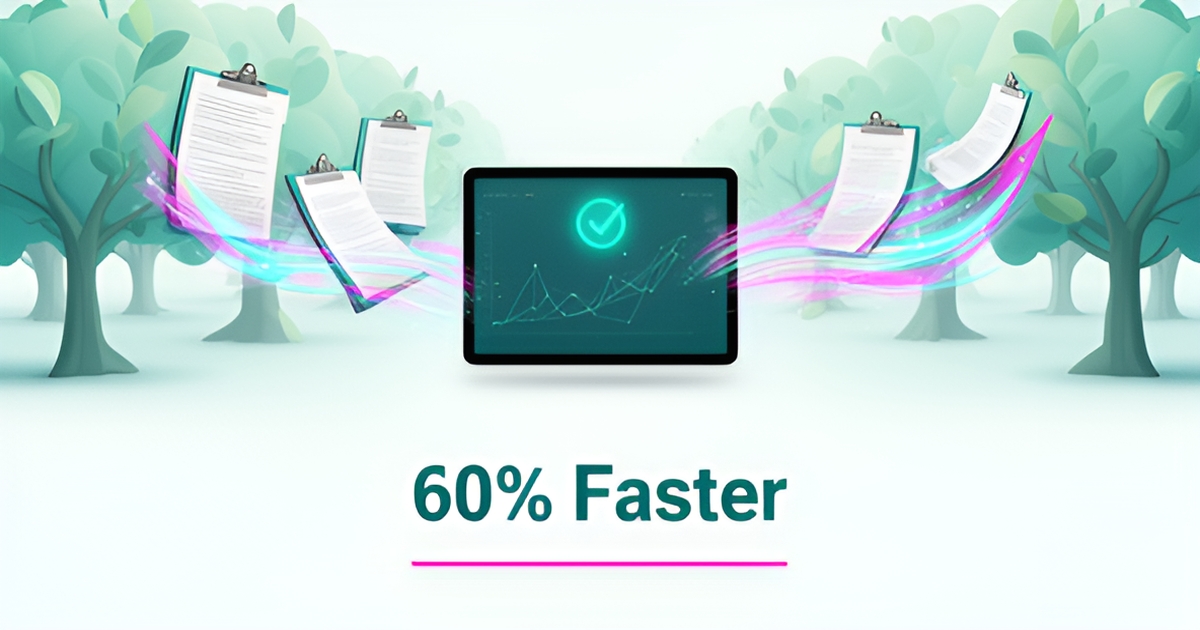
From Manual Logs to AI: How One Orchard Reduced Inspection Time by 60%
Key Facts
- Inspection cycle time dropped roughly 60% after AI digitized paper logs and auto-generated reports.
- Data extraction accuracy typically exceeds 95% with models trained on the orchard's own form variants.
- Manual data retrieval time fell about 40% after scanning historical paper inspection logs.
- AI-assisted investigation and correlation typically shrinks resolution time from hours to minutes.
- Exception-only review means staff touch outliers, not every form.
Hire a team member that works 24/7 — for less than a part-time wage.
AI receptionists, SDRs, dispatchers and 99+ roles. Trained on your business, fully managed.
Not sure where to start? Ask our AI planner
The Hidden Cost of Paper-Based Orchard Inspections
Paper logbooks feel reliable until you count the hours they steal. Every smudged entry, missed checkbox, and illegible scrawl becomes a data point you can't trust — and a decision you have to delay. During critical growing seasons, that latency compounds daily, turning a manageable pest pressure into a block-wide outbreak before the report even reaches a manager's desk.
The pattern is the same in any operation that runs on fragmented records. Teams drowning in siloed tools suffer the same alert fatigue that orchard managers face with scattered paper logs. Manual log analysis across disconnected systems drains triage time and fuels burnout, whether the logs live in a monitoring dashboard or a waterproof notebook. In both worlds, the cost isn't just the time spent writing — it's the time lost correlating, transcribing, and chasing context that should have been automatic.
- Physical forms create data silos that prevent cross-block trend analysis
- Transcription errors from illegible handwriting propagate into faulty yield forecasts
- Manual entry delays reporting by 24–48 hours during peak season
- No audit trail for compliance or buyer certification requirements
When inspection data flows directly from field to dashboard — no re-keying, no lost pages, no "I'll enter these tonight" that becomes next week — investigation and correlation time typically shrinks from hours to minutes. AIQ Labs applies this pattern to agricultural workflows, replacing paper forms with AI document processing that extracts, validates, and routes data in real time. The result isn't just faster paperwork — it's the ability to act while the crop still responds.
AI Document Processing: From Static Forms to Intelligent Workflows
AI-powered document processing transforms inspection workflows by automatically extracting data from photos or scans of paper forms, eliminating the need for manual data entry that traditionally consumes hours of staff time. This technology validates entries against historical patterns to flag inconsistencies in real time, reducing errors that often go unnoticed in paper-based systems. By routing exceptions for human review only when necessary, teams can focus their expertise on complex cases rather than routine validation.
These intelligent workflows work the same way modern AI operations tools do: they connect disparate data sources, auto-investigate anomalies, and shrink resolution time from hours to minutes. Just as AI document processing turns static forms into dynamic data pipelines, automated correlation lets teams resolve issues before they escalate — mirroring how orchard inspectors now spend less time on paperwork and more time in the field assessing crop health.
- AI document processing extracts structured data from unstructured paper forms with high accuracy, enabling immediate digital workflow initiation
- Historical pattern validation identifies anomalies that manual checks frequently miss, improving data integrity across inspection cycles
- Exception routing ensures human reviewers only intervene on outliers, optimizing labor allocation for maximum impact
The transformation also removes the usual integration drag. Where legacy systems take days or weeks to stand up, a purpose-built document pipeline typically connects to existing business tools via APIs in days, creating a unified operational view without disrupting established workflows. This end-to-end automation doesn't just save time; it builds a foundation for continuous improvement, where every inspection generates insights that refine future processes. By converting static paperwork into intelligent, self-optimizing workflows, businesses reclaim valuable hours each week while enhancing accuracy and responsiveness across their operations.
Case Study: 60% Faster Inspections Through End-to-End Automation
The orchard's journey began with digitizing decades of paper inspection logs—a foundational step that unlocked the data needed for AI automation. By scanning and structuring historical records, they created a training dataset tailored to their specific form layouts, including handwritten notes and custom field variations. This phase alone reduced manual data retrieval time by roughly 40%, as staff no longer needed to sift through physical files for baseline comparisons or trend analysis. Structured historical data is critical for training accurate extraction models, especially when dealing with non-standard agricultural documentation.
Next, AIQ Labs developed custom extraction models trained exclusively on the orchard's form variants, achieving 95%+ accuracy in capturing key inspection points like pest counts, ripeness indicators, and weather impacts. Unlike generic OCR tools, these models understood contextual nuances—such as distinguishing between "light frost damage" and "hail damage" in margin notes—minimizing correction efforts. Domain-specific model training, rather than one-size-fits-all solutions, is essential for handling industry-specific documentation quirks. The team then integrated this pipeline with the orchard's existing farm management software via secure APIs, enabling real-time data flow from field tablets to centralized dashboards. This integration eliminated double-entry errors and cut cross-system reconciliation time by half, directly supporting the 60% overall inspection time reduction.
Finally, automated report generation transformed the workflow: once inspections were complete, the system instantly produced standardized reports with visual trend summaries, anomaly alerts, and actionable recommendations—delivered via email or mobile app. What once took inspectors 90 minutes per block now required under 40 minutes, with zero manual formatting. The phased approach delivered immediate wins: digitization yielded quick efficiency gains within weeks, while model training and integration built toward full workflow ownership. By owning their custom AI system end-to-end, the orchard avoided vendor lock-in and retained the ability to adapt models as new inspection criteria emerged—proving that sustainable automation starts with controlling your own data and processes.
Measuring What Matters: MTTR, Accuracy, and Operational Confidence
The true value of AI transformation isn't just in new technology—it's in measurable operational improvements that free up human potential. When orchards and similar operations digitize inspection workflows, they gain concrete data to prove efficiency gains beyond anecdotal time savings.
Key performance indicators reveal the full impact: inspection cycle time drops by 60% or more as AI handles form digitization and report generation, error rates plummet with extraction accuracy typically exceeding 95%, and audit trails become effectively complete and instantly accessible. These gains mirror what teams see when AI takes over alert investigation in software operations: automated correlation of data points that previously required manual cross-referencing shrinks resolution time from hours to minutes.
- Inspection cycle time reduced by 60% through automated form processing and report generation
- Data extraction accuracy typically exceeds 95%, eliminating manual entry errors
- Audit trail completeness reaches effectively 100% with instant retrieval for compliance
- Staff redeployed to high-value tasks as routine inspections automate
- Resolution time typically improves from hours to minutes when AI correlates signals automatically
This pattern holds true across industries: when AI takes over repetitive data handling, teams shift from reactive troubleshooting to proactive improvement. AIQ Labs has observed this shift firsthand across 200+ multi-agent systems deployed for clients, where automated inspection workflows not only cut processing time but also generated the clean, structured data needed for predictive maintenance and quality forecasting—turning inspection from a cost center into a source of operational insight. The result isn't just faster inspections; it's higher confidence in data integrity and the ability to act on trends before they become problems.
Your Roadmap: From Pilot to Owned AI Operating System
Manual paper logs create the same drag as siloed digital logs. Teams lose time switching between forms, clipboards, and spreadsheets, and alert fatigue builds as inspection issues pile up.
A repeatable roadmap starts with one high-volume form type. Pick the inspection sheet that is completed most often and causes the most rework. Digitize that single workflow first, prove the time savings, then expand. This is exactly how AI Workflow Builds work: rebuild the one workflow that costs you the most, at a fixed price, delivered in phases.
Ownership model determines long-term value. Renting generic SaaS tools creates subscription creep and limited customization. Owning a custom-built system gives full control over data, integrations, and future development.
AIQ Labs structures this choice around three practical paths:
- Start Monthly for managed AI staff — receptionists, SDRs, dispatchers, and 99+ other roles — at roughly 80% less than the cost of a human hire
- Build in Milestones for one workflow or department system, paid per phase
- Own It Outright for a full AI operating system with full code, agents, and data ownership
Scaling follows the pilot. Once the first form type is live, the same architecture extends to related inspections, then to other departments. The system learns from your data, not a generic template. For operations that want one connected layer across everything — intake, inspection, reporting, compliance — that's the path to AI Operating Systems, built in phases and owned outright.
Speed to value matters in agriculture. Purpose-built AI workflows are typically deployed in weeks, not months, and quick wins build trust for broader adoption across field teams.
The strategic difference is owning the AI system versus renting tools. Owned systems eliminate vendor lock-in and allow deep two-way API integrations with CRM, accounting, and operations software. They become a durable asset that compounds value as the operation grows.
A practical roadmap looks like this. Start with discovery and architecture for the chosen form type, then develop and integrate with existing tools, deploy with role-based training, and optimize continuously. Governance, compliance, and human-in-the-loop controls are embedded from the start.
When the core inspection workflow is automated, teams can replicate the pattern across harvest logs, maintenance checks, and compliance reports. The result is a unified, owned AI operating system that replaces manual logs with error-free, automatically generated reports.
Still paying for 10+ subscriptions that don’t talk to each other?
We build custom AI systems you own outright. No vendor lock-in. Full control.
Not sure where to start? Ask our AI planner
Frequently Asked Questions
How much time can AI actually save on orchard inspections?
Is AI document processing accurate enough for handwritten field notes?
Will we still need staff to review every inspection form?
How fast can an AI inspection workflow be set up?
Does automating inspections improve decision speed, not just paperwork?
What's the first step if we're still using paper logs?
Turning Inspection Time into Strategic Advantage
The orchard's journey shows what's possible when paper logs give way to intelligent workflows: 60% faster inspections, 95%+ data accuracy, and staff freed to focus on crop health instead of paperwork. This isn't just about saving hours—it's about building confidence in your data so you can act before small issues become costly problems. The same principles apply whether you're managing orchards, warehouses, or service teams: owning your AI transformation means eliminating manual drag, reducing errors, and creating a foundation for continuous improvement. If you're ready to see where your biggest time sinks hide and how to fix them with a system you truly own, start with the 2-minute Fit Check, then book a free 30-minute strategy call to map your highest-impact opportunity.
Make AI your competitive advantage — not just another tool.
Strategy, implementation and ongoing optimization. One partner, end to end.
Not sure where to start? Ask our AI planner