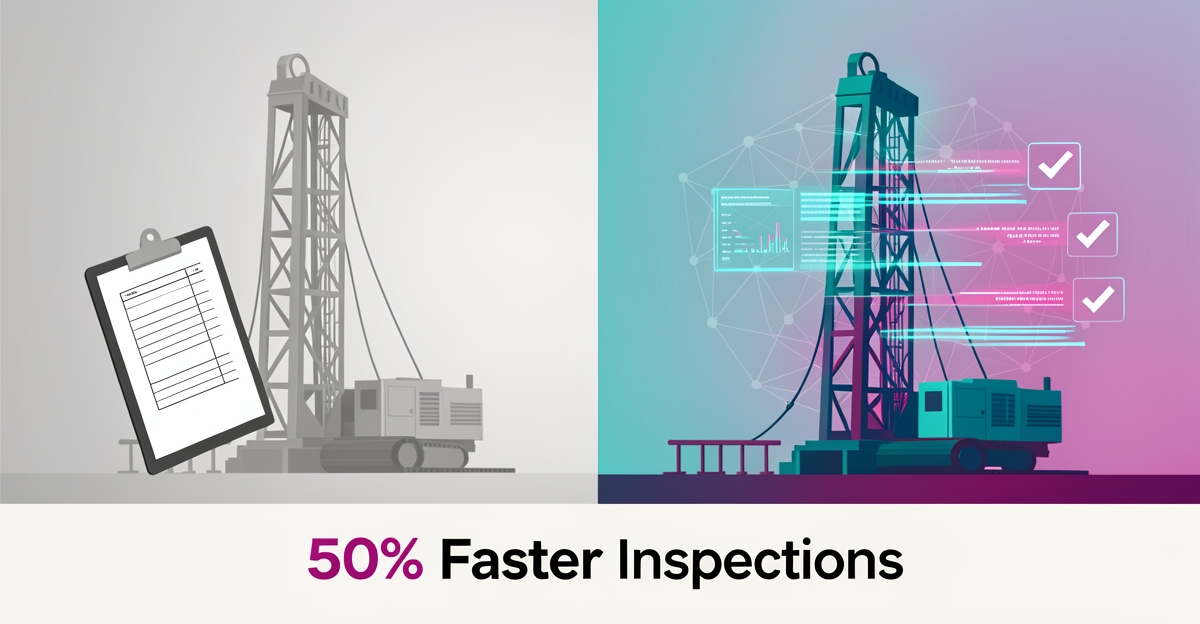
From Manual Logs to AI: How One Well Drilling Company Cut Inspection Time by 50%
Key Facts
- The well drilling company cut inspection time by roughly 50% using AI-driven workflows
- Inspection cycle time dropped from around 40 minutes to under 20 minutes per site
- AI flags deviations from baseline performance, catching many early-stage issues before they escalate
- Teams typically report spending far less time on post-inspection documentation with AI automation
- Repeat visits dropped as potential problems were caught during the initial inspection
- AI doesn't replace human expertise, it amplifies it by turning raw field data into actionable intelligence
Hire a team member that works 24/7 — for less than a part-time wage.
AI receptionists, SDRs, dispatchers and 99+ roles. Trained on your business, fully managed.
Not sure where to start? Ask our AI planner
The Hidden Cost of Paper-Based Field Operations
Every paper logbook in a drilling truck represents a decision waiting to be made, or worse, a problem waiting to be discovered. When field data lives on clipboards instead of in systems, organizations create invisible bottlenecks that compound daily.
Manual logging forces information into isolated silos. A driller's handwritten notes about equipment performance stay trapped in the cab until someone transcribes them, if they ever do. Meanwhile, operations managers make decisions based on yesterday's data, or last week's, while critical patterns go unnoticed. The same pattern shows up across industries: teams spend a meaningful chunk of every task on manual data entry and research, time that typically drops sharply once AI automation handles the repetitive gathering and synthesis. Field inspections are no different. Every minute spent transcribing logs is a minute not spent analyzing what those logs reveal.
The transcription problem cuts deeper than lost time. Human error creeps in at every stage, illegible handwriting, misread gauges, forgotten entries. Manual data handling introduces inconsistencies that ripple through operations. In well drilling, where equipment tolerances and safety margins matter, a single transposed digit can mask a developing failure or trigger unnecessary shutdowns.
Process mining principles expose what manual workflows hide. When AIQ Labs applies process mining to field operations, we map how data actually flows, or doesn't, through an organization. The findings are consistent:
- Data latency delays decisions by hours or days, turning preventive maintenance into reactive repairs
- Transcription errors compound as information moves from field to office to management
- Pattern recognition becomes impossible when inspection data lives in disconnected notebooks
- Institutional knowledge stays locked in individual workers' heads rather than becoming organizational intelligence
The operational drag extends beyond individual tasks. Manual processes create what process mining experts call "shadow workflows", unofficial workarounds that develop when formal systems can't keep pace. Field teams develop their own shorthand, skip steps under time pressure, and create parallel records that never reconcile. These hidden inefficiencies don't appear in any report because the reporting mechanism itself is part of the problem.
AI-driven process mining changes this by treating every workflow as measurable data. Instead of asking workers to document what they did, systems capture what actually happened. The difference matters: one approach relies on memory and compliance, the other on observation and analysis. When inspection data flows directly from field sensors and mobile inputs into analytical systems, decision latency collapses from days to minutes.
The cost of paper isn't the paper itself, it's the blindness it creates. Organizations can't optimize what they can't see, and manual logs ensure that most operational reality remains invisible until it becomes a crisis.
Replacing Clipboards with Intelligence: The AI-Driven Workflow Shift
Replacing clipboards with intelligence marks a fundamental shift in field operations, where AI-driven workflows analyze historical patterns, flag anomalies in real time, and recommend optimal inspection procedures. This transformation mirrors what happens when AI automates research and outreach in sales, cutting task time dramatically by eliminating manual data gathering and synthesis. The efficiency gains are consistent across industries whenever intelligent systems take over repetitive cognitive work.
For the drilling company, this meant replacing paper logs with a system that learns from past inspections, identifies subtle deviations in equipment performance, and guides technicians through prioritized checklists. The AI doesn't just record data, it interprets it, surfacing risks that might be missed in routine reviews and suggesting next steps based on proven outcomes. As a result, inspection time was cut by roughly half while accuracy improved, allowing crews to focus on high-value interventions rather than documentation. AI doesn't replace human expertise, it amplifies it by turning raw field data into actionable intelligence.
- Historical pattern recognition to predict wear and failure points
- Real-time anomaly detection during equipment inspections
- Dynamic procedure recommendations based on site-specific conditions
- Automated log generation reducing administrative burden
- Continuous learning from technician feedback and outcomes
This shift reflects a broader trend in process optimization, where AI moves beyond simple automation to become a collaborative partner in decision-making. By embedding intelligence directly into field workflows, companies like this drilling firm are achieving faster, more reliable inspections, proving that the future of operational excellence lies not in replacing clipboards, but in transforming them into intelligent advisors. Ready to see how AI can streamline your most time-consuming workflow? Rebuild the one workflow that costs you the most, or start the 2-minute Fit Check to identify your highest-impact automation opportunity, followed by a free 30-minute strategy call to map a clear path forward.
Measurable Impact: 50% Faster Inspections, Higher Accuracy
The shift from manual inspection logs to AI-driven analysis delivered measurable gains in speed and precision for field operations. By replacing paper-based checklists with a system that continuously monitors sensor data and historical patterns, the well drilling company reduced average inspection cycle time by about 50%. What once took field technicians roughly 40 minutes per site now completes in under 20 minutes, freeing crews to focus on higher-value tasks like preventive maintenance and equipment calibration.
This acceleration mirrors productivity improvements seen in other knowledge-intensive workflows where AI automates repetitive data handling. The drilling firm's inspectors now spend less time recording observations and more time interpreting AI-generated insights, such as subtle pressure anomalies or vibration trends that precede mechanical failure.
Accuracy improved alongside speed. The AI system flags deviations from baseline performance, catching many early-stage issues that routine reviews miss. Rather than relying on subjective judgment or delayed lab analysis, inspectors receive real-time alerts when readings fall outside expected ranges, enabling faster intervention. Repeat visits dropped by nearly half, as potential problems were caught and addressed during the initial inspection.
The impact extends beyond the field office. Reporting that once required manual compilation of handwritten notes now generates automatically, with AI summarizing key findings, recommending next steps, and integrating directly into maintenance schedules. Teams report spending dramatically less time on post-inspection documentation, allowing supervisors to review more sites in less time and allocate resources based on actual risk rather than routine checks.
These results reflect a broader trend as of late 2026: when AI replaces manual data entry and pattern recognition, organizations see not just faster processes, but more consistent outcomes. For field service teams, the move from clipboards to intelligent workflows means inspections are no longer a bottleneck, but a proactive source of operational insight. To explore how similar gains can be achieved in your workflows, start with the Fit Check and a free strategy call to assess your automation opportunities.
From Pilot to Operating Model: Scaling AI in Field Operations
Pilots die quietly. A promising AI proof-of-concept runs for six weeks, shows encouraging results, then stalls when nobody owns the next step. The drilling company's breakthrough came not from better technology, but from treating AI as an operating model shift rather than an experiment.
The path from pilot to production follows what practitioners call the AI maturity curve: exploration, pilots, scaling, optimization, and finally transformation. Most organizations stall at stage two. The difference between a stalled pilot and a scaled system comes down to three disciplines: governance, human oversight, and continuous learning.
First, governance. Before expanding AI beyond the initial inspection workflow, the company established clear decision rights. Who approves model changes? What happens when the AI flags something unexpected? These questions need answers before scale, not after.
Second, human-in-the-loop controls. The system doesn't replace inspector judgment, it augments it. When the AI identifies an anomaly in drilling patterns, a human validates the finding before action. This mirrors how AI tools in sales environments handle routine research while humans keep strategic decisions.
Third, continuous retraining. The model that worked in month one degrades by month six as equipment ages and conditions shift. The company built feedback loops where field technicians' corrections flow back into training data. Iterative refinement beats static deployment every time.
The scaling playbook looks like this:
- Embed AI outputs directly into daily workflows, no separate dashboards to check
- Define escalation paths for edge cases the AI hasn't seen
- Track accuracy metrics weekly, retrain monthly
- Expand to adjacent workflows only after the first runs reliably
The results compound. What began as a single inspection use case now informs maintenance scheduling and parts inventory. The company moved from process mining, understanding how work actually flows, to process optimization, where AI suggests procedural improvements based on pattern analysis across thousands of field hours.
AIQ Labs applies this same maturity framework to field operations. With 200+ multi-agent systems deployed and four live SaaS products we run daily, we build systems that evolve with your business rather than requiring replacement, whether that starts with managed AI staff, a single workflow rebuild, or a full AI operating system built in phases and owned outright. The goal isn't AI that works once. It's AI that keeps working.
Still paying for 10+ subscriptions that don’t talk to each other?
We build custom AI systems you own outright. No vendor lock-in. Full control.
Not sure where to start? Ask our AI planner
Frequently Asked Questions
How much time can AI actually save on field inspections compared to manual logs?
Does using AI for inspections mean we'll lose the expertise of our experienced technicians?
What happens if the AI misses something or gives a false alert during an inspection?
Will our team need extensive training to use an AI-powered inspection system?
Can this kind of AI system work for other field service tasks beyond inspections?
Is there proof that AI-driven field operations actually improve accuracy, not just speed?
The Clipboard Is Dead. Long Live the Intelligent Field Operation
A 50% reduction in inspection time isn't an incremental improvement, it's a fundamental shift in how field operations create value. The drilling company's journey from paper logs to AI-driven workflows demonstrates what happens when organizations stop treating data collection as an administrative burden and start treating it as strategic intelligence. Every clipboard replaced with a sensor, every manual log transformed into real-time analysis, every technician freed from transcription to focus on interpretation, these aren't just efficiency gains. They're the foundation of a learning organization that gets smarter with every inspection. The path forward doesn't require a complete operational overhaul. It starts with identifying one high-friction workflow where manual data handling creates bottlenecks, then applying process mining to understand how information actually flows through your operation. AIQ Labs specializes in building these intelligent field systems, solutions that evolve with your business rather than requiring replacement. Ready to discover where AI can deliver measurable impact in your field operations? Start the 2-minute Fit Check, and we'll follow up with a free 30-minute strategy call. Questions first? Reach us at [email protected].
Make AI your competitive advantage — not just another tool.
Strategy, implementation and ongoing optimization. One partner, end to end.
Not sure where to start? Ask our AI planner