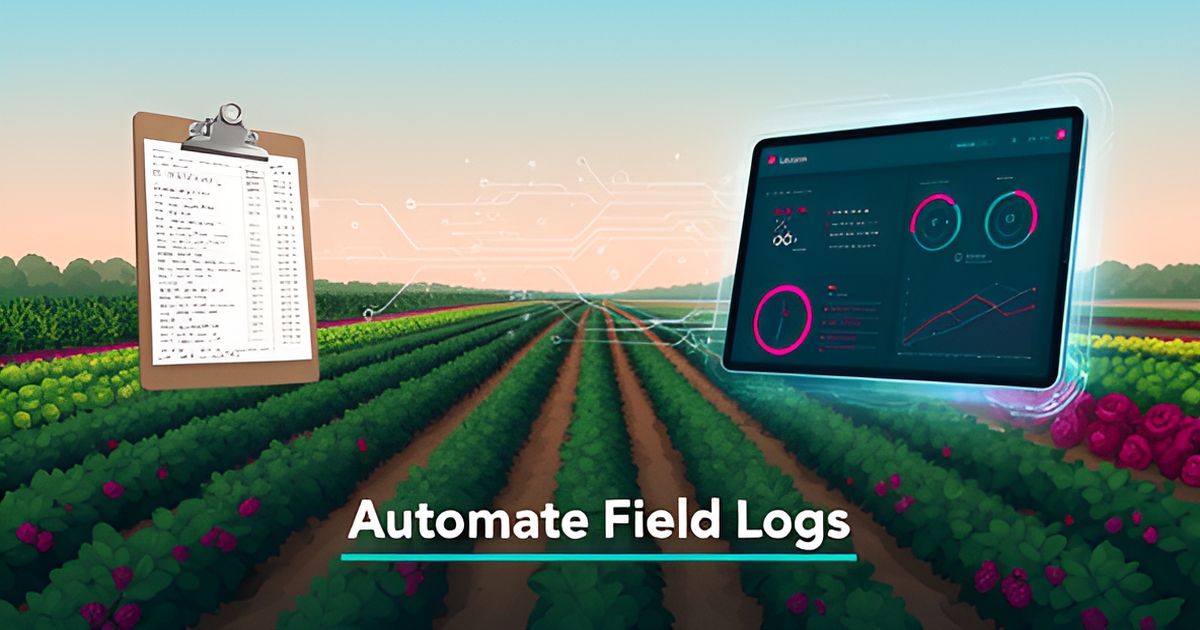
From Manual Logs to AI: How U-Pick Farms Can Automate Daily Field Logs and Crop Tracking
Key Facts
- Timely intervention guided by real-time monitoring typically improves treatment efficacy compared with reactive, paper-based scouting
- Digital farm systems can track plant development stages automatically, without manual scouting
- Purpose-built farm management apps typically go live within days, with minimal worker training
- On-farm camera and sensor systems can capture crop detail that satellite imagery cannot match
- Wireless soil sensors can operate for multiple years on a single battery, without cables or infrastructure
- Digital recordkeeping preserves field notes, milestones, and solutions for years, enabling season-over-season analysis
- Modern farm apps work across smartphones, tablets, and desktops for real-time field access
Hire a team member that works 24/7 — for less than a part-time wage.
AI receptionists, SDRs, dispatchers and 99+ roles. Trained on your business, fully managed.
Not sure where to start? Ask our AI planner
The Hidden Cost of Paper Logs in U-Pick Operations
When a Saturday rush brings hundreds of visitors through the gates, a clipboard in the field office becomes the weakest link in the entire operation. Paper logs feel simple and cheap, but they quietly tax a U-Pick farm in ways that only become visible at peak season.
The first cost is labor. Every hour a field manager spends handwriting picking times, tallying visitor counts, or reconciling soggy log sheets is an hour not spent managing crops or customers. Farm technology platforms built for labor-intensive operations like berries and orchards exist precisely because manual tracking consumes so much managerial bandwidth — centralizing farm data into a single digital system streamlines operations and helps growers make faster, better decisions.
The second cost is accuracy. Handwritten entries get skipped during rushes, misread during transcription, and lost entirely when a sheet goes missing. Modern crop monitoring systems can now track plant development stages automatically, without manual scouting — which underscores how much observational labor paper-based crop logs quietly absorb each week.
The third cost is timing. Paper is a rearview mirror. By the time someone compiles the week's logs, the berries in block four are already past peak ripeness and the staffing decision that mattered was made three days ago. Research on smart field monitoring consistently shows that timely intervention guided by real-time data improves treatment outcomes — a window that paper records simply cannot open.
These costs compound in specific, predictable places:
- Visitor flow blind spots — no real-time count of who is in the field, which rows are overpicked, or when to open the next section.
- Crop condition gaps — issues like stress or disease onset get recorded days after they became visible, if at all.
- Season-end reconciliation chaos — hundreds of loose sheets must be deciphered before any yield or revenue analysis can begin.
- Zero historical leverage — paper notes are nearly impossible to compare across seasons, while digital recordkeeping preserves field notes, milestones, and solutions for years.
Scalability is where paper truly breaks. A farm that manages fine with a notebook at 20 weekend visitors drowns at 200. Adding more clipboards doesn't add capacity — it adds more transcription, more errors, and more lag between what happens in the field and what the operator actually knows.
This is the gap AI-powered document processing is built to close. Rather than digitizing paper after the fact, systems like the ones AIQ Labs builds capture picking times, visitor data, and crop conditions at the source and organize them into live dashboards. The result is real-time visibility that paper was never designed to deliver — and a foundation that scales with the farm instead of against it. For farms that want to start with a single high-cost workflow, an AI Workflow Build rebuilds exactly that one process at a fixed price.
How AI-Powered Digital Tracking Eliminates Manual Entry and Enables Real-Time Insights
Paper logs and mental tallies create blind spots that grow larger with every harvest. When picking times, visitor counts, and crop conditions live only on clipboards, patterns disappear before they can inform the next decision.
AI-driven field monitoring changes the equation by turning daily observations into structured, searchable intelligence. Solar-powered camera systems now on the market capture RGB and NDVI imagery day and night, delivering close-range crop detail that satellite imagery cannot match — especially for young plants. Computer vision isolates vegetation to remove noise from soil, shadows, and crop residues, producing NDVI readings that reflect actual plant health rather than environmental interference. Built-in weather sensors add hyperlocal conditions in real time, while wireless multi-depth soil sensors with multi-year battery life track moisture and temperature across depths without cables or complex infrastructure.
Mobile data capture platforms complement this visibility by centralizing workforce and quality data on any smartphone, tablet, or desktop browser. Setup for these platforms typically takes days rather than weeks, and workers need little training to begin logging attendance, monitoring crop quality in real time, and feeding live dashboards accessible from the field or the office. The category is built for labor-intensive crops — berries, vegetables, orchards, and open-field farms — and adoption has spread across growers on multiple continents.
Together, these layers replace reactive scouting with proactive, targeted interventions:
- Automated development-stage tracking monitors plant growth without manual scouting
- Paperless notes preserve field history, seasonal milestones, issues, and solutions for years
- Photo galleries create visual timelines for field and season-over-season comparison
- AI-powered recommendations, an emerging capability, translate real-time imagery into field work planning
AIQ Labs applies this same architecture — automated capture, intelligent processing, and unified dashboards — to custom systems that eliminate manual entry across operations. The result is a single source of truth that updates itself, so decisions rest on current reality instead of last week's notebook.
From Pilot to Production: Implementing AI Field Tracking with AIQ Labs
Moving from a paper-based workflow to an AI-powered field tracking system works best when it follows the rhythm of the growing season. A phased approach lets you validate the technology during a single harvest window, refine the data model, and scale before the next planting cycle begins. This mirrors how modern agri-platforms deploy: setup typically takes days, and workers need little training, so the first pilot can go live almost immediately.
- Discovery & Architecture: Map current log sheets, visitor check-in flows, and crop-scouting routines into a unified data schema
- Development & Integration: Build custom AI agents that ingest voice notes, photos, and sensor feeds, then sync with existing CRM and accounting tools
- Deployment & Training: Roll out to one field crew first, using real-time dashboards that replace the clipboard entirely
- Optimization & Scale: Expand to all blocks, add predictive yield alerts, and hand off ongoing tuning to a managed AI Employee
AIQ Labs structures this journey through three entry points. AI Employees are managed AI staff — dispatchers, coordinators, and logging assistants across 99+ roles — that handle daily capture tasks around the clock at a fraction of a human hire's cost. AI Workflow Builds rebuild the one workflow that costs you the most, at a fixed price and in phases. And AI Operating Systems connect everything into one operating layer, built in phases and owned outright by you. You can start monthly, build in milestones, or own it outright — no vendor lock-in, and a cost structure that scales with the harvest. Continuous digital recordkeeping means notes about fields, seasons, and crop milestones are preserved for years, with 24/7 dashboard access for visual history and field comparison.
Still paying for 10+ subscriptions that don’t talk to each other?
We build custom AI systems you own outright. No vendor lock-in. Full control.
Not sure where to start? Ask our AI planner
Frequently Asked Questions
How much time can AI-powered field tracking save compared to manual paper logs for U-Pick farms?
What specific accuracy problems do paper logs create during peak harvest times at U-Pick farms?
Can AI field tracking systems really improve crop treatment effectiveness?
How long does it typically take to set up an AI field tracking system on a U-Pick farm?
What happens to field data at the end of the season when using paper logs versus AI-powered digital tracking?
Do AI field tracking systems require complex infrastructure like cables or constant internet access in remote fields?
Turn Field Chaos into Clarity: Your Next Step Toward Smarter Harvests
From the hidden labor drain of paper logs to the accuracy gaps that cost real-time decisions, manual tracking silently erodes U-Pick farm profitability — especially during peak season when every hour counts. AI-powered systems built on solar-powered cameras, multi-depth soil sensors, and mobile data capture replace reactive scouting with proactive insights, delivering close-range crop detail, automated growth-stage tracking, and unified dashboards that scale with your operation. AIQ Labs' three entry points — managed AI Employees, fixed-price Workflow Builds, and fully owned AI Operating Systems — mean you can start small, prove value in one harvest, and scale on your terms with no vendor lock-in. The result isn't just digital logs; it's a living record of your field's history that informs smarter planting, staffing, and harvest decisions year after year. Every season you stay on paper is a season of decisions made on stale data. Start with a two-minute Fit Check to see if there's a fit, then map your opportunity on a free strategy call — no pitch, just clarity. Start your Fit Check or book your free 30-minute strategy call and find out how much time and insight you're leaving in the field.
Make AI your competitive advantage — not just another tool.
Strategy, implementation and ongoing optimization. One partner, end to end.
Not sure where to start? Ask our AI planner