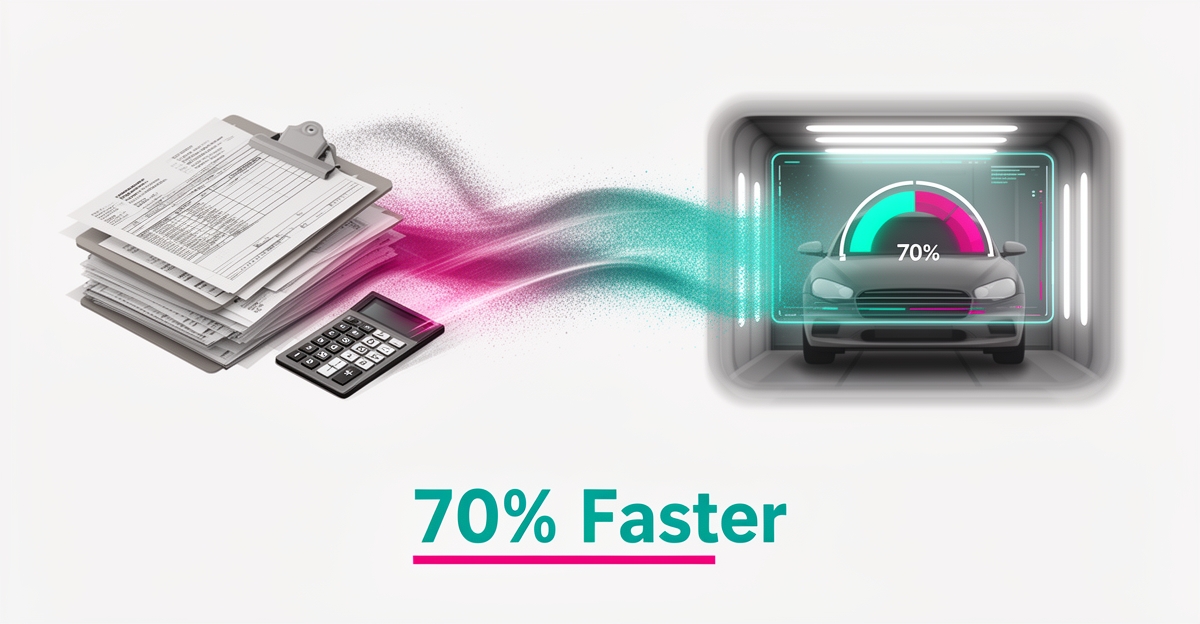
From Manual Quotes to AI: How Auto Paint Shops Are Cutting Quote Time by 70%
Key Facts
- Manual quotes commonly take 20–30 minutes per inquiry; AI estimators reduce that by roughly 70% in typical deployments
- Industry analyses of AI in automotive paint operations consistently point to large reductions in rework and material waste once manual steps are replaced with consistent, data-driven systems
- Paint shops are among the most resource-intensive parts of automotive operations, so administrative waste compounds margin pressure
- AIQ Labs has deployed 200+ multi-agent systems and runs 4 live SaaS products daily — the same engineering discipline applies to shop quoting
- Shops own their system outright: code, agents, and data, with no vendor lock-in or subscription dependency
Hire a team member that works 24/7 — for less than a part-time wage.
AI receptionists, SDRs, dispatchers and 99+ roles. Trained on your business, fully managed.
Not sure where to start? Ask our AI planner
The Cost of Manual Quoting in Auto Paint Shops
Every hour a shop spends building quotes by hand is an hour it isn't spraying, wrapping, or booking new work. For small auto paint and wrap shops, that trade-off quietly caps revenue no matter how strong demand gets.
Customization demand keeps climbing, yet most small shops still run quoting on manual processes that bottleneck growth. The shop floor isn't the constraint. The front office is.
Manual quoting bleeds time in ways owners rarely tally up. Each estimate requires pulling vehicle specs, checking current material costs, factoring labor hours, and accounting for design complexity — then formatting it all into something a customer can approve. Multiply that by every inquiry, and the true cost of manual quoting compounds fast.
The downstream damage shows up in three places:
- Human error in estimates — mispriced materials or underestimated labor erodes margin on every job, and rework driven by inaccurate scoping is one of the most expensive failure modes in paint operations.
- Slow response times — customers requesting custom wrap or paint quotes are comparison shopping; a quote that takes two days loses to one that takes two minutes.
- Inconsistent pricing — without a standardized system, two similar jobs get quoted differently depending on who answers the phone, undermining trust and profitability.
This inefficiency is especially striking given what's at stake operationally. Paint shops are notoriously resource-intensive environments — margins are already under pressure before a single quote goes out the door. Shops simply can't afford to burn administrative hours on top of that.
The contrast with AI-enabled operations is stark. Industry analyses of AI in automotive paint contexts consistently report meaningful reductions in rework and strong first-year returns when manual, subjective steps are replaced with systems that process data consistently and instantly — the exact same logic that applies to quote generation.
This is the gap AIQ Labs targets with AI Workflow Builds: taking the one process that costs the most — often quoting, which touches vehicle data, material pricing, and design complexity — and rebuilding it at a fixed price so the shop's expertise drives the output, not the owner's calendar.
How AI-Powered Estimators Transform Quote Accuracy and Speed
An AI estimator doesn't just speed up quotes — it transforms accuracy by processing vehicle data, material costs, and design complexity in seconds through a custom multi-agent system. Each agent specializes: one scans vehicle specifications from uploaded images or VINs, another cross-references current material pricing from supplier databases, and a third evaluates design intricacy like curves, panels, and custom graphics to calculate labor and material multipliers. This orchestrated approach eliminates guesswork and manual lookups, turning what once took 20–30 minutes into a near-instantaneous output.
Shops that deploy this kind of system typically report quote-time reductions in the 70% range, driven by the same factors every AI-in-manufacturing study points to: less human error and faster data synthesis. The consistency gain matters as much as the speed. Because the system applies the shop's own pricing rules the same way every time, quotes reflect actual shop conditions rather than generic templates — reducing costly underbids or overruns.
The multi-agent architecture allows the system to reason through variables like paint type compatibility, surface complexity, and prep requirements, adapting quotes in real time. This level of dynamic, context-aware processing is what AIQ Labs engineers into custom systems for automotive service providers — with 200+ multi-agent systems deployed, the pattern is well proven. The result isn't just faster quotes. It's a foundation for consistent, data-driven pricing that protects margins while improving customer trust through transparency and precision. As workflows shift from manual to AI-augmented, a shop gains more than speed: it gains reliability, scalability, and a competitive edge in a market where accuracy directly impacts profitability and reputation.
Implementation Roadmap: From Manual Process to AI Ownership
Getting an AI estimator live in a working shop takes more than plugging in software — it takes a structured rollout that respects how the shop actually runs. A typical deployment follows a deliberate sequence: discovery, build, training, and ownership transfer, with each phase approved before the next begins.
Phase 1: Discovery and Architecture
The first phase focuses on mapping the manual quoting process end to end. Every step — measuring vehicle dimensions, pulling material costs, calculating labor for design complexity — gets documented, along with the data sources the shop already relies on. This mirrors the first recommended step in any AI rollout: assess current capabilities, including technology infrastructure, data availability, and workforce skills, before defining clear objectives tied to business goals.
The output is a solution architecture and a plain business case: what the broken workflow costs today, and what the rebuilt version saves.
Phase 2: Build in Milestones
Rather than a single large deliverable, the build is split into phases under AIQ Labs' Build in Milestones model — each phase shipped, tested, and approved before payment moves forward. The estimator is trained on the shop's specific materials and pricing structure, then connected directly to existing tools through API integration so quotes pull live data instead of requiring manual entry. This phased approach also reflects broader industry guidance: pilot in a limited scope first, evaluate results, then scale.
Phase 3: Training and Deployment
Workforce adaptation is one of the most cited challenges in AI adoption — successful implementation hinges on both high-quality data and a workforce ready to use it. Training is customized to each role: front desk staff learn to generate quotes, while the owner learns to adjust pricing rules and review performance dashboards. Go-live typically takes under two weeks, with documentation and monitoring in place from day one.
Phase 4: Ownership and Ongoing Optimization
The final piece is often overlooked: who controls the system. Under the Own It Outright model, the shop owns the estimator — code, agents, and data — with no vendor lock-in or subscription dependency. That matters because AI is not a one-time install; ongoing optimization, retraining, and feature expansion determine whether the initial gains hold.
The results validate the approach. Beyond the roughly 70% reduction in quote time, shops gain the kind of consistency manual quoting could never deliver — objective, repeatable outputs instead of subjective estimates. That consistency advantage shows up across AI-powered paint operations, where automated systems outperform manual methods on both accuracy and speed.
For shop owners considering a similar move, the roadmap is clear: start with one broken workflow, prove the value in weeks, and keep everything you build.
Still paying for 10+ subscriptions that don’t talk to each other?
We build custom AI systems you own outright. No vendor lock-in. Full control.
Not sure where to start? Ask our AI planner
Frequently Asked Questions
How much time can an AI estimator really save on paint and wrap quotes?
Will AI quotes be accurate enough for custom paint and wrap work?
Is AI adoption actually common in auto paint shops right now?
What's the cost of sticking with manual quoting?
Do paint shops see ROI from AI beyond quoting?
How is an AI estimator implemented without disrupting the shop?
Turning Quote Time Into Growth Time
The shift from manual quotes to AI-powered estimation isn't just about saving minutes — it's about reclaiming hours that can be spent spraying, wrapping, and booking real work. Shops that make the move typically cut quote generation time by around 70% while gaining consistency, reducing error risk, and building a foundation for scalable pricing. That kind of operational clarity doesn't just protect margins — it creates breathing room in a business where every hour counts. For shop owners watching their front office bottleneck growth, the path forward starts with a single workflow. AIQ Labs helps you map that bottleneck, rebuild it at a fixed price in phases, and hand you a system you own outright. If you're ready to see where AI can unlock capacity in your shop, take the 2-minute Fit Check and then book a free 30-minute strategy call to explore your highest-impact opportunity.
Make AI your competitive advantage — not just another tool.
Strategy, implementation and ongoing optimization. One partner, end to end.
Not sure where to start? Ask our AI planner