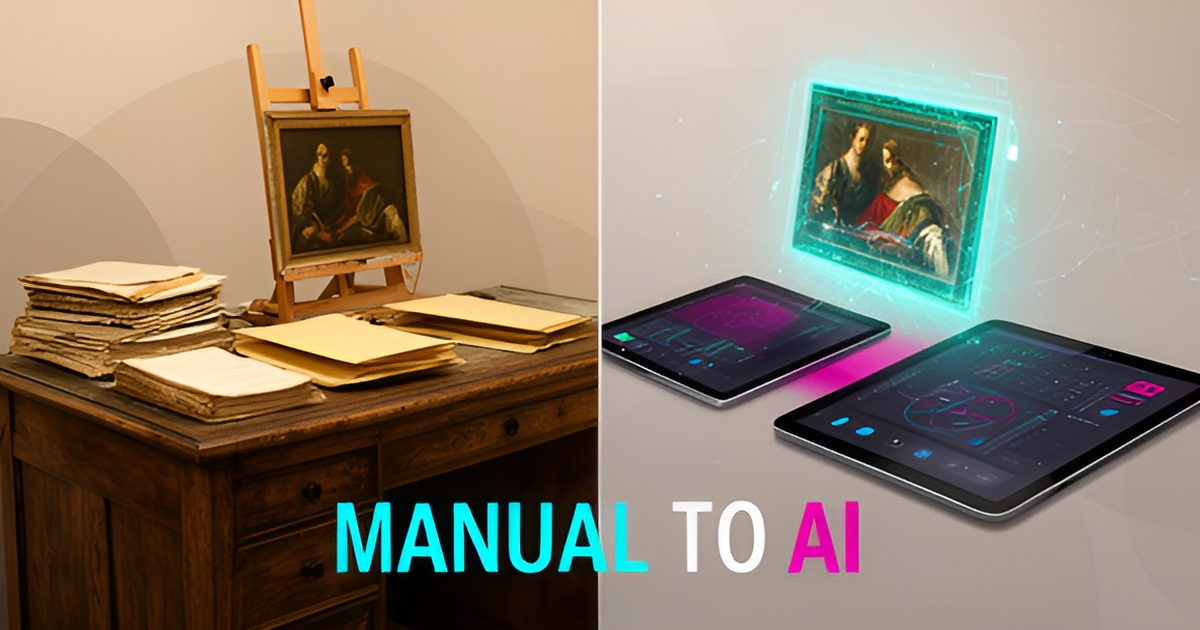
From Manual Records to AI: Modernizing Art Restoration Studio Operations Step-by-Step
Key Facts
- Document automation typically cuts data entry time dramatically and shortens month-end close, though exact figures depend on the studio's starting point
- Department-wide automation consistently reduces operational errors in condition reports, treatment logs, and scheduling
- Testing AI workflows against a copy of studio data before go-live lets teams validate changes without touching live artwork files
- Widely adopted responsible AI frameworks, such as Microsoft's, rest on six core principles: fairness, reliability and safety, privacy and security, inclusivity, transparency, and accountability
- Studios that codify tribal knowledge into searchable systems can take on complex, multi-phase projects without adding administrative headcount
- AI in cultural heritage work requires human-in-the-loop controls where conservators retain final authority over every intervention
Hire a team member that works 24/7 — for less than a part-time wage.
AI receptionists, SDRs, dispatchers and 99+ roles. Trained on your business, fully managed.
Not sure where to start? Ask our AI planner
The Hidden Costs of Manual Operations in Art Restoration
Paper-based documentation creates significant bottlenecks in art restoration workflows. Conservators spend excessive time searching for physical files, updating handwritten condition reports, and manually cross-referencing treatment histories across disparate binders. This fragmentation leads to duplicated effort and delays in project timelines, as critical information stays siloed in individual experts' notebooks rather than accessible studio-wide systems. Manual processes inherently limit scalability without proportional increases in administrative staff.
Knowledge loss represents another critical hidden cost when restoration experts depart. Years of accumulated expertise—subtle material insights, proprietary techniques, and contextual understanding of specific artworks—often exist only in personal notebooks or undocumented workflows. When senior conservators leave, this tribal knowledge vanishes, forcing studios to relearn lessons through costly trial and error. Preserving specialized knowledge requires systematic capture methods that manual systems fundamentally cannot provide, creating vulnerability during staff transitions.
Manual scheduling further compounds inefficiencies through rigid, error-prone coordination. Studio managers juggle paper calendars, phone calls, and sticky notes to allocate limited resources like specialized equipment or expert conservators' time. This approach frequently results in double-booked assets, underutilized skilled labor, and rushed treatments when scheduling conflicts arise. Consistent workflow optimization is impossible without digital foundations, because paper-based tracking produces no measurable data. These combined constraints prevent studios from taking on additional projects or complex cases without hiring proportional administrative support, directly capping growth potential. AIQ Labs addresses these operational constraints through AI Workflow Builds, which target the single workflow that costs your studio the most and rebuild it at a fixed price, in phases.
Responsible AI Framework for Cultural Heritage Work
When a studio handles an irreplaceable 18th-century canvas, "move fast and break things" is not an option. Adopting AI in cultural heritage work requires a governance framework that treats algorithmic suggestions with the same rigor as a master restorer's chemical analysis, ensuring technology serves as a precision instrument rather than an autonomous decision-maker.
Widely adopted responsible AI frameworks—Microsoft's being the most cited example—are built on six pillars: fairness, reliability and safety, privacy and security, inclusivity, transparency, and accountability. For art restoration, these translate into specific operational safeguards. Human accountability remains paramount: people, not algorithms, must answer for AI-assisted decisions. Conservators should retain final authority over every intervention, using AI for pigment analysis or structural prediction while maintaining a human-in-the-loop for all physical treatments.
Reliability and safety take on heightened significance when algorithms guide work on unique artifacts. AI systems must perform consistently across varying lighting conditions, material degradations, and historical contexts not represented in their training data. Measurement is key to ensuring AI operates according to plan, which means studios should validate computer vision models against known conservation outcomes before applying them to fragile surfaces.
Privacy and security extend beyond typical business data to encompass proprietary restoration methodologies and high-resolution imagery of private collections. Studios must ensure their AI infrastructure protects client confidentiality while maintaining detailed audit trails. This documentation becomes part of the artwork's permanent conservation record, detailing exactly which algorithmic recommendations were accepted or overridden by human experts.
Fairness and inclusivity require training datasets that represent diverse artistic traditions, preventing bias toward Western European techniques when analyzing Asian lacquerware or Indigenous artifacts. Studios implementing these systems should assess whether their AI assistants perform equitably across different cultural materials and artistic periods, using open bias-audit tooling where available.
Practical implementation of these principles involves several critical safeguards:
- Establishing clear escalation protocols where AI confidence scores below a defined threshold automatically trigger senior conservator review
- Maintaining immutable logs of all AI-generated condition reports to ensure transparency in insurance and provenance documentation
- Regular bias audits of training data to ensure historical restoration techniques from diverse cultures receive equal algorithmic weight
- Client consent protocols specifying whether proprietary artwork images may be used to train or fine-tune machine learning models
AIQ Labs integrates these governance frameworks directly into transformation roadmaps, helping studios configure validation layers and human-in-the-loop controls that match the ethical stakes of cultural heritage work. By embedding these six principles into your operational DNA from day one, your studio ensures that AI amplifies human expertise rather than compromising the irreplaceable artifacts in your care.
Digital Twin Strategy: Risk-Free AI Adoption
Manual records still dominate many art restoration studios, where physical work rather than mental work defines daily operations. Moving directly to live AI risks disruption to delicate conservation projects.
A digital twin creates a virtual replica of studio operations, letting teams test AI workflows before touching real artwork. The concept is well established in engineering and research settings, where teams build digital replicas of physical systems so they can develop and test complex configurations without direct access to the physical platform. The same logic applies to a restoration studio.
For restoration studios, that means simulating document automation, condition reporting, and scheduling against a safe copy of the studio's data. Think of it as a flight simulator for your operations. The virtual environment mirrors intake forms, treatment logs, and calendar constraints so changes can be evaluated without risk.
Testing in the twin reduces trial-and-error costs and increases overall efficiency. The approach enables parallel testing across competing configurations, so studios can compare multiple AI setups for condition reporting accuracy and scheduling logic side by side before committing to one.
A twin also enforces responsible AI practices before go-live. The six principles—fairness, reliability and safety, privacy and security, inclusivity, transparency, and accountability—can be validated in the sandbox first. Human oversight remains central, with humans accountable for AI systems at every stage.
Manual operations are, by definition, done with the hands—physical labor rather than automated processes. That hands-on reality is exactly why restoration needs protected testing: a digital twin preserves the studio's physical reality in data form while keeping the actual work untouched.
In practice, a studio digital twin can be used to:
- Validate document automation against historical intake and treatment records without touching live files
- Run condition reporting prompts on copies of artwork assessments to check tone, accuracy, and compliance
- Stress-test scheduling AI for conservator availability, drying times, and client windows
- Measure adoption friction and train staff in a risk-free environment
This mirrors how AIQ Labs approaches transformation: a measurable, phased transition with clear ROI tracking, built in milestones so you approve each step before the next one begins. Once the twin proves stable, the validated workflow moves to production with governance, monitoring, and human-in-the-loop controls already built in.
The result is risk-free AI adoption that respects conservation standards and staff experience.
Phased Implementation: From Pilot to Embedded Capability
Art restoration studios begin their AI transformation by targeting a single, high-impact workflow to prove value quickly and build internal confidence. Starting with invoice processing or condition reporting allows teams to experience measurable gains—faster data entry, quicker month-end close—without disrupting core creative work. Measurement is the discipline that keeps early pilots honest, making early wins critical for sustained momentum. This pilot phase focuses on seamless integration with existing tools like accounting software or project trackers, using AI to extract data from scanned invoices or standardize condition notes, laying the foundation for trust and scalability. This is exactly the model behind AI Workflow Builds: one workflow, fixed price, delivered in phases.
With the pilot stabilized, studios expand AI into department-wide automation, connecting client intake and project tracking into a unified flow that eliminates manual handoffs and reduces operational errors. Practical testing builds confidence before broader rollout—AI agents begin handling initial client inquiries, routing project details, and updating timelines in real time across teams. Studios that want managed capacity at this stage often add AI Employees—receptionists, dispatchers, and other managed AI staff that cost roughly 80% less than a human hire. This phase transforms isolated fixes into departmental efficiency, freeing conservators to focus on delicate restoration work rather than administrative bottlenecks.
Finally, studios scale to a unified operating system where AI becomes embedded in daily operations, linking client management, financial tracking, and resource planning into a single intelligent layer. The shift from manual to AI-powered workflows represents a fundamental modernization—replacing paper logs and siloed spreadsheets with real-time insights, predictive maintenance alerts for equipment, and automated compliance tracking for artwork handling. At this stage, AI Operating Systems from AIQ Labs gives studios full ownership of their custom AI ecosystem: built in phases, owned outright, with no recurring dependency on the vendor that built it.
Measuring ROI Beyond Time Savings
Time savings alone rarely justifies a studio transformation. Restoration leaders need proof that AI changes quality, risk, and capacity, not just the clock.
Manual operations involve physical, hand-based work rather than automated processes. That hands-on reality creates documentation gaps, inconsistent handoffs, and knowledge that lives with individuals. Physical, hand-based processes scale poorly when complexity rises—which is precisely where studios feel the pain first.
A mature ROI model tracks value at each maturity stage from pilot to transformation. Early pilots focus on error reduction and reporting speed. Later stages measure knowledge retention and the ability to take on complex projects without hiring.
Measurement is key to ensuring AI works as planned. Responsible AI principles emphasize that measurement is critical, and that systems should be transparent, reliable, and trustworthy. That framing maps directly to studio operations.
Success metrics that matter for art restoration studios include:
- Reduction in documentation errors across condition reports, treatment logs, and provenance files
- Faster client reporting turnaround from completion to delivery
- Knowledge retention rates as tribal knowledge is codified into searchable repositories
- Capacity to accept complex, multi-phase projects without adding headcount
Tracking these metrics requires baseline data before automation. Studios that define error rates, average reporting cycle time, and repeat question volume can show improvement without relying on anecdotes.
Governance also protects value. A framework built on six guiding principles—fairness, reliability and safety, privacy and security, inclusivity, transparency, and accountability—helps studios maintain human oversight while scaling AI. People should be accountable for AI systems, and human oversight mechanisms are essential at every stage.
AIQ Labs approaches transformation as a lifecycle partnership: assessment and strategy first, then adoption and change management, with payment models—Start Monthly, Build in Milestones, or Own It Outright—that match your commitment level at each stage. That structure supports ROI tracking from discovery through optimization, ensuring metrics stay aligned to business outcomes rather than tool usage.
When studios measure beyond hours saved, they see the real impact: fewer reworks, faster client trust, preserved expertise, and sustainable growth.
Still paying for 10+ subscriptions that don’t talk to each other?
We build custom AI systems you own outright. No vendor lock-in. Full control.
Not sure where to start? Ask our AI planner
Frequently Asked Questions
What are the hidden costs of sticking with paper-based documentation in our restoration studio?
How can we adopt AI responsibly when working on irreplaceable cultural artifacts?
What is a digital twin and how does it reduce risk when implementing AI in our studio?
What's the recommended phased approach for implementing AI in our restoration studio?
How do we measure ROI beyond just time savings when transforming our studio operations?
Will AI replace our conservators' expertise and hands-on judgment?
Your Studio's Next Evolution Starts Here
Modernizing art restoration studio operations isn't about replacing human expertise with AI—it's about amplifying it. By addressing the hidden costs of manual workflows, embedding responsible AI principles from the start, testing safely before go-live, and scaling through phased implementation, studios can preserve irreplaceable knowledge while unlocking new capacity for complex projects. The real value emerges not just in time saved, but in reduced errors, faster client reporting, retained tribal knowledge, and the ability to grow without proportional overhead. AIQ Labs has deployed 200+ multi-agent systems and runs four live SaaS products daily—this is work we do, not just talk about. If you're ready to assess where your studio stands, start with the 2-minute Fit Check, then book a free 30-minute strategy call to map your biggest bottleneck and explore practical next steps—no obligation, just clarity on your AI opportunity.
Make AI your competitive advantage — not just another tool.
Strategy, implementation and ongoing optimization. One partner, end to end.
Not sure where to start? Ask our AI planner