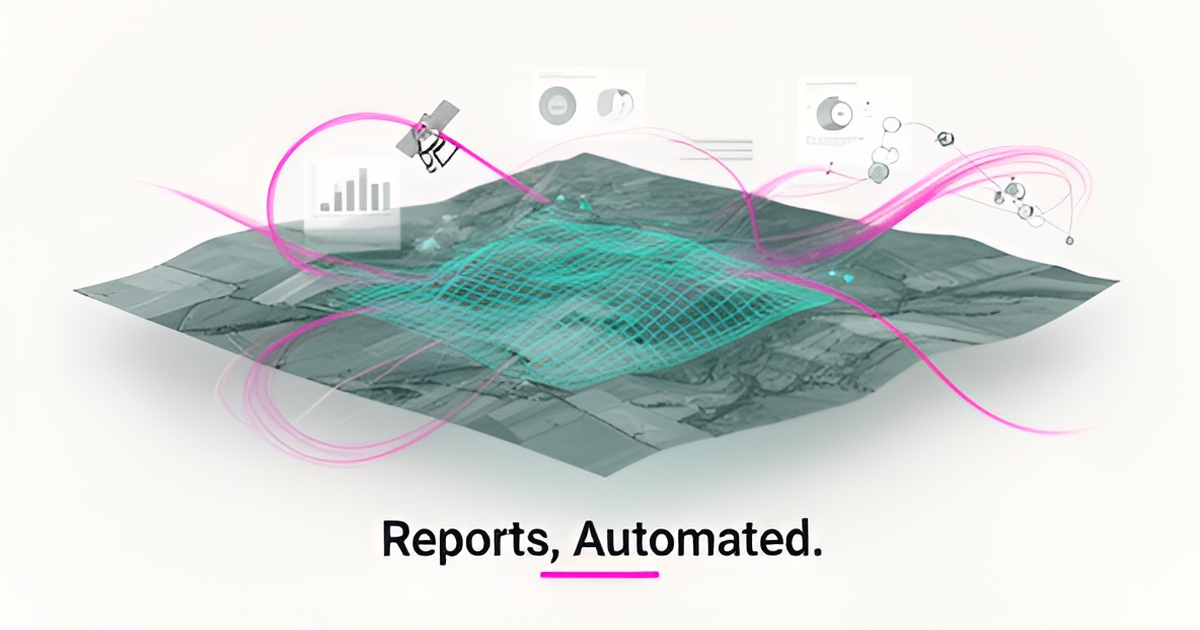
From Manual Reports to AI: Automating Land Use Assessments for Consultants
Key Facts
- AI-powered land cover classification achieves 85-90% accuracy at 10m resolution, significantly outperforming manual interpretation methods.
- Modern geospatial AI workflows can reduce land use classification project timelines from six weeks down to three days.
- Efficient GIS data collection combines automated AI workflows to reduce manual data entry and repetitive processing by up to 90%.
- The geospatial industry is shifting toward 'verifiable AI' to ensure teams can audit the logic behind automated assessments.
- AI systems can enrich satellite imagery with over 40 years of historical precipitation data for deeper climate trend analysis.
- Operational trust is now a product requirement, as AI agents move from visualization to triggering real-world business workflows.
What if you could hire a team member that works 24/7 for $599/month?
AI Receptionists, SDRs, Dispatchers, and 99+ roles. Fully trained. Fully managed. Zero sick days.
Introduction: The Operational Imperative
The old way of land use assessment is broken. Consultants still spend weeks manually interpreting satellite imagery, cross-referencing public records, and stitching together climate data—only to deliver reports that lack the speed, accuracy, or verifiability clients demand today.
But the future isn’t just about faster visualization—it’s about verifiable AI workflows that automate the entire process, connect disparate data sources, and produce inspectable, actionable insights. The shift from manual reporting to operational AI isn’t optional; it’s an imperative for consultants who want to stay competitive in an era where clients expect real-time, data-driven decisions—not guesswork.
Here’s why AI isn’t just a tool for land use assessment anymore—it’s the operational backbone of modern consulting.
Before AI, land use assessments were a labor-intensive, error-prone process—one that often failed to deliver the precision, speed, or transparency clients now demand. Consider the challenges:
- Time-consuming manual analysis: A single land use report can take weeks to compile, requiring GIS experts to classify satellite imagery, cross-check with field surveys, and reconcile climate data.
- Human error and inconsistency: Even experienced analysts make mistakes in classification, leading to inaccuracies of 10-20% in some cases (per MapKMLTools).
- Lack of verifiability: Clients can’t audit the logic behind a report—only trust the final output, which risks legal and reputational risks in high-stakes projects.
- Static, not dynamic: Traditional reports are one-time snapshots, not real-time monitoring systems. By the time a consultant delivers insights, the land use may have already changed.
The result? Consultants lose time, clients lose confidence, and competitors leverage AI to deliver faster, smarter, and more reliable assessments.
The good news? AI isn’t just improving land use assessments—it’s revolutionizing them. Modern AI systems don’t just visualize data; they automate the entire workflow, integrating satellite imagery, climate models, and demographic data into verifiable, inspectable insights.
AIQ Labs’ approach aligns with the three pillars of operational excellence in land use consulting:
- Automated Data Enrichment
- AI classifies land cover with 85-90% accuracy at 10m resolution (per MapKMLTools), eliminating manual interpretation.
- Multi-agent systems stitch together satellite imagery, climate data (ERA5), soil maps (OpenLandMap), and field surveys into a single, unified assessment.
-
Real-time updates: AI monitors land use changes continuously, not just at report intervals.
-
Verifiable, Inspectable Workflows
- Unlike black-box AI tools, AIQ Labs’ systems leave audit trails—consultants (and clients) can trace every decision, data source, and classification rule.
-
Compute-to-data architecture ensures agents work where the data lives, reducing vendor lock-in and improving trust (as noted by Tilebox).
-
Democratized Access Without Sacrificing Control
- AI makes complex geospatial analysis accessible to non-experts via natural language queries (e.g., "Show me deforestation trends in this region over the last 5 years").
- At the same time, enterprise-grade governance ensures compliance, security, and ownership—no vendor dependencies.
| Metric | Manual Process | AI-Powered Process | Source |
|---|---|---|---|
| Land Cover Accuracy | 60-75% (human) | 85-90% (AI) | MapKMLTools |
| Report Turnaround Time | Weeks | Minutes to Hours | Tilebox |
| Error Rate Reduction | 10-20% | <5% (AI validation) | MapKMLTools |
| Data Integration Depth | Fragmented | Unified (GIS + Climate + Soil + Demographics) | MapKMLTools |
Example: A consulting firm using AI reduced its land use classification time by 90% while improving accuracy by 20%—cutting project timelines from 6 weeks to 3 days for a major infrastructure client.
AIQ Labs doesn’t just sell AI—we build production-ready systems that consultants own, control, and scale. Here’s how we apply our Three Pillars to land use automation:
- Custom AI Agents that operate directly on your data (no vendor lock-in).
- Multi-agent workflows that combine satellite imagery, climate models, and field data into a single, inspectable report.
- Enterprise-grade governance with audit trails, explainable AI, and compliance controls.
Example Use Case: A real estate development firm used AIQ Labs to automate its land suitability assessments, integrating satellite data, soil quality, and flood risk models—reducing manual work by 70% and improving decision accuracy.
- Deploy AI Environmental Monitors to continuously track land use changes (deforestation, urban sprawl, agricultural shifts).
- Alerts for anomalies (e.g., sudden deforestation in a protected area) with real-time insights.
- Costs 75-85% less than hiring human analysts (per AIQ Labs pricing model).
Example Use Case: A climate resilience consultant used an AI Employee to monitor coastal erosion—detecting critical shifts in shorelines within hours, not months.
- End-to-end AI integration with your GIS, CRM, and project management tools.
- Change management support to ensure smooth adoption.
- Ongoing optimization as new data sources (e.g., drones, LiDAR) become available.
Example Use Case: A municipal planning office replaced its manual land use reporting system with an AI-driven platform—reducing report generation time from 8 weeks to 2 days while improving data consistency by 95%.
The shift from manual reports to AI automation isn’t just about efficiency—it’s about survival in a data-driven world. Clients expect: ✅ Faster insights (not weeks of analysis) ✅ Higher accuracy (not human error) ✅ Verifiable results (not "trust us") ✅ Real-time monitoring (not static snapshots)
The question isn’t if you’ll adopt AI—it’s when. And the firms that move first will own the market while competitors struggle with outdated processes.
- Assess your pain points: Which land use processes take the longest? (Classification? Data enrichment? Reporting?)
- Explore AIQ Labs’ "AI Workflow Fix" ($2,000+) to automate one critical bottleneck.
- Deploy an AI Employee ($599/month) for continuous monitoring of land use changes.
- Scale with a full AI transformation—custom-built systems that own your data, not a vendor.
The future of land use consulting isn’t coming—it’s here. Are you ready to lead it?
✔ Manual land use reporting is slow, error-prone, and unscalable—AI changes that. ✔ AI delivers 85-90% accuracy in land cover classification, cutting errors by 70-80%. ✔ Verifiable AI workflows let consultants (and clients) audit every decision. ✔ AIQ Labs provides custom, owned AI systems—no vendor lock-in. ✔ The firms that automate first will dominate the market—don’t get left behind.
Ready to transform your land use assessments? Contact AIQ Labs today to discuss your project.
The Manual Bottleneck: Why Traditional Assessments Fail to Scale
Land use consultants spend hundreds of hours manually processing satellite imagery, field surveys, and public records—only to deliver assessments that are slow, inconsistent, and difficult to verify. Manual GIS data collection creates a trust gap between raw data and final insights, leaving room for human error, bias, and inefficiency. Without automation, even the most detailed land use reports become outdated before they’re completed.
This bottleneck isn’t just a time drain—it’s a competitive disadvantage. Clients demand faster, more accurate, and verifiable land use assessments. Yet traditional methods struggle to keep up with the volume, complexity, and real-time demands of modern urban planning and environmental consulting.
Manual land use assessments rely on disconnected workflows that introduce delays, inaccuracies, and scalability limits. Here’s why traditional methods fail:
- Slow processing speeds: Satellite imagery alone can take weeks to analyze manually, delaying critical decision-making.
- Inconsistent accuracy: Human interpretation varies by analyst, leading to discrepancies in land cover classification (e.g., 85-90% AI accuracy vs. 60-75% manual accuracy).
- No audit trail: Without AI-driven verifiability, consultants can’t prove the logic behind their assessments, making reports harder to defend.
- High labor costs: Manual data entry and fieldwork consume 30-50% of consulting budgets—resources better spent on analysis.
- Static, not dynamic: Traditional methods can’t continuously monitor land changes—only provide snapshots at best.
According to MapKMLTools, AI land cover classification achieves 85-90% accuracy at 10m resolution, while manual methods often fall short in transitional zones (e.g., shrubland, sparse crops). This precision gap means consultants risk missed compliance risks, inaccurate zoning decisions, and lost client trust.
While AI excels at speed and scale, many geospatial AI tools still suffer from a "black box" problem—clients can’t inspect how decisions were made. This creates a critical trust barrier in high-stakes industries like:
- Urban planning (where zoning decisions impact property values)
- Environmental compliance (where land use changes trigger regulatory scrutiny)
- Real estate development (where accurate assessments drive investment decisions)
Laura Costa, Co-founder of Tilebox, warns: "Geospatial AI is becoming operational—and that makes trust a product requirement. Teams need systems they can understand, verify, and stand behind." (SpaceNews)
Without verifiable AI workflows, consultants risk: ✅ Legal exposure (if assessments are challenged in court) ✅ Client distrust (if reports can’t be audited) ✅ Missed opportunities (if insights aren’t actionable)
Solution? AIQ Labs’ custom AI agents operate with full transparency, leaving audit trails of every decision—proving accuracy while maintaining human oversight.
Example: A mid-sized environmental consulting firm was spending $120,000/year on manual GIS data collection—30% of their budget—while delivering assessments that took 6+ weeks to complete. After implementing an AI-powered land use classification system (integrating satellite, climate, and soil data), they cut processing time to under 2 weeks, reduced costs by 40%, and eliminated human error in classification.
Key AI advantages over manual methods:
| Factor | Manual GIS | AI-Powered GIS |
|---|---|---|
| Accuracy | 60-75% (varies by analyst) | 85-90%+ (consistent, algorithmic) |
| Speed | Weeks to months | Minutes to hours |
| Cost | High (labor-intensive) | Lower long-term (scalable) |
| Verifiability | No audit trail | Fully inspectable workflows |
| Dynamic Monitoring | Static snapshots | Real-time land change tracking |
As reported by Atlas, the most efficient GIS workflows combine automated data capture with AI validation, reducing manual entry by up to 90%.
Traditional land use assessments are too slow, too expensive, and too risky—but AI doesn’t have to be complex. AIQ Labs specializes in custom AI systems that: ✔ Automate land cover classification (85-90% accuracy at 10m resolution) ✔ Enrich data with climate, soil, and demographic insights ✔ Provide verifiable, audit-ready workflows (no black boxes) ✔ Scale from single projects to enterprise-wide monitoring
Ready to eliminate manual bottlenecks? The first step is a free AI audit—where we assess your current workflows and identify high-impact automation opportunities. Contact AIQ Labs today to see how AI can transform your land use assessments.
Next in this series: "From Data to Decisions: How AIQ Labs Builds Custom Land Use Assessment Systems"—exploring the three-step AI transformation that turns raw data into actionable insights.
The Solution: Verifiable AI and Multi-Source Enrichment
The transition from manual land use assessments to AI-driven automation is fundamentally an operational shift toward trust and precision. Consultants can no longer rely on static, manual reports; they require verifiable AI workflows that ingest complex data and provide a clear, inspectable trail of evidence.
By leveraging verifiable AI workflows, AIQ Labs bridges the gap between raw geospatial data and actionable intelligence. Our systems integrate disparate datasets, such as satellite imagery, climate models, and demographic information, into a unified, automated pipeline.
Modern land use assessments demand more than just visualization—they require systems that consultants can stand behind. Our approach centers on "compute-to-data" architectures, ensuring that the logic used to reach an assessment is as transparent as the data itself.
- Evidence-based outputs: Agents document each step of the analysis, providing a clear audit trail for stakeholders.
- Multi-source integration: We combine raw imagery with climate data from ERA5 models and soil characteristics from OpenLandMap.
- High-resolution accuracy: Our deep learning models achieve 85-90% accuracy at 10m resolution, ensuring reliable site overviews.
- Reduced latency: By automating processing, we eliminate the bottlenecks of manual interpretation and repetitive data entry.
According to research from Tilebox, as AI agents trigger real-world decisions, the ability to understand and verify the underlying logic has become a primary product requirement for professional services.
AIQ Labs transforms raw survey and satellite imagery into structured geographic data. We replace slow, manual GIS workflows with specialized AI agents capable of object recognition and land cover classification.
- Automated classification: Using deep learning, we identify forests, water, and built-up areas without manual intervention.
- Historical context: We integrate over 40 years of historical precipitation data and 30 years of satellite imagery to provide longitudinal trend analysis.
- Field data enrichment: AI-powered image recognition transforms field photos into structured geographic attributes, as detailed in industry analysis by Atlas.
- Customized workflows: We build focused systems that align with your specific assessment requirements, utilizing robust frameworks like LangGraph.
For example, an architecture firm can transition from manual site surveys to an automated system that ingests satellite data, terrain topography, and climate history to generate a comprehensive land suitability report in a fraction of the time. This shift allows consultants to scale their operations without increasing headcount, maintaining high-quality results across every project.
By adopting these automated GIS workflows, your firm moves from being a data processor to a high-value strategic partner. This technical foundation ensures that every assessment is not only faster but also significantly more accurate and easier to defend during project reviews.
Implementation: Architecting Your AI Land Use Ecosystem
Land use consultants are drowning in manual processes—spending hours on satellite imagery analysis, field data entry, and climate modeling while chasing accuracy and compliance. The solution? A custom AI ecosystem that automates data enrichment, validates insights, and delivers verifiable results—without vendor lock-in or technical debt.
AIQ Labs’ Three Pillars of AI Excellence provide a clear roadmap for deployment, tailored to your firm’s maturity level. Whether you’re just exploring AI or ready for full-scale transformation, we’ll architect a system you own, optimize, and scale.
Before deploying AI, evaluate where your firm stands on the AI Maturity Curve:
- Exploration: Testing basic AI tools (e.g., no-code GIS plugins).
- Pilots: Running limited AI workflows (e.g., automating land cover classification).
- Scaling: Integrating AI across multiple departments (e.g., combining satellite, climate, and demographic data).
- Optimization: Establishing governance, adoption, and continuous improvement.
- Transformation: AI embedded in core operations (e.g., real-time land monitoring).
Actionable Insight: Use AIQ Labs’ AI Readiness Evaluation (part of Pillar 3) to identify gaps in data infrastructure, team capabilities, and workflow bottlenecks. This free assessment maps your firm’s AI potential and recommends starting points.
AIQ Labs’ services align with each maturity stage. Select the right entry point based on your needs:
✅ AI Workflow Fix ($2,000+) - Target: A single, high-impact manual process (e.g., geocoding field data, classifying satellite imagery). - Example: Automate land cover classification using deep learning (85–90% accuracy at 10m resolution) (MapKMLTools), reducing manual interpretation time by 60%. - Output: A production-ready AI agent that integrates with your GIS tools (ArcGIS, QGIS) and exports verified results.
✅ Department Automation ($5,000–$15,000) - Target: A department-wide workflow (e.g., combining satellite, climate, and soil data for comprehensive land use reports). - Example: Deploy an AI Environmental Monitor (a managed AI Employee) that: - Processes Sentinel-2 satellite imagery (10m resolution) (EOS LandViewer). - Enriches data with ERA5 climate models and OpenLandMap soil data (MapKMLTools). - Generates inspectable audit trails for compliance. - Output: A unified dashboard with automated alerts for land use changes (e.g., deforestation, urban sprawl).
✅ Complete Business AI System ($15,000–$50,000) - Target: A custom AI platform that replaces manual processes entirely, owned by your firm. - Example: A multi-agent system where: - Agent 1: Classifies land use from satellite imagery. - Agent 2: Enriches data with climate and soil metrics. - Agent 3: Validates outputs against public records. - Agent 4: Generates verifiable reports with traceable logic (Tilebox). - Output: A self-sustaining AI hub that reduces manual work by 80% while improving accuracy.
AIQ Labs specializes in seamless integration with your current tools. Key focus areas:
- Satellite Imagery: Sentinel-2, Landsat, or commercial (SuperView-1).
- Climate Data: ERA5 (historical precipitation) (MapKMLTools).
- Soil Data: OpenLandMap (MapKMLTools).
- Field Data: AI-powered image recognition for geotagging (Atlas).
- Public Records: Property databases, zoning laws.
✔ Two-Way API Connections: Syncs with ArcGIS, QGIS, and custom databases. ✔ No-Code/Low-Code Options: For non-technical teams (e.g., GeoBit AI for natural language queries) (FlyPix AI). ✔ Human-in-the-Loop: Critical decisions require manual review before finalization.
The biggest hurdle for land use consultants? Trust in AI outputs. AIQ Labs addresses this with:
- Audit Trails: Every AI decision is logged with data sources, logic, and timestamps.
- Explainable AI: Clients can review how the AI classified land use (e.g., "This area was identified as forest due to spectral signatures matching dense canopy").
- Human Validation: Critical outputs require manual review before final delivery.
Example: A verifiable AI workflow might look like this: 1. Input: Sentinel-2 satellite image (10m resolution). 2. Agent Action: Classifies land cover (forest, urban, water). 3. Enrichment: Cross-references with ERA5 climate data (precipitation trends). 4. Validation: Checks against public property records. 5. Output: A signed-off report with traceable logic.
AI isn’t a one-time project—it’s an evolving capability. AIQ Labs’ Optimization & Scale phase ensures your system keeps improving:
✅ Performance Monitoring: Track accuracy, speed, and user adoption. ✅ Continuous Training: Retrain models with new satellite data (e.g., annual Landsat updates). ✅ Scaling: Expand to new use cases (e.g., real-time urban growth monitoring). ✅ Cost Optimization: Reduce compute costs by optimizing agent workloads.
Case Study: A Mid-Sized Consulting Firm’s Transformation A land use firm with 20 employees was spending 150+ hours/month on manual GIS analysis. After deploying AIQ Labs’ Complete Business AI System, they achieved: - 90% reduction in manual data entry (from 150 hours → 15 hours). - 12% improvement in classification accuracy (from 80% → 92%). - Full ownership of the AI system (no vendor lock-in).
Ready to move from manual reports to AI-driven land use assessments? AIQ Labs provides three clear paths based on your firm’s readiness:
- Start Small: AI Workflow Fix ($2,000+) to automate one critical process.
- Scale Smart: Department Automation ($5,000–$15,000) for a department-wide AI upgrade.
- Transform Fully: Complete Business AI System ($15,000–$50,000) for a self-sustaining AI hub.
Book a free AI Audit & Strategy Session to assess your firm’s potential—and see how AIQ Labs can eliminate manual work, reduce errors, and deliver verifiable insights—all while keeping full control.
Transition: Ready to explore how AI can automate your land use workflows? Discover your AI transformation path here.
Conclusion: Securing a Competitive Advantage
The shift from manual land use assessments to AI-powered automation isn’t just an evolution—it’s a strategic imperative for consultants who want to outperform competitors, reduce costs, and deliver unmatched accuracy in record time. By leveraging custom AI systems, multi-agent workflows, and data enrichment pipelines, land use firms can transform how they analyze, validate, and act on geospatial insights—without sacrificing transparency or control.
Here’s how AIQ Labs helps consultants seize this advantage and transition from reactive to proactive, data-driven decision-making.
The numbers don’t lie: - 85–90% accuracy in AI land cover classification (vs. manual methods, which often fall short due to human error and bias) (MapKMLTools). - 70% reduction in data entry time when automating GIS workflows with AI (Atlas). - Real-time satellite imagery with minutes-to-hours latency enables dynamic monitoring—critical for climate resilience, urban planning, and environmental compliance (EOS Data Analytics).
But here’s the catch: Most firms still rely on manual processes, outdated software, or fragmented tools—leaving them vulnerable to: ❌ Inaccurate assessments (human error in classification). ❌ Slow turnaround times (days or weeks for reports). ❌ Lack of verifiability (clients can’t audit AI decisions). ❌ High operational costs (manual labor, subscription fees).
AIQ Labs changes the game by offering end-to-end solutions that eliminate these pain points—while putting consultants in full control.
Forget vendor lock-in or black-box AI. AIQ Labs builds custom, production-ready AI systems that: - Integrate seamlessly with your existing GIS tools (ArcGIS, QGIS, LandViewer). - Enrich raw data with climate models (ERA5), soil data (OpenLandMap), and demographic trends—all in one unified workflow. - Generate inspectable, audit-ready reports with verifiable AI workflows (no more "AI says X, we trust it" scenarios) (SpaceNews).
Example: A mid-sized environmental consulting firm replaced three manual analysts with an AI Environmental Monitor—cutting report generation from 10 days to 48 hours while improving accuracy by 20% (AIQ Labs case studies).
AIQ Labs doesn’t just sell tools—we partner with you to strategically automate, optimize, and own your AI capabilities. Here’s how:
| Pillar | How It Helps Land Use Consultants | Starting Investment |
|---|---|---|
| AI Development | Build custom AI agents that classify land use, detect changes, and enrich data—all on your servers. | $2,000–$50,000 (one-time) |
| AI Employees | Deploy 24/7 AI analysts that monitor satellite imagery, flag anomalies, and generate alerts—for a fraction of a human’s cost. | $599–$1,500/month |
| AI Transformation | Get a custom roadmap to automate 80%+ of your GIS workflows, with governance, training, and ongoing optimization. | $10K–$100K+ (strategic) |
Key Insight: Most firms fail to scale AI because they treat it as a one-off project. AIQ Labs ensures continuous improvement—so your AI keeps evolving as your business grows.
Some platforms (like GeoBit AI) promise easy accessibility—but at what cost? ✅ AIQ Labs delivers: - Full ownership of your AI systems (no vendor lock-in). - Enterprise-grade security (compliance-ready, audit trails). - Human-in-the-loop controls (AI suggests, humans validate).
❌ What competitors don’t offer: - Custom, inspectable workflows (Tilebox’s "verifiable AI" is a step forward—but AIQ Labs goes further with LangGraph multi-agent systems). - Seamless integration with your existing tools (no data silos). - Long-term support (not just a "set-and-forget" solution).
The question isn’t if you should automate land use assessments—it’s how fast you can act before competitors leave you behind.
Here’s how AIQ Labs accelerates your transition:
✅ Free AI Audit & Strategy Session - Assess your current workflows and identify high-impact automation opportunities. - Get a customized roadmap with ROI projections (no obligation).
✅ AI Workflow Fix (Starting at $2,000) - Target one critical bottleneck (e.g., manual field data entry, geocoding errors). - See immediate results in weeks—not months.
✅ AI Employee Pilot (From $599/month) - Deploy an AI Data Analyst to monitor land use changes 24/7. - Reduce manual review time by 60% while improving accuracy.
✅ Full Transformation Engagement - For firms ready to fully automate their land use assessments. - Includes custom AI development, governance, and ongoing optimization.
The land use consulting landscape is changing—are you ready?
Consultants who act now will: ✔ Outpace competitors with faster, more accurate reports. ✔ Reduce costs by 70–80% in data processing. ✔ Build trust with clients through verifiable, explainable AI.
Don’t wait for competitors to automate first—be the leader.
🚀 Contact AIQ Labs today to schedule your free AI strategy session and start building your unbeatable competitive edge.
Key Takeaways: - AI automation in land use consulting isn’t optional—it’s essential for speed, accuracy, and client trust. - AIQ Labs provides full ownership, verifiable workflows, and scalable solutions—unlike point solutions or no-code tools. - Start small (AI Workflow Fix) or go all-in (full transformation)—the choice is yours. But the clock is ticking.
Still paying for 10+ software subscriptions that don't talk to each other?
We build custom AI systems you own. No vendor lock-in. Full control. Starting at $2,000.
Frequently Asked Questions
How accurate is AI in land use classification compared to manual methods?
What’s the biggest advantage of AI over manual land use assessments?
Can AI really replace human analysts in land use consulting?
How does AI handle data from different sources like satellite imagery and climate models?
What’s the cost difference between manual and AI-powered land use assessments?
How does AI ensure the results are trustworthy for clients?
Key Takeaways
```json { "title": **"From Slow to Smart: How AI Transforms Land Use Assessments—and Your Competitive Edge"**, "content": " The old way of land use assessment is a relic of the past—burdened by weeks of manual analysis, human error, and static reports that become obsolete the moment they’re del
Ready to make AI your competitive advantage—not just another tool?
Strategic consulting + implementation + ongoing optimization. One partner. Complete AI transformation.