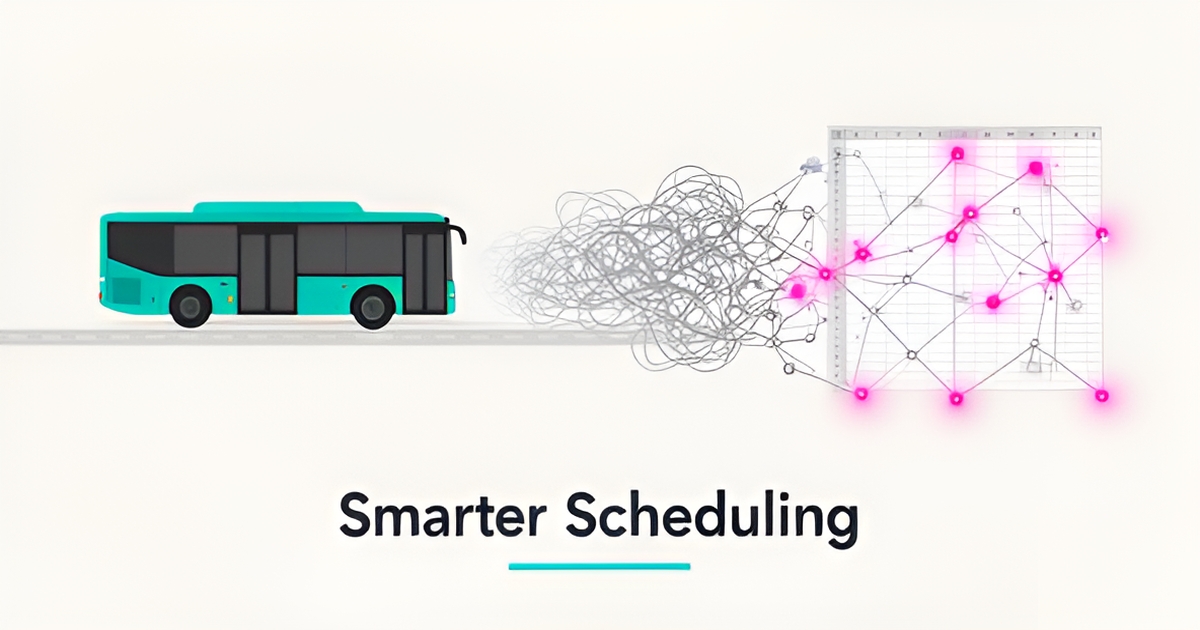
From Manual Scheduling to AI: Transforming Charter Bus Operations in Halifax
Key Facts
- Industry analyses commonly report that a large share of AI projects underdeliver — typically attributed to inadequate planning and poor integration rather than the technology itself.
- AI scheduling tools are frequently reported to cut scheduling time dramatically compared to manual methods, though exact figures vary by operation and data quality.
- Automated conflict detection is one of the most reliable gains from AI scheduling — double-bookings and missing rest windows get caught before they reach a driver.
- Optimized driver-vehicle assignment typically improves fleet utilization, though the size of the gain depends on how much slack your current schedule carries.
- Real-time scheduling requires tasks to complete neither too early nor too late — a constraint spreadsheets cannot enforce.
- General-purpose AI calendar tools struggle with the sheer number of constraints in multi-week charter scheduling, which is why generic tools rarely fit dispatch operations.
- The scheduling-tool category keeps consolidating — as of late 2026, several popular AI calendar products have shut down or been acquired, a reminder of the platform risk in rented scheduling solutions.
Hire a team member that works 24/7 — for less than a part-time wage.
AI receptionists, SDRs, dispatchers and 99+ roles. Trained on your business, fully managed.
Not sure where to start? Ask our AI planner
The Hidden Cost of Spreadsheet Scheduling in Charter Operations
Halifax charter operators start their day buried in spreadsheets — cross-referencing driver availability, vehicle maintenance windows, and fluctuating seasonal demand while racing to avoid double-bookings. What feels like routine coordination is actually a real-time constraint problem: buses, drivers, and maintenance must align precisely, neither too early nor too late, to keep operations running. As fleets grow and demand patterns shift, the limits of manual scheduling become impossible to ignore.
Scheduling has always been side work for a charter operation, but the burden multiplies with every additional vehicle, driver, and route. It quickly exceeds what one person — or one spreadsheet — can manage well. The workbook that worked for a five-coach fleet starts breaking down at fifteen, and the cracks show up as costly inefficiencies that ripple through the whole operation.
The hidden costs reveal themselves in concrete ways: hours of dispatcher time spent on coordination instead of customers, scheduling errors that leave buses idle or drivers in overtime, and missed revenue during peak seasons when demand swings are most pronounced. Industry analyses of AI scheduling tools commonly report major time savings, large reductions in scheduling conflicts, and meaningful utilization gains — but those numbers only materialize when the system actually fits the operation. For operators still on manual methods, every week without automation is labor and revenue that doesn't come back.
- Driver-vehicle mismatches causing last-minute scrambles
- Maintenance windows missed due to poor visibility
- Double-bookings during high-demand periods
- Seasonal peaks overwhelming manual coordination
- Revenue lost from underutilized fleet capacity
These challenges aren't just operational headaches — they point to a fundamental mismatch between the complexity of modern charter scheduling and the tools used to manage it. A large share of AI initiatives underdeliver, and the reason is almost always the same: organizations underestimate the integration and change management required. Recognizing that scheduling is a real-time systems problem is the first step toward understanding why spreadsheets alone can't scale with your ambitions.
What AI-Driven Scheduling Actually Delivers (and Where It Struggles)
The numbers behind AI scheduling are genuinely promising — and the fine print matters just as much. For charter operators weighing the jump from spreadsheets, understanding both the upside and the limits is the difference between a system that works and one of the many AI projects that quietly stall.
The documented gains are real where deployments are done well. Industry analyses of AI scheduling tools commonly report scheduling-time reductions of up to 80%, conflict reductions of 95% or more through automated detection, and utilization improvements in the 30-40% range from optimized driver-vehicle assignment. Treat those as directional benchmarks, not guarantees — your actual results depend on data quality and how well the system encodes your constraints. For a dispatch office spending hours each week untangling assignments, even the conservative end of those ranges translates into recovered labor hours and fewer last-minute scrambles.
These systems work by analyzing preferences, learning operational habits, and handling conflicts automatically while integrating with calendars, email, and communication platforms. Conflict detection that once required a human eye — the double-booked coach, the driver with no rest window — becomes automatic.
But honesty requires the other side of the ledger. General-purpose AI calendar tools struggle with the huge number of constraints involved in planning several weeks at once — which is precisely the problem charter dispatch faces. A charter operation isn't a personal calendar. It's a multi-week puzzle of driver-hours compliance, vehicle maintenance windows, tour commitments, and customer bookings that must land neither too early nor too late, as real-time scheduling theory puts it.
Off-the-shelf tools fall short for another reason:
- Tools like Reclaim and Motion are built for individual calendars and team meetings, not dispatch operations.
- None of them natively encode driver-hours regulations or vehicle compliance rules.
- Generic tools create subscription dependencies without adapting to the operator's actual workflow.
- The category itself keeps churning — as of late 2026, several popular AI calendar products have shut down or been absorbed, a standing reminder of platform risk.
There's a broader caution here, too. A large share of AI projects — figures commonly cited run to 70-80% — fail to meet expectations, primarily due to inadequate planning and poor integration. The takeaway for charter operators is the same one experienced project leaders keep repeating: don't chase the tool. Design the system.
This is why purpose-built systems outperform subscription widgets in this industry. A scheduling system engineered around a specific operator's constraints, data, and compliance requirements — the approach AIQ Labs takes with custom workflow builds — delivers the documented benefits while avoiding the ceiling of generic tools. The right question isn't "which scheduling app should we buy?" but "what system does our operation actually need?"
Why So Many AI Projects Fail — and How to Avoid Being One
Most AI initiatives fail not because the technology lacks potential, but because organizations treat tool selection as the solution rather than the starting point. Commonly cited industry figures put the failure rate for AI projects at 70-80%, primarily due to inadequate planning and lack of proper integration. This isn't a technology problem — it's a transformation problem. Without integration, ownership, and alignment, no tool matters. The most advanced AI scheduling assistant will underperform if it doesn't connect with your dispatch systems, if staff aren't trained to use it, or if leadership hasn't defined clear ownership of outcomes.
True transformation begins with assessing organizational readiness across four pillars. First, conduct an AI maturity assessment to understand where your charter operation stands — are you experimenting with basic automation, or ready to deploy predictive scheduling across multiple depots? Second, inventory your data resources: do you have clean historical data on route times, driver availability, maintenance cycles, and booking patterns? Third, evaluate your technical infrastructure — can your current systems handle real-time data processing and API integrations? Finally, develop a skills strategy that combines internal training with external partnership. Skipping any of these steps undermines the project, no matter how sophisticated the tool appears.
Integration, ownership, and alignment matter infinitely more than tool selection. Don't chase the tool — design the system. That means choosing an approach — native AI features in existing dispatch software, external API connections, or a custom-built solution — that aligns with your operational workflows, data governance, and long-term goals. Be wary of vendor lock-in from rented scheduling platforms that promise quick wins but create dependencies that limit flexibility and raise costs over time. Instead, favor systems you own outright, where you retain control over data, customization, and evolution. For Halifax charter operators, that means an AI scheduling system with its own integrations into GPS tracking, maintenance logs, and booking platforms — technology that serves your operational rhythm, not the other way around. When the system is designed around your business, AI stops being a project and starts becoming a competitive advantage. Ready to assess your readiness? Start the Fit Check, then book a free 30-minute strategy call to map your biggest bottleneck and identify high-ROI automation opportunities. If there isn't a clear win, we'll say so. Not a sales pitch — a real working session with an AI engineer.
The Transition Roadmap: From First Pilot to Fully Automated Dispatch
The journey from manual scheduling to AI-driven dispatch doesn't happen overnight — it requires a deliberate, phased approach that builds confidence and capability at each step. For charter bus operators in Halifax, starting with a clear audit of current workflows and data quality is essential. Given how many AI projects stall on inadequate planning and poor integration, this foundational step is critical for success.
Once the current state is understood, prioritize one high-impact use case — such as driver-vehicle assignment or booking-to-dispatch automation — where AI can deliver immediate value. Pilot the solution with human-in-the-loop controls and manual backup procedures to ensure reliability while teams adapt. This phased method mirrors AIQ Labs' build approach: systems clients own outright, delivered through flexible payment models — Start Monthly, Build in Milestones, or Own It Outright — that de-risk the transition by letting investment scale with proven results.
- Audit current scheduling workflows and data sources for accuracy and accessibility
- Select one high-impact use case for initial AI application
- Pilot with human oversight and manual backups before scaling
- Monitor performance, gather feedback, and refine before expanding
- Scale incrementally using a milestone-based build approach
By grounding each phase in organizational readiness and technical feasibility, charter bus operations can move confidently from spreadsheets to intelligent dispatch. The result is not just automated scheduling, but a resilient, owned AI system that evolves with the business — whether that starts with a single workflow rebuild or grows into a full AI operating system for the whole operation.
Your Next Step: Map the Opportunity Before You Commit
Before investing in AI transformation, it's critical to understand exactly where your operation stands. Many charter bus operators in Halifax spend 15+ hours a week on manual scheduling — time that could go to growth instead. Industry analyses commonly report major time savings and conflict reductions from AI scheduling, but those gains only materialize when the solution aligns with your specific workflow, data quality, and technical readiness. Tech alone doesn't drive transformation — integration, ownership, and alignment do.
Start by mapping your biggest scheduling bottleneck with a no-obligation working session. Our two-minute Fit Check helps surface your pain points, followed by a free 30-minute strategy call with an AI engineer who will assess your current systems, evaluate data readiness, and identify whether AI can deliver a clear win for your operation. If there isn't a measurable opportunity, we'll tell you that upfront — no pitch, just clarity.
- Review your current scheduling process and time spent on manual coordination
- Assess data quality and accessibility across dispatch, driver, and vehicle systems
- Evaluate technical infrastructure and integration readiness with existing tools
- Define success metrics — time saved, conflict reduction, resource utilization gains
- Determine if AI deployment aligns with your operational maturity and goals
This grounded approach ensures you move forward only when the ROI math is clear — not because of hype, but because your data supports it. Let's find out if now is the right time to turn scheduling from a manual burden into a strategic advantage.
Still paying for 10+ subscriptions that don’t talk to each other?
We build custom AI systems you own outright. No vendor lock-in. Full control.
Not sure where to start? Ask our AI planner
Frequently Asked Questions
How much time can AI scheduling tools actually save for charter bus operators in Halifax?
Why do most AI scheduling projects fail, and how can Halifax charter operators avoid that?
Can generic AI scheduling tools like Reclaim or Motion handle charter bus dispatch needs?
What's the first step Halifax charter companies should take before investing in AI scheduling?
Do AI scheduling tools improve resource utilization, and by how much?
Is it better to build a custom AI scheduling system or buy an off-the-shelf tool for charter operations?
The Future of Charter Operations Starts with a Single Decision
The transition from manual scheduling to AI-driven dispatch isn't just about technology — it's about reclaiming time, reducing errors, and unlocking growth. AI scheduling can deliver major time savings and conflict reductions, but success hinges on more than the tool itself. Integration, ownership, and alignment are the real drivers of transformation. For Halifax charter operators, the path forward starts with understanding your unique constraints and opportunities. AIQ Labs builds custom AI systems that fit your operation, not the other way around — and you own them outright. Ready to see what's possible? Start with a Fit Check and a free 30-minute strategy call to map your biggest bottleneck. No hype, just clarity.
Make AI your competitive advantage — not just another tool.
Strategy, implementation and ongoing optimization. One partner, end to end.
Not sure where to start? Ask our AI planner