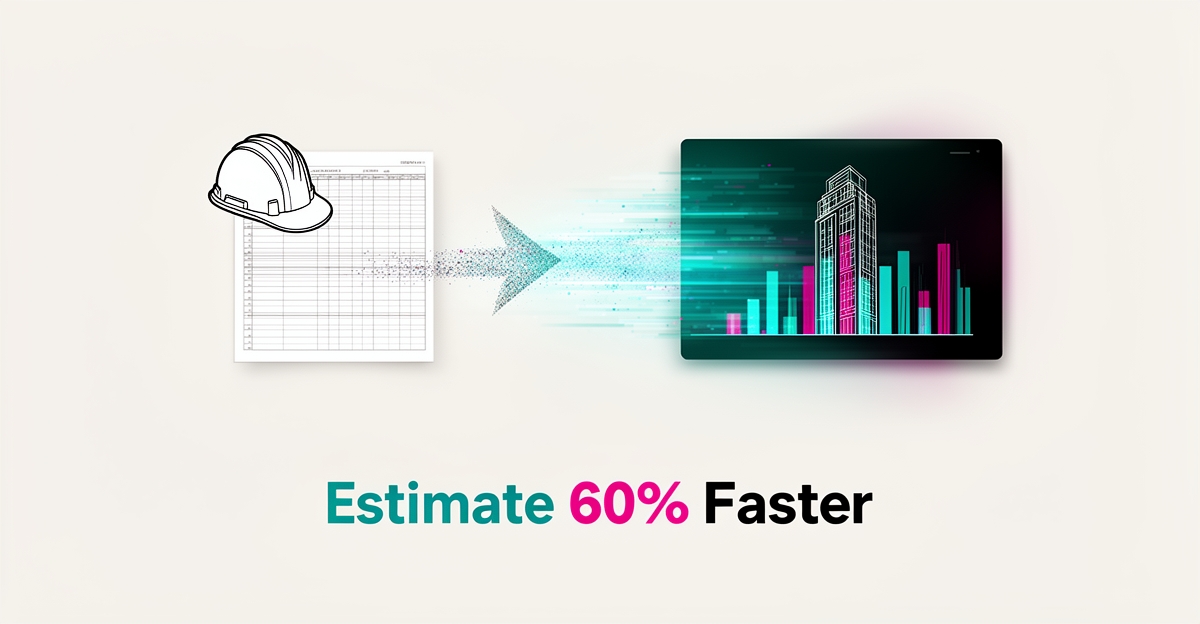
From Manual Sheets to AI: Transforming Construction Estimating Workflows
Key Facts
- Vendor-reported data from Houzz Pro suggests construction professionals can spend roughly 60% less time building estimates with AI-assisted tools
- The same vendor reporting points to faster client-ready schedules and expense creation when AI handles repetitive steps
- McKinsey's State of AI research has reported majority-level AI adoption among surveyed businesses for at least one function, with adoption continuing to climb through 2026
- The most common estimating bottlenecks are manual cost breakdowns, repeated material lookups, and inconsistent job classification
- AIQ Labs has deployed 200+ multi-agent systems and runs 4 live SaaS products daily
Hire a team member that works 24/7 — for less than a part-time wage.
AI receptionists, SDRs, dispatchers and 99+ roles. Trained on your business, fully managed.
Not sure where to start? Ask our AI planner
The Hidden Cost of Manual Estimating: Why Spreadsheets Are Holding You Back
The construction industry is at a crossroads. While some firms cling to manual spreadsheets and paper-based workflows, others are using AI-powered tools that turn estimating from a tedious chore into a strategic advantage. The gap between these two approaches is widening, and the cost of staying manual is higher than many realize.
Manual estimating is a time sink. Vendor-reported data from tools like Houzz Pro suggests professionals can spend on the order of 60% less time building estimates when AI handles the repetitive steps. Treat vendor figures as directional rather than guaranteed—your mileage depends on how manual your current process is—but the direction is consistent: every hour spent re-keying line items is an hour not spent bidding more work, refining proposals, or building client relationships.
The inefficiencies don't stop at estimates. Manual processes delay other critical workflows too: client-ready schedules, expense tracking, and takeoffs all slow down when the same data has to be entered again and again. These delays ripple through projects, pushing timelines and frustrating clients.
Errors compound the problem. Manual data entry, formula mistakes, and version control issues in spreadsheets lead to costly inaccuracies. McKinsey's State of AI research has reported majority-level adoption of AI for at least one business function among surveyed firms, and that share has only grown since. Firms that lag behind risk falling further as competitors automate repetitive tasks like cost breakdowns and material lookups.
The hidden costs of manual estimating include:
- Wasted hours on repetitive calculations and data entry
- Higher error rates leading to budget overruns or lost bids
- Slower response times to client requests and market changes
- Difficulty scaling operations without adding headcount
The competitive disadvantage is clear. Firms stuck in manual workflows aren't just slower—they're less agile, less accurate, and less profitable. AIQ Labs helps construction businesses break free from these constraints through AI Workflow Builds that rebuild the one workflow costing you the most—often estimating—on a fixed price, in phases.
The question isn't whether AI will reshape construction estimating—it's whether your business will lead the shift or struggle to catch up.
How AI Uncovers and Fixes Estimating Bottlenecks: The Process Mining Advantage
Legacy estimating workflows hide bottlenecks in plain sight — manual cost breakdowns, repeated material lookups, and inconsistent job classification that slow every bid.
Process mining makes those patterns visible. By analyzing how estimates actually get built, AI maps how data moves through spreadsheets, takeoffs, and approvals, then flags repetitive tasks that consume hours without adding value. AIQ Labs uses this discovery work to identify automation targets, then builds systems that reduce manual input and eliminate common estimation mistakes.
Vendor-reported figures from estimating platforms point to where automation pays first: less time building estimates, faster client-ready schedules, and quicker expense creation. Exact numbers vary by firm and workflow, but the pattern holds—automating repetitive steps is where the first gains show up.
Process mining typically surfaces three high-ROI friction points in construction estimating:
- Cost breakdowns that are rebuilt manually for each bid
- Material lookups across catalogs, suppliers, and past projects
- Job classification and coding inconsistencies that break reporting
Once mapped, automation replaces repetitive input with verified, repeatable logic. AI can auto-populate line items from plans, standardize classifications, and cross-check pricing against historical jobs, reducing errors that compound into margin loss.
Industry adoption keeps accelerating. McKinsey's State of AI research has reported majority-level adoption for at least one business function, and as of late 2026 AI use in construction and field services continues to expand from scheduling and takeoffs into estimating itself.
For estimators, that means moving from reactive cleanup to proactive control. Process mining reveals where manual rework happens, AI handles the repeatable work, and teams focus on pricing strategy and client relationships. The result is faster bids, cleaner data, and estimates that are both accurate and defensible.
AIQ Labs applies this approach through its AI Workflow Builds service—mapping the workflow that costs you the most, then rebuilding it in phases at a fixed price, with systems you integrate into your existing estimating and accounting tools.
From Insight to Action: Implementing AI in Your Estimating Workflow Without Disruption
Estimating teams can move from disruption to measurable gains when AI is introduced in phases, not all at once. A phased approach protects current projects while building a system that reduces manual input and eliminates common estimation mistakes.
Start with a workflow assessment using process mining to map how estimates are built today. Mapping reveals where cost breakdowns, material lookups, and job classification create bottlenecks and manual rework. AIQ Labs uses this discovery to design an implementation plan that aligns with existing systems like QuickBooks or Procore, so integration does not require rebuilding your stack.
Select tools that match the highest-impact pain points first. Vendor-reported results from estimating platforms consistently show the biggest early gains in estimate assembly, scheduling, and expense creation. These gains come from automating repetitive tasks, not replacing estimator judgment.
Integration should be practical and incremental. Connect AI to the tools estimators already use daily, automate data sync between takeoff, estimating, and accounting, and keep human review points for pricing decisions and exceptions. This reduces errors and preserves trust while the team adapts.
Training is the adoption lever. Short, role-specific sessions focused on reviewing AI outputs and handling exceptions drive confidence faster than broad overviews. Teams that understand where AI assists and where they decide perform better and adopt more quickly.
Monitor results against baseline metrics from the assessment phase. Track time per estimate, change order frequency, and rework hours to prove value early.
A practical rollout can follow these milestones:
- Assess and map current estimating workflows with process mining to find manual steps and error points
- Pilot AI on a single workflow such as material lookup or cost breakdown with integration to QuickBooks or Procore
- Train estimators on review and exception handling, then expand to scheduling and takeoffs
- Measure time saved, accuracy improvements, and adoption, then scale across departments
AIQ Labs' payment models support different risk profiles. Start Monthly lets teams begin with AI Employees—managed AI staff at roughly 80% less cost than a human hire—on a flat monthly plan that includes build, training, integrations, monitoring, and improvements. Build in Milestones splits a workflow rebuild into phases you approve and pay per phase. Own It Outright delivers an AI Operating System—one connected operating layer, built in phases, owned outright, code, agents, and data included.
With AI adoption across industries continuing to climb as of late 2026, a deliberate, phased rollout turns insight into action without disrupting the jobs already in progress.
Still paying for 10+ subscriptions that don’t talk to each other?
We build custom AI systems you own outright. No vendor lock-in. Full control.
Not sure where to start? Ask our AI planner
Frequently Asked Questions
How much time can AI save in construction estimating compared to manual methods?
What specific estimating tasks does AI automate to reduce errors and save time?
Will using AI in estimating require me to replace my current software like QuickBooks or Procore?
How do I know if AI will actually improve accuracy and not just speed up bad estimates?
Is AI adoption in construction estimating growing, or is it still niche?
What's the best way to start using AI in estimating without disrupting ongoing projects?
Turn Estimating Into Your Competitive Edge
The shift from manual spreadsheets to AI-powered estimating isn't just about saving time—it's about reclaiming strategic focus. Firms using AI report faster estimate assembly, quicker schedules, and fewer errors that lead to costly overruns. These gains come from targeting repetitive bottlenecks like cost breakdowns and material lookups through process mining, then automating them with verified, repeatable logic. The result isn't just faster bids—it's more accurate data, stronger client relationships, and the ability to scale without adding headcount. For construction businesses ready to move beyond manual workflows, the path forward starts with understanding where AI delivers the highest impact. Take the 2-minute Fit Check, then book a free 30-minute strategy call to map your biggest estimating bottleneck and see where automation can drive real value—without disrupting your current projects.
Make AI your competitive advantage — not just another tool.
Strategy, implementation and ongoing optimization. One partner, end to end.
Not sure where to start? Ask our AI planner