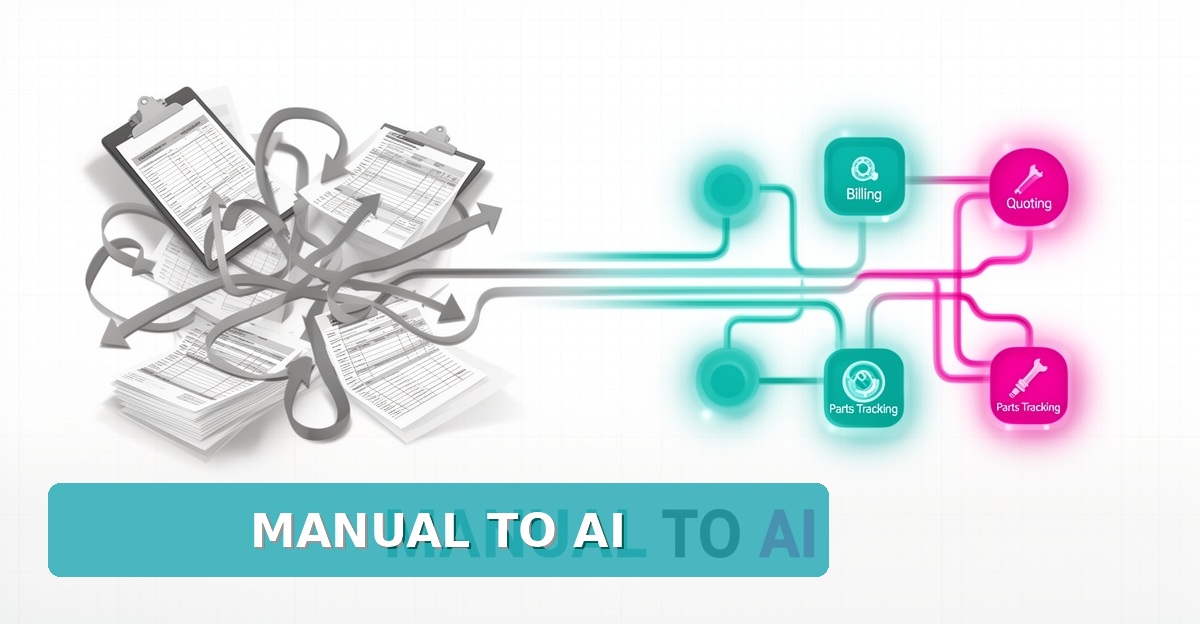
From Manual to AI: Transforming Back-Office Workflows in Collision Repair Centers
Key Facts
- Process mining can generate a digital twin of your organization, giving an end-to-end view of how work actually flows through billing, quoting, and parts tracking.
- Workflows with high AI exposure and low human-verification requirements typically deliver the fastest automation returns.
- Manual document handling—estimates, claims paperwork, invoices—consumers a disproportionate share of back-office staff time in most repair centers.
- Governance frameworks such as Microsoft's Cloud Adoption Framework recommend risk assessment and continuous monitoring before and during AI deployment.
- AIQ Labs has deployed 200+ multi-agent systems and runs four live SaaS products daily—production experience, not theory.
Hire a team member that works 24/7 — for less than a part-time wage.
AI receptionists, SDRs, dispatchers and 99+ roles. Trained on your business, fully managed.
Not sure where to start? Ask our AI planner
The Hidden Cost of Manual Back-Office Work in Collision Repair
Every manual billing entry, delayed quote, and misplaced parts order in a collision repair center quietly drains both time and profit. What appears as routine paperwork often conceals systemic inefficiencies that compound across dozens of daily transactions.
Process mining tools can generate a digital twin of an organization (DTO), providing an end-to-end overview of company processes. This visibility reveals exactly where manual workflows break down—whether in billing reconciliation, quote generation, or parts tracking.
The scope of manual inefficiency becomes clearer when examining specific operational areas:
- Billing reconciliation — Manual invoice processing creates delays and errors that ripple through cash flow management
- Quote generation — Time-consuming manual estimates delay customer responses and reduce conversion rates
- Parts tracking — Disconnected inventory systems lead to ordering delays and repair bottlenecks
- Data entry duplication — The same information gets manually entered across multiple systems, multiplying error opportunities
Large-scale document automation projects in other industries have shown that AI-assisted document analysis can cut manual review time dramatically. While collision repair centers handle different documents than financial contracts, the principle holds: manual document processing consumes disproportionate staff time.
Research on real-world AI adoption consistently finds that processes with high AI exposure and low verification requirements offer the fastest path to automation ROI. Back-office workflows like billing and parts tracking typically fall into this "golden quadrant."
Microsoft's Cloud Adoption Framework emphasizes that successful transformation begins with identifying existing inefficiencies before deploying solutions. For collision repair centers, this means conducting thorough process analysis to quantify exactly where manual workflows create the greatest operational drag.
At AIQ Labs, we've observed that most repair centers underestimate the cumulative cost of these manual processes by focusing only on direct labor hours, missing the downstream effects on customer satisfaction and repair cycle times.
Using Process Mining to Uncover Automation Opportunities
Most collision repair centers know their back office bleeds time and money, yet few can point to exactly where the leaks occur or which processes would benefit most from automation. Process mining solves this visibility problem by creating a digital twin of your organization—a dynamic, data-driven map that reveals how work actually flows through billing, quoting, and parts tracking operations.
This digital twin provides an end-to-end overview of company processes, enabling managers to compare actual workflows against optimized hypothetical scenarios. Instead of guessing which inefficiencies matter most, you see precisely where estimates stall, where parts orders bottleneck, and where billing errors compound. Industry analysis consistently ranks process mining among the most accessible yet impactful projects for identifying existing inefficiencies and achieving measurable savings.
Once you have this visibility, the next challenge involves deciding which workflows to automate first. Not every process offers equal return on investment. A practical prioritization framework rests on two critical factors: AI exposure and verification overhead.
The golden quadrant represents workflows with high AI exposure—meaning AI already handles these tasks effectively—combined with low human verification requirements. These processes offer the fastest deployment and quickest returns. For collision repair centers, this typically includes:
- Initial damage estimate generation and quote preparation
- Parts inventory tracking and automated reordering
- Customer status updates and appointment scheduling
- Insurance documentation processing and claims intake
- Invoice generation and payment processing
Contrast these with strategic business planning or regulatory compliance tasks, which typically demand extensive human verification to validate critical assumptions. While these high-stakes processes certainly benefit from AI assistance, they demand oversight that slows automation value.
AIQ Labs applies this methodology through AI Workflow Builds: we rebuild the one workflow that costs you the most, at a fixed price, in phases. By analyzing your specific billing cycles, parts procurement patterns, and customer communication workflows, we identify which processes sit in your golden quadrant and design targeted automation that delivers immediate efficiency gains without disrupting high-touch customer interactions.
The result is a prioritized transformation roadmap that replaces operational guesswork with data-driven confidence, ensuring your first AI implementation tackles the bottleneck costing you the most time and revenue.
Deploying Agentic AI and Governance for Sustainable Automation
Claims processing in collision repair centers is a multi-step chain where delays in one back-office task cascade into longer cycle times and eroded customer trust.
Agentic AI closes that gap by orchestrating autonomous systems that handle multi-step workflows from initiation to completion with minimal human intervention. For collision repair, this means an agent can intake a claim, validate coverage, order parts, schedule repair bays, and trigger billing without manual hand-offs.
Process mining provides the foundation for this automation. A digital twin of your organization provides an end-to-end overview of company processes and enables simulation to compare actual and hypothetical scenarios. That visibility reveals bottlenecks in billing, quoting, and parts tracking that are invisible in spreadsheets.
AIQ Labs builds tailored, production-grade automation on this foundation—200+ multi-agent systems deployed to date, plus four live SaaS products we run ourselves every day. For recurring back-office roles, AI Employees offer managed AI staff at roughly 80% less cost than a human hire, covering everything from receptionists to dispatchers.
Deployment starts with mapping the claims workflow and defining agent responsibilities. Autonomous agents are configured for reasoning and acting loops, with specialization for research, communication, data entry, and decisions. Integration connects the agents to CRM, estimating, parts catalogs, and accounting systems so actions execute in real time.
Governance is built in from the start. Microsoft's Cloud Adoption Framework guidance emphasizes conducting thorough risk assessments to identify the potential risks AI technology introduces to an organization.
A sustainable deployment framework includes:
- Risk assessment tied to AI task objectives, scope, and implementation
- Responsible AI principles covering privacy protection, reliability, safety, fairness, inclusivity, transparency, and accountability
- Policy documentation aligned with ethical standards, legal requirements, and business objectives
- Continuous monitoring to ensure systems perform as expected and risks are managed
Prioritization matters. Tasks with high AI exposure and low verification time—like document intake, status updates, and invoicing—fit the "golden quadrant" for rapid, scalable automation, while strategic planning demands hours of human verification and should come later in the roadmap.
The result is an end-to-end system that reduces manual review and error rates. When verification overhead is low, the compounding effect across hundreds of transactions is where the real savings show up.
With governance and monitoring embedded, agentic AI moves from pilot to production, delivering consistent throughput, auditable decisions, and measurable efficiency gains across the back office. When you're ready to connect everything—billing, quoting, parts, scheduling—into one operating layer you own outright, AI Operating Systems is the destination.
Still paying for 10+ subscriptions that don’t talk to each other?
We build custom AI systems you own outright. No vendor lock-in. Full control.
Not sure where to start? Ask our AI planner
Frequently Asked Questions
How much time is manual back-office work actually costing my collision repair center?
Where should I start if I can't see where the bottlenecks are?
Which back-office workflows are easiest to automate first?
Isn't AI governance too complex for a small repair shop?
Will automating back-office work hurt customer experience?
How do I know AI automation will actually pay off?
Turn Your Back Office Into Your Competitive Advantage
The path from manual back-office chaos to streamlined, AI-powered operations starts with visibility—using process mining to uncover where time and revenue are truly leaking in your collision repair center. By mapping your actual workflows against optimized scenarios, you gain the data-driven clarity needed to prioritize automation in high-impact areas like billing, quoting, and parts tracking—processes that sit in the 'golden quadrant' of high AI exposure and low verification overhead. The result isn't just faster cycle times or fewer errors; it's a foundation for scalable growth, improved customer satisfaction, and measurable ROI. AIQ Labs helps collision repair centers take this journey from assessment to implementation, building owned, production-grade AI systems that integrate with your existing tools—whether that's a single Workflow Build, managed AI Employees, or a full AI Operating System you own outright. To see where your biggest bottleneck lies, take the 2-minute Fit Check and book a free 30-minute strategy call—no obligation, just clarity on your AI opportunity.
Make AI your competitive advantage — not just another tool.
Strategy, implementation and ongoing optimization. One partner, end to end.
Not sure where to start? Ask our AI planner