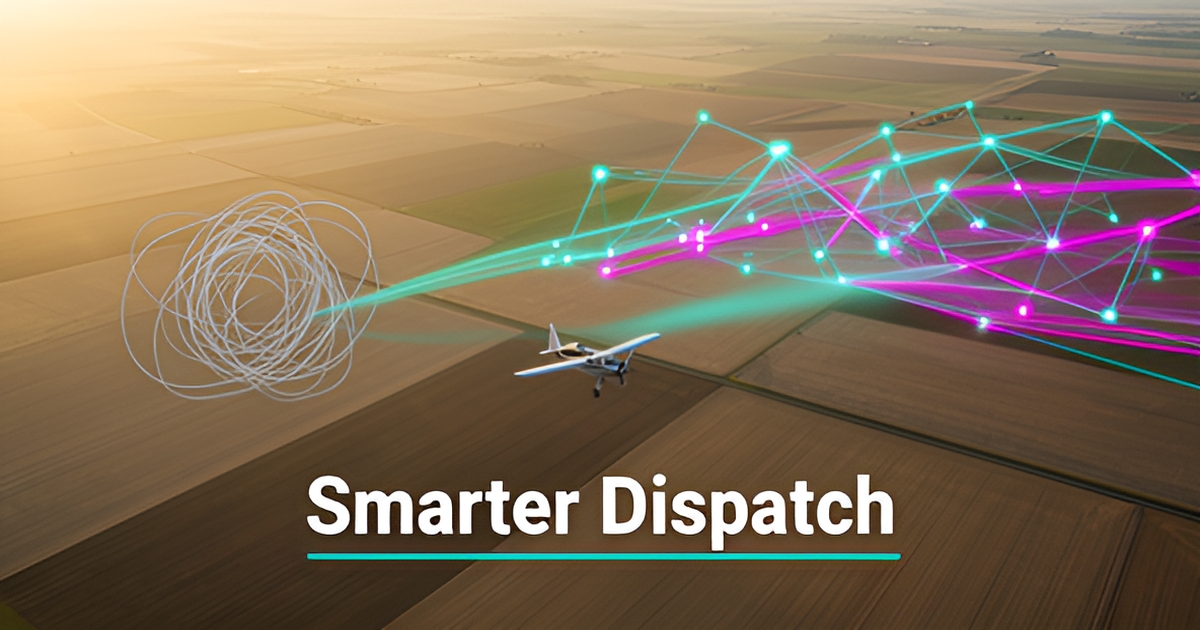
From Manual to AI: Transforming Crop Dusting Job Dispatch with Automation
Key Facts
- Industry fleet management analyses suggest manual dispatch costs fleets roughly 25% more in operating expenses than AI-optimized alternatives.
- A typical 25-vehicle fleet can lose tens of thousands of dollars annually from manual dispatch inefficiencies, according to fleet management research.
- AI dispatch typically cuts daily route planning from 1–2 hours to under five minutes, per dispatch comparison studies.
- AI can enable one dispatcher to manage 35–50 vehicles versus 10–12 manually, according to AI fleet analyses.
- Large farms over 5,000 acres have shown strong willingness — around 81% in recent strategic agriculture research — to adopt AI.
- AI-driven crop monitoring can improve yield prediction accuracy by up to 30%, per agriculture case studies.
Hire a team member that works 24/7 — for less than a part-time wage.
AI receptionists, SDRs, dispatchers and 99+ roles. Trained on your business, fully managed.
Not sure where to start? Ask our AI planner
The Cost of Manual Crop Dusting Dispatch
For many agribusinesses, the dispatch office remains a bottleneck of phone calls, scribbled notes, and spreadsheet juggling. This manual approach creates a cascade of operational friction: double-booked aircraft, pilots dispatched to the wrong fields, and critical weather windows missed while coordinators scramble to confirm details. Fleet management analyses suggest manual dispatching costs fleets roughly 25% more in total operating expenses than AI-optimized alternatives — losses that come from fuel inefficiency, overtime, and administrative overhead.
- Route planning consumes 1–2 hours daily versus under five minutes with automation
- Mid-day rerouting takes 15–45 minutes manually compared to 30–90 seconds with AI
- Compliance reporting demands 3–5 hours weekly versus automatic generation
- Dispatcher-to-vehicle ratios stall at 1:10–12 instead of scaling to 1:35–50
These inefficiencies are magnified in crop dusting, where timing is agronomic, not just logistical. A delay of hours can mean the difference between controlling a pest outbreak and losing a crop block. Every operation reaches an inflection point where manual processes that work today simply cannot scale tomorrow. AIQ Labs addresses this by building custom automation systems that ingest GPS data, live weather feeds, and field specifications to assign the right aircraft to the right job in seconds — eliminating the phone-tag and guesswork that erode margins and trust with growers.
How AI Dispatch Optimizes Field Work in Real Time
The moment a spray plane lifts off, the clock starts ticking on fuel, chemical efficacy, and weather windows. Manual dispatch relies on static maps and radio chatter, leaving operators blind to shifting winds or last-minute field changes. AI-driven dispatch flips that model by ingesting live GPS telemetry, hyper-local weather feeds, soil composition data, and field boundaries to calculate optimal job sequences in seconds rather than hours.
Dispatch comparison studies indicate AI dispatch can reduce planning time from two to four hours down to under five minutes while processing thousands of assignment combinations simultaneously. For agricultural fleets, this typically translates to a 10–15% reduction in fuel consumption and a 20–35% drop in overtime and idle time. Fleet management analyses consistently find manual dispatching costs fleets roughly 25% more in total operating expenses, driven by fuel inefficiency and administrative overhead.
- Real-time weather integration prevents application during inversion layers or high winds
- Soil type and field size analytics match the right aircraft and payload to each job
- GPS-based fleet tracking enables dynamic rerouting when conditions change mid-day
- Automated compliance logging eliminates paper records and reduces regulatory risk
AIQ Labs builds these automation layers directly into existing fleet management tools, connecting disparate data streams into a single dispatch intelligence engine. The system learns from every completed job, continuously refining its assignment logic to account for pilot experience, equipment maintenance windows, and historical field performance. This shift from reactive scheduling to predictive optimization is where precision farming ROI moves from projection to balance sheet reality.
From Reactive to Proactive: Data That Drives Spray Decisions
The shift begins with what the human eye cannot see. Every crop carries a unique spectral fingerprint across visible, near-infrared, and thermal wavelengths — data that AI-driven remote sensing decodes to identify stress before visual symptoms appear. This capability moves agricultural operations from reactive scheduling to proactive intervention, where spray decisions originate from field intelligence rather than calendar dates.
Research on spectral signatures indicates AI models trained on diverse crop species can distinguish water, nutrient, and disease pressure at early stages. When this remote sensing data feeds directly into dispatch systems, operators gain a living map of field priority that updates with every satellite pass and drone flight. The result is a precision workflow where aircraft deploy only where thresholds are breached, reducing unnecessary applications and optimizing chemical use.
- Early stress detection via spectral analysis before visual symptoms emerge
- Yield prediction accuracy improvements up to 30% through AI-driven monitoring
- Real-time field prioritization replacing fixed calendar schedules
- Integration of multispectral imagery, ground sensors, and weather feeds
- Automated job creation triggered by data thresholds, not phone calls
This data-driven approach mirrors what fleet management research demonstrates across industries: AI optimization reduces planning time from hours to minutes while cutting total operating expenses by roughly 25%. For crop dusting operations, the variables multiply — field size, soil type, crop stage, wind windows, and buffer zones all factor into each assignment. Market analyses show large farms (over 5,000 acres) lead adoption at roughly 81%, recognizing that manual dispatch cannot scale with this complexity.
Dispatch comparison studies show AI systems process thousands of assignment combinations simultaneously, factoring distance, capacity, and timing constraints that overwhelm human planners. AIQ Labs applies this same multi-variable optimization to agricultural aviation, building dispatch automation that ingests GPS boundaries, live weather feeds, and fleet telemetry to generate optimal daily plans. The system doesn't just assign jobs — it continuously rebalances as conditions shift, ensuring the right aircraft reaches the right field at the right moment.
Building an Owned AI Dispatch System with AIQ Labs
Moving from spreadsheets to an intelligent dispatch engine requires a structured integration layer that connects GPS telemetry, live weather feeds, and existing fleet management tools into a single decision loop. Dispatch comparison analyses indicate AI dispatch can reduce planning time from hours to under five minutes while processing thousands of assignment combinations across distance, capacity, and time windows. For agricultural aviation, this means factoring in field boundaries, crop stage, and wind thresholds before a pilot ever leaves the hangar.
AIQ Labs approaches this through three entry points that match how businesses actually buy technology. AI Employees gives you a managed AI Dispatcher — built, trained, integrated, and continuously optimized — at roughly 80% less cost than a human hire. Workflow Builds rebuilds the one workflow that costs you the most, at a fixed price and in phases you approve. AI Operating Systems delivers one connected operating layer across your business, built in phases and owned outright. Payment is equally flexible: Start Monthly, Build in Milestones, or Own It Outright — no fake prices, no invented case-study numbers.
- GPS and telemetry integration for real-time aircraft positioning and route adherence
- Weather API ingestion with wind, precipitation, and thermal inversion alerts
- Fleet management sync for maintenance windows, pilot certifications, and chemical inventory
- Field data layer incorporating soil type, crop variety, and application history
- Automated compliance logging for regulatory reporting and audit trails
The technical foundation relies on multi-agent architectures where specialized agents handle routing optimization, regulatory checks, and customer communication simultaneously. AIQ Labs has deployed 200+ multi-agent systems and runs four live SaaS products daily — this is proven infrastructure, not experimental tooling. Implementation follows a phased arc: discovery and architecture, development and integration, deployment and training, then continuous optimization — each phase designed to de-risk the transition while delivering measurable wins at every stage.
Still paying for 10+ subscriptions that don’t talk to each other?
We build custom AI systems you own outright. No vendor lock-in. Full control.
Not sure where to start? Ask our AI planner
Frequently Asked Questions
How much does manual dispatch actually cost a crop dusting operation compared to AI?
Can AI dispatch really react faster than my experienced coordinator during weather changes?
How does AI know which fields need spraying before the crops show visible damage?
Is AI dispatch overkill for a small agricultural aviation business?
Will AI dispatch replace my human dispatchers or work with them?
What specific data does an AI dispatch system need to integrate with my existing tools?
The Runway Ahead: From Dispatch Chaos to Precision Control
Manual dispatch isn't just an operational headache — it's a measurable profit leak. Industry analyses point to roughly 25% higher operating costs, dispatcher ratios that cap growth at 1:12 instead of scaling to 1:50, and planning cycles measured in hours instead of minutes. AI-driven dispatch flips the equation: planning drops from hours to minutes, fuel consumption typically falls 10–15%, and compliance becomes automatic instead of a weekly time sink. For crop dusting operations where weather windows and field conditions change by the hour, the shift from reactive scheduling to predictive optimization isn't optional — it's the difference between protecting a crop and losing it. AIQ Labs builds these systems as owned assets, not rented tools, integrating GPS telemetry, live weather, and fleet data into a single dispatch intelligence engine that learns from every job. Whether you start with an AI Employee on a monthly plan or build a full AI Operating System in phases, the entry point is the same: the two-minute Fit Check, followed by a free 30-minute strategy call to map your biggest bottleneck and identify the highest-ROI win. The question isn't whether to automate — it's how fast you can capture the savings.
Make AI your competitive advantage — not just another tool.
Strategy, implementation and ongoing optimization. One partner, end to end.
Not sure where to start? Ask our AI planner