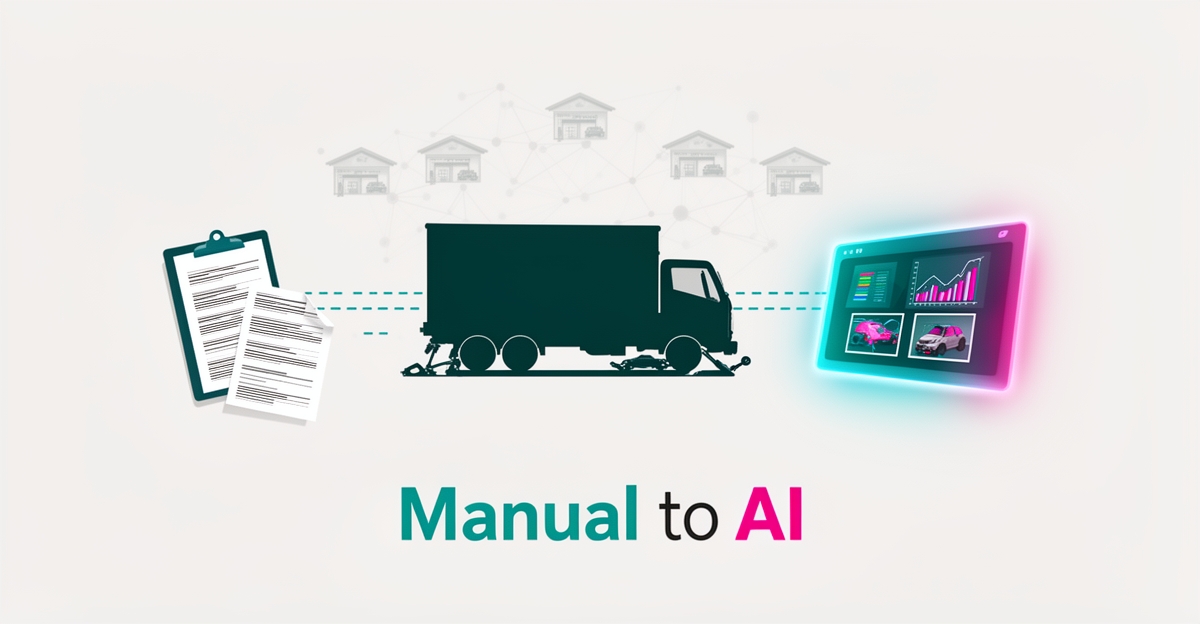
From Manual to AI: Transforming Daily Operations in a Fleet Collision Repair Shop
Key Facts
- Major fleet operators like Penske run collision repair centers across multiple states, including Alabama, Arizona, California, and more according to their service pages
- Repair centers typically operate on varied schedules, with 24-hour operations at select locations like Channahon, IL and Woodland, CA based on market demand
- Services commonly cover commercial vehicles from light-duty trucks to heavy-duty trucks and 12 ft. to 53 ft. trailers as part of comprehensive offerings
- Penske emphasizes 'highly detailed estimates with photos' to eliminate guesswork in repair decisions per service standards
- The organization provides 'complete visibility into repairs' enabling proactive decision-making for fleet managers as a core service promise
- End-to-end collision repair without requiring multiple providers reduces complexity and delays through one-stop shop capability
- Certified technicians perform specialized repairs including computerized color matching and certified welding on aluminum, fiberglass, and metton ensuring top-notch repairs
Hire a team member that works 24/7 — for less than a part-time wage.
AI receptionists, SDRs, dispatchers and 99+ roles. Trained on your business, fully managed.
Not sure where to start? Ask our AI planner
The Hidden Costs of Paper-Based Collision Repair Workflows
Fleet collision repair shops relying on paper-based workflows face operational bottlenecks that undermine scalability and consistency—even for operators managing large multi-location networks. Manual estimate creation, where technicians handwrite assessments and attach physical photos, introduces delays and inconsistencies that ripple through the entire repair lifecycle. Industry leaders like Penske Truck Leasing highlight the expectation for "highly detailed estimates with photos" as a standard for transparent decision-making, yet paper-based systems struggle to deliver this level of detail uniformly across shifts, locations, or estimators. This fragmentation leads to rework, misaligned expectations with insurers, and extended vehicle downtime—directly impacting fleet operators who depend on predictable repair timelines.
The absence of centralized digital documentation exacerbates communication gaps between estimators, technicians, parts coordinators, and customer service teams. When photo evidence lives in physical folders or disparate email threads, critical damage details can be overlooked, misinterpreted, or lost entirely—particularly in high-volume environments handling light-duty to 53-foot trailers across varied operating hours. The industry emphasis on "complete visibility into repairs" to empower proactive decisions becomes nearly impossible when information is siloed in paper trails, forcing managers to spend excessive time chasing down updates rather than optimizing workflow. These inefficiencies compound during peak seasons or emergency surges, where the lack of real-time data sharing prevents agile resource allocation across geographically dispersed facilities.
Ultimately, paper-based systems create a ceiling on operational excellence that even well-resourced shops cannot bypass without digital transformation. The challenge of maintaining quality consistency across dozens of locations—each potentially operating on different schedules and service specializations—becomes unmanageable when estimates, approvals, and repair notes rely on manual handoffs. Without a unified digital foundation, shops cannot achieve the standardized processes that minimize guesswork and ensure reliable outcomes. This infrastructure gap not only limits current productivity but also blocks the adoption of advanced capabilities like AI-driven damage assessment or predictive parts ordering, leaving manual shops perpetually reactive rather than proactive in serving commercial fleets. Addressing these workflow limitations is the critical first step toward sustainable, AI-enhanced transformation.
Mapping Your Path from Manual to AI-Driven Operations
Starting the transformation journey requires a clear-eyed assessment of where your shop stands today. Large nationwide networks like Penske's collision repair centers set a benchmark for operational maturity, particularly through their emphasis on highly detailed estimates with photos and complete repair visibility—practices that eliminate guesswork and build customer trust. These standards highlight what digital maturity looks like in action: standardized documentation, transparent workflows, and proactive decision-making enabled by integrated systems.
To begin your own assessment, audit every step from initial damage documentation through final insurance coordination. Map how estimators currently capture damage—whether through handwritten notes, basic photos, or fragmented digital tools—and trace how that information flows to technicians, parts coordinators, and insurance adjusters. Look for pain points where manual handoffs create delays, where photos get lost in email threads, or where estimators spend excessive time re-entering data across systems. These friction points represent high-value automation opportunities.
Focus especially on the estimate generation and damage documentation phases, where mature operators show significant value. When estimators create detailed, photo-rich assessments at the customer's location or facility, they reduce uncertainty for both the shop and the insurer. Yet in many shops, this process remains paper-based or siloed in disconnected apps, leading to inconsistent documentation, missed damage items, and prolonged approval cycles. AI-driven tools can standardize this workflow—guiding technicians through structured capture protocols, automatically organizing visual evidence, and generating preliminary estimates that align with OEM procedures and insurance requirements.
Similarly, examine how repair visibility is currently provided to fleet managers and insurance partners. If status updates rely on phone calls or periodic emails, there's a clear opportunity to implement real-time tracking that mirrors the proactive decision-making model used by leading networks. Automation here doesn't just reduce administrative burden—it transforms the customer experience by turning repair progress into a transparent, predictable process.
This assessment phase isn't about adopting technology for its own sake. It's about identifying where manual processes introduce risk, inefficiency, or customer dissatisfaction—and where AI can deliver measurable improvements in accuracy, speed, and transparency. By grounding your strategy in the operational excellence demonstrated by industry leaders, you ensure that every step toward automation solves a real problem and moves your shop closer to true digital maturity. For shops ready to begin, AIQ Labs' AI Workflow Builds rebuild the one workflow that costs you the most—fixed price, in phases—starting with a workflow analysis that pinpoints where automation will deliver the highest return on investment.
Building the Digital Foundation: Process Automation and Integration
Fleet collision repair lives or dies on repeatable execution across dozens of sites, varied hours, and high-stakes insurance workflows. Manual estimates, phone updates, and siloed shop management create lag that fleets cannot afford.
Building a digital foundation starts with standardizing the core repair lifecycle that already exists in mature networks. Penske operates collision repair centers across multiple states including Alabama, Arizona, California, Colorado, Connecticut, Florida, Georgia, Illinois, Indiana, Kentucky, Louisiana, Maine, Maryland, and Michigan with a nationwide service network. That scale demands consistent estimate quality, photo documentation, and visibility from intake to delivery.
AI-powered estimate generation with photo analysis replaces paper-based assessments. Experienced estimators at leading networks perform highly detailed repair estimates with photos to take the guesswork out of the repair process according to industry service standards. Computer vision models can ingest those photos at intake, auto-tag damage, suggest parts and labor hours, and pre-fill carrier forms, cutting estimator cycle time while preserving human review for complex frame and alignment work.
Automated customer visibility systems close the communication gap. The market expects complete visibility into repairs, empowering you to make proactive decisions confidently as a core service promise. Integrated management platforms push real-time status, photo updates, and ETAs to fleet managers and drivers, reducing inbound status calls and aligning expectations across locations with varied schedules.
Digital insurance carrier coordination removes administrative friction. Direct correspondence with all insurance carriers streamlines claims and reduces burden on customers. An integrated system can route estimates, capture approvals, and sync billing automatically, maintaining audit trails required for commercial fleets.
Maintaining consistent service quality across varied operating hours and locations requires integrated management platforms. Repair centers typically operate with varied schedules, including 24-hour operations at select locations while others maintain standard business hours reflecting market demand differences. A unified platform ensures a 24-hour site and a standard-hours site use the same workflow, parts catalog, and reporting.
Process automation and integration typically involves:
- Photo-first intake with AI damage classification and automated estimate drafting
- Centralized repair tracking with automated notifications to customers and carriers
- Digital work order routing that respects location capabilities such as body and paint, truck body and trailer repair, frame & alignment, and decaling
- Unified dashboards for service advisors to monitor throughput across the fleet network
This technical transformation mirrors the step-by-step path from paper-based records to AI-driven operations. Process mapping, staff training, and tech integration are sequenced so shops retain service quality while gaining speed. When shops are ready to connect these workflows into one operating layer, AIQ Labs' AI Operating Systems build that layer in phases—owned outright, not rented.
The result is a digital backbone that standardizes excellence without standardizing the human expertise that certified technicians provide for a wide range of commercial vehicles.
Managing the Human Side of AI Adoption in the Shop
Change management often determines whether AI transformation succeeds or stalls in collision repair environments. When industry leaders emphasize that their "certified technicians are highly skilled, ensuring top-notch repairs for a wide range of commercial vehicles," this highlights the human expertise that must remain central even as AI systems handle documentation and workflow coordination.
The transition from paper-based estimates to AI-enhanced workflows requires careful attention to how certified technicians adapt to digital tools. The practice of providing "highly detailed estimates and photos to take the guesswork out of the repair process" demonstrates how documentation standards can evolve without compromising the technical judgment that experienced estimators bring to frame alignment assessments and damage evaluation.
Successful change management in collision repair environments focuses on several critical areas:
- Role-specific training that shows technicians how AI handles routine documentation while preserving their expertise in complex repair decisions
- Gradual workflow transitions that maintain service quality during the learning curve
- Clear communication about how AI tools enhance rather than replace human skills
- Feedback systems that let staff influence how new technologies integrate into daily operations
The complexity of modern collision repair—from computerized color matching to certified welding on aluminum, fiberglass, and metton—requires training programs that respect existing technical knowledge. Staff need to understand how AI documentation supports their craftsmanship rather than questioning it.
Maintaining service quality during transition periods demands careful coordination. When repair facilities operate at the scale of large multi-location networks across North America, consistency becomes paramount. AI systems can help standardize documentation and customer communication, but only when technicians understand how these tools support their repair expertise.
The most effective approach involves positioning AI as a tool that eliminates administrative burden. Instead of spending time on paperwork, estimators can focus on damage assessment while AI handles insurance correspondence and repair documentation. This shift allows shops to maintain the "complete visibility into repairs" that customers expect while reducing manual overhead. AIQ Labs' AI Employees—managed AI staff covering reception, dispatch, and 99+ other roles at roughly 80% less cost than a human hire—take on exactly this kind of administrative load.
Sustainable transformation requires more than technology deployment. Change management strategies must give certified technicians and estimators training programs that build confidence in AI tools while preserving the technical expertise that drives quality repairs and customer satisfaction.
Scaling AI Operations: From Single Shop to Network-Wide Intelligence
The final transformation stage separates industry leaders from followers: successfully scaling AI capabilities across multiple locations while preserving the personalized service that defines exceptional customer experiences. This expansion phase requires sophisticated orchestration that maintains consistency without sacrificing the human touch.
Consider the complexity of managing a network like Penske's collision repair operations, which spans locations across the United States and Canada. The organization operates facilities with varying service hours—from standard business operations to 24-hour availability in select markets. This operational diversity demonstrates the challenges of maintaining service consistency while adapting to local market demands.
AIQ Labs addresses these scaling challenges through a phased implementation approach that begins with pilot automation projects and evolves into comprehensive operational intelligence. Each expansion stage is sequenced so that AI systems enhance rather than replace the customer-centric approach that drives loyalty and referrals.
The scaling process typically follows a structured pathway:
- Pilot location optimization — Perfect AI workflows at a flagship location before network-wide deployment
- Standardized intelligence — Implement consistent AI processes while allowing for local market customization
- 24/7 capability expansion — Deploy AI Employees to support round-the-clock operations at select locations
- Cross-location learning — Enable AI systems to share insights and improvements across the entire network
- Geographic expansion support — Use AI infrastructure to rapidly establish operations in new markets
The most successful scaling initiatives maintain what industry leaders describe as "complete visibility into repairs, empowering you to make proactive decisions confidently." AI systems excel at providing this transparency across multiple locations, ensuring customers receive consistent communication regardless of which facility handles their repair.
Network-wide AI implementation enables capabilities that single-location shops cannot achieve. Centralized intelligence can optimize resource allocation across facilities, predict demand patterns by region, and ensure that specialized services—whether frame alignment, decaling, or aluminum welding—are efficiently distributed based on local capacity and expertise.
The transformation extends to supporting diverse vehicle portfolios, from light-duty trucks to heavy-duty commercial vehicles and trailers ranging from 12 to 53 feet. AI systems can intelligently route vehicles to facilities with appropriate capabilities while maintaining the one-stop shop convenience that customers value, even across a distributed network.
Geographic expansion becomes more manageable when AI provides the operational backbone. New locations can launch with proven processes, established customer communication protocols, and immediate access to network-wide intelligence—dramatically reducing the time and risk typically associated with market expansion.
Still paying for 10+ subscriptions that don’t talk to each other?
We build custom AI systems you own outright. No vendor lock-in. Full control.
Not sure where to start? Ask our AI planner
Frequently Asked Questions
What are the main problems with paper-based workflows in fleet collision repair shops?
How do leading fleet operators set a benchmark for digital maturity in collision repair?
Can AI tools replace estimators and technicians in collision repair shops?
What specific AI capabilities help standardize estimates and damage documentation?
How do collision repair shops maintain consistency across locations with different hours and specialties when adopting AI?
What is the recommended first step for a collision repair shop starting its AI transformation?
Your Shop's Next Move Isn't More Paper, It's Smarter Operations
Moving from manual, paper-based workflows to AI-driven operations isn't about replacing technicians—it's about removing the friction that keeps fleet collision repair shops reactive. Standardizing photo-first intake, automated estimate drafting, and real-time repair visibility creates the consistency that leading nationwide networks demonstrate across their service footprint, while freeing certified estimators to focus on judgment, not paperwork. The path starts with mapping where handoffs create delays, then building a digital foundation that preserves service quality during transition and scales intelligence across sites. For shops ready to assess high-ROI automation opportunities, start with the 2-minute Fit Check at https://aiqlabs.ai/apply and book a free 30-minute strategy call at https://aiqlabs.ai/book to map your biggest bottleneck and build a practical roadmap tailored to your operation.
Make AI your competitive advantage — not just another tool.
Strategy, implementation and ongoing optimization. One partner, end to end.
Not sure where to start? Ask our AI planner