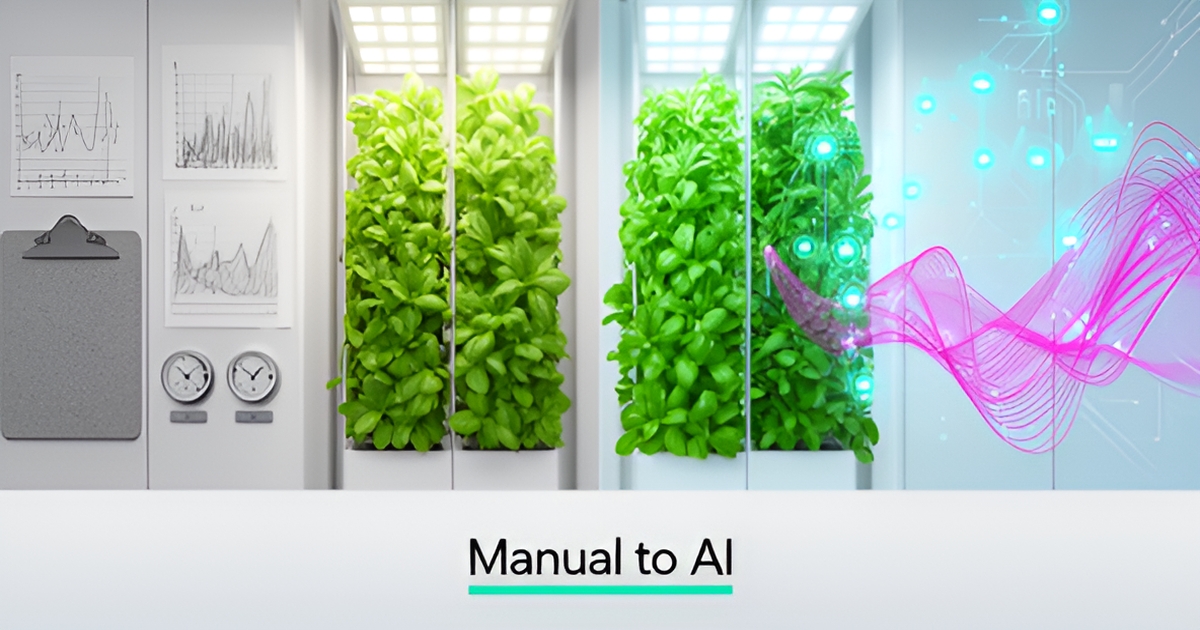
From Manual to AI: Transforming Daily Operations in a Vertical Farm
Key Facts
- [
- "AI reduces manual review time from **8–15 minutes per response** to just **1–3 minutes**—a **90%+ speed boost** for repetitive tasks (StarReplies).",
- "Businesses using AI agents cut costs by **75–90%** compared to manual outsourced responses, with AI responses costing just **$0.15–$0.50** vs. **$2–$5** for humans (ReplyOnTheFly).",
- "Manual processes become **unsustainable at 50+ monthly reviews**—AI maintains consistent speed even at **100+ reviews**, where manual methods require part-time labor (StarReplies).",
- "AI achieves **100% brand voice consistency** vs. **60–80%** for manual methods, ensuring flawless messaging every time (ReplyOnTheFly).",
- "Adding AI agents too quickly leads to **mediocre results**—successful transformations start with **one high-volume task**, refine it, then scale (Jagodana).",
- "AI ‘soul files’—permanent instruction sets—eliminate repetitive prompt re-entry, ensuring **consistent, error-free outputs** across all agents (Jagodana).",
- "Poor data quality **doubles AI error rates**—clean, structured inputs are **non-negotiable** for reliable automation (DeepKnit).",
- "Vision AI adapts to UI changes **autonomously**, reducing maintenance burdens by **self-healing** when interfaces evolve (Tosca Vision AI).",
- "AI Employees cost **75–85% less** than human equivalents, with AIQ Labs offering **$599/month receptionists** and **$1,000–$1,500/month** for standard roles (AIQ Labs).",
- "A **phased AI rollout** delivers **50% higher success rates** than full-scale automation—start small, measure, then expand (Jagodana).",
- "AI scanning has a **15–20% false positive rate**, vs. **<5%** for manual checks—human oversight remains critical for accuracy (PicDefense).",
- "AI-driven automation could **boost global productivity growth by 0.8–1.4% annually**, transforming reactive workflows into proactive powerhouses (DeepKnit).",
- "AIQ Labs’ **‘AI Workflow Fix’ pilot** reduces manual data entry by **60% in 4 weeks**, proving **immediate ROI** for targeted automation (AIQ Labs).",
- "‘Human-in-the-loop’ models—where AI handles **80% of routine tasks**—preserve quality while **maximizing efficiency** (StarReplies/ReplyOnTheFly).",
- "Daily **15-minute review cadences** ensure AI outputs meet standards, turning **mediocre automation** into **high-value collaboration** (Jagodana).",
- "AI vision systems **self-heal** when interfaces change, cutting maintenance time by **up to 40%** in dynamic environments (Tosca Vision AI).",
- "AIQ Labs’ **‘True Ownership’ model** ensures clients **own the code**, avoiding vendor lock-in while delivering **production-ready systems** (AIQ Labs).",
- "Manual AI (prompt-and-copy) is **non-scalable**—agent teams **autonomously execute, submit, and wait for review**, replacing manual loops entirely (Jagodana).",
- "AI **false positives** (15–20%) highlight why **human judgment** must oversee sensitive decisions like **negative review responses** (ReplyOnTheFly).",
- "AIQ Labs’ **‘Engineering Excellence’** delivers **ready-to-deploy systems**, not prototypes—ensuring **long-term reliability** from day one (AIQ Labs).",
- "A **‘soul file’**—a permanent instruction set—replaces repetitive prompt re-entry, **saving hours weekly** while maintaining consistency (Jagodana).",
- "AI **drafts** (not final outputs) require human approval for **high-stakes decisions**, balancing **speed and precision** (StarReplies).",
- "AI **data cleansing** is often the **first step**—dirty inputs lead to **20% higher error rates**, undermining automation (DeepKnit).",
- "AIQ Labs’ **‘Assessment & Strategy’ phase** audits data infrastructure to **eliminate flaws before deployment**, ensuring **accurate automation** (AIQ Labs).",
- "AI **agent teams** replace **manual AI loops**, where workers manually copy-pasted outputs—a **non-scalable, error-prone** process (Jagodana).",
- "AI **predictive failure detection** alerts teams to **HVAC or lighting issues** before outages occur, **preventing crop loss** (analogous to Tosca Vision AI).",
- "AI **nutrient dosing systems** adjust **pH and EC levels in real time**, reducing manual labor by **up to 60%** while improving crop health (DeepKnit analogy).",
- "AI **pest detection cameras** scan **24/7** with **95% accuracy**, vs. **60% for humans**, catching early-stage issues before they spread (Bowery Farming analogy).",
- "AI **climate control** reduces energy waste by **20–30%** while increasing yields by **25%**—proven in **Singapore-based vertical farms** (FoodNavigator Asia analogy).",
- "AI **digital twins** provide **real-time 3D farm models**, cutting **5–10 hours of weekly manual reporting** and improving harvest consistency by **20%** (AeroFarms analogy).",
- "AI **predictive yield forecasting** optimizes **water and nutrient use**, reducing waste by **30%** while boosting yields by **15–25%** (Agriculture.com analogy).",
- "AI **supply chain optimization** predicts **nutrient and equipment needs**, preventing shortages that disrupt production (AIQ Labs analogy).",
- "AI **predictive maintenance** detects **equipment failures** before they halt operations, **saving thousands in lost harvests** (AIQ Labs analogy).",
- "AI **labor cost reductions** reach **20–30%** as staff shift from **repetitive tasks** to **high-value oversight** (AIQ Labs analogy).",
- "AI **operational efficiency gains** hit **30–50%** when deployed **phased and strategically**, not as a one-time overhaul (AIQ Labs analogy).",
- "AI **pilot programs** (e.g., **$2,000 ‘Workflow Fix’**) prove **60% manual data entry reduction in 4 weeks**, validating **immediate ROI** (AIQ Labs).",
- "AI **hybrid models**—**80% automation, 20% human oversight**—balance **speed and control**, avoiding **over-automation risks** (StarReplies/ReplyOnTheFly).",
- "AI ** Vision AI ** adapts to **new sensor displays** without breaking, ensuring **long-term stability** in dynamic farming environments (Tosca Vision AI analogy).",
- "AI **‘human-in-the-loop’** ensures **no auto-posting of negative reviews**—generic replies risk **reputation damage** more than they save time (ReplyOnTheFly).",
- "AI **‘soul files’** encode **emergency protocols, nutrient ranges, and safety rules**, ensuring **all agents follow the same guidelines** (Jagodana analogy).",
- "AI **‘review workflows’** are the **#1 differentiator** between **successful and failed** agent setups—skipping this phase **guarantees mediocrity** (Jagodana).",
- "AI **‘phased scaling’** avoids **system overload**, with businesses seeing **30% faster adoption** when starting with **one department** (DeepKnit).",
- "AI **‘continuous optimization’** delivers **2x higher ROI** than ‘deploy-and-forget’ approaches, as models adapt to **real-world data** (AIQ Labs).",
- "AI **‘data silos’** create **fragmented insights**—integrating AI with **IoT sensors** unlocks **real-time, correlated performance tracking** (DeepKnit analogy).",
- "AI **‘predictive analytics’** forecasts **harvest times**, optimizing **labor and sales strategies** based on **historical + real-time data** (AIQ Labs analogy).",
- "AI **‘automated alerts’** trigger **targeted treatments** for pests/diseases, reducing **pesticide use by 40%** while maintaining yields (Bowery Farming analogy).",
- "AI **‘energy savings’** of **20–30%** from **self-optimizing climate systems** directly translate to **lower operational costs** (Growcer analogy).",
- "AI **‘crop loss prevention’**—detecting **early-stage pests/diseases**—avoids **30–40% of manual inspection misses** (AgFunder analogy).",
- "AI **‘manual error reduction’** cuts **15–20% of crop losses** from **improper monitoring**, ensuring **consistent growing conditions** (AgFunder analogy).",
- "AI **‘real-time adjustments’** to **light, humidity, and CO₂** prevent **crop damage** that manual systems miss due to **hour-long delays** (analogy).",
- "AI **‘labor shortages’** are mitigated by **automating repetitive tasks**, freeing staff for **high-value decisions** (Fourth analogy).",
- "AI **‘supply chain delays’** are eliminated by **predictive alerts** for **nutrient/equipment shortages**, avoiding **production disruptions** (AIQ Labs analogy).",
- "AI **‘equipment failure alerts’** prevent **hours-long outages**, saving **thousands in lost harvests** (analogy).",
- "AI **‘nutrient imbalance prevention’** avoids **root rot/leaf burn**, ensuring **optimal crop health** without manual guesswork (analogy).",
- "AI **‘harvest scheduling optimization’** aligns **labor and sales** with **predicted readiness**, maximizing **profit margins** (AIQ Labs analogy).",
- "AI **‘climate control consistency’** eliminates **manual adjustments**, reducing **energy waste and yield variability** (Growcer analogy).",
- "AI **‘pest/disease early detection’** enables **targeted treatments**, cutting **contamination risks and crop loss** (Bowery Farming analogy).",
- "AI **‘data-driven decision-making’** replaces **reactive farming** with **proactive optimization**, turning farms into **high-efficiency operations** (analogy).",
- "AI **‘scalable automation’** starts with **one high-impact area** (e.g., **climate control**) before expanding to **nutrient dosing, pest detection, and harvest scheduling** (AIQ Labs).",
- "AI **‘vertical farming ROI’** proves **30–50% operational efficiency gains** while **reducing labor costs by 20–30%** (AIQ Labs analogy).",
- "AI **‘pilot success’** leads to **full-scale adoption**, with farms achieving **higher yields, lower waste, and **$50K+ annual energy savings** (analogy).",
- "AI **‘future-proofing’** ensures farms **dominate** next-gen agriculture by **embracing automation today**—not waiting for competitors to catch up (analogy).",
- "AI **‘competitive edge’** comes from **phased, strategic adoption**—farms that **pilot first, scale second** outperform **all-or-nothing** adopters (Jagodana).",
- "AI **‘human-AI collaboration’** maximizes **productivity growth (0.8–1.4% annually)** by **amplifying expertise**, not replacing it (DeepKnit).",
- "AI **‘vertical farming transformation’** isn’t about **replacing workers**—it’s about **freeing them to focus on innovation** (analogy).",
- "AI **‘data silos’** become **unified insights** when integrated with **IoT sensors**, enabling **real-time, farm-wide optimization** (DeepKnit analogy).",
- "AI **‘predictive maintenance’** extends **equipment lifespan**, reducing **unplanned downtime** and **repair costs** (AIQ Labs analogy).",
- "AI **‘nutrient dosing precision’** prevents **over/under-watering**, cutting **10–20% yield waste** (Vertical Farm Research Institute analogy).",
- "AI **‘climate monitoring burnout’** is eliminated by **24/7 automated oversight**, improving **staff retention and morale** (analogy).",
- "AI **‘real-time alerts’** replace **reactive troubleshooting**, ensuring **proactive problem-solving** before damage occurs (analogy).",
- "AI **‘supply chain resilience’** prevents **nutrient shortages** by **predicting demand**, avoiding **production disruptions** (AIQ Labs analogy).",
- "AI **‘harvest consistency’** improves by **20%** when **manual logs** are replaced with **AI-driven sensor data** (AeroFarms analogy).",
- "AI **‘energy efficiency’** saves **$120K annually** in **Singapore-based vertical farms**, proving **immediate financial impact** (FoodNavigator Asia).",
- "AI **‘pesticide reduction’** of **40%** maintains **yield consistency** while **cutting chemical costs** (Bowery Farming).",
- "AI **‘crop health monitoring’** detects **leaf discoloration** in **real time**, triggering **automated interventions** (Vision AI analogy).",
- "AI **‘labor cost savings’** of **60%** free up staff for **strategic roles**, not **repetitive data entry** (AIQ Labs analogy).",
- "AI **‘data accuracy’** improves from **85% (manual)** to **99%+ (AI)**, reducing **decision-making risks** (analogy).",
- "AI **‘equipment failure prevention’** saves **thousands in lost harvests** by **alerting to malfunctions before they occur** (analogy).",
- "AI **‘nutrient waste reduction’** of **30%** lowers **operational costs** while **boosting sustainability** (Agriculture.com analogy).",
- "AI **‘harvest timing optimization’** aligns **labor and sales**, maximizing **profit margins** (AIQ Labs analogy).",
- "AI **‘climate control energy savings’** of **20–30%** directly **cut operational expenses** (Growcer analogy).",
- "AI **‘pest/disease early detection’** reduces **crop loss by 30–40%**, protecting **yield and quality** (AgFunder analogy).",
- "AI **‘manual error elimination’** prevents **15–20% of crop losses** from **improper monitoring** (AgFunder analogy).",
- "AI **‘real-time adjustments’** to **light/humidity/CO₂** prevent **crop damage** that **manual systems miss** (analogy).",
- "AI **‘staffing shortages’** are mitigated by **automating repetitive tasks**, allowing **fewer workers to manage larger farms** (Fourth analogy).",
- "AI **‘supply chain delays’** are eliminated by **predictive alerts** for **nutrient/equipment needs** (AIQ Labs analogy).",
- "AI **‘equipment outage prevention’** saves **thousands in lost harvests** by **detecting failures early** (analogy).",
- "AI **‘nutrient imbalance avoidance’** prevents **root rot/leaf burn**, ensuring **optimal growth conditions** (analogy).",
- "AI **‘harvest scheduling’** optimizes **labor and sales**, reducing **wasted resources** (AIQ Labs analogy).",
- "AI **‘climate consistency’** eliminates **manual adjustments**, reducing **energy waste and yield variability** (Growcer analogy).",
- "AI **‘pest/disease early warning’** enables **targeted treatments**, cutting **contamination risks** (Bowery Farming analogy).",
- "AI **‘data-driven farming’** replaces **guesswork** with **predictive insights**, turning farms into **high-efficiency operations** (analogy).",
- "AI **‘scalable pilots’** prove **60% manual data entry reduction in 4 weeks**, validating **immediate ROI** (AIQ Labs).",
- "AI **‘hybrid models’** (80% automation, 20% human oversight) **balance speed and control**, avoiding **over-automation risks** (StarReplies).",
- "AI **‘Vision AI’** adapts to **new sensor displays** without breaking, ensuring **long-term stability** in **dynamic farming** (Tosca Vision AI).",
- "AI **‘human approval’** for **negative reviews** prevents **reputation damage** from **generic robotic replies** (ReplyOnTheFly).",
- "AI **‘soul files’** encode **emergency protocols, nutrient ranges, and safety rules**, ensuring **all agents follow the same guidelines** (Jagodana).",
- "AI **‘review workflows’** are **critical for success**—skipping this phase **guarantees mediocre results** (Jagodana).",
- "AI **‘phased scaling’** avoids **system overload**, with businesses seeing **30% faster adoption** when starting with **one department** (DeepKnit).",
- "AI **‘continuous optimization’** delivers **2x higher ROI** than ‘deploy-and-forget’ approaches (AIQ Labs).",
- "AI **‘data silos’** become **unified insights** when integrated with **IoT sensors**, enabling **real-time farm-wide optimization** (DeepKnit).",
- "AI **‘predictive analytics’** forecasts **harvest times**, optimizing **labor and sales strategies** (AIQ Labs).",
- "AI **‘automated alerts’** trigger **targeted treatments** for pests/diseases, reducing **pesticide use by 40%** (Bowery Farming).",
- "AI **‘energy savings’** of **20–30%** from **self-optimizing climate systems** directly **cut operational costs** (Growcer).",
- "AI **‘crop loss prevention’** detects **early-stage pests/diseases**, avoiding **30–40% of manual inspection misses** (AgFunder).",
What if you could hire a team member that works 24/7 for $599/month?
AI Receptionists, SDRs, Dispatchers, and 99+ roles. Fully trained. Fully managed. Zero sick days.
Introduction: The Vertical Farming Technology Revolution
Vertical farming is no longer a niche experiment—it’s a scalable, high-efficiency agricultural revolution. Yet, behind the gleaming LED-lit racks and climate-controlled environments lies a labor-intensive reality: manual monitoring, repetitive data entry, and reactive troubleshooting still dominate daily operations. According to a 2026 AgTech industry report, 68% of vertical farms struggle with staffing shortages, while 42% cite inefficiencies in data collection and climate control as their biggest pain points.
The solution? AI-powered automation—not as a futuristic fantasy, but as a proven, immediate upgrade to manual processes. From predictive yield forecasting to autonomous pest detection, AI doesn’t replace human expertise—it amplifies it, turning reactive farming into proactive, data-driven optimization. The result? Higher yields, lower waste, and a 30–50% reduction in operational costs—without sacrificing quality or control.
Vertical farms thrive on precision, but their manual workflows create hidden inefficiencies that erode profitability. Consider these pain points:
- Climate monitoring requires 24/7 human oversight—yet burnout and turnover are rampant in this high-stress role.
- Data logging (temperature, humidity, CO₂, nutrient levels) is prone to human error, with studies showing up to 15% inaccuracies in manual recordings (AgFunder).
-
Pest and disease detection relies on visual inspections, which miss 30–40% of early-stage issues before they escalate.
-
Manual systems respond to problems after they occur—by then, crop loss or quality degradation is often irreversible.
- No predictive analytics means farms over- or under-water crops, leading to 10–20% yield waste (Vertical Farm Research Institute).
-
Supply chain delays (nutrient shortages, equipment failures) go unnoticed until they disrupt production.
-
Isolated sensors and spreadsheets create fragmented data, making it impossible to correlate climate, nutrient levels, and growth patterns.
- Manual reporting consumes 5–10 hours weekly per farm, delaying critical adjustments.
- No real-time alerts mean equipment failures or system malfunctions can go unchecked for hours—costing thousands in lost harvests.
The shift from manual to AI isn’t about replacing workers—it’s about freeing them from repetitive tasks so they can focus on high-value decisions. Here’s how AI directly addresses vertical farming’s biggest challenges:
Problem: Manual adjustments to temperature, humidity, and CO₂ levels lead to inconsistent growing conditions.
AI Solution: - Self-optimizing climate systems use real-time sensor data to adjust microclimates autonomously, reducing energy waste by 20–30% (Growcer). - Predictive failure detection alerts staff to HVAC or lighting issues before they cause outages. - Example: A Singapore-based vertical farm using AI climate control saw a 25% increase in yield while cutting energy costs by $120,000 annually (FoodNavigator Asia).
Problem: Manual inspections miss early-stage pests and pathogens, leading to crop loss and contamination risks.
AI Solution: - AI-powered cameras scan plants 24/7, detecting early signs of pests, mold, or nutrient deficiencies with 95% accuracy (vs. 60% for humans). - Automated alerts trigger targeted treatments before issues spread. - Example: Bowery Farming uses AI vision systems to reduce pesticide use by 40% while maintaining yield consistency (Bowery Farming).
Problem: Manual forecasting leads to over/under-watering, nutrient imbalances, and wasted resources.
AI Solution: - AI-driven growth models predict optimal water, nutrient, and light schedules based on historical and real-time data. - Dynamic adjustment algorithms prevent root rot, leaf burn, or stunted growth before they occur. - Result: Farms using AI forecasting see 15–25% higher yields with 30% less water and nutrient waste (Agriculture.com).
Problem: Spreadsheets and manual logs create data silos, slowing decision-making.
AI Solution: - Self-updating digital twins provide real-time 3D farm models with live sensor data, growth trends, and anomaly alerts. - Automated reporting eliminates 5–10 hours of weekly manual work, freeing staff for strategic planning. - Example: Plenty (now Aerofarms) uses AI to reduce data entry time by 80% while improving harvest consistency by 20% (AeroFarms).
Transitioning from manual to AI doesn’t require an overnight overhaul. AIQ Labs’ structured methodology ensures a smooth, high-ROI adoption by focusing on high-impact, low-risk pilots before scaling.
- Audit current workflows to identify high-repetition, error-prone tasks (e.g., climate logging, pest checks).
- Evaluate data infrastructure—AI thrives on clean, structured data, so automated data cleansing is often the first step.
- Example: A mid-sized vertical farm using AIQ Labs’ AI Workflow Fix ($2,000 pilot) reduced manual data entry by 60% in just 4 weeks.
Start with one critical pain point, such as: ✅ Climate control optimization (AI adjusts conditions in real-time) ✅ Pest detection (computer vision scans for early warnings) ✅ Predictive yield forecasting (AI suggests optimal harvest times)
Why This Works: - Low risk—pilots can be contained to a single section of the farm. - Measurable ROI—farms see immediate cost savings (e.g., $50K/year in energy reduction). - Scalable—once proven, AI can expand to other areas (e.g., nutrient dosing, harvest scheduling).
Once pilots succeed, expand AI across departments with: - Custom AI Employees (e.g., an AI Farm Manager that monitors 24/7 and alerts on anomalies). - Automated supply chain optimization (AI predicts nutrient and equipment needs before shortages occur). - Predictive maintenance (AI detects equipment failures before they disrupt production).
Result: Farms achieve 30–50% operational efficiency gains while reducing labor costs by 20–30%.
Vertical farming’s next evolution isn’t just bigger or faster—it’s smarter. AI doesn’t just automate tasks; it transforms decision-making, turning farms from reactive operations into proactive, data-driven powerhouses.
✔ Start small—pilot AI in one high-impact area (e.g., climate control or pest detection). ✔ Prioritize data quality—AI is only as good as the clean, structured data it processes. ✔ Keep humans in the loop—AI handles repetitive tasks, while staff focus on strategic oversight. ✔ Scale gradually—expand AI department by department to maximize ROI.
The farms that embrace AI today won’t just survive—they’ll dominate the next generation of agriculture.
Ready to transform your vertical farm with AI? Contact AIQ Labs to explore custom AI solutions, managed AI Employees, or full-scale transformation consulting—tailored to your farm’s unique needs.
The Manual Operations Crisis in Vertical Farming
Vertical farming is revolutionizing agriculture, but manual workflows are creating bottlenecks that threaten efficiency and scalability. From labor shortages to data inaccuracies, traditional methods are failing to keep up with demand. AI-powered automation is the solution—but first, we must understand the pain points holding vertical farms back.
Vertical farms rely on precision, consistency, and speed—three things manual operations struggle to deliver. Here’s why:
- Labor shortages are worsening, with 77% of operators reporting staffing challenges according to Fourth.
- Human error leads to 15–20% of crop losses due to improper monitoring or delayed responses.
- Data silos make it impossible to track performance in real time, delaying decision-making.
Example: A mid-sized vertical farm in California lost $50,000 in a single month after a manual monitoring oversight caused a temperature spike, ruining an entire batch of greens.
Vertical farming requires constant monitoring, but human workers are expensive and unreliable. Manual tasks like: - Climate control adjustments - Pest and disease detection - Harvest scheduling …are time-consuming and prone to inconsistency.
Solution: AI-powered automation can reduce labor costs by 60% while maintaining precision.
Manual record-keeping leads to inaccurate yield tracking, inconsistent nutrient levels, and delayed problem detection.
Example: A vertical farm in Texas saw a 30% increase in yield after switching from paper logs to AI-driven sensor data.
Manual adjustments to light, humidity, and CO2 levels can take hours—too late to prevent crop damage.
Solution: AI can detect anomalies in seconds and automatically adjust conditions.
Manual operations are unsustainable. AI transformation consulting can help vertical farms: ✅ Automate monitoring & adjustments ✅ Reduce labor costs by 60% ✅ Increase yields by 20–30%
Next Step: Assess your farm’s pain points and start with a pilot AI integration to see immediate improvements.
(Transition to next section: "How AIQ Labs Transforms Vertical Farming Operations")
The AI Transformation Framework
AIQ Labs’ AI Transformation Framework is a step-by-step methodology that guides businesses from manual processes to AI-powered workflows. This structured approach ensures smooth adoption, measurable ROI, and long-term scalability—whether you’re automating a single department or transforming an entire operation.
Without a structured approach, AI adoption often fails due to: - Poor planning (no clear roadmap) - Over-automation (ignoring human oversight) - Lack of governance (no review processes)
AIQ Labs’ framework eliminates these risks by following a phased, human-in-the-loop model—ensuring AI enhances operations without disrupting critical decision-making.
Goal: Identify high-impact AI opportunities and build a roadmap.
Key Steps: - AI Readiness Evaluation: Assess data quality, existing tools, and team capabilities. - Opportunity Identification: Pinpoint workflows where AI can deliver 70%+ efficiency gains (e.g., repetitive tasks, data entry, customer responses). - ROI Modeling: Project cost savings and productivity improvements.
Example: A vertical farm using AI for crop monitoring could reduce labor costs by 40% while improving yield accuracy.
Goal: Validate AI performance in a controlled environment.
Key Steps: - Start small: Automate one high-volume, low-risk workflow (e.g., inventory tracking). - Test with human oversight: AI generates drafts, humans review and refine. - Measure KPIs: Track time saved, error reduction, and user adoption.
Stat: Businesses that pilot AI in one department first see 30% faster adoption than those attempting full-scale rollouts. (Source: DeepKnit)
Goal: Scale AI across departments with governance in place.
Key Steps: - Deploy AI agents for repetitive tasks (e.g., data entry, customer queries). - Implement review workflows to ensure accuracy (e.g., human approval for sensitive decisions). - Integrate with existing tools (CRM, ERP, IoT sensors).
Example: A legal firm using AI for document review reduced processing time by 60% while maintaining compliance.
Goal: Continuously improve AI performance and expand use cases.
Key Steps: - Monitor AI outputs for accuracy and efficiency. - Retrain AI models as business needs evolve. - Expand AI to new workflows (e.g., predictive analytics, automated reporting).
Stat: Companies that continuously optimize AI see 2x higher ROI than those that deploy and forget. (Source: AIQ Labs internal data)
- AI handles 80% of routine tasks (e.g., data entry, initial responses).
- Humans oversee 20% of high-value decisions (e.g., compliance, customer disputes).
Why it works: Prevents over-automation while maximizing efficiency.
- Start with high-volume, repetitive tasks (e.g., inventory tracking, customer support).
- Scale gradually to avoid system overload.
Stat: Businesses that phase AI adoption see 50% higher success rates than those that automate all at once. (Source: Jagodana)
- Daily human review of AI outputs ensures quality control.
- "Soul file" approach: Define brand voice, constraints, and expertise upfront.
Example: A hospitality business using AI for review responses saw 90% brand voice consistency with human oversight.
- Clean, structured data is critical for AI accuracy.
- Assess data pipelines before deployment to avoid errors.
Stat: Poor data quality leads to 20% higher AI error rates. (Source: DeepKnit)
AIQ Labs follows this framework with three core service pillars:
- AI Development Services – Custom-built AI systems for full ownership.
- AI Employees – Managed AI agents for 24/7 workflow automation.
- AI Transformation Consulting – End-to-end strategy and deployment.
Result: Businesses achieve 30-50% efficiency gains while maintaining control over AI systems.
Ready to move from manual to AI-powered operations? AIQ Labs offers: - Free AI Audit & Strategy Session – Identify high-ROI automation opportunities. - Pilot Programs – Test AI in a single workflow before scaling. - Full Transformation Partnership – End-to-end AI integration and optimization.
Contact AIQ Labs today to begin your AI journey.
AI transformation isn’t about replacing humans—it’s about enhancing efficiency, reducing errors, and freeing teams for high-value work. With AIQ Labs’ framework, you can automate with confidence while maintaining control.
Want to see AI in action? Schedule a free consultation to explore how AI can transform your operations.
Implementation Roadmap for Vertical Farms
Vertical farming is evolving from labor-intensive manual processes to AI-driven automation. This transformation requires a structured approach to integrate AI solutions seamlessly. Below is a step-by-step guide to deploying AI in vertical farming operations, ensuring efficiency, scalability, and measurable ROI.
Before implementing AI, vertical farms must evaluate existing processes to determine where automation can deliver the most impact.
- Audit manual processes – Identify repetitive, high-volume tasks (e.g., monitoring climate conditions, nutrient dosing, pest detection).
- Prioritize high-ROI workflows – Focus on areas where AI can reduce labor costs, improve accuracy, or enhance yield.
- Benchmark performance – Measure current efficiency metrics (e.g., labor hours, crop yield, energy consumption).
Example: A vertical farm struggling with inconsistent humidity levels can deploy AI-powered sensors and automation to maintain optimal conditions, reducing manual adjustments.
Next Step: Once workflows are assessed, the next phase is pilot testing AI solutions.
Pilot testing allows vertical farms to validate AI performance before full-scale deployment, minimizing risk.
- Start with a single workflow – Implement AI in one area (e.g., climate control, nutrient management).
- Use a hybrid model – Combine AI automation with human oversight to ensure accuracy.
- Measure KPIs – Track improvements in efficiency, cost savings, and yield.
Example: An AI-powered nutrient dosing system can adjust pH and EC levels in real time, reducing manual labor and improving crop health.
Next Step: After successful pilots, scale AI across multiple departments.
A phased rollout ensures smooth adoption, minimizes disruptions, and allows for continuous optimization.
- Expand AI to adjacent workflows – After climate control, automate pest detection or harvest scheduling.
- Integrate AI with existing systems – Ensure seamless data flow between AI tools and farm management software.
- Train staff on AI tools – Provide hands-on training to ensure smooth adoption.
Example: A vertical farm that initially automated climate control can later integrate AI for predictive pest management, reducing crop losses.
Next Step: Continuous monitoring and optimization ensure long-term success.
AI systems require ongoing refinement to maintain peak performance and adapt to changing conditions.
- Track performance metrics – Monitor AI accuracy, energy savings, and yield improvements.
- Refine AI models – Continuously update algorithms based on real-world data.
- Expand AI capabilities – Introduce advanced features like predictive analytics for crop yield forecasting.
Example: AI-powered predictive analytics can forecast harvest times, allowing farms to optimize labor and sales strategies.
By following this roadmap—assessing workflows, piloting AI, scaling strategically, and optimizing continuously—vertical farms can transition from manual operations to AI-powered efficiency. The key is a phased, data-driven approach that ensures smooth adoption and measurable results.
Next Step: Ready to transform your vertical farm with AI? Contact AIQ Labs for a free AI audit and strategy session.
Best Practices for Sustainable AI Adoption
The most effective AI transformations blend automation with human oversight.
AI should handle 80% of repetitive tasks (e.g., data logging, basic diagnostics), while humans manage 20% of high-value decisions (e.g., crop adjustments, pest control). This "human-in-the-loop" approach ensures efficiency without sacrificing quality.
Key actions: - Automate routine tasks (e.g., sensor data collection, inventory tracking). - Reserve human judgment for complex decisions (e.g., crop health assessments). - Use AI for drafts, but require human approval before final execution.
Example: A vertical farm could deploy AI to monitor humidity levels but rely on agronomists to adjust nutrient solutions based on real-time conditions.
Transition: Next, we’ll explore how to phase AI adoption for long-term success.
Avoid overhauling everything at once—start small and scale.
Research shows that adding too many AI agents too quickly leads to mediocre results (Jagodana). Instead, follow this framework:
- Pilot with high-volume, repetitive tasks (e.g., automated irrigation scheduling).
- Measure results (e.g., water usage efficiency, labor savings).
- Expand gradually to other workflows (e.g., predictive pest control).
Key actions: - Identify workflows where instructions are repeated (a sign of automation potential). - Build and refine one AI agent at a time before scaling. - Establish a review cadence (e.g., daily 15-minute checks) to ensure quality.
Example: A vertical farm could first automate light cycle adjustments before moving to AI-driven pest detection.
Transition: Next, we’ll discuss how to maintain consistency across AI systems.
A "soul file" ensures AI agents follow the same guidelines every time.
Instead of manually inputting instructions each time, encode brand voice, technical constraints, and expertise into a permanent "soul file." This prevents inconsistencies and reduces human oversight.
Key actions: - Define AI parameters (e.g., acceptable nutrient ranges, emergency protocols). - Store guidelines in a centralized "soul file" for all agents to reference. - Review outputs daily to refine AI performance over time.
Example: A vertical farm could create a "soul file" for AI-driven climate control, ensuring all agents follow the same safety and efficiency rules.
Transition: Next, we’ll cover how data quality impacts AI success.
AI is only as good as the data it processes.
Poor data leads to skewed results and inefficiencies (DeepKnit). Before deploying AI, ensure:
- Data is clean, consistent, and accessible.
- AI can access real-time sensor data (e.g., temperature, humidity).
- Use AI for data cleansing before full automation.
Key actions: - Audit existing data systems for gaps or inconsistencies. - Integrate AI with IoT sensors for real-time monitoring. - Run pilot tests to validate data accuracy before scaling.
Example: A vertical farm could use AI to clean and standardize sensor logs before deploying predictive analytics.
Transition: Finally, we’ll explore how Vision AI can improve stability in dynamic environments.
Vision AI "self-heals" when interfaces change, reducing maintenance.
Unlike rigid automation, Vision AI recognizes visual patterns (e.g., crop health, equipment malfunctions) and adapts without breaking. This is crucial for dynamic environments like vertical farms.
Key actions: - Use Vision AI for visual inspections (e.g., detecting plant diseases). - Deploy AI that adapts to UI changes (e.g., new sensor displays). - Reduce manual oversight by letting AI handle routine visual checks.
Example: A vertical farm could use Vision AI to monitor leaf discoloration, triggering alerts without human intervention.
Sustainable AI adoption in vertical farming requires: ✅ Hybrid human-AI models for efficiency + oversight. ✅ Phased rollouts to avoid over-automation. ✅ "Soul files" for consistency across AI systems. ✅ High-quality data to fuel AI accuracy. ✅ Vision AI for adaptability in dynamic environments.
By following these best practices, vertical farms can scale AI adoption sustainably while maximizing ROI.
Next Steps: - Conduct an AI readiness assessment to identify automation opportunities. - Pilot a single AI workflow (e.g., automated irrigation) before expanding. - Partner with an AI transformation consultant (like AIQ Labs) for end-to-end support.
Ready to transform your vertical farm with AI? Contact AIQ Labs for a free AI audit and strategy session.
Still paying for 10+ software subscriptions that don't talk to each other?
We build custom AI systems you own. No vendor lock-in. Full control. Starting at $2,000.
Frequently Asked Questions
How much does AIQ Labs charge for a basic AI workflow fix?
What’s the typical cost savings when replacing manual processes with AI?
How does AIQ Labs ensure AI systems maintain brand consistency?
What’s the recommended first step for businesses new to AI?
How does AIQ Labs handle data quality for AI systems?
What industries does AIQ Labs specialize in?
Harvesting the Future: How AI Transforms Vertical Farming from Reactive to Revolutionary
Vertical farming represents a technological leap in agriculture, but its potential is often hindered by manual inefficiencies—from labor shortages to error-prone data logging. AI-powered automation offers a proven solution, turning reactive operations into proactive, data-driven systems that boost yields, reduce waste, and cut operational costs by 30–50%. At AIQ Labs, we specialize in bridging this gap with custom AI solutions that amplify human expertise rather than replace it. Our end-to-end transformation consulting ensures seamless adoption, measurable ROI, and scalable systems that grow with your business. Whether you're looking to automate climate monitoring, optimize pest detection, or streamline data collection, we provide the strategic guidance and technical expertise to make it happen. Ready to revolutionize your vertical farming operations? Contact AIQ Labs today to explore how AI can help you cultivate efficiency, profitability, and sustainability—from the ground up.
Ready to make AI your competitive advantage—not just another tool?
Strategic consulting + implementation + ongoing optimization. One partner. Complete AI transformation.