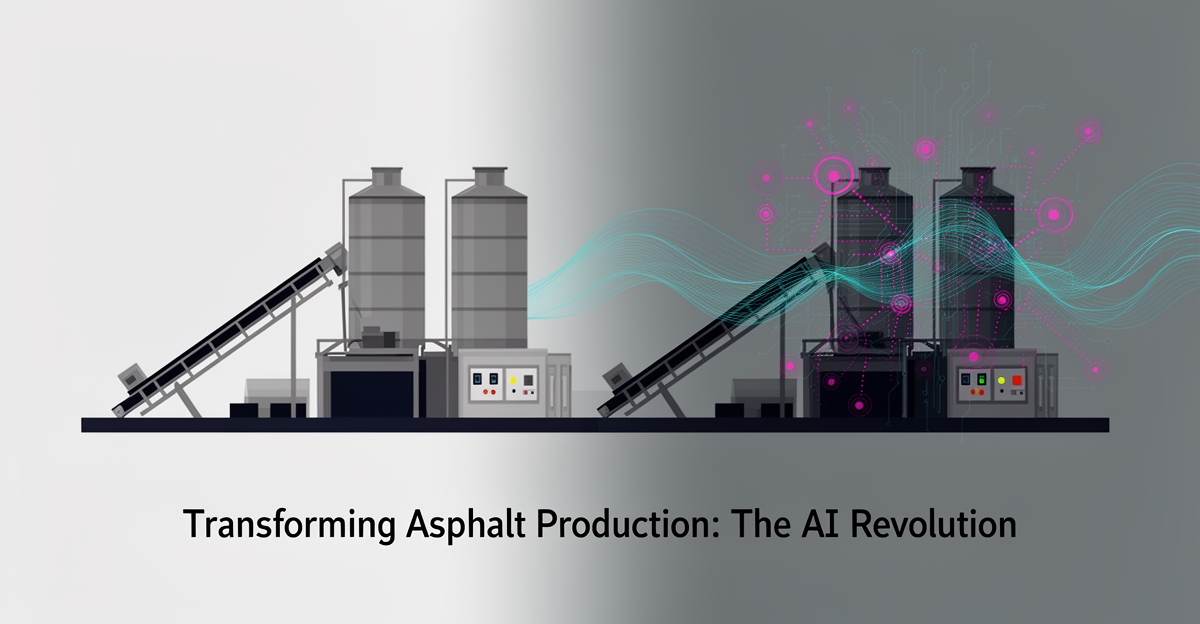
From Manual to AI: Transforming Daily Operations in an Asphalt Plant
Key Facts
- 78% of AI users are bringing their own AI tools to work, creating data security risks for unprepared organizations according to Microsoft's 2024 Work Trend Index
- Process mining reveals hidden inefficiencies in material flow, batch processing, and delivery schedules that manual oversight misses entirely as demonstrated by Infor's process mining software
- 90% of AI users report the technology helps them save time, enabling focus on higher-value work according to Microsoft's workplace research
- 60% of leaders worry their organization lacks a strategic plan for AI implementation despite employee adoption as revealed in Microsoft's 2024 Work Trend Index
- Process mining uses system-generated event logs to map actual workflows rather than designed processes, exposing real bottlenecks through automated discovery
- 79% of leaders agree AI adoption is necessary for competitive advantage, yet most lack implementation roadmaps according to Microsoft's research
- Asphalt plants can identify material flow delays, batch inconsistencies, and scheduling gaps through process mining before deploying targeted AI solutions using event log analysis
Hire a team member that works 24/7 — for less than a part-time wage.
AI receptionists, SDRs, dispatchers and 99+ roles. Trained on your business, fully managed.
Not sure where to start? Ask our AI planner
The Hidden Inefficiencies in Asphalt Plant Operations
Every asphalt plant runs on three moving parts—material flow, batch processing, and delivery scheduling—and most operators assume their supervisors can see all three. The reality is that manual oversight captures only what is visible at the moment someone happens to look. The most expensive inefficiencies are the ones that never get witnessed: the aggregate pile that sits idle while a batch waits, the inconsistent mix times that quietly erode quality, the delivery windows that drift because dispatch and production never share the same picture.
Traditional audits struggle to surface these problems because they rely on static reporting and periodic observation. Process mining flips that model by analyzing system-generated event logs to map how work actually flows through a plant—not how the SOP says it should. Platforms like Infor's process mining software give organizations rapid end-to-end process visibility, identifying bottlenecks and detecting process variants that deviate from standard models without requiring deep technical expertise. In manufacturing settings, this approach has proven its value; at Xpress Boats, Information Systems Manager Jennifer Terry credits process mining with "the speed and precision needed to refine our business processes."
For an asphalt plant, process mining typically exposes hidden friction in a few predictable places:
- Material flow delays where aggregate and binder deliveries stall upstream of the drum, leaving the plant burning fuel while it waits
- Batch processing inconsistencies where actual cycle times vary widely from the designed process, producing quality drift that only shows up in lab results days later
- Delivery scheduling gaps where load-out, truck dispatch, and paving crews operate on mismatched timelines, forcing costly rescheduling
- Reactive problem identification, where issues surface only after a customer complaint or a failed mix rather than being detected in real time
The urgency to fix these gaps is not hypothetical. According to Microsoft's 2024 Work Trend Index, 78% of AI users are already bringing their own AI tools to work without organizational guidance—and 80% of that unsanctioned usage happens at small and medium-sized companies. Employees are effectively telling leadership that the tools they've been given don't meet their needs, so they're improvising. Meanwhile, 60% of leaders worry their organization lacks a plan and vision to implement AI strategically, which means the improvisation continues unchecked, often with real data security implications.
This is precisely the gap that structured discovery closes. By first mapping actual workflows with process mining, then deploying custom AI systems against the specific bottlenecks uncovered, operations teams get improvements grounded in evidence rather than guesswork. That is the approach AIQ Labs takes: use process mining to reveal where material flow, batch consistency, and scheduling actually break down, then build AI-driven automation targeted at those exact points—delivering measurable gains in throughput and cost control rather than another generic dashboard nobody watches.
The hidden inefficiencies are already costing money every production day. The only question is whether they get found by a spreadsheet audit next quarter or by a system that sees them in real time.
How Process Mining Reveals AI Optimization Opportunities
An asphalt plant runs on thousands of invisible handoffs. What looks like a smooth flow on paper is often a patchwork of manual adjustments, rework loops, and delayed batches that never appear in standard reports.
Process mining changes that visibility. Tools analyze system-generated event logs to reconstruct actual workflows as they happened, not as they were designed. The result is an end-to-end map of material flow, batch processing, and delivery schedules with variants and bottlenecks exposed in real time.
Infor's process mining software demonstrates this capability in manufacturing, delivering rapid end-to-end process visibility and identifying bottlenecks without requiring deep technical expertise. Industry deployments show how mapping real event data reveals hidden patterns that traditional analysis misses, enabling targeted improvements before AI is applied.
That discovery layer is critical for prioritizing AI intervention. Instead of guessing where automation will help, teams see exactly where delays accumulate, where process variants diverge from the standard, and where manual exceptions are costly. Process mining turns operational intuition into measurable intervention points.
The business case for acting on those insights is strong. Microsoft's 2024 Work Trend Index finds 90% of AI users say it helps them save time, with 75% of global knowledge workers already using AI at work. Time savings translate directly in plants where throughput and cost control drive margin.
For asphalt operations, process mining typically surfaces opportunities such as:
- Material flow stalls between silo discharge and mixer loading
- Batch processing variants caused by manual recipe adjustments
- Delivery schedule drift from dispatch to loading dock
- Rework loops triggered by quality checks and documentation gaps
AIQ Labs applies this discovery-first approach across its service lineup. If the bottleneck lives in one workflow—say, dispatch scheduling or batch documentation—an AI Workflow Build rebuilds that single workflow at a fixed price, in phases. If the plant needs staff-level coverage for scheduling, dispatch, or reception, AI Employees provide managed AI staff at roughly 80% less cost than a human hire. And when the goal is one connected operating layer across the whole plant, an AI Operating System is built in phases and owned outright.
Once the map is clear, AI can be applied precisely. Predictive models anticipate demand spikes and adjust batch sequencing. Computer vision and sensor data reduce manual inspections. Automated scheduling aligns trucks with plant readiness. Each intervention is prioritized by the bottleneck evidence process mining provides.
This is AI Business Process Automation grounded in real operations, not assumptions. The combination of event-log discovery and targeted AI deployment moves plants from manual firefighting to continuous, data-driven optimization.
Deploying Custom AI Systems for Measurable Gains
Process mining reveals what spreadsheets and site walks cannot: the actual rhythm of material flow, batch cycles, and dispatch decisions as they happen. By analyzing system-generated event logs, teams can pinpoint where trucks idle, where mix designs drift, and where scheduling conflicts cascade into missed delivery windows. Infor's process mining software demonstrates how organizations achieve rapid end-to-end visibility without deep technical expertise, turning raw operational data into a map of hidden inefficiencies.
- Automated discovery of process variants that deviate from standard operating procedures
- Real-time bottleneck detection across material handling, production, and logistics
- Benchmarking against industry performance standards for continuous improvement
- Quantified impact analysis to prioritize AI investments by ROI potential
Microsoft's 2024 Work Trend Index shows that 79% of leaders agree AI is necessary to stay competitive, yet 60% worry their organization lacks a plan to implement it. This gap is where custom AI systems deliver measurable gains. AIQ Labs uses process mining insights to build AI systems that automate batch optimization, predictive scheduling, and material routing—integrated with existing tools so they operate inside current workflows, not alongside them. The systems are owned by the client outright, monitored for throughput and cost improvements, and paid for on clear terms: start monthly, build in milestones, or own it outright—no invented case-study numbers, just evidence from 200+ multi-agent systems deployed and four live SaaS products AIQ Labs runs daily.
Research indicates 90% of AI users say it helps them save time and 85% say it helps them focus on their most important work. In an asphalt plant, that translates to operators spending less time firefighting mix adjustments and more time on quality control, while dispatchers shift from reactive phone calls to proactive route optimization. The result is a measurable lift in daily tonnage throughput and a reduction in off-spec material—gains that compound across every shift.
Still paying for 10+ subscriptions that don’t talk to each other?
We build custom AI systems you own outright. No vendor lock-in. Full control.
Not sure where to start? Ask our AI planner
Frequently Asked Questions
How can process mining help identify hidden inefficiencies in asphalt plant operations?
What specific bottlenecks does process mining typically uncover in asphalt plants?
Is process mining difficult to implement without deep technical expertise?
How does AI build on process mining findings to improve asphalt plant operations?
What evidence shows that AI improves productivity and focus in industrial settings like asphalt plants?
Why are employees bringing their own AI tools to work without company approval?
From Visibility to Velocity
The hidden costs in an asphalt plant are not failures, they are gaps in visibility. Process mining makes those gaps visible by reconstructing actual material flow, batch cycles, and dispatch handoffs from system event logs, exposing the idle piles, variant mix times, and scheduling drift that manual oversight misses. That discovery-first view turns operational intuition into measurable intervention points, so AI can be applied precisely where it moves throughput and cost, not spread thinly across generic dashboards. With 78% of AI users already bringing their own tools to work without organizational guidance, plants need an evidence-based path to scale AI strategically rather than reactively. AIQ Labs maps those real workflows with process mining and then builds custom AI systems to automate the highest-impact steps—whether that's one workflow rebuilt at a fixed price, managed AI staff, or a full AI Operating System the plant owns outright. If you want to see where your plant is leaking time and margin today, start the two-minute Fit Check at aiqlabs.ai/apply, then book a free 30-minute strategy call to map your biggest bottleneck and identify high-ROI automation opportunities.
Make AI your competitive advantage — not just another tool.
Strategy, implementation and ongoing optimization. One partner, end to end.
Not sure where to start? Ask our AI planner