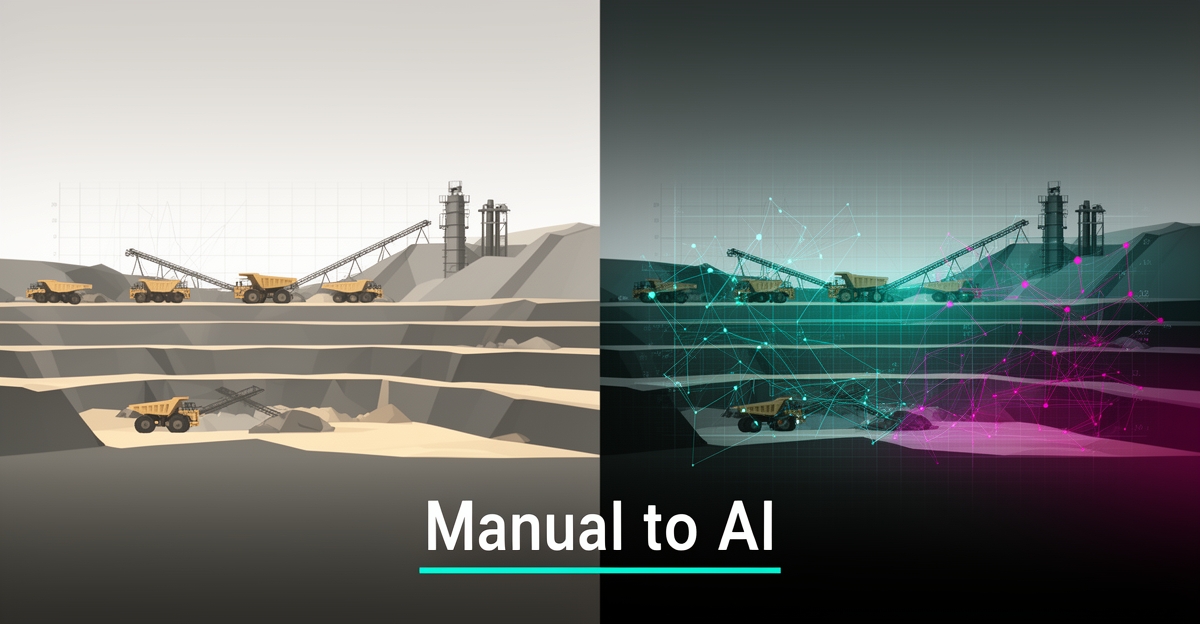
From Manual to AI: Transforming Daily Quarry Planning with Smart Workflows
Key Facts
- Static spreadsheets and experience-based estimates cannot adapt to changing site conditions, creating waste in material estimation, crew scheduling, and delivery forecasting.
- AI-driven workflows continuously ingest real-time site signals—production rates, equipment availability, weather, and customer demand—so plans adjust as conditions change.
- A staged rollout (discovery, pilot, targeted rollout, benefits maximization, scale) proves value before committing budget, and avoids the pilot-stage stall that traps most AI projects.
- AIQ Labs has deployed 200+ multi-agent systems and runs four live SaaS products daily, applying the same production discipline to client builds.
- Owned systems transfer code, agents, and data to the client—no vendor lock-in, no subscription dependency.
Hire a team member that works 24/7 — for less than a part-time wage.
AI receptionists, SDRs, dispatchers and 99+ roles. Trained on your business, fully managed.
Not sure where to start? Ask our AI planner
The Manual Planning Bottleneck in Quarry Operations
Quarry planning remains stubbornly manual in many operations, relying on static spreadsheets and experience-based estimates that fail to adapt to changing site conditions. This approach creates significant waste in material estimation, where over-ordering or under-ordering directly impacts project costs and timelines. Crew scheduling suffers similarly, with supervisors allocating labor based on historical patterns rather than real-time demand, leading to idle workers or critical shortages during peak activity. Delivery forecasts drift out of date almost as soon as they are printed. The result is a cascade of inefficiencies that erode profitability and strain operational resilience.
Replacing static planning with adaptive systems changes the math. In quarry contexts, AI-driven improvements typically translate to more accurate material forecasts that minimize excess inventory and prevent costly rush orders. Crew scheduling becomes dynamic, aligning workforce deployment with actual extraction rates and weather-dependent site accessibility rather than fixed shifts. Delivery forecasts gain precision by incorporating real-time haul road conditions, crusher throughput, and customer demand signals, reducing the guesswork that traditionally buffers schedules with costly contingencies.
- Material estimation errors reduced through continuous sensor data integration
- Crew schedules optimized daily based on production velocity and equipment availability
- Delivery forecasts adjusted for real-time traffic, weather, and customer priority shifts
AIQ Labs designs custom AI systems that transform these manual bottlenecks into intelligent workflows, using real-time site data to continuously refine planning accuracy. By automating repetitive calculations and scenario modeling, quarry planners shift from data processors to strategic decision-makers, focusing on operational improvements rather than spreadsheet maintenance. This adaptation not only reduces waste but builds resilience against the variability inherent in extractive operations, where static plans quickly become obsolete as geological conditions, market demands, and equipment performance evolve throughout the day. The shift from experience-based guessing to data-driven anticipation marks the foundation for sustainable efficiency in modern quarry management.
How AI Replaces Repetitive Planning with Data-Driven Workflows
Manual spreadsheets and gut-feel estimates are no longer enough for quarry planning. Real-time site conditions and shifting demand require workflows that adapt as fast as the operation changes.
AI replaces repetitive planning tasks with intelligent, data-driven workflows that continuously ingest site signals and demand patterns. Instead of static forecasts, crews and material flows adjust dynamically to production rates, equipment availability, and customer orders. Where a planner once spent hours each morning reconciling yesterday's output with today's orders, a well-built workflow surfaces the reconciled picture in minutes—along with the exceptions that actually need human judgment.
The efficiency gains show up across operational automation. Operators who move planning off spreadsheets typically report fewer estimation errors, less idle labor, and schedules that hold up under changing conditions rather than collapsing into rush fixes and overtime.
In quarry contexts, intelligent workflows automate three core planning burdens:
- Material estimation that learns from historical extraction, grade variability, and weather impacts
- Crew scheduling aligned to real-time equipment status, haul routes, and safety constraints
- Delivery forecasting that reconciles inventory, crusher output, and customer demand signals
These systems capture every operational detail automatically, allowing human planners to focus on exceptions and strategy rather than documentation.
AIQ Labs designs custom AI systems that adapt to real-time site conditions and changing demand, improving accuracy and reducing waste. For operations with one clearly broken, high-cost workflow, a targeted engagement like an AI Workflow Build rebuilds that single workflow at a fixed price, in phases. For teams that need managed capacity—dispatch coordination, order intake, customer follow-up—AI Employees handle the repetitive communication layer at a fraction of a human hire's cost.
The result is data-driven planning that replaces experience-based guesswork with continuous optimization. Human teams stay in control of strategic decisions while AI handles routine data processing, pattern recognition, and predictive analysis.
Staged Implementation from Discovery to Scale
The biggest mistake quarry operators make with AI is trying to automate everything at once. The operations that succeed follow a staged path—one that starts small, proves value quickly, and scales only what works.
The methodology moves through five deliberate stages. It begins with discovery: identifying where AI delivers maximum value, defining baseline metrics, and gauging potential business impact before selecting any toolkit. For a quarry, this might mean pinpointing material estimation or crew scheduling as the highest-friction manual tasks.
Next comes the pilot. Rather than transforming the entire planning operation, apply AI to a reasonable, contained scope—say, automating daily delivery forecasts for one product line. The goal is to validate measurable performance and confirm real gains before committing further. This is where a targeted engagement like an AI Workflow Build fits naturally: rebuild a single critical workflow with a custom solution and see results in weeks, not months.
Stage three is targeted rollout, expanding the validated approach to the product or site level to establish system stability and assess improvements. Stage four is benefits maximization—analyzing which specific tasks AI has improved most and doubling down there. The discipline matters: most organizations stall at the pilot stage—limited trials that never reach production. Structured rollout with clear milestones is what prevents that.
The final stage is scale and handover, where AI-driven approaches extend across the organization and teams are upskilled to run the systems themselves.
Payment structures can mirror this staged logic:
- Start with a single workflow build to prove feasibility quickly
- Expand to department automation once the pilot shows measurable gains
- Use milestone-based builds, approving and paying per phase as each ships
- Stop anytime and keep everything built so far—no sunk-cost risk
This is the model AIQ Labs applies across engagements—Start Monthly, Build in Milestones, or Own It Outright: split the build into phases, validate each before the next, and ensure the client owns the resulting system outright. The same principle applies to the technology itself. Efficient model design keeps deployment practical on site, supporting edge and real-time analytics where latency matters.
Business continuity is the thread running through every stage. The transformation must not break what already works—your existing planning rhythms keep running while AI capabilities are introduced alongside them, then gradually take over the repetitive layers like material estimation and delivery forecasting.
If you want to find your highest-value starting point, the two-minute Fit Check at aiqlabs.ai/apply leads to a free 30-minute strategy call—a working session to map your biggest bottleneck and identify where staged AI automation would deliver the clearest win.
Building Owned AI Systems for Quarry Teams
Quarry teams are moving from static spreadsheets and experience-based guesses to systems that react to the pit, the plant, and the market in real time. Building owned AI means those workflows stay inside the business, adapt to site conditions, and compound value instead of renting it from a vendor.
Owned systems start with real-time integration, not dashboards. When material estimation, crew scheduling, and delivery forecasts pull from weighbridge, telematics, and sales orders in the same loop, planning becomes continuous. Modern AI architecture emphasizes grounding agents in your live operational data so they retrieve and act on current conditions rather than isolated prompts.
Model efficiency determines whether those systems are practical on site. Compact, well-designed models make deployment faster and more sustainable for SMB operations, supporting edge and real-time analytics where latency matters.
Ownership changes the economics and control. With custom-built, production-ready AI, quarry teams keep full control over customization, data, and future development. AIQ Labs designs systems that businesses own and control, replacing costly subscription chaos with unified digital assets that adapt as demand and conditions change. For operations ready to connect planning, dispatch, sales, and reporting into one layer, an AI Operating System approach builds that connected core in phases—owned outright from day one.
A staged build reduces risk while proving value:
- Discovery of high-value planning workflows with baseline metrics for material estimation and crew utilization
- Pilot on one workflow, such as delivery forecasting, to validate measurable gains before wider rollout
- Targeted rollout across planning, dispatch, and sales with integrated data sources and human-in-the-loop controls
- Scale and handover with monitoring, retraining, and continuous improvement built in
In quarry planning, the pattern is consistent: routine data processing and pattern recognition move to AI, freeing crews and planners for strategic decisions while accuracy improves with every cycle of site data.
Adaptive systems also avoid vendor lock-in. Because the code, agents, and data transfer to the client, SMB quarries can evolve capabilities without renegotiating licenses or migrating platforms. True ownership means the intelligence built from site-specific data remains a durable competitive asset, not a subscription.
Start the Fit Check at aiqlabs.ai/apply for a free 30-minute strategy call to map your biggest planning bottleneck and identify high-ROI automation opportunities.
Still paying for 10+ subscriptions that don’t talk to each other?
We build custom AI systems you own outright. No vendor lock-in. Full control.
Not sure where to start? Ask our AI planner
Frequently Asked Questions
How much can AI actually cut costs in quarry planning?
Will switching to AI slow down our planning cycles?
Is AI too resource heavy to run on site?
Do we have to automate everything at once?
Will we own the AI system or be locked into a vendor?
Which planning tasks make the best first AI project?
From Guesswork to Growth: Your Next Step in Smarter Quarry Planning
This article has shown how AI transforms quarry planning from static spreadsheets into adaptive workflows that continuously refine material estimation, crew scheduling, and delivery forecasts using real-time site data. By automating repetitive calculations and pattern recognition, teams shift from data processors to strategic decision-makers, reducing waste and building resilience against daily variability in extraction operations. The staged implementation approach—starting with discovery, piloting a single workflow, and scaling what works—ensures measurable gains without disrupting existing rhythms. AIQ Labs has deployed 200+ multi-agent systems and designs custom AI systems that quarry teams own and control, turning site-specific intelligence into a durable competitive asset. To identify your highest-value starting point and see where AI can deliver the clearest win in your planning process, take the two-minute Fit Check at aiqlabs.ai/apply to begin a free, no-obligation strategy call with our team.
Make AI your competitive advantage — not just another tool.
Strategy, implementation and ongoing optimization. One partner, end to end.
Not sure where to start? Ask our AI planner