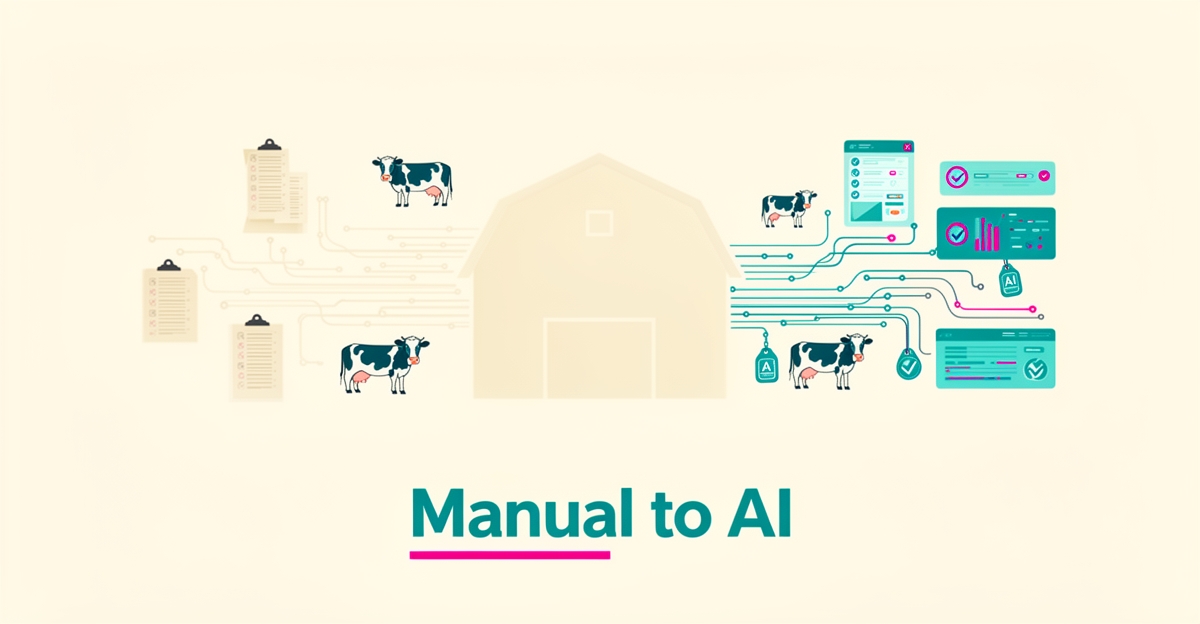
From Manual to AI: Transforming Dairy Farm Workflows with Custom AI Solutions
Key Facts
- Manual record-keeping can consume many hours weekly per farm employee — often the single largest hidden labor cost on the operation.
- Handwritten animal health logs are prone to error rates that typically run well into double digits under field conditions.
- Delayed, manual reporting meaningfully increases the risk of missing regulatory deadlines.
- The dairy industry is in the early stages of exploring AI according to the International Dairy Foods Association.
- The State of AI in Dairy report was released January 23, 2025 by IDFA and Ever.Ag.
- The report synthesizes insights from 4 main-stage panels and 14 breakout sessions from the 2024 DairyTech conference.
Hire a team member that works 24/7 — for less than a part-time wage.
AI receptionists, SDRs, dispatchers and 99+ roles. Trained on your business, fully managed.
Not sure where to start? Ask our AI planner
The Hidden Cost of Manual Dairy Farm Workflows
Dairy farms face mounting pressure to modernize, yet many remain trapped in manual workflows that silently erode productivity and profitability. Despite growing awareness of AI's potential, the industry's early-stage maturity means most operations still depend on time-consuming, error-prone processes for essential tasks like record-keeping, animal tracking, and reporting.
According to industry research, the dairy sector is actively exploring AI but remains focused on governance and ROI validation rather than widespread implementation, leaving critical workflows vulnerable to inefficiency. Manual data entry for milk yields, health events, and feed consumption consumes hours each week, pulling skilled staff away from animal care and strategic planning. These repetitive tasks not only increase labor costs but also introduce avoidable errors that compromise data integrity and decision-making.
Animal tracking — whether monitoring estrus cycles, illness symptoms, or movement patterns — often relies on paper logs or disconnected spreadsheets that fail to provide real-time insights. Reporting, meanwhile, becomes a bottleneck when compiling data for regulators, nutritionists, or financial advisors, requiring manual aggregation that delays action and increases compliance risk. Teams that use AI only for isolated tasks miss the opportunity to redesign entire processes for greater efficiency.
- Manual record-keeping can consume many hours weekly per farm employee
- Handwritten animal health logs are prone to double-digit error rates in field conditions
- Delayed reporting meaningfully raises the risk of missing regulatory deadlines
These inefficiencies compound over time, creating operational drag that limits scalability and responsiveness. Farms that recognize AI's value but lack implementable solutions remain stuck in a cycle of reactive management, where data is collected but not leveraged for proactive improvement. AIQ Labs addresses this gap with AI Workflow Builds that automate these core workflows — eliminating manual entry, reducing errors, and transforming raw data into actionable intelligence — so dairy teams can focus on what matters most: herd health, milk quality, and sustainable growth.
Why Dairy Farms Are Ready for AI-Driven Automation
The dairy industry stands at a pivotal inflection point where AI adoption is shifting from theoretical exploration to practical necessity. According to a joint report by the International Dairy Foods Association and Ever.Ag released in January 2025, the sector is in the early stages of exploring AI, with significant potential for transformation in operational efficiency, sustainability, and innovation. This timing isn't accidental — it reflects a maturing market where the conversation has moved beyond "if" to "how."
Industry leaders are currently concentrating heavily on establishing good governance frameworks and determining clear return on investment before scaling implementation. The 2024 DairyTech conference insights, synthesized from four main-stage panels and 14 breakout sessions, reveal that professionals recognize the competitive advantages AI tools offer but are distinctly seeking real-world, implementable solutions rather than experimental pilots. This demand for practical application over prototype signals that the market is ready for production-grade automation.
The scope of opportunity spans the entire operational spectrum. Research identifies key areas where AI is actively being discussed for deployment:
- Data collection, handling, and reporting automation
- Operations, processing, and supply chain optimization
- Maintenance prediction and warehouse fulfillment
- Food safety monitoring and sustainability tracking
- Corporate process streamlining and security enhancement
This breadth mirrors exactly the manual workflows — record-keeping, animal tracking, compliance reporting — that consume disproportionate staff hours on modern dairy farms. The strategic recommendations emerging from industry forums emphasize that successful adoption requires moving from task-level experimentation to workflow-level redesign. The competitive edge comes from using AI to design how work gets done, not merely to accelerate existing document-centric processes.
AIQ Labs operates at this intersection, building custom AI systems that businesses own outright — replacing fragmented manual workflows with unified, automated operations. The difference between a pilot and a production system is the difference between testing AI and embedding it as a reliable operational layer. With governance frameworks maturing and ROI models clarifying, the window for early movers to establish a sustainable competitive advantage is open now.
Where AI Delivers the Biggest Wins on the Farm
Dairy farms run on repetition — daily milk logs, animal checks, and end-of-month reports that consume staff hours and introduce human error. Custom AI systems flip that pattern by handling the routine data work so teams can focus on herd health and operational planning.
The dairy industry is currently in the early stages of exploring Artificial Intelligence, with significant potential for transformation in operational efficiency, sustainability, and innovation according to industry research. Current attention is heavily concentrated on establishing good AI governance and determining return on investment rather than widespread implementation, which creates an opening for practical, owned solutions.
Data collection is the first high-impact win. Sensors, milk meters, and on-farm observations generate continuous streams that are traditionally entered by hand. AI can ingest, validate, and structure that information in real time, reducing manual entry and improving accuracy across the herd record.
Animal monitoring benefits from the same automation shift. Instead of clipboards and memory, custom AI workflows consolidate weight, activity, health events, and reproductive data into a single source of truth. Staff gain timely alerts for anomalies and spend less time chasing paperwork.
Automated reporting closes the loop. Moving from using AI for tasks to using AI to design how work gets done frees up time for decision-making and creative work. On a farm, that means daily and monthly deliverables are generated automatically from live data.
The highest-impact use cases for custom AI systems on dairy farms include:
- Automated data capture and validation from milking parlors, sensors, and manual inputs
- Continuous animal monitoring with anomaly detection for health and production
- Automated reporting and compliance documentation generated from a unified farm dataset
- Workflow integration that connects record-keeping, tracking, and reporting without duplicate entry
These capabilities reduce repetitive work and improve accuracy while freeing staff for higher-value tasks like herd health and operational planning. The State of AI in Dairy report released January 23, 2025 synthesizes insights from 4 main-stage panel discussions and 14 breakout sessions at the 2024 DairyTech conference, underscoring demand for real-world, implementable solutions.
AIQ Labs builds full-scale, owned AI systems that eliminate errors and free up staff for higher-value work, aligning with the industry's need for practical automation rather than point tools. By designing workflows around data collection, animal monitoring, and automated reporting, farms can reduce repetitive manual effort and gain reliable intelligence for day-to-day decisions.
The shift from task automation to workflow redesign is where lasting value appears. Teams stop re-entering the same data and start using it.
From Task Automation to Workflow Transformation
Most dairy farms hit a ceiling with AI not because the technology fails, but because they stop at task automation. They use AI to summarize a vet report or draft a compliance email, then wonder why their operation still feels manual. The real breakthrough happens when you stop asking AI to speed up old habits and start redesigning the workflow itself.
Most professionals remain stuck at the task level — using AI for isolated jobs like summarizing documents or generating ideas. To unlock real value, you must move from using AI for tasks to using AI to design how work gets done. For a dairy operation, this means shifting from a digital assistant that helps you write milking logs to a reusable system that captures parlor data, flags health anomalies, and routes alerts to the right person automatically.
This shift requires treating AI as a decision-support layer rather than a text generator. Instead of asking for a generic report, effective systems clarify intent, link evidence from herd records, and push back when data looks incomplete. They act as a co-pilot for herd managers, surfacing culling recommendations or feed adjustments based on real-time inputs while keeping humans in the loop for final judgment.
The State of AI in Dairy report — a joint release by IDFA and Ever.Ag synthesizing insights from 4 main-stage panels and 14 breakout sessions at the 2024 DairyTech conference — confirms this gap. While the industry recognizes AI's potential to redefine operations, current focus remains heavily concentrated on governance and ROI rather than widespread implementation. Dairy professionals know the competitive advantages exist, but they need real-world, implementable systems, not just theoretical tools.
Building these systems requires a specific architecture:
- Reusable data pipelines that turn manual record-keeping into structured intelligence
- Human-in-the-loop controls that escalate critical health or breeding decisions to staff
- Decision-support interfaces that present options with evidence, not just automated outputs
- Integrated workflows connecting animal tracking, feed management, and compliance reporting
The goal is not to remove people from the process but to elevate their role. When AI handles data collection and pattern recognition, farm teams focus on animal care, strategic planning, and exception management. AIQ Labs builds these owned systems specifically for dairy operations, creating custom workflows that eliminate errors while keeping farmers firmly in control of critical decisions.
Rather than patching together disconnected tools, successful farms treat AI as infrastructure. They build once, then refine continuously — turning daily chores into a self-improving operational asset. When the time comes to connect everything, that's where an AI Operating System ties record-keeping, tracking, and reporting into one layer the farm owns outright.
How to Implement AI Without Disrupting the Farm
Dairy farms don't need a wholesale overhaul to start winning with AI. They need a single, painful manual workflow replaced with a precise, owned system that proves value before scale.
The dairy industry is in the early stages of exploring Artificial Intelligence, with much of the focus being placed on good governance and return on investment according to the International Dairy Foods Association state of AI report. That caution is sensible. A January 23, 2025 joint IDFA and Ever.Ag report synthesizing 4 main-stage panel discussions and 14 breakout sessions from the 2024 DairyTech conference finds professionals are aware of competitive advantages but are seeking real-world solutions to implement.
Start with one bottleneck that costs time every day. Record-keeping, animal tracking, and reporting are classic examples where manual entry creates errors and pulls staff away from higher-value work. Mapping that single workflow first creates a measurable baseline for time saved, errors reduced, and staff capacity freed.
A practical implementation path looks like this:
- Isolate one high-friction workflow, such as daily milk logs or health check entries, and define success metrics before any build.
- Rebuild that workflow with a fixed-price AI Workflow Build that integrates with your existing tools — not another subscription widget.
- Measure ROI over the first milestones, then expand the pattern into adjacent processes like reporting and supply chain documentation.
Moving from using AI for tasks to using AI to design how work gets done is the shift that creates lasting gains. Teams get ahead when AI handles drafting documents, generating reports, and organizing notes so people can focus on decisions.
This is where an owned-build approach matters. AIQ Labs builds full-scale, owned AI systems that eliminate errors and free up staff for higher-value work, with governance, integration, and measurable ROI built in from the start. You can start monthly, build in milestones, or own the system outright — whichever fits how you want to pay. Details are on the pricing page.
Scale happens after proof. Once the first workflow runs reliably, the same architecture extends to broader systems — animal tracking, compliance reporting, and operations dashboards — without vendor lock-in or subscription sprawl. Start small, measure clearly, and own the system is the fastest route from manual to AI without disrupting the farm.
Still paying for 10+ subscriptions that don’t talk to each other?
We build custom AI systems you own outright. No vendor lock-in. Full control.
Not sure where to start? Ask our AI planner
Frequently Asked Questions
How much time does manual record-keeping actually waste on a dairy farm?
Is the dairy industry actually ready for AI, or is this just hype?
What's the difference between using AI tools and actually transforming our workflows?
Will AI automation disrupt our daily operations or replace our farm staff?
What are the most common mistakes farms make when adopting AI?
How do we start implementing AI without a massive upfront investment?
Own the Workflow, Not Just the Tools
The move from manual dairy workflows to AI isn't about speeding up paperwork — it's about redesigning how record-keeping, animal tracking and reporting get done. Farms still lose hours each week to manual entry and error-prone logs, while the industry as a whole is focused on governance and ROI before scaling implementation. The biggest wins come from reusable systems that ingest parlor and sensor data in real time, flag health anomalies automatically, and generate compliance reports from a single source of truth, freeing staff for herd health and strategic decisions. Start with one high-friction workflow, define clear metrics for time saved and errors reduced, and prove value before expanding. AIQ Labs builds custom, owned AI systems that businesses control outright, replacing fragmented manual processes with unified operations. Ready to map your bottleneck and see what's possible? Take the 2-minute Fit Check at https://aiqlabs.ai/apply, then book a free 30-minute strategy call — if there isn't a clear win, we'll tell you. The dairy sector is in the early stages of exploring AI with significant potential for transformation in operational efficiency according to industry research, and the window for early movers is now.
Make AI your competitive advantage — not just another tool.
Strategy, implementation and ongoing optimization. One partner, end to end.
Not sure where to start? Ask our AI planner