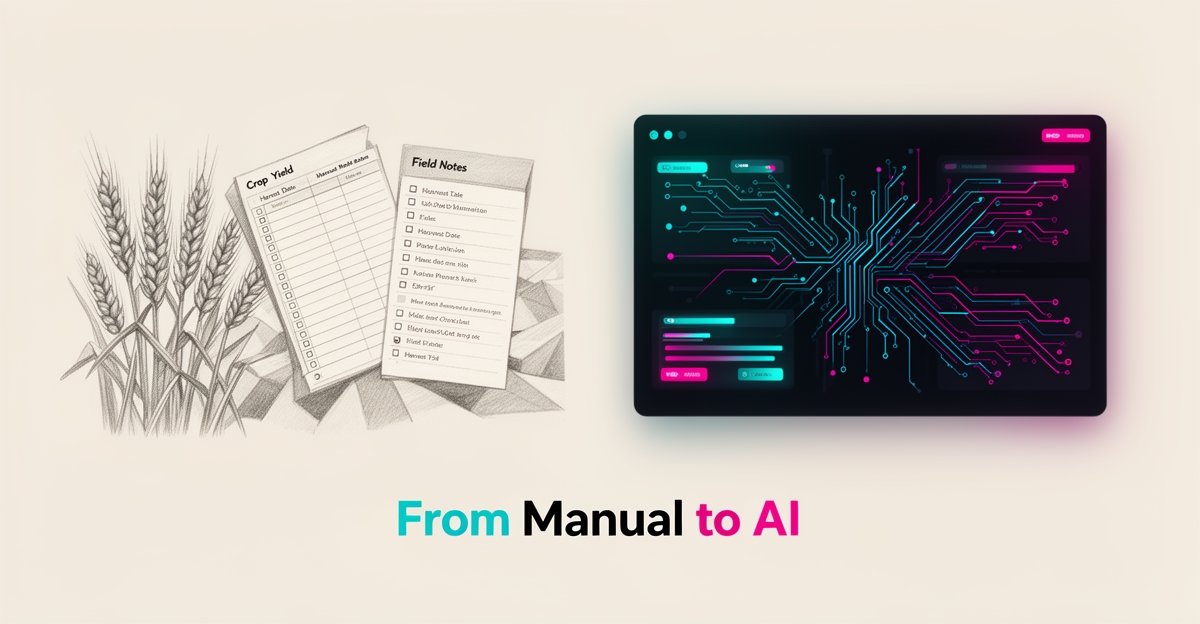
From Manual to AI: Transform Farm Advisory Workflows
Key Facts
- Most agribusinesses recognize AI's potential, but only a small fraction have fully adopted it—a gap that keeps advisory teams stuck in manual workflows
- Data collection is the most cited barrier to AI implementation in farming; fixing data pipelines typically resolves the majority of AI-related challenges
- Image-based datasets make up the largest share of AI inputs in agriculture, yet collection remains labor-intensive
- Sensor data is often underutilized due to integration complexity, leaving valuable field signals out of advisory decisions
- Farmer logs and notes remain a small but critical input, highlighting the need for structured capture
- AIQ Labs has deployed 200+ multi-agent systems and runs 4 live SaaS products daily—this is proven infrastructure, not theory
Hire a team member that works 24/7 — for less than a part-time wage.
AI receptionists, SDRs, dispatchers and 99+ roles. Trained on your business, fully managed.
Not sure where to start? Ask our AI planner
The Manual Advisory Bottleneck Holding Farms Back
The advisory bottleneck in agriculture isn't about a lack of vision—it's about execution. Most agribusinesses recognize AI's potential, yet only a small fraction have fully adopted it, leaving a persistent gap between aspiration and reality. This disconnect stems not from resistance to technology, but from foundational operational friction that stalls progress before it begins.
At the heart of this delay lies data collection—the most commonly cited barrier to AI implementation in farming. Practitioners consistently find that fixing data collection pipelines resolves the majority of AI-related challenges, yet fragmented, inconsistent, and manually gathered data remains the norm across advisory workflows. Advisors spend excessive time chasing inputs from disparate sources—farmer logs, sensor feeds, satellite imagery—only to contend with gaps, delays, and inaccuracies that undermine analysis. Without reliable, timely data, even the most sophisticated AI models produce generic or misleading recommendations.
This manual dependency creates a cascade of inefficiencies. Advisory services suffer from delayed response times, inconsistent advice across agents or regions, and missed opportunities to optimize inputs, timing, or market engagement. Farms lose revenue not because the insights don't exist, but because the workflow to uncover them is too slow and error-prone to act upon. The result is a system where expertise is underutilized, and innovation is perpetually deferred.
- Image-based datasets make up the largest share of AI inputs in agriculture, yet collection remains labor-intensive
- Sensor data is often underutilized due to integration complexity
- Farmer logs and notes remain a small but critical input, highlighting the need for structured capture
AIQ Labs addresses this bottleneck through AI Workflow Builds—mapping your existing advisory workflow to pinpoint where manual data handling creates drag, then rebuilding that one workflow at a fixed price. By automating ingestion, validation, and enrichment of multi-source data, we enable advisors to shift from data gatherers to insight interpreters. The outcome isn't just faster advice—it's more consistent, actionable, and timely guidance that helps farms capture value before it slips away.
Process Mining to AI Automation: A Proven Transformation Path
Farm advisory teams are drowning in repetitive paperwork, follow-ups, and data consolidation while farmers wait for timely guidance. Moving from manual to AI starts with seeing the workflow clearly before automating it.
Process mining reveals where advisory work actually happens versus where it should. By mapping real interactions across calls, emails, field visits, and reports, inefficiencies become visible and measurable. This diagnostic step prevents automation of broken processes and focuses investment on high-impact tasks.
AIQ Labs applies this approach through its AI Workflow Builds service for consulting firms digitizing advisory workflows. The method pairs discovery with deployment, turning insight into owned systems that improve service delivery and client satisfaction—built in phases, at a fixed price, with no surprise invoices.
The business case for this transformation is strengthening. Industry analyses of AI in agriculture consistently point to meaningful ROI and yield improvements alongside significant resource efficiency gains, and the global AI in agriculture market continues to grow at a strong clip as of late 2026.
Adoption remains uneven, which creates opportunity for advisory firms to lead. Most agribusinesses recognize AI's potential, yet full adoption is still rare—farm-management software and precision agriculture tools lead the way, but penetration remains modest. The firms that close this gap first will set the standard their competitors have to match.
The transformation path follows a clear sequence:
- Map the advisory journey with process mining to find bottlenecks in intake, triage, recommendations, and follow-up
- Rebuild the one workflow that costs the most—scheduling, data aggregation, report generation—with a fixed-price AI Workflow Build
- Deploy managed AI employees that work alongside agronomists for 24/7 client coverage and consistent knowledge delivery, at roughly 80% less cost than a human hire
- Optimize continuously with performance data to expand automation and improve client outcomes
Generative AI is reshaping the advisory role itself. Strategic guidance in the sector highlights the rise of generative AI-powered virtual agronomists, alongside autonomous farm machinery and verified carbon farming. Precision farming techniques, real-time data analytics, and machine learning advancements are key drivers of growth.
For consulting firms, this means advisory workflows can shift from manual tracking to intelligent orchestration. Repetitive tasks are handled by AI, freeing experts to focus on judgment, relationship building, and complex problem solving. The result is faster response times, more consistent advice, and measurable improvements in client satisfaction.
AIQ Labs builds these systems as owned digital assets, not subscriptions. You can start monthly, build in milestones, or own the system outright—the choice is yours, and the pricing is honest from day one.
Implementation Roadmap for Consulting Firms
Consulting firms seeking to modernize farm advisory workflows face a clear path forward: start with data readiness, pilot simple tools, and scale toward integrated AI systems. Because fixing data collection pipelines typically resolves the majority of AI implementation challenges in agriculture, this is the critical first step for any transformation effort. Firms should begin by auditing existing data sources—such as farmer logs, sensor feeds, and historical records—to identify gaps and inconsistencies before introducing AI tools.
Once data foundations are strengthened, firms can pilot targeted AI solutions that address specific pain points without disrupting established routines. Simple tools like yield prediction models or pest detection systems offer low-risk entry points—starting with easy-to-use AI solutions that solve one clear problem increases adoption success. These pilots should be designed to integrate smoothly into current workflows, allowing advisors to validate benefits while minimizing resistance to change.
As pilots prove value, firms can advance to multi-agent advisory systems that orchestrate specialized AI functions across the farm operation lifecycle. This approach mirrors AIQ Labs' experience deploying 200+ multi-agent systems and running 4 live SaaS products daily—demonstrating that multi-agent architectures scale effectively when built on solid foundations. Such systems can automate tasks from irrigation scheduling to market analysis while maintaining human oversight for strategic decisions.
Throughout this journey, change management remains essential to sustain momentum and drive organization-wide adoption. Firms must invest in role-specific training, establish feedback loops, and track performance metrics to ensure AI becomes a lasting capability rather than a temporary project. By following this roadmap—grounded in data readiness, pragmatic pilots, scalable architecture, and deliberate change management—consulting firms can transform farm advisory services from manual processes to intelligent, AI-augmented workflows that deliver measurable improvements in efficiency and client outcomes.
From Pilot to Scale: Avoiding the Adoption Trap
Many organizations launch AI pilots with enthusiasm, only to see momentum fade before scaling. In practice, most AI problems stem from data incompleteness, making foundational data practices critical for moving beyond experimentation. Fixing data collection pipelines resolves the majority of implementation barriers, turning fragmented efforts into scalable capabilities.
Success requires three interconnected pillars: data quality foundations, community training, and governance. Consistent data collection routines—using tools like sensors, cameras, and structured farmer logs—ensure inputs are complete and relevant, directly addressing the root cause of most AI failures. Meanwhile, training local advisors and farmers builds community support, empowering users to share results and refine tools through real-world use. Without this human layer, even technically sound systems stall due to low adoption or mistrust.
Governance provides the structure needed to scale responsibly, embedding ethics, compliance, and continuous improvement into AI workflows. For firms ready to go beyond isolated pilots, AIQ Labs' AI Operating Systems connect advisory workflows into one operating layer—built in phases and owned outright by you. By aligning technical readiness with organizational capacity, businesses avoid the adoption trap and build AI capabilities that deliver lasting value rather than another stalled experiment.
Still paying for 10+ subscriptions that don’t talk to each other?
We build custom AI systems you own outright. No vendor lock-in. Full control.
Not sure where to start? Ask our AI planner
Frequently Asked Questions
Why do most AI projects in agriculture fail despite high interest in the technology?
How can consulting firms start transforming farm advisory workflows without disrupting current operations?
What are the key inputs used in AI for agriculture, and which is most commonly underutilized?
How does process mining help in transforming farm advisory workflows before automation?
How does AIQ Labs price and deliver advisory workflow automation?
Turning Advisory Bottlenecks into Breakthroughs
The gap between recognizing AI's potential and actually deploying it isn't a technology problem—it's a workflow problem. As we've explored, manual data collection and fragmented processes remain the primary barriers keeping advisory firms from delivering the timely, consistent guidance farms need to thrive. The path forward is clear: start with process mining to see where work actually happens, fix your data foundations, pilot targeted AI solutions, and scale with governance and training. Firms that execute this transformation thoughtfully don't just improve efficiency—they build a durable operational advantage while competitors keep doing things the slow way. AIQ Labs helps consulting firms navigate this journey from manual bottlenecks to intelligent workflows, with 200+ multi-agent systems deployed and 4 live SaaS products run daily as proof the approach works. Ready to see where your biggest automation opportunity lies? Start with a two-minute Fit Check at https://aiqlabs.ai/apply, then book a free 30-minute strategy call to map your highest-ROI workflow transformation.
Make AI your competitive advantage — not just another tool.
Strategy, implementation and ongoing optimization. One partner, end to end.
Not sure where to start? Ask our AI planner