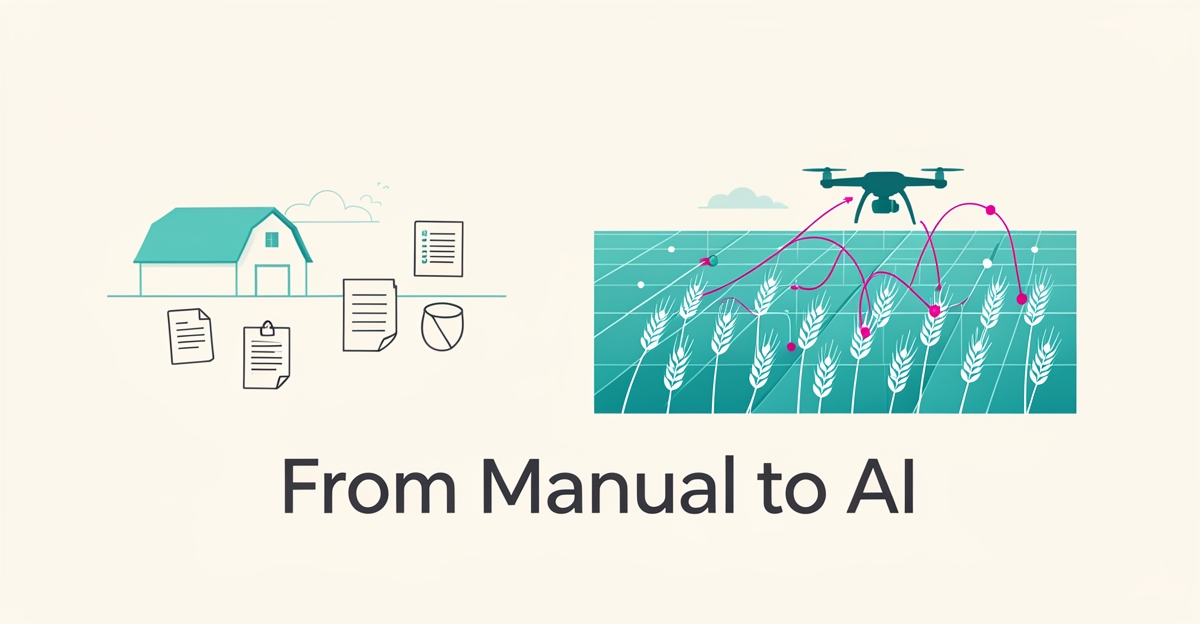
From Manual to AI: Transform Farm Operations with Automated Workflows
Key Facts
- Industry research as of late 2026 suggests only around 14% of farmers actively use AI tools, despite a global AI in agriculture market estimated in the billions according to industry research
- Farms adopting AI have reported returns on investment of roughly 150% alongside higher yields in strategic analyses per strategic analysis
- AI agents can eliminate 20+ hours weekly of manual data entry while sharply reducing operational errors based on reported farm automation results
- Integrated AI workflows have delivered roughly 30% water savings in precision irrigation in published case studies as shown in case studies
- AI Employees from AIQ Labs typically cost about 80% less than an equivalent human hire while operating continuously per AIQ Labs pricing model
- Predictive inventory systems have been reported to cut excess inventory by around 40% and reduce stockouts significantly according to applied AI market data
- AIQ Labs has deployed 200+ multi-agent systems and runs 4 live SaaS products daily, demonstrating production-grade multi-agent experience
Hire a team member that works 24/7 — for less than a part-time wage.
AI receptionists, SDRs, dispatchers and 99+ roles. Trained on your business, fully managed.
Not sure where to start? Ask our AI planner
The Adoption Gap: Why Most Farms Still Run on Manual Workflows
Industry research as of late 2026 suggests only around 14% of farmers actively use AI tools, despite a global AI in agriculture market estimated in the billions of dollars. That leaves a stark adoption gap between available technology and on-farm implementation. The disconnect is especially pronounced in field operations, where manual workflows for order processing, supply requests, and daily coordination remain the norm. Larger operations show stronger uptake in office functions, while field-level applications like yield prediction and agronomy lag behind, creating bottlenecks that hinder scalability and increase error rates.
These disconnected manual processes force farmers to juggle spreadsheets, phone calls, and paper forms across departments, leading to delayed responses, miscommunication, and missed opportunities for optimization. Supply requests often sit in email queues while order processing waits on manual data entry, slowing fulfillment and increasing the risk of over- or under-ordering inputs. Without integrated systems, even small delays compound into significant operational friction, especially during peak seasons when timing is critical. The result is a ceiling on growth that no amount of additional labor can overcome.
AIQ Labs helps bridge this gap by transforming fragmented workflows into owned, AI-driven systems that connect office and field operations. By automating routine tasks like order tracking, inventory alerts, and supplier coordination, farms reduce manual effort and create a single source of truth for decision-making. This foundation enables real-time responsiveness, fewer errors, and the ability to scale without proportional increases in staff or complexity. The shift isn't just about efficiency—it's about building resilience into the core of farm operations.
- Eliminate 20+ hours weekly of manual data entry
- Sharply reduce operational errors
- Scale operations without adding headcount
From Point Tools to Connected Workflows: The AI Transformation Model
Most farms don't suffer from a lack of AI tools — they suffer from a graveyard of disconnected subscriptions. The real transformation happens when those isolated point solutions merge into a single, intelligent workflow that runs the operation end to end.
The numbers behind integrated adoption are hard to ignore. According to a strategic analysis of AI in agriculture, farms adopting AI have reported returns on investment of roughly 150% alongside higher yields. Yet the same research reveals a stark gap: while most agribusinesses recognize AI's potential, only a minority have fully adopted it.
Why the hesitation? Because most farms assemble their AI stack one subscription at a time — a forecasting tool here, a scheduling app there — and end up with fragmented data and manual handoffs between systems. The value leaks out in the gaps.
A connected workflow closes those gaps by chaining specialized AI agents together, each handling one stage of the operation:
- Order intake: An AI agent captures incoming orders from phone, email, or portal and validates them automatically.
- Inventory forecasting: Predictive models analyze historical demand, seasonality, and current stock to trigger supply requests before shortages hit.
- Dispatch coordination: Field crews and deliveries are scheduled and rerouted in real time based on weather, availability, and priority.
- Supplier communication: Automated follow-ups confirm orders, flag delays, and keep procurement moving without manual chasing.
This isn't theoretical. Research on AI agriculture case studies shows that integrated systems can deliver measurable results — from roughly 30% water savings in precision irrigation to profit gains when AI connects the full supply chain. The pattern is consistent: connected workflows outperform isolated tools because data flows without friction between stages.
AIQ Labs builds exactly this kind of unified system. With 200+ multi-agent systems deployed and 4 live SaaS products the company runs daily, the team architects multi-agent workflows where order intake, forecasting, dispatch, and supplier communication operate as one coordinated system — not four separate logins. And because you own the system outright, there's no vendor lock-in and no subscription sprawl. Learn more at AI Workflow Builds.
The shift from point tools to connected workflows isn't about adding more technology. It's about replacing chaos with a system you control — one where every agent, every data point, and every decision works toward the same operational goal.
Step-by-Step: Automating the Three Core Farm Workflows
Farm operations are drowning in manual workflows that drain time and resources—order processing, supply requests, and field coordination often consume hours each day with repetitive, error-prone tasks. AIQ Labs transforms these high-impact areas into automated systems that run 24/7, giving farms full ownership of their AI-powered workflows while eliminating bottlenecks.
Order processing begins with AI agents capturing orders from phone, email, or chat, instantly validating them against real-time inventory levels and routing approved requests to fulfillment—reducing manual entry dramatically and accelerating month-end close, consistent with industry research showing significant ROI from AI adoption. This targets a critical pain point with a robust, custom solution that scales without adding headcount.
For supply requests, predictive inventory agents analyze historical usage patterns, field schedules, and seasonal trends to auto-generate purchase orders before stock runs low—reported results include excess inventory reductions of around 40% and significantly fewer stockouts as demonstrated in applied AI market data. This transforms procurement from reactive to proactive, integrating seamlessly with financial systems for end-to-end control.
Field coordination uses dispatch agents that assign crews based on skill, location, and urgency, optimize routes in real time using live traffic and field conditions, and update stakeholders automatically—cutting response delays and improving first-call resolution per operational efficiency benchmarks. Together, these workflows form a connected operating layer where AI becomes embedded in the operating model, driving strategic advantage through owned, production-ready automation.
- AI agents handle order capture, validation, and routing 24/7
- Predictive inventory systems auto-generate POs from usage patterns
- Dispatch agents optimize crew assignments and routes in real time
- Each workflow maps to an AIQ Labs entry point: AI Employees, Workflow Builds, or a full AI Operating System
- Full ownership and control—no vendor lock-in or platform dependencies
Implementation Playbook: Start Small, Own the System, Scale Fast
Manual farm workflows are breaking under pressure, and the gap between what AI can do and what farms actually use is widening. Industry research as of late 2026 suggests the global AI in agriculture market is worth billions, yet only a small share of farmers actively use AI tools. That adoption gap is the opportunity for a practical playbook.
Start with one painful workflow, not the whole farm. Successful adoption begins by targeting a single measurable pain point, not trying to automate everything at once. A practical 5-step guide emphasizes auditing readiness first, then digitizing historical and operational data into a structured format. Quality data is the foundation for any agent to learn and act reliably.
Digitize, then deploy a custom agent with tool integrations. Once the workflow is mapped and data is clean, a custom AI agent can be built to run the process end-to-end — order processing, supply requests, field coordination — with connections to CRM, accounting and operations tools. This mirrors the AI maturity curve from pilots to scaling, where businesses move from limited trials to embedded automation.
Measure ROI fast, then expand. Pilots should prove value before scaling across the operation. Strategic guidance notes AI adoption has delivered returns on investment of roughly 150% for farms, while most agribusinesses recognize the benefits but few have fully adopted. A practical roadmap follows:
- Audit one painful workflow and define success metrics
- Digitize its data and integrate source systems
- Deploy a custom AI agent with tool integrations and human-in-the-loop controls
- Measure processing time reduction and cost savings, then expand
Ownership de-risks the first win. With AIQ Labs, clients keep code, agents and data, avoiding vendor lock-in. The ownership model supports three payment paths that match your risk tolerance: Start Monthly for AI Employees, Build in Milestones for a workflow or department system, and Own It Outright for a full AI Operating System. See pricing for how the models work.
Starting small proves the system, owning it secures the long-term advantage, and scaling fast turns a single workflow fix into an operating model transformation.
What Full Ownership Looks Like in Production
The gap between knowing AI works and actually owning a production system is where most agricultural operations stall. Industry surveys suggest most large farms recognize AI's potential, yet only a minority have fully adopted these technologies. The difference isn't access to tools—it's the shift from experimentation to owning infrastructure that runs your operation.
Full ownership means your AI systems work as permanent infrastructure, not rented subscriptions. AIQ Labs builds dispatch automation that integrates directly with your existing CRM and field management software, creating a 24/7 Dispatcher that coordinates schedules without human intervention. The same approach replaces manual admissions and collections workflows with an AI system that handles intake, payment processing, and follow-up communications autonomously.
These implementations move organizations from the Exploration phase to full Transformation on the AI maturity curve. Instead of pilot projects that stall, you deploy AI Employees—specialized agents like Order Processors and Supply Coordinators across 99+ roles—that handle end-to-end workflows. AIQ Labs' own operations run on multi-agent systems across 4 live SaaS products, proving these architectures handle complex, real-world coordination at scale.
The economics shift dramatically at this level. AI Employees typically cost about 80% less than an equivalent human hire while operating continuously. For agricultural cooperatives, this means an AI Dispatcher coordinates logistics across member farms, an Order Processor manages supply requests without data entry errors, and a Supply Coordinator monitors inventory levels across silos and storage facilities—all connecting to your existing accounting and field software.
Key operational gains include:
- 24/7 coordination of dispatch, ordering, and supply logistics without overtime costs
- Integration with existing CRM, accounting, and field management systems
- Full code ownership with no vendor lock-in or platform dependencies
- Scalable workflows that handle seasonal volume spikes without additional hires
The results mirror broader agricultural outcomes. According to published case studies, AI implementation has delivered strong returns for farms, and precision agriculture systems have been reported to reduce input costs meaningfully. When you own the underlying AI infrastructure, these efficiencies compound year over year rather than disappearing when subscription budgets tighten.
Transformation completes when AI stops being a project and becomes your operational backbone. With full ownership of custom-built systems, your cooperative controls its automation destiny—scaling workflows, modifying logic, and integrating new tools without permission from external vendors. For the full connected layer, see AI Operating Systems.
Still paying for 10+ subscriptions that don’t talk to each other?
We build custom AI systems you own outright. No vendor lock-in. Full control.
Not sure where to start? Ask our AI planner
Frequently Asked Questions
Why are so few farms actually using AI if the market is growing?
Is AI really delivering ROI for farms, or is it just hype?
What's the difference between using point tools and a connected workflow?
Can AI help with the boring office tasks like order processing and inventory?
How do I start without trying to automate everything at once?
Will I be locked into a vendor if I adopt farm AI?
Own the Workflow, Own the Future
The gap between recognizing AI's potential and actually running it in production is where most farm operations stall. Manual workflows—order processing, supply requests, field coordination—drain hours, introduce errors, and cap growth no matter how many people you add. The transformation isn't about stacking more subscriptions; it's about connecting these workflows into a single system you control. Start small with one painful bottleneck, digitize the data, deploy a custom agent, and measure the results. When you own the code and the infrastructure, you eliminate vendor lock-in and build an asset that scales with your operation. Research suggests farms adopting AI see the strongest returns when systems are integrated, not isolated. AIQ Labs builds these owned, production-ready systems for agricultural operations—giving you full control from day one. Ready to map your biggest bottleneck? Start the two-minute Fit Check at aiqlabs.ai/apply, then book a free 30-minute strategy call at aiqlabs.ai/book. No obligation—just clarity on your next step.
Make AI your competitive advantage — not just another tool.
Strategy, implementation and ongoing optimization. One partner, end to end.
Not sure where to start? Ask our AI planner