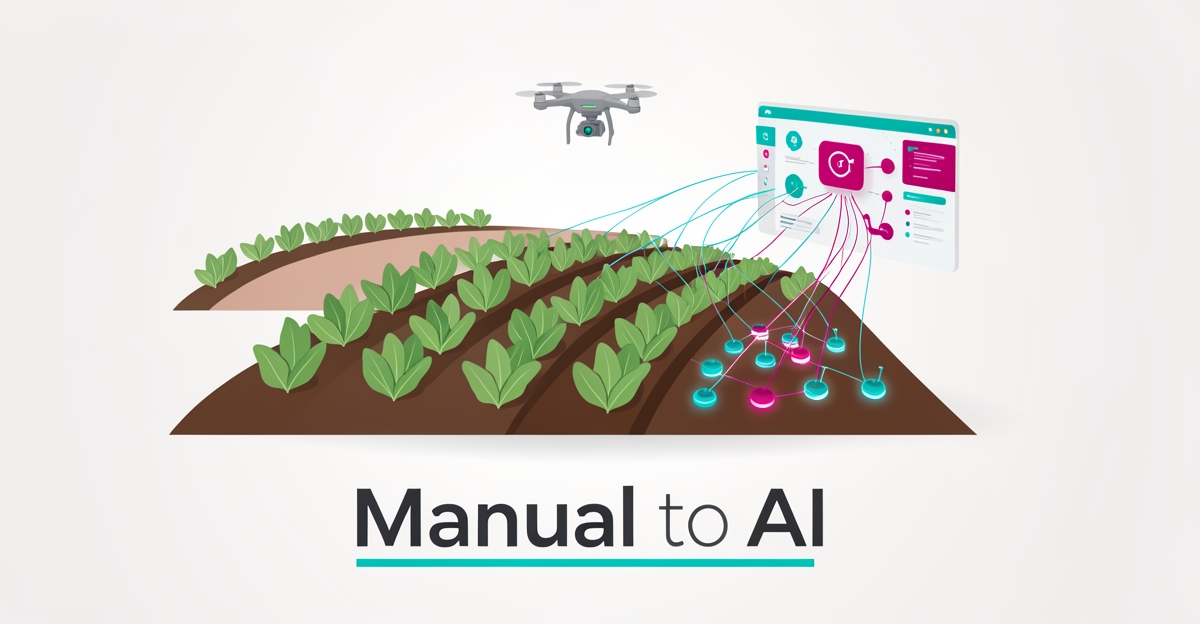
From Manual to AI: Transforming Field Operations in Organic Farming
Key Facts
- Agriculture automation has been steadily increasing as farms adopt AI to reduce labor-intensive tasks, according to industry analyses as of late 2026.
- AI systems can analyze soil composition, moisture levels, and weather patterns to determine optimal planting times and irrigation schedules.
- AI-powered robots and drones can perform weed control, crop scouting, and plant growth monitoring without synthetic herbicides.
- Handwritten harvest logs introduce transcription errors that distort performance analysis and complicate organic certification audits.
- Manual planting schedules risk suboptimal timing that directly impacts germination rates and early growth vigor.
- Automation adoption spans manufacturing, logistics, and farming alike, with agriculture continuing to gain ground as of late 2026.
- AI weather forecasting tuned to microclimate data can optimize timing for farming activities and provide climate change insights.
Hire a team member that works 24/7 — for less than a part-time wage.
AI receptionists, SDRs, dispatchers and 99+ roles. Trained on your business, fully managed.
Not sure where to start? Ask our AI planner
The Hidden Cost of Manual Field Operations in Organic Farming
Organic farming demands meticulous attention to detail, yet many field operations remain stubbornly manual—creating bottlenecks that ripple through the entire season. From planting schedules to harvest logging, farmers spend countless hours on repetitive tasks that could be automated, diverting focus from strategic decisions about soil health and crop diversity. These workflows are not just time-consuming; they are prone to human error, especially during peak seasons when fatigue sets in and data entry becomes rushed.
Consider the planting schedule: manually tracking optimal sowing windows based on soil temperature, moisture levels, and weather forecasts requires constant cross-referencing of paper charts or disconnected spreadsheets. A single miscalculation can throw off germination rates, leading to uneven stands and reduced yields. Similarly, harvest logging—recording yields, quality grades, and field conditions by hand—introduces transcription errors that distort performance analysis and complicate certification audits for organic standards. Field monitoring, whether for pest scouting or irrigation checks, often relies on sporadic walks through rows, meaning issues like nutrient deficiencies or water stress are spotted too late to correct effectively.
Industry analyses as of late 2026 show agriculture automation continuing to climb as farms seek to reduce labor-intensive tasks, reflecting a growing recognition that manual processes limit scalability and increase operational risk. This trend is particularly relevant for organic farms, where compliance with certification requirements demands precise, traceable records—something manual systems struggle to deliver consistently. The hidden cost isn’t just in labor hours; it’s in missed opportunities to optimize inputs, prevent crop loss, and build resilient, data-driven practices that support long-term soil fertility and market competitiveness.
- Manual planting schedules increase the risk of suboptimal timing, directly impacting germination and early growth vigor.
- Handwritten harvest logs introduce transcription errors that compromise data integrity for organic certification and market reporting.
- Infrequent field monitoring delays detection of pest outbreaks or irrigation issues, allowing preventable losses to accumulate.
- Reliance on paper-based systems creates version control challenges, making it difficult to track changes or share updates across farm teams.
- Time spent on administrative tasks diverts attention from regenerative practices like cover cropping and compost application that build long-term soil health.
These inefficiencies compound over time, creating a ceiling on how much land a single farmer or small team can manage effectively while maintaining organic integrity. As consumer demand for transparently grown produce rises, the ability to demonstrate precise, auditable field practices becomes not just an operational advantage but a market necessity—one that manual workflows are increasingly ill-equipped to provide.
How AI Automates Core Organic Farming Workflows
Organic farming has always demanded intimate knowledge of every acre — but the sheer volume of decisions, from planting windows to irrigation timing, stretches even the most experienced growers thin. AI systems can shoulder that cognitive load by continuously analyzing soil composition, moisture levels, and weather patterns to pinpoint optimal planting times and irrigation schedules, increasing crop yield while minimizing resource wastage. These systems turn raw field data into precise, actionable guidance that would take humans hours to calculate manually.
- Autonomous robots and drones handle weed control and crop scouting without synthetic herbicides
- Real-time plant growth monitoring catches stress signals before they become visible
- Predictive maintenance on irrigation and equipment prevents costly mid-season breakdowns
- Weather forecasting models tuned to microclimate data optimize every field pass
The shift is measurable: automation in agriculture keeps rising as AI takes on repetitive, labor-intensive tasks, freeing skilled workers for higher-value decisions. Industry analyses show this human-AI partnership model — where technology handles routine execution while growers drive strategy — delivers the strongest outcomes across manufacturing, logistics, and farming alike. AI-powered robots and drones performing weed control, crop scouting, and growth monitoring reduce manual labor needs while boosting overall productivity.
AIQ Labs builds custom AI workflow systems that embed this same logic into farm operations — connecting sensor data, equipment telemetry, and forecasting models into a unified automation layer the farm owns outright. No subscription dependencies, no vendor lock-in. Just production-grade AI that runs your planting, irrigation, and scouting workflows 24/7, learns from each season, and improves over time. With 200+ multi-agent systems deployed and four live SaaS products we run daily, this is automation built on real operational experience, not theory.
Implementing AI in Organic Farming: From Pilot to Full Ownership
Organic farming operations often begin with small, manageable workflow fixes before scaling to broader AI integration. Starting with a single pain point—like manual harvest logging—allows farm owners to test AI solutions with minimal risk while demonstrating immediate value. This approach aligns with AIQ Labs’ AI Workflow Builds, which rebuild the one workflow that costs you the most at a fixed price, in phases. By focusing on a defined task first, farms can validate AI’s impact before expanding to more complex operations.
Scaling successfully requires a structured, milestone-based approach that builds confidence and capability over time. Implementing AI Employees for field monitoring—such as tracking crop health or irrigation needs—creates a bridge between initial fixes and full-system ownership. These managed AI agents work 24/7, integrating with existing tools to provide real-time insights without adding headcount, typically at around 80% less cost than a human hire. AI-driven monitoring in agriculture can increase productivity by reducing manual scouting time and optimizing resource use, directly supporting organic farming’s precision and sustainability goals. The Build in Milestones payment model ensures farms only pay for completed phases, retaining all work done even if they pause mid-project.
Ultimately, full ownership of custom AI systems transforms organic farms from users of AI tools to controllers of their own intelligent infrastructure. Achieving this stage means the farm owns the code, agents, and data—free from vendor lock-in and able to evolve the system as needs change. This outcome is possible through the Own It Outright payment model, which delivers a complete AI Operating System tailored to the farm’s unique workflows, built in phases and owned outright. With full control, organic farms can continuously refine their AI to handle everything from planting schedules to harvest logging, ensuring long-term efficiency and competitive advantage in sustainable agriculture.
Still paying for 10+ subscriptions that don’t talk to each other?
We build custom AI systems you own outright. No vendor lock-in. Full control.
Not sure where to start? Ask our AI planner
Frequently Asked Questions
How does AI actually improve planting schedules in organic farming?
Can AI help reduce errors in harvest logging for organic certification?
What specific tasks can AI-powered robots and drones handle in organic fields?
Is AI automation actually growing in agriculture?
Will using AI mean I lose ownership of my farm’s data or systems?
How do I start implementing AI without overhauling my entire operation?
Own Your Field Intelligence
Organic farming proves that precision and stewardship can scale, but only when manual bottlenecks stop dictating the season. From error-prone planting schedules and handwritten harvest logs to late pest detection, repetitive field work drains time from the regenerative practices that build soil health and certification-ready records. AI shifts that balance by continuously analyzing soil, moisture and weather to time planting and irrigation, while robots and drones handle scouting and weed control, freeing growers to focus on strategy. With agriculture automation climbing as of late 2026, the farms that win are moving from pilots to owned systems. Start with one critical workflow, validate the impact, then build in milestones toward full ownership of code, agents and data. AIQ Labs helps small and mid-sized farms architect custom AI workflows they control outright, without vendor lock-in. Take the 2-minute Fit Check at aiqlabs.ai/apply, then book a free 30-minute strategy call at aiqlabs.ai/book to map your highest-ROI automation opportunity.
Make AI your competitive advantage — not just another tool.
Strategy, implementation and ongoing optimization. One partner, end to end.
Not sure where to start? Ask our AI planner