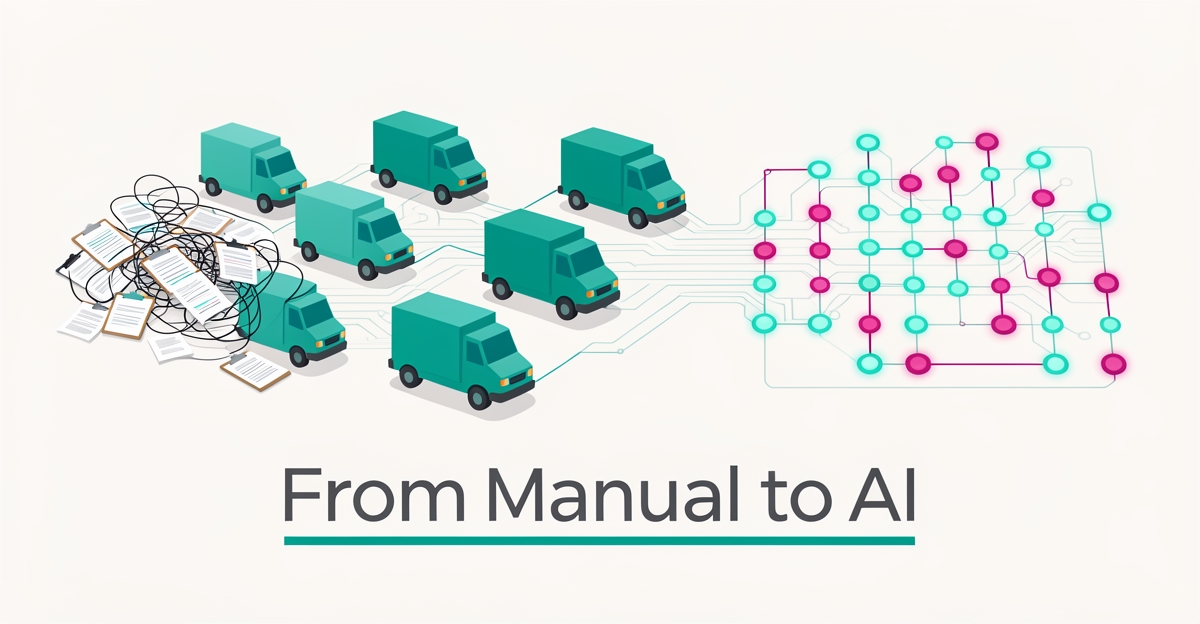
From Manual to AI: Transforming Fleet Booking Workflows in Rental Companies
Key Facts
- 56% of industry leaders report manual decisioning takes 1-3 weeks according to Penske Truck Leasing
- AI-powered dispatch can reduce coordination time by 40-60% per FleetRabbit's 2026 analysis
- AI route optimization typically delivers 15-25% operating cost savings per FleetRabbit
- AI dispatch can improve on-time delivery rates by 20-30% based on fleet management studies
- Planning speed can drop from 2-4 hours daily to under 5 minutes with AI per Upper Inc's comparison
- AI can enable managing 5 to 500+ vehicles per dispatcher vs. 10-15 manually per Upper Inc data
- 92% of executives believe AI will improve supply chain resiliency Penske Truck Leasing reports
Hire a team member that works 24/7 — for less than a part-time wage.
AI receptionists, SDRs, dispatchers and 99+ roles. Trained on your business, fully managed.
Not sure where to start? Ask our AI planner
The Manual Booking Bottleneck in Rental Fleets
Rental companies still rely on manual dispatch and phone-based booking, creating costly coordination delays that ripple through operations. These processes require staff to juggle multiple systems, verify availability by hand, and confirm bookings through back-and-forth communication—introducing avoidable errors and hidden labor costs. The result is a workflow where simple booking decisions stretch into lengthy cycles, undermining responsiveness and customer satisfaction.
According to industry research, 56% of transportation and logistics leaders report that manual decisioning and comparisons take 1-3 weeks to complete. This extended timeline isn't just inefficient—it actively prevents companies from capitalizing on time-sensitive opportunities, especially in competitive rental markets where speed determines win rates. Meanwhile, FleetRabbit's 2026 analysis indicates that AI-powered dispatch software can reduce coordination time by 40-60%, turning what once took hours into near-instantaneous outcomes.
These bottlenecks show up as tangible operational pain points: double-booked equipment, missed pickup windows, and dispatcher overload during peak periods. Staff spend excessive time on reactive problem-solving instead of proactive fleet optimization, while customers experience frustration from unclear ETAs and scheduling conflicts. The hidden cost isn't just in labor—it's in eroded trust, lost revenue from avoidable cancellations, and the opportunity cost of tying up skilled employees in repetitive, low-value tasks.
- Manual verification of equipment availability across locations
- Phone-based booking requiring repeated confirmation calls
- Paper or spreadsheet-based dispatch logs prone to transcription errors
- Reactive exception handling due to lack of real-time visibility
- Delayed invoicing from disconnected booking and billing systems
AIQ Labs helps rental companies diagnose these exact friction points, identifying where automation delivers the highest impact—often through a focused AI Workflow Build that rebuilds the one booking workflow costing you the most. By replacing manual handoffs with intelligent workflows, businesses reclaim coordination time, reduce error rates, and create a foundation for scalable, AI-enhanced operations—without disrupting existing customer relationships or service standards. The shift isn't just about technology; it's about redefining how rental fleets operate at their core.
What AI Dispatch Delivers for Fleet Rental Operations
AI-powered dispatch transforms fleet rental operations by delivering efficiency gains that manual processes simply cannot match. Industry analyses report that companies using AI for route optimization typically achieve 15-25% operating cost savings while improving on-time delivery rates by 20-30%, creating immediate financial and service advantages. FleetRabbit's analysis attributes these benefits to intelligent algorithms that continuously refine routing based on real-time traffic, weather, and delivery windows.
The contrast between manual and AI dispatch becomes stark when examining operational metrics. Planning speed can drop from 2-4 hours daily to under 5 minutes, freeing dispatchers to focus on exceptions rather than routine scheduling. Mileage efficiency improves with 20-35% fewer miles driven through optimized routing, directly reducing fuel costs and vehicle wear. Upper Inc's comparison shows scalability expands dramatically—from managing just 10-15 drivers per dispatcher in manual systems to handling fleets of 5 to 500+ vehicles with AI, enabling growth without proportional staffing increases.
Real-time visibility represents another critical advancement, replacing sporadic check-in calls with live GPS dashboards that provide instant location tracking and status updates. This transparency allows proactive issue resolution before delays impact customers, while consistent algorithmic decision-making reduces error rates compared to variable human judgment. For rental companies evaluating this shift, a managed AI Dispatcher from AIQ Labs can take over routine scheduling and coordination at roughly 80% less cost than a human hire. The result is a dispatch function that scales efficiently, cuts waste, and elevates service reliability across the entire fleet operation.
AI Readiness Assessment for Rental Booking Workflows
Many rental operators still rely on manual booking and dispatch methods, creating delays and errors that ripple through daily operations. Assessing current workflows is the essential first step to uncover where AI can deliver measurable improvements in efficiency, cost savings, and customer satisfaction.
Start by defining clear goals for your AI transformation, such as reducing coordination time, lowering operating costs, or improving on-time delivery rates. Industry analyses suggest AI-powered dispatch software can cut coordination time by 40-60% and reduce operating costs by 15-25% per FleetRabbit, while also boosting on-time delivery performance by 20-30% based on fleet management studies. These benchmarks help prioritize which processes to target first.
Next, evaluate your existing technology stack and data quality. AI systems depend on accurate, integrated data from sources like booking calendars, maintenance logs, and customer records. Gaps in data consistency or legacy system incompatibilities can hinder AI performance, so identifying these limitations early allows for targeted upgrades or integration planning. Finally, map out integration needs with your CRM, scheduling tools, and dispatch platforms to ensure seamless AI agent deployment. AIQ Labs' two-minute Fit Check at aiqlabs.ai/apply follows this structured approach to help rental operators pinpoint high-impact opportunities and build a practical roadmap for transformation.
Implementation Playbook: From Audit to AI-Powered Dispatch
Moving from manual dispatch to AI-powered operations isn't a single switch—it's a structured progression that begins with an honest audit of how work actually gets done today. Research shows that 56% of industry leaders report manual decision-making cycles of one to three weeks, while 77% still rely on annual forecasting to guide procurement. Those numbers reveal the hidden cost of intuition-based planning and make the case for a deliberate, phased rollout.
- Map every handoff in the current booking-to-dispatch workflow and flag steps that consume the most dispatcher hours
- Validate data completeness across GPS, telematics, maintenance logs, and customer records before any model training begins
- Run a controlled pilot on one route cluster measuring coordination time, mileage, and on-time performance against the baseline
- Upskill dispatchers and drivers with hands-on sessions so they trust the system's recommendations instead of overriding them
- Scale to AI-powered route optimization and safety scoring once the pilot hits the 40-60% coordination-time reduction and 15-25% operating-cost savings benchmarks
AIQ Labs structures this journey through three entry points that match a rental company's risk appetite and capital strategy. AI Employees is the monthly starting point: a managed AI Dispatcher—built, trained, integrated, and continuously optimized—for roughly 80% less than a human hire, with the freedom to pause or adjust anytime. AI Workflow Builds rebuild the one workflow that costs you the most at a fixed price, delivered in approved phases you keep even if you stop early. AI Operating Systems deliver one connected operating layer across the business—built in phases and owned outright, eliminating vendor lock-in entirely. Each path includes the same governance, compliance, and change-management rigor that moves organizations past the pilot stage where 92% of executives say AI will determine future resiliency.
Still paying for 10+ subscriptions that don’t talk to each other?
We build custom AI systems you own outright. No vendor lock-in. Full control.
Not sure where to start? Ask our AI planner
Frequently Asked Questions
How much time can AI dispatch actually save compared to manual booking?
What does AI dispatch cost savings look like in real numbers?
Will AI dispatch work if my fleet grows beyond what my current dispatcher can handle?
How do I know if my rental company is ready for AI booking automation?
Will AI replace my dispatchers?
What's the best way to roll out AI dispatch without disrupting operations?
The Dispatch Desk Has Changed — Has Your Operation?
Manual booking and dispatch workflows aren't just slow — they're actively expensive. The data shows coordination times stretching one to three weeks for over half of industry leaders, while AI-powered dispatch can cut that by 40-60% and reduce operating costs 15-25%. The gap between 2-4 hours of daily planning and under five minutes isn't a marginal improvement; it's a structural shift in what a rental fleet can handle without adding headcount. Companies that move through the audit-to-pilot-to-scale sequence outlined here don't just automate a task — they rebuild the coordination layer that touches every customer, every driver, and every asset. AIQ Labs helps rental operators navigate that progression with three entry points — AI Employees, AI Workflow Builds, and AI Operating Systems — so the pace and risk profile match the business. The next step is simple: run the two-minute Fit Check at aiqlabs.ai/apply and book the free 30-minute strategy call to see exactly where AI dispatch delivers the fastest return for your operation.
Make AI your competitive advantage — not just another tool.
Strategy, implementation and ongoing optimization. One partner, end to end.
Not sure where to start? Ask our AI planner