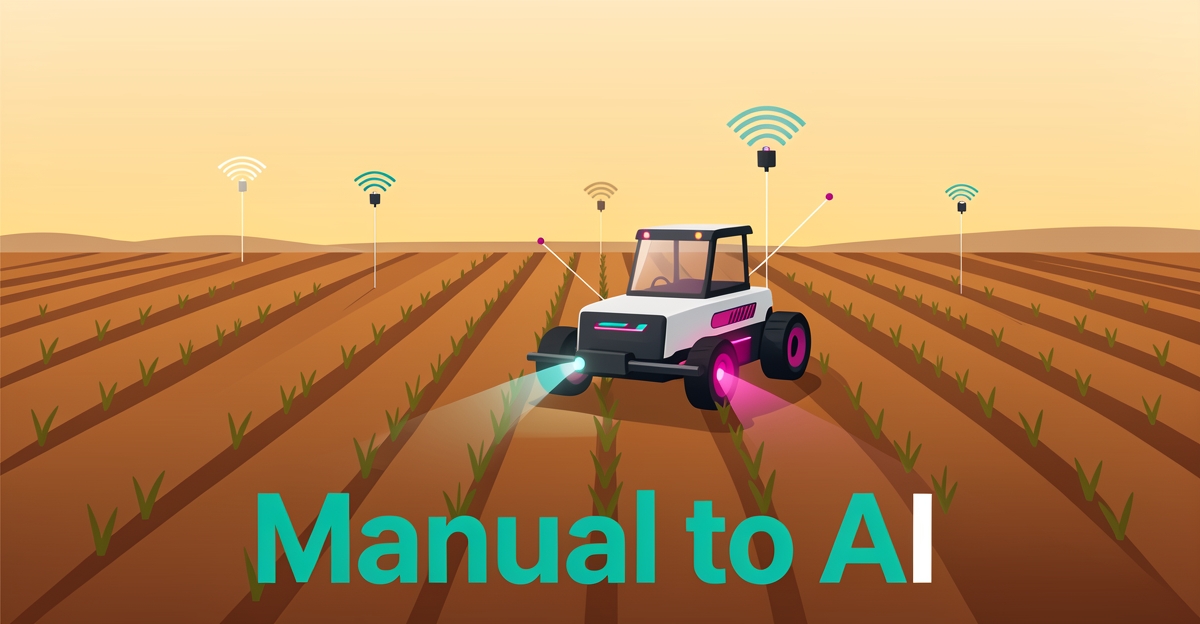
From Manual to AI: Transforming Harvesting Workflows with Smart Systems
Key Facts
- Computer-vision weeding tools like Carbon Robotics' LaserWeeder and Blue River Technology's See & Spray are in commercial field use, targeting individual weeds instead of blanket-spraying whole fields
- Adoption of AI in large-scale farming has grown steadily since 2023, with a substantial share of large operations now using some form of AI to optimize harvest workflows
- AI platforms eliminate scouting gaps by providing real-time visibility across every acre through integrated satellite, sensor, and weather data
- Harvest CROO Robotics automates strawberry harvesting to increase speed and reduce labor dependency in field operations
- Naïo Technologies' Oz Robot delivers autonomous weeding aimed at small to medium farming operations
- AIQ Labs has deployed 200+ multi-agent systems and runs four live SaaS products daily—the same engineering discipline applies to agricultural workflows
Hire a team member that works 24/7 — for less than a part-time wage.
AI receptionists, SDRs, dispatchers and 99+ roles. Trained on your business, fully managed.
Not sure where to start? Ask our AI planner
The Hidden Costs of Manual Harvesting Workflows
For generations, harvest decisions have lived in notebooks, radio chatter, and the intuition of a few seasoned scouts walking rows at dawn. That model worked when labor was plentiful and margins had breathing room—neither is true today.
Weather unpredictability, labor shortages, and razor-thin margins demand maximum efficiency from every acre, yet manual processes offer only limited coverage compared to the continuous monitoring modern operations require. AI adoption in agriculture has grown steadily since 2023, and as of late 2026 a substantial share of large-scale operations use some form of artificial intelligence to close the gap between what human-only workflows can deliver and what the season demands.
- Scouting gaps: experienced scouts provide contextual depth but cannot be everywhere at once
- Reactive timing: decisions lag behind fast-changing field conditions by hours or days
- Documentation drift: handwritten logs and basic mobile apps create fragmented records
- Labor dependency: critical workflows stall when skilled workers are unavailable
The core difference is where decisions get made: traditional approaches depend on human judgment and field experience, while AI platforms optimize inputs mathematically using integrated data from satellites, soil sensors, weather stations, and equipment telemetry. AIQ Labs helps agricultural operations make this shift through AI Workflow Builds—rebuilding the one workflow that costs the most, at a fixed price, in phases—turning reactive, labor-heavy processes into proactive, data-driven workflows the business owns outright.
What Smart Harvesting Systems Actually Do
Smart harvesting systems transform field operations through continuous monitoring and data-driven decision-making. These AI platforms integrate satellite imagery, soil sensors, and weather data to provide real-time visibility across every acre, eliminating the blind spots inherent in manual scouting. This continuous monitoring capability directly addresses labor shortages by automating routine decisions that would otherwise require constant human presence in the field.
The core advantage lies in how decisions are made—AI systems optimize inputs mathematically using integrated data streams rather than relying on human judgment alone. By processing information from multiple sources simultaneously, these platforms create comprehensive operational insights that enable precise scheduling of harvest activities, irrigation adjustments, and resource allocation based on actual field conditions rather than seasonal assumptions or experience-based guesswork.
- Real-time decision-making based on sensor, drone, and satellite data optimizes crop yields while minimizing resource waste
- Computer-vision systems like Blue River Technology's See & Spray distinguish crops from weeds plant-by-plant, dramatically cutting herbicide use compared with blanket application
- Carbon Robotics' LaserWeeder targets individual weeds with lasers, covering ground faster than hand crews and reducing weed control costs substantially
AIQ Labs builds custom systems that embed these capabilities directly into existing field operations, enabling proactive workflow adjustments instead of reactive responses. The technology shifts harvesting from a labor-intensive, experience-dependent process to a mathematically optimized operation where every input—water, nutrients, timing—is calibrated to current field data. This approach not only improves efficiency but also creates scalable solutions that maintain precision whether managing ten acres or ten thousand.
The Business Case: AI vs. Manual in Numbers
The economics of agricultural AI have moved well past the pilot stage. As of late 2026, a substantial and growing share of large-scale farming operations employ some form of artificial intelligence in harvest workflows—these are production deployments solving real operational constraints, not experiments.
- Blue River Technology's See & Spray uses computer vision to distinguish crops from weeds, cutting herbicide use dramatically versus field-wide spraying
- Carbon Robotics' LaserWeeder targets weeds individually with lasers, reducing weed control costs compared with manual and chemical approaches
- Harvest CROO Robotics automates strawberry harvesting to increase speed and reduce labor dependency
- Naïo Technologies' Oz Robot delivers autonomous weeding aimed at small to medium operations
The economics shift fundamentally when AI moves from decision support to decision execution. Manual processes rely on experienced scouts and localized knowledge—valuable but limited in coverage. AI platforms integrate satellite imagery, soil sensors, weather stations, and equipment telemetry to optimize inputs mathematically across every acre continuously. This paradigm shift directly addresses the labor shortages and razor-thin margins that make maximum efficiency non-negotiable.
AIQ Labs applies this same transformation logic to business operations beyond the field. Our AI Employees handle the repetitive coordination work—dispatching, scheduling, monitoring—at roughly 80% less cost than a human hire, while AI Workflow Builds rebuild the single workflow that costs your operation the most. The pattern holds whether you're harvesting strawberries or processing invoices: organizations that move from manual judgment to AI-driven execution capture compounding advantages in speed, accuracy, and scale.
Building Your AI Harvesting System: A Practical Roadmap
The journey from manual harvesting to AI-driven operations doesn't require a complete overhaul of existing infrastructure. Many farms already use equipment and platforms like John Deere Operations Center or Climate FieldView, which can serve as foundational data sources for AI integration. Rather than replacing these systems, AI enhances them by adding intelligent decision-making layers that automate routine tasks such as crop monitoring, irrigation scheduling, and supply chain coordination—functions that manual processes struggle to scale due to limited coverage and reliance on intermittent field scouting. This hybrid approach allows operations to retain valuable local knowledge while gaining the precision and continuity of AI-driven insights.
A practical roadmap begins with assessing current workflows to identify high-impact automation opportunities, such as real-time yield prediction or adaptive harvesting schedules based on weather and soil data. AI systems excel here by continuously analyzing inputs from satellites, drones, and ground sensors to optimize decisions mathematically—reducing dependence on reactive, experience-based judgments. This shift enables proactive adjustments rather than delayed responses to issues like pest outbreaks or irrigation needs.
Implementation should proceed in phases, starting with a single workflow—such as automating harvest dispatch or yield forecasting—before expanding to broader operations. This incremental strategy minimizes risk and lets teams build confidence in the technology while day-to-day functionality continues. AIQ Labs works exactly this way: fixed-price, milestone-based builds that integrate with your existing tools via APIs, so data flows between legacy systems and new AI agents without a rip-and-replace. When the operation is ready for a connected layer across scheduling, monitoring, and dispatch, an AI Operating System ties it together—built in phases and owned outright. The focus stays on augmenting human expertise rather than replacing it. To explore how this could work for your operation, start with the 2-minute Fit Check, then book a free 30-minute strategy call to map your biggest bottleneck and identify high-ROI automation opportunities.
From Data to Decisions: The Future of Harvesting Is Already Here
The shift from manual to AI-driven harvesting isn't about replacing experience—it's about amplifying it. By integrating satellite data, soil sensors, and real-time weather inputs, smart systems eliminate blind spots, reduce waste, and enable proactive decisions that keep pace with changing field conditions. AIQ Labs helps agricultural businesses make this transition through custom builds that create owned, scalable systems—augmenting human expertise with continuous monitoring and mathematically optimized workflows. With 200+ multi-agent systems deployed and four live SaaS products we run daily, the engineering discipline is proven. The path forward starts with identifying your highest-impact bottleneck. Take the 2-minute Fit Check, then book a free strategy call to map your opportunity and see what's possible.
Make AI your competitive advantage — not just another tool.
Strategy, implementation and ongoing optimization. One partner, end to end.
Not sure where to start? Ask our AI planner