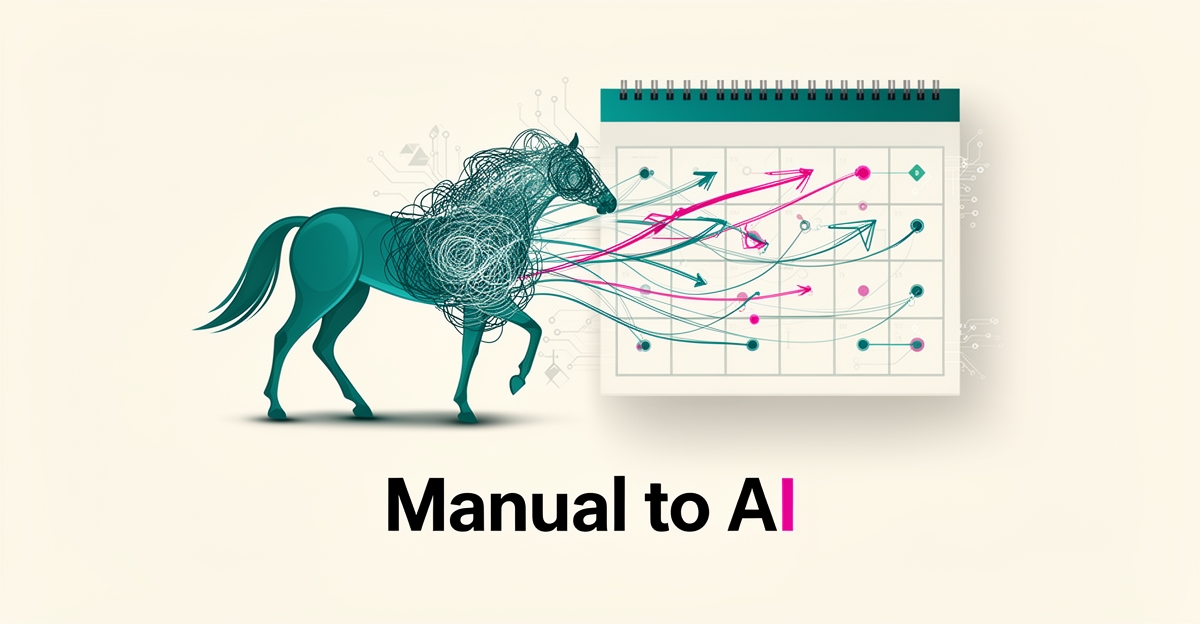
From Manual to AI: Transforming Horse Training Booking Workflows
Key Facts
- Most of a successful AI transformation is process work—mapping, data collection, testing, and integration—not the AI itself
- Process mapping alone can expose booking bottlenecks before any technology is introduced
- AI workflow automation interprets unstructured input and makes context-aware decisions beyond traditional rule-based automation
- AI workflows typically follow four stages: Trigger, Process, Action, and Learn, improving scheduling accuracy over time
- Automated, personalized reminders and self-service rescheduling are the most direct levers for reducing no-shows
Hire a team member that works 24/7 — for less than a part-time wage.
AI receptionists, SDRs, dispatchers and 99+ roles. Trained on your business, fully managed.
Not sure where to start? Ask our AI planner
The Hidden Cost of Manual Booking in Horse Training Facilities
Every missed call at a busy horse training facility is a lost booking, and most owners never know it happened. While a trainer is in the saddle, the phone rings out, the voicemail fills up, and a prospective client quietly books elsewhere. The problem isn't a lack of demand—it's a booking workflow built for a slower era.
Manual scheduling creates friction at every step. Staff juggle phone calls between lessons, cross-reference availability in spreadsheets, and manually send reminders—if they remember at all. Each touchpoint adds delay, and delay kills conversions. When a client has to wait a day for a callback to confirm a simple opening, the booking is already at risk.
The hidden costs stack up in ways that rarely appear on a balance sheet:
- Slow response times that push clients toward competitors who answer instantly
- No-shows caused by absent or inconsistent reminder systems
- Double bookings and scheduling errors from manually updated spreadsheets
- Hours of administrative work that pulls trainers away from billable training time
This is fundamentally a workflow issue, not a staffing issue. Most of the fix has nothing to do with AI itself—mapping out your processes often makes a business more efficient even before any technology is introduced. Documenting how a booking actually flows through your facility frequently exposes the bottlenecks before any tool enters the picture. In successful AI transformations, only a small fraction of the work involves the AI; the rest is process mapping, data collection, testing, and integration.
The cost of ignoring the problem compounds. Every unanswered call is revenue handed to a competitor, every missed reminder is an empty slot you can't resell, and every hour of admin is billable training time lost. Meanwhile, businesses that automate their workflows gain something harder to quantify: visibility. They finally know what's happening in their own schedule.
For horse training facilities, the pattern is familiar across service industries. Traditional automation handles the predictable, but AI workflow automation goes further by making context-aware decisions—interpreting a vague voicemail, checking real-time availability, and confirming a slot without human intervention. That's the shift AIQ Labs focuses on with its [AI Workflow Builds](/workflow-builds): rebuild the one workflow that costs you the most, at a fixed price, in phases.
Before any solution is proposed, though, the first step is honest accounting. Tally the hours spent on phone tag, count the no-shows from missed reminders, and measure how long it takes to answer a simple availability question. That baseline reveals the true cost of manual booking—and whether the workflow deserves a rebuild.
How AI Workflow Automation Replaces Judgment Calls in Scheduling
Manual scheduling in horse training facilities often relies on staff judgment to coordinate trainer availability, client preferences, and facility resources—creating bottlenecks and inconsistent outcomes. AI workflow automation replaces these subjective decisions with data-driven processes that interpret context, handle exceptions, and adapt in real time. By combining natural language understanding with agentic AI, these systems transform scheduling from a reactive task into a proactive, self-correcting operation.
The AI workflow typically follows four stages: Trigger, Process, Action, and Learn. A trigger might be a client submitting a booking request via web form or phone call, initiating the process. During the Process phase, the AI analyzes the input to extract intent, preferred time slots, trainer specialization needs, and even urgency from client messages. This enables context-aware understanding that goes beyond keyword matching to interpret nuances like flexibility in scheduling requests.
In the Action stage, the system checks real-time availability across integrated calendars, confirms trainer qualifications match the requested session type, and books the appointment—all while respecting facility constraints like arena availability or equipment needs. Automated reminders are then triggered via SMS or email, personalized based on client history and past no-show patterns. Finally, in the Learn phase, the system refines future decisions by analyzing outcomes such as confirmation rates, rescheduling frequency, and client feedback, continuously improving accuracy and reducing manual oversight.
AIQ Labs applies this framework through [AI Employees](/ai-employees)—managed AI staff like booking assistants and receptionists that handle end-to-end scheduling workflows. They integrate with existing tools like Google Calendar and CRM systems, so facility staff don't have to learn new interfaces. These agents run the full booking lifecycle—from initial request to post-session follow-up—while maintaining audit trails and escalating complex cases to human staff when needed. The result is a scheduling system that reduces administrative burden and improves client experience through timely, personalized communication and fewer missed appointments. By anchoring decisions in data rather than judgment, training facilities gain reliability, scalability, and efficiency gains that compound over time.
A Process-Driven Roadmap From Spreadsheets to Self-Service
Spreadsheets and phone calls create bottlenecks that cost training facilities time, clients, and revenue every week. Moving to AI self-service is less about installing software and more about redesigning the booking workflow from the ground up.
Transformation starts with problem identification. Facilities map the manual steps that create friction: intake calls, spreadsheet availability checks, and manual reminder texts. In most successful AI projects, the majority of the effort goes into workflow mapping, data collection, testing, integration, and adoption—not the model itself.
Workflow mapping documents the current reality in detail. Staff log how bookings are requested, confirmed, and reminded, including edge cases like last-minute cancellations and double bookings. Process mapping alone improves efficiency by exposing hidden delays before any technology is added.
Data collection follows the map. Real-world inputs such as past messages, booking histories, and exception cases are gathered to train and test the system. This step ensures the AI understands the language clients use and the rules trainers actually follow.
Prototyping builds a minimal viable solution. A focused pilot automates one critical path, such as availability checks and instant confirmations, rather than rebuilding the entire operation. Start narrow, measure results, then scale what works.
Testing and iteration refine the workflow with user feedback. Trainers and clients use the prototype with live data, revealing gaps in logic and communication style. Process and adoption work drives most of the transformation, not the model.
System integration connects the new workflow to existing tools. Calendar APIs, CRM records, and payment systems sync so the AI can check availability, hold slots, and trigger reminders without manual re-entry. AI workflow automation handles decisions across connected platforms rather than in isolated silos.
Rollout and training embed the system into daily operations. Staff learn to oversee the AI, handle exceptions, and coach clients on self-service options. Adoption and culture ensure the workflow sticks, with feedback loops for continuous improvement.
Measurement closes the loop. Facilities track reduced no-shows, faster response times, and staff hours reclaimed—against the baseline captured before the project started.
A process-driven roadmap for horse training booking typically includes:
- Problem identification for scheduling, availability checks, and reminders
- Workflow mapping of phone, spreadsheet, and manual confirmations
- Data collection from historical bookings and client communications
- Prototyping, testing, and integration with calendars and messaging
- Rollout, training, and adoption across trainers and clients
AIQ Labs follows this exact sequence in its [AI Workflow Builds](/workflow-builds), helping facilities automate appointment scheduling and client communication with production-ready systems the team owns and controls. For facilities ready to connect scheduling, reminders, billing, and follow-up into one layer, an [AI Operating System](/ai-operating-systems) takes the same approach at scale—built in phases, owned outright.
Building an Owned AI Booking System That Reduces No-Shows
Training facilities still relying on manual booking systems lose staff time to repetitive admin and revenue to preventable no-shows. AI workflow automation handles appointment scheduling, availability checks, and reminder systems through intelligent agents that learn and adapt over time. This approach eliminates repetitive administrative tasks while improving accuracy and client communication.
The gains come from AI's ability to interpret unstructured input, make context-aware decisions, and take actions like sending reminders or updating calendars in real time. For horse training businesses, this means fewer missed appointments and more predictable revenue.
AIQ Labs builds owned automation systems that integrate directly with existing tools like CRM and scheduling platforms, ensuring seamless data flow without vendor lock-in. Unlike off-the-shelf solutions, custom AI workflows are designed around your specific booking logic—whether managing private lessons, group clinics, or facility rentals. The system learns from historical data to optimize scheduling patterns and reduce conflicts that lead to no-shows.
- Automated appointment booking via voice, chat, or web interfaces
- Real-time availability checks across trainers, horses, and arenas
- Intelligent reminder sequences via SMS, email, and voice calls
- Self-service rescheduling and cancellation handling
- No-show risk flags and proactive client outreach
By focusing on workflow mapping and data preparation first, facilities can pilot a booking automation solution quickly and scale based on measured results. This method ensures the AI aligns with real-world processes before full deployment, reducing risk and increasing adoption. Facilities that implement such systems typically see measurable improvements in attendance rates and staff efficiency, turning a reactive booking process into a proactive, client-centered operation.
Still paying for 10+ subscriptions that don’t talk to each other?
We build custom AI systems you own outright. No vendor lock-in. Full control.
Not sure where to start? Ask our AI planner
Frequently Asked Questions
How much time do horse training facilities typically waste on manual booking tasks like phone tag and spreadsheet updates?
Can AI workflow automation really reduce no-shows for horse training appointments, and if so, how?
Is implementing AI for booking workflows mostly about the technology, or does it involve other steps?
What kind of return on investment can horse training facilities expect from AI-powered booking automation?
Do I need to replace my current calendar or CRM system to use an AI booking workflow?
From Phone Tag to Predictable Revenue
Manual booking is costing horse training facilities more than staff hours — it's lost clients, no-shows, and trainers pulled away from billable work. The real leverage isn't just AI, it's mapping the workflow first: intake calls, spreadsheet checks, and manual reminders all create delay, and delay kills conversions. AI workflow automation replaces those judgment calls with context-aware scheduling that interprets requests, checks real-time availability, and confirms appointments without human intervention, while learning from outcomes to reduce errors over time. A process-driven roadmap — problem identification, workflow mapping, data collection, focused pilot, integration, and measurement — lets facilities prove value before scaling. That shift turns scheduling from an administrative burden into a client experience advantage and a more predictable revenue stream. If you're ready to see where your booking process leaks time and revenue, start with a clear audit of response times, no-shows, and admin hours. Then take the 2-minute Fit Check at aiqlabs.ai/apply to book a free 30-minute strategy call and map your biggest bottleneck — no obligation. You can also reach the team directly at [email protected].
Make AI your competitive advantage — not just another tool.
Strategy, implementation and ongoing optimization. One partner, end to end.
Not sure where to start? Ask our AI planner