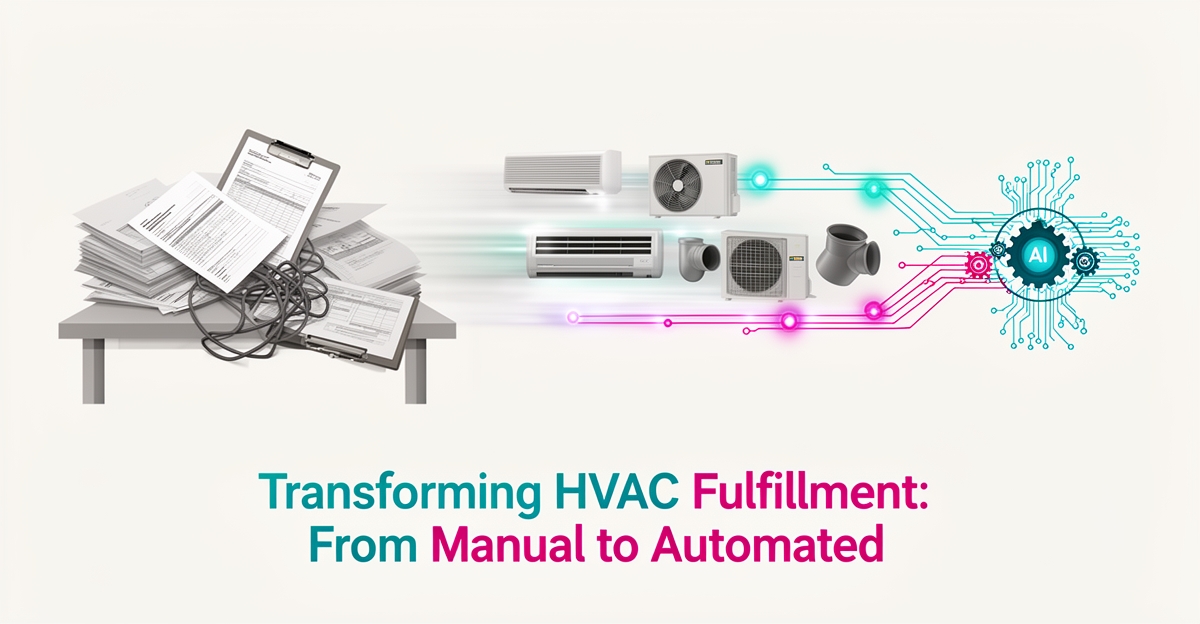
From Manual to AI: Transforming HVAC Parts Order Fulfillment Workflows
Key Facts
- Manual work order assignment commonly takes 8-15 minutes per order; AI-powered dispatching typically completes it in under 90 seconds
- Manual certification and parts matching typically runs 85-90% accuracy; automated systems can push this significantly higher
- Manual scheduling often adds 20-35% excess drive time, which AI route optimization can largely eliminate
- AI integrates with existing ERP and inventory systems — no rip-and-replace required
- AIQ Labs has deployed 200+ multi-agent systems and runs 4 live SaaS products daily
Hire a team member that works 24/7 — for less than a part-time wage.
AI receptionists, SDRs, dispatchers and 99+ roles. Trained on your business, fully managed.
Not sure where to start? Ask our AI planner
The Hidden Costs of Manual HVAC Dispatching and Order Fulfillment
The hidden costs of manual HVAC dispatching and order fulfillment often go unnoticed until they erode profitability and customer trust. Every minute spent on repetitive tasks compounds into hours of lost productivity, directly impacting service delivery and operational margins.
Traditional workflows commonly require 8-15 minutes to assign a single work order, creating immediate bottlenecks when technicians are waiting for dispatch instructions. This delay not only slows response times but also frustrates customers who expect prompt service, especially during urgent repairs or extreme weather conditions.
Manual dispatching also introduces significant inefficiencies in route planning, often adding 20-35% excess drive time as technicians navigate suboptimal paths between jobs. These unnecessary miles increase fuel costs, vehicle wear and tear, and technician fatigue—all while reducing the number of service calls that can be completed in a day.
- Delayed work order assignments increase customer wait times
- Suboptimal routing drives up operational expenses
- Manual processes limit technician productivity and job completion rates
- Inconsistent dispatching leads to errors in parts allocation and service tracking
- Administrative overhead distracts from core service delivery
Beyond direct costs, manual systems create hidden drains on profitability through increased administrative burden and reduced scalability. Dispatchers spend valuable time on data entry, phone coordination, and error correction—tasks that could be automated—while struggling to handle peak demand periods without adding staff.
These inefficiencies accumulate over time, creating a competitive disadvantage as more agile competitors adopt automated workflows. For HVAC parts distributors and service providers, the true cost of manual dispatching isn't just in the minutes wasted—it's in the missed opportunities, dissatisfied customers, and eroded margins that prevent sustainable growth.
How AI Transforms Order Accuracy and Speed in HVAC Fulfillment
The difference between guessing which technician has the right certification and knowing with near certainty changes everything for HVAC parts distributors. Manual dispatching typically achieves 85-90% certification matching accuracy, while AI-powered systems can push that figure meaningfully higher. That gap represents fewer wrong parts shipped, fewer return trips, and customers who get the right component the first time.
Speed compounds the advantage. A dispatcher spending 8-15 minutes assigning a single work order creates a bottleneck that ripples across the entire fulfillment chain. AI-powered dispatching typically collapses that window to under 90 seconds, freeing human teams to focus on exceptions and complex problem-solving rather than repetitive matching tasks. The impact extends beyond the warehouse — optimized routing cuts much of the excess drive time that manual scheduling typically adds, reducing fuel costs and accelerating delivery windows.
- Certification matching accuracy improves well beyond the 85-90% typical of manual methods
- Work order assignment drops from minutes to seconds
- Route optimization removes much of the excess drive time from manual scheduling
- Teams shift from repetitive matching to high-value exception handling
AIQ Labs builds these workflows through AI Workflow Builds — we rebuild the one workflow that costs you the most, at a fixed price and in phases. The AI Dispatcher and AI Fulfillment Agent roles from our managed AI employee catalog handle end-to-end order processing, certification validation, and routing logic around the clock — at roughly 80% less cost than a human hire. And when you're ready to connect everything into one operating layer, our AI Operating Systems offering builds it in phases, owned outright by you rather than rented.
Building Your AI-Powered Fulfillment Workflow: Integration, Not Replacement
Many HVAC distributors hesitate to adopt AI, fearing it means replacing their entire tech stack. The reality is far more practical: AI amplifies what already works. Rather than ripping out ERP or inventory systems, AI integrates with them to create a unified operational flow that enhances accuracy and speed without disruption.
Consider the accuracy gap: manual dispatching typically achieves only 85-90% certification matching accuracy, while AI-powered systems can reach substantially higher rates. This leap in precision doesn't require new software—it comes from AI intelligently interpreting existing part numbers, technician qualifications, and job requirements within current workflows. The same applies to timing: assigning a work order manually takes minutes, but AI typically reduces this to under 90 seconds, freeing staff to focus on exceptions and customer relationships.
The true power lies in redesigning end-to-end processes, not automating isolated tasks. AIQ Labs implements this by connecting AI agents to existing ERP platforms—syncing inventory levels, automating reorder triggers, and updating fulfillment status in real time—so human teams gain visibility without learning entirely new systems.
Implementation challenges like staff training and process adaptation are minimized through phased integration. Teams continue using familiar interfaces while AI handles background tasks such as data validation, route optimization, and status notifications. This approach reduces excess drive time, not by overhauling logistics software, but by enhancing dispatch logic within current systems. The result is a workflow that improves steadily, where AI works quietly in the background to make every human decision faster, more accurate, and less burdensome. Ready to see how AI integrates with your specific systems? Start the two-minute Fit Check, then schedule a free 30-minute strategy call to map your integration path.
Your Roadmap from Manual to Automated: Implementation Steps That Work
The journey from manual to automated HVAC parts order fulfillment begins with a clear-eyed assessment of your current workflow. Manual dispatching often adds significant excess drive time due to inefficient routing and takes minutes to assign a single work order, creating bottlenecks that slow down the entire operation. AI-powered dispatching addresses these pain points with measurable precision.
Start by mapping every step in your order-to-delivery process, from parts inquiry to technician dispatch, to identify where delays and errors consistently occur. Look for repetitive tasks like manual data entry, scheduling conflicts, or certification mismatches that consume valuable technician time. This diagnostic phase reveals the specific workflows ripe for AI intervention, ensuring your automation efforts target the highest-impact areas first rather than attempting a wholesale overhaul.
Next, implement a custom AI workflow solution that integrates seamlessly with your existing ERP or inventory system—no rip-and-replace required. AIQ Labs builds production-ready multi-agent systems that handle real-time dispatching, route optimization, and parts allocation while maintaining full data synchronization with your current tools. These systems dynamically optimize technician routes based on location, skill set, and parts availability.
Deploy the solution in phases, beginning with a single critical workflow such as emergency parts dispatch or high-volume SKU fulfillment. This approach allows your team to adapt gradually while delivering quick wins that build confidence and momentum. Throughout implementation, AIQ Labs provides ongoing management, performance monitoring, and continuous optimization—ensuring the system evolves with your business needs without vendor lock-in or hidden costs.
Finally, establish a cycle of measurement and refinement using built-in analytics to track key metrics like assignment time, drive time reduction, and first-time fix rates. Use these insights to fine-tune AI models, expand automation to adjacent workflows, and scale capabilities as your distribution network grows. This iterative process transforms AI from a one-time project into a sustainable competitive advantage that delivers enterprise-grade efficiency at an SMB-appropriate investment.
Still paying for 10+ subscriptions that don’t talk to each other?
We build custom AI systems you own outright. No vendor lock-in. Full control.
Not sure where to start? Ask our AI planner
Frequently Asked Questions
How long does it typically take to assign a work order manually versus with AI-powered dispatching?
Will implementing AI require me to replace my existing ERP or inventory system?
How much can AI reduce excess drive time for HVAC technicians compared to manual routing?
What improvement in certification matching accuracy can I expect from switching to AI-powered dispatching?
Is AI in HVAC fulfillment only about automating tasks, or does it change how workflows operate?
What's the first step to determine if AI automation is right for my HVAC parts fulfillment process?
Your HVAC Fulfillment Workflow: Smarter, Faster, and Built to Last
The shift from manual to AI-powered HVAC parts order fulfillment isn't about replacing what works—it's about amplifying it. By integrating intelligent automation with existing ERP and inventory systems, distributors can improve certification matching accuracy well beyond manual benchmarks, cut work order assignment from minutes to seconds, and eliminate much of the excess drive time that manual routing adds. These aren't just efficiency gains; they translate directly into faster service, lower operational costs, and stronger customer trust—especially during peak demand or urgent repairs. The real advantage lies in owning a system that evolves with your business, freeing your team to focus on high-value tasks while AI handles the repetitive work behind the scenes. If you're ready to see how this could work in your specific workflow, start with a free Fit Check to map your biggest bottlenecks and explore a clear path forward—no obligation, just clarity on where AI can deliver the highest impact for your operation.
Make AI your competitive advantage — not just another tool.
Strategy, implementation and ongoing optimization. One partner, end to end.
Not sure where to start? Ask our AI planner