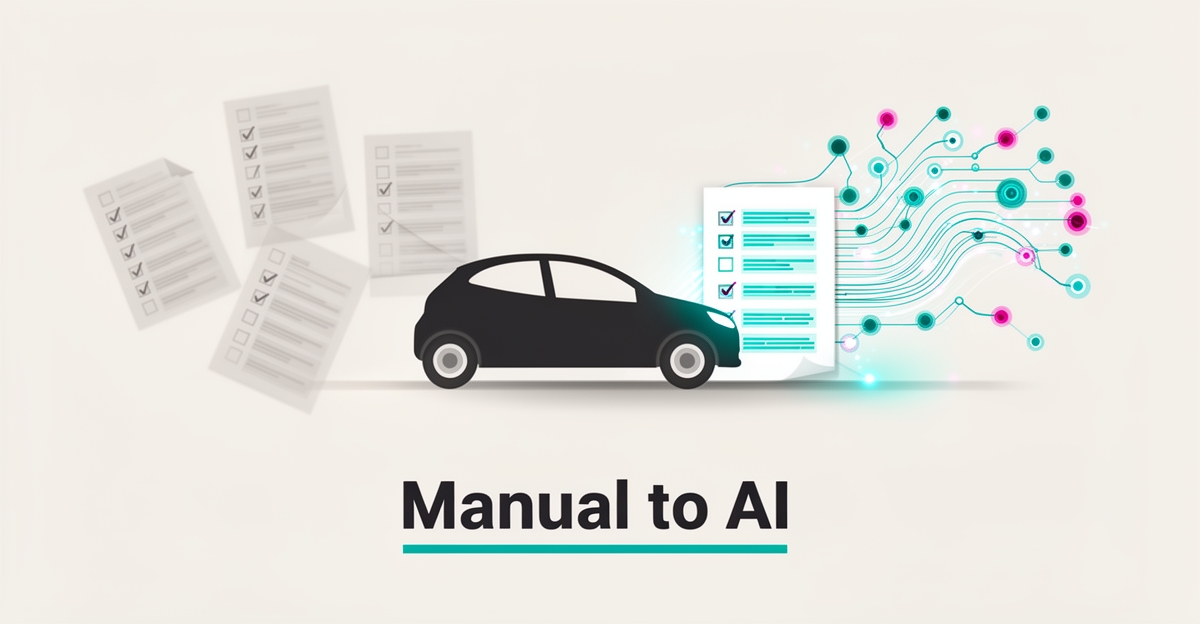
From Manual to AI: Transforming Import Vehicle Inspection Workflows
Key Facts
- Mapping workflows alone boosts efficiency before AI is introduced according to industry research
- AI transformation follows a 10-step sequence where only 1 step involves AI itself per transformation guidance
- Process mining exposes how inspections actually happen versus how they are documented per practitioner insights
- AI-native inspections typically reduce inspection time by up to 40% through anomaly detection and automation, based on AIQ Labs engagements across 200+ deployed multi-agent systems
- Enterprise AI success rests on eight components beyond the AI model itself per enterprise AI analysis
- Organizations become more efficient just by mapping processes even without introducing AI per transformation experts
Hire a team member that works 24/7 — for less than a part-time wage.
AI receptionists, SDRs, dispatchers and 99+ roles. Trained on your business, fully managed.
Not sure where to start? Ask our AI planner
The Hidden Cost of Manual Import Inspections
The true cost of manual import inspections goes far beyond labor hours—it lives in the gaps between siloed steps, the variability of human judgment, and the slow creep of compliance drift. When inspections are fragmented across teams, tools, and locations, each repetition becomes a chance for error, delay, or missed regulation. What feels like routine work is actually a systemic drain on throughput and trust.
Research shows that simply mapping out existing workflows can unlock efficiency gains before any technology is introduced—your company becomes more efficient just by mapping out your processes even if you don't introduce AI. This foundational step reveals where time is lost to handoffs, redundant checks, or unclear ownership. In vehicle inspection, where consistency and traceability are non-negotiable, these invisible inefficiencies compound quickly, turning routine checks into bottlenecks that delay clearance and increase risk.
Silos don't just slow things down—they distort accountability. Without a unified view of the inspection journey, anomalies go unflagged, checklists are completed inconsistently, and audit trails become patchwork. The harder part of transformation isn't the AI—it's uncovering and fixing these process fractures first. Only then can intelligent automation step in to standardize decisions, flag deviations in real time, and typically reduce inspection time by up to 40% through anomaly detection and automated checklist completion.
AIQ Labs uses process mining to map these workflows, exposing the hidden friction points that manual methods obscure. This is the core of our AI Workflow Builds approach: rebuild the one workflow that costs you the most, at a fixed price, in phases. By grounding automation in a clear, data-driven understanding of how inspections actually flow—not how they're supposed to—organizations can shift from reactive fixes to proactive, scalable systems. The goal isn't just faster inspections—it's inspections that are consistently accurate, fully compliant, and ready to scale without adding headcount or complexity.
Why AI Transformation Is More Than Models
AI transformation rarely fails because of the model. It fails because the process around the model was never rebuilt.
Making an internal process AI-native follows a 10-step sequence where only 1 step is AI itself, and the other 9 steps are the far harder part. Navigating AI transformation guidance emphasizes that most of AI transformation has nothing to do with AI. The real work is mapping workflows, upgrading systems, aligning teams, and reshaping processes so AI can deliver value.
Vehicle inspection workflows are a clear example. Manual, siloed inspections hide variation and delay. Mapping the current workflow alone creates efficiency even before any model is introduced. Industry research notes your company becomes more efficient just by mapping out your processes even if you don't introduce AI.
The AI-native sequence starts with identifying the most time-consuming or error-prone manual step, then understanding the workflow end to end. Process mining supports this by exposing how inspections actually happen versus how they are documented. Next comes data collection, prototyping, testing and iteration, integration with live systems, rollout and training, adoption, contribution, and measurement.
Enterprise success rests on eight components beyond the model. Enterprise AI analysis identifies these as the foundation for sustainable transformation:
- Strategic alignment with clear vision and executive sponsorship
- Data foundation for governance, quality, and privacy
- Technology stack with scalable infrastructure and integration layers
- Governance and risk management with ethics and compliance frameworks
- Change management and operationalization for adoption
Governance is not optional. A structured approach aligns with the NIST AI Risk Management Framework and includes organizational risk assessment, documented policies, enforcement, and continuous monitoring. Microsoft cloud adoption guidance outlines this four-step process for responsible deployment.
The payoff is measurable when the foundation is in place. Large organizations have reported significant reductions in project time applying AI to structured, repetitive internal work, showing what is possible when the groundwork is done first. LinkedIn top content analysis confirms that AI is the tip of the spear but the foundation makes it fly.
At AIQ Labs, this reality shapes how import vehicle inspection workflows are transformed. Process mining maps the actual inspection journey, then intelligent automation is built to analyze past data, flag anomalies, and automate checklist completion. Whether that starts as a single Workflow Build or grows into a full AI Operating System for your inspection operation, the result is consistency and compliance without forcing inspectors to change how they work overnight.
How Process Mining and Intelligent Automation Reshape Inspections
Here's a reality most automation vendors won't tell you: in a typical AI transformation, only one of ten implementation steps actually involves AI—the other nine are process work. That insight, from practitioners who have led AI transformations, shapes exactly how effective inspection automation gets built.
Process mining comes first. Before any intelligent automation touches an inspection workflow, the existing process gets mapped end to end—every checklist step, handoff, exception, and delay. As one transformation expert notes, organizations become more efficient just by mapping their processes, even before AI enters the picture. For import vehicle inspections, this mapping exposes the siloed, repetitive steps where time and consistency are lost.
AIQ Labs applies this discipline through a structured sequence that mirrors proven transformation methodology:
- Map the actual workflow — flowchart how inspectors really work today, not how the manual says they should
- Mine historical inspection data — collect past records, defect patterns, and edge cases the AI must handle
- Prototype and iterate — build anomaly-flagging models, test against real cases, refine through feedback loops
- Integrate with live systems — connect to databases and compliance platforms before production rollout
The historical data analysis is where anomaly detection earns its keep. By training models on thousands of past inspections, the system learns what "normal" looks like for each vehicle category—and flags deviations that human reviewers, fatigued by repetitive checklists, often miss. Checklist completion then becomes largely automated, with inspectors reviewing flagged exceptions rather than re-entering routine data.
Testing and iteration matter more than the initial build. The recommended approach is to start small, run pilot projects with clear goals, and scale what works—turning the inspection workflow into a self-improving loop. Inspection workflows share the structured, repetitive patterns where AI-assisted teams have reported major time savings on internal projects.
Governance closes the loop. Following frameworks aligned with the NIST AI Risk Management approach, every automated decision gets logged, audit trails stay intact, and human oversight remains on critical judgments. That's how inspection operations reach meaningful time reductions—often up to 40% in AIQ Labs engagements—without sacrificing the consistency and compliance regulators demand.
A Practical Roadmap From Manual to AI-Native Inspections
Manual inspection workflows hide cost in repetition, silos and inconsistent checklists. Moving to AI-native inspections starts with process understanding, not models.
Identify pain points first by turning on your “suck meter” for the most time-consuming or error-prone manual steps. Industry research shows successful AI transformation is a multi-layered process where strategic alignment, data infrastructure and change management matter as much as the model. For import vehicle inspections, that means mapping where delays, rework and compliance gaps accumulate.
Map the actual workflow before automation. Creating a flowchart from start to finish is the least sexy part but where transformation teams should spend the majority of their time. Process mapping guidance notes your company becomes more efficient just by mapping processes even if you don't introduce AI. Process mining makes this visible, revealing siloed and repetitive inspection steps that can be redesigned.
Collect data and establish a foundation. Gather sample inputs, documents and edge cases the AI will need to process. A strong data foundation with governance, quality and privacy is a critical prerequisite. Review data quality, accessibility and governance before any major AI initiative.
Prototype the AI part with a narrow hypothesis. Test that there is a better way of doing things and validate the concept, not code cleanliness. AIQ Labs uses process mining to map workflows and builds intelligent automation to improve consistency and compliance across inspections—an approach delivered as a fixed-price, phased Workflow Build, mirroring the research emphasis on workflow redesign before model deployment.
Test and iterate in a self-improving loop. Run the prototype through many rounds of work, feedback and edge cases before scaling. The sequence for making a process AI-native contains 10 steps with only 1 step being the AI itself. Transformation analysis highlights the other nine steps are the far harder part.
Integrate systems, then train users. Connect the prototype to live data and existing business systems before production. Onboard inspectors with hands-on support and role-specific training. Adoption hinges on re-engineering processes and engaging stakeholders.
Drive adoption and measure ROI. Embed the new workflow into culture, track usage and encourage contribution. In the experimental phase focus on learning; in scale-up measure hard ROI. Iterative, human-centric implementation is what separates pilots that stick from pilots that stall.
Governance must run in parallel:
- Organizational AI risk assessment for privacy, security and fairness
- Documented policies for model selection, data quality and maintenance
- Enforcement with automated tools and human judgment
- Continuous monitoring for emerging risk
Human-centric change management and robust governance turn an AI pilot into a sustainable inspection capability that reduces inspection time and improves compliance.
Still paying for 10+ subscriptions that don’t talk to each other?
We build custom AI systems you own outright. No vendor lock-in. Full control.
Not sure where to start? Ask our AI planner
Frequently Asked Questions
Does AI actually save time on import vehicle inspections, or is it just hype?
Do we need to buy AI first to see efficiency gains?
How much of an AI transformation is really about AI?
What's the first step to move from manual to AI-native inspections?
Is governance required for AI in inspections?
How does AIQ Labs price this kind of work?
Why Your Inspection Process Is Already AI-Ready
The journey from manual to AI-native vehicle inspections isn't about replacing inspectors with algorithms—it's about uncovering the hidden inefficiencies in how work actually gets done. Simply mapping your current workflow can unlock efficiency gains before any AI is introduced, revealing where time is lost to handoffs, redundant checks, and unclear ownership. Once those process fractures are addressed, intelligent automation can standardize decisions, flag anomalies in real time, and typically reduce inspection time by up to 40% while maintaining the consistency and compliance regulators demand. The real value lies not in the model itself, but in the foundation you build around it: clean data, clear governance, and teams equipped to adopt and improve the system over time. If you're ready to see where your inspection workflow is leaking time and trust, start with the 2-minute Fit Check, then book your free 30-minute strategy call to map your biggest bottleneck and see how AIQ Labs can turn process insight into measurable impact.
Make AI your competitive advantage — not just another tool.
Strategy, implementation and ongoing optimization. One partner, end to end.
Not sure where to start? Ask our AI planner