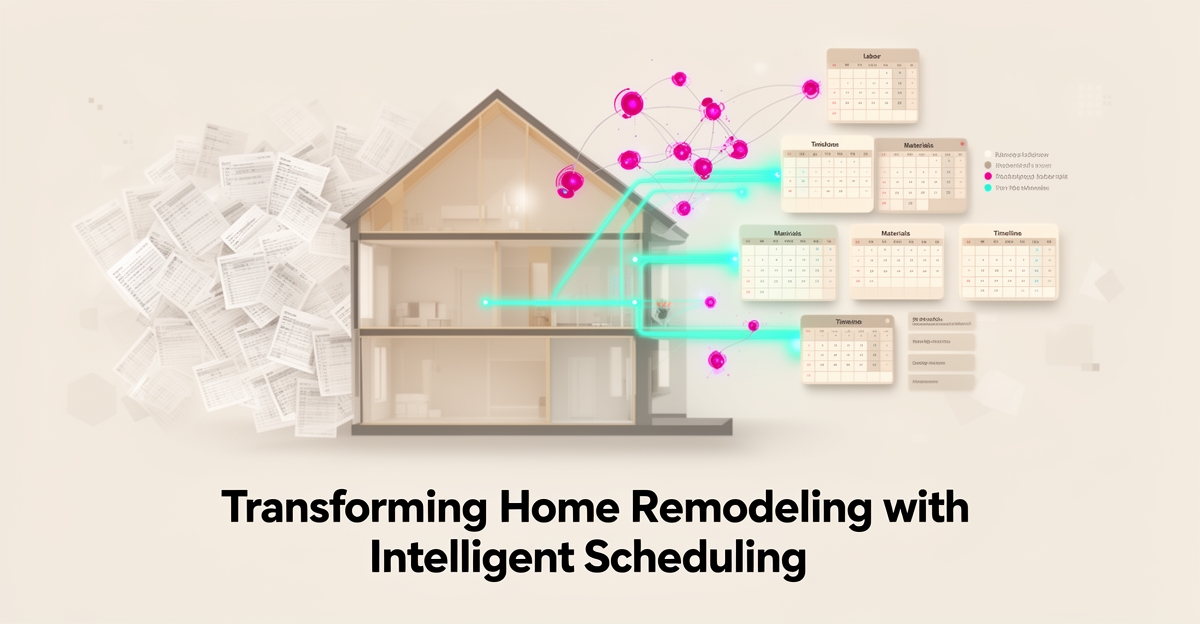
From Manual to AI: Transforming Job Scheduling for Residential Remodeling Contractors
Key Facts
- Industry research on AI workflows reports handling-time reductions of roughly 40-70% versus manual processes according to OMQ
- As of late 2026, most organizations that adopt AI report increasing their investment year over year, with continued expansion planned
- Workforce surveys consistently find a majority of employees feel positive about AI-powered co-workers when automation removes busywork
- Roughly half of organizations report difficulty integrating AI with existing systems—integration should be validated early, not assumed
- AIQ Labs has deployed 200+ multi-agent systems and runs 4 live SaaS products daily, so scheduling logic is built on production-proven infrastructure
Hire a team member that works 24/7 — for less than a part-time wage.
AI receptionists, SDRs, dispatchers and 99+ roles. Trained on your business, fully managed.
Not sure where to start? Ask our AI planner
The Scheduling Bottleneck Costing Remodelers Time and Revenue
Every residential remodeling contractor knows the sinking feeling of realizing two crews are scheduled for the same job, or a client calls asking why no one showed up. These aren't occasional mishaps—they're symptoms of a scheduling system buckling under the weight of manual coordination.
Manual job scheduling forces contractors to juggle labor availability, material lead times, and client timelines across spreadsheets, text messages, and memory. The result is predictable: overbooking that strains crew capacity, missed deadlines that erode client trust, and idle time that turns profitable days into losses. When a tile shipment arrives three days late but the demo crew was never notified, or when your best carpenter sits idle because his assignment changed without warning, you're not just losing time—you're burning revenue on both ends.
Industry research on AI workflow efficiency suggests automated systems can reduce handling times by roughly 40-70% compared to manual processes. For scheduling specifically, that translates to hours reclaimed from the daily chaos of phone calls, text chains, and last-minute reshuffling. Yet many remodelers continue absorbing these costs, unaware that the bottleneck isn't their team's competence—it's the toolset.
The gap between AI adopters and manual operators is widening. As of late 2026, most organizations investing in AI report increasing that investment year over year, with continued expansion planned. These aren't experimental budgets—they're strategic reallocations away from processes that bleed money. When competitors automate scheduling while you're still cross-referencing three calendars, the efficiency gap compounds daily.
The hidden costs of manual scheduling extend beyond the obvious:
- Crew idle time when material delays aren't communicated in real time
- Client frustration from overbooked timelines and missed start dates
- Project manager burnout from constant schedule firefighting
- Revenue leakage from underutilized labor capacity
- Reputation damage that limits referral business
What makes these costs particularly insidious is their invisibility. Unlike a line-item expense, scheduling inefficiency hides inside "normal operations." The remodeling business that loses a meaningful slice of potential revenue to idle crews and rushed deadlines often can't point to where the money went—only that margins keep tightening despite steady demand.
AIQ Labs builds scheduling systems that eliminate this bottleneck by syncing labor availability, material tracking, and client timelines in real time—whether as a single rebuilt workflow via AI Workflow Builds or as part of a connected AI Operating System. The transformation isn't about replacing human judgment—it's about freeing your team from coordination overhead so they can focus on the work that actually builds value.
How AI Workflows Automate Scheduling Around Labor, Materials, and Clients
Manual scheduling struggles to keep pace with the dynamic realities of residential remodeling—where labor availability shifts daily, material lead times fluctuate, and client expectations evolve. This constant juggling often leads to overbooking, delayed starts, and frustrated homeowners. AI workflows transform this chaos into a synchronized system by continuously analyzing labor calendars, supplier delivery windows, and client-milestone deadlines in real time. Industry research suggests AI workflows can reduce handling times by roughly 40-70% by eliminating manual coordination bottlenecks.
These intelligent systems act as a central nervous system for job scheduling, automatically rescheduling tasks when a crew member calls in sick or a shipment is delayed, while proactively notifying clients of timeline adjustments. By integrating with project management tools and field data feeds—such as daily progress updates from foremen or inventory levels from job sites—AI ensures every decision reflects current conditions. This creates a self-correcting schedule that minimizes idle time and prevents costly rush orders. For example, if drywall delivery slips by two days, the AI instantly reevaluates subsequent tasks like painting or flooring, shifting crews to other ready jobs without manual intervention.
The result is a scheduling ecosystem that adapts as fluidly as the remodeling process itself. Contractors gain visibility into true capacity, reduce last-minute scrambling, and build trust through transparent, accurate timelines. AIQ Labs embeds this intelligence directly into operational workflows, connecting with the tools you already use to turn scheduling from a reactive chore into a proactive advantage. As projects flow smoothly from demolition to final walkthrough, both teams and clients experience fewer surprises and greater confidence in the process.
From Pilot to Production: Implementation Steps Contractors Can Take Now
Moving from spreadsheets and phone tags to AI-powered scheduling starts with small, controlled wins that prove value before you scale.
Contractors typically begin by mapping where delays cost the most. That means listing every manual scheduling touchpoint and measuring the impact on labor utilization, material arrival, and client callbacks. Industry research indicates AI workflows can reduce handling times by roughly 40-70%, a range that mirrors what remodeling teams report when repetitive coordination is automated.
A practical first step is to isolate repetitive scheduling tasks that follow a clear pattern. Crew availability checks, lead-time confirmations for cabinets or stone, and client window confirmations are ideal candidates. Document the current flow, the tools involved, and the exceptions that break it. This creates a baseline for measuring time saved and errors avoided.
Next, choose an integrated workflow rather than a standalone tool. Scheduling gains disappear when crews must re-enter data across project management, accounting, and field apps. Look for an AI workflow that syncs with the systems you already use and pulls real-time field data to prevent overbooking. Roughly half of organizations report struggling to integrate AI with existing systems, which is why integration should be validated early, not assumed.
Monitoring outcomes keeps the pilot honest. Track on-time starts, change orders tied to scheduling errors, and crew idle hours. Set a simple review cadence for the first 30 days, then adjust rules for material lead times and client preferences. This feedback loop is what turns a pilot into a reliable production system.
Contractors who want owned systems without long-term subscription lock-in can use phased delivery. AIQ Labs supports this with Build in Milestones, where the one workflow that costs you the most is rebuilt at a fixed price in phases, and Start Monthly, a flat monthly plan that covers build, training, integrations, monitoring, and improvements. Both models let teams pause or adjust as adoption grows. Full details are on the pricing page.
Common first actions for teams include:
- Audit the current scheduling chain from estimate to completion and log every manual handoff
- Define success metrics such as reduced overbooking and fewer missed deadlines before any build starts
- Pilot AI automation on one crew or project type with clear labor, material, and client timeline inputs
- Review integration points with project management and field tools to ensure real-time sync
- Measure results weekly and expand only after the workflow proves stable and adopted
Adoption improves when teams see the system working alongside them. Workforce surveys consistently find a majority of employees feel positive about AI-powered co-workers, a sentiment that holds when automation reduces busywork rather than replacing judgment.
With clear tasks, integrated workflows, and disciplined monitoring, manual scheduling can evolve into an AI-powered operation that protects margins and client trust.
Why Owned AI Beats Subscription Scheduling Tools for Remodelers
Generic scheduling subscriptions promise speed but deliver fragmentation. Remodelers end up juggling labor calendars, material lead times, and client deadlines across disconnected tools, which creates overbooking and missed deadlines.
Owned AI changes the equation. Instead of renting a feature set, businesses control a system built around their specific crews, suppliers, and workflows. That ownership eliminates vendor lock-in and allows deep two-way integration with project management tools and real-time field data.
The integration gap is real. Roughly half of organizations report struggling to integrate AI with their existing systems, a challenge that mirrors operations teams in construction and remodeling. Subscription tools rarely solve this; they add another layer to manage.
AI workflows demonstrate measurable efficiency gains when properly implemented. Industry research indicates handling-time reductions of roughly 40-70% versus manual processes. For remodelers, that translates to faster crew dispatch, fewer double-books, and clearer client updates.
Investment momentum is accelerating. As of late 2026, most organizations investing in AI report increasing that investment year over year, with further expansion planned. The pressure to move beyond point solutions is clear.
A custom-built scheduling system owned by the business delivers advantages subscriptions cannot:
- Full ownership of code, agents, and data with no vendor lock-in
- Native integration with existing project management, accounting, and field tools
- Workflows trained on labor availability, material lead times, and client timelines
- Continuous improvement without waiting for a vendor roadmap
AIQ Labs builds scheduling systems that sync with project management tools and real-time field data, replacing costly subscription chaos with unified, owned digital assets. With the Own It Outright model, clients receive full ownership of their custom-built system and complete control over customization and future development.
Production experience matters. AIQ Labs has deployed 200+ multi-agent systems and runs 4 live SaaS products daily on its own infrastructure. That proven engineering capability informs how scheduling logic is architected for reliability and scale.
Subscription tools optimize for average use cases. Owned AI optimizes for your business.
Still paying for 10+ subscriptions that don’t talk to each other?
We build custom AI systems you own outright. No vendor lock-in. Full control.
Not sure where to start? Ask our AI planner
Frequently Asked Questions
How much time can AI scheduling actually save a remodeling contractor?
What happens when a material delivery slips or a crew member calls in sick—can AI reschedule automatically?
Will my crew actually accept AI scheduling, or will it feel like a threat?
Why not just use an off-the-shelf scheduling subscription instead of a custom system?
How do I start implementing AI scheduling without disrupting my current jobs?
How much does a custom AI scheduling system cost, and do I get locked into a subscription?
Own Your Schedule, Protect Your Margins
Manual scheduling is quietly eroding remodeler margins through overbooking, idle crews, and last-minute firefighting that hides in 'normal operations'. AI workflows change that by continuously syncing labor availability, material lead times and client milestones in real time, automatically rescheduling when conditions shift and keeping every stakeholder informed. The result is fewer double-books, less idle time, and timelines clients can trust. Moving forward doesn't require a wholesale overhaul. Audit your current handoffs from estimate to completion, define clear success metrics like on-time starts and crew utilization, and pilot automation on one crew or project type with integrated data from your project management and field tools. As most organizations keep increasing AI investment into late 2026, the gap between owned, integrated systems and rented subscriptions is widening. AIQ Labs builds scheduling systems that sync with the tools you already use so you keep full ownership and control. Start with the 2-minute Fit Check at aiqlabs.ai/apply, then book a free 30-minute strategy call to map your biggest bottleneck and identify a high-ROI automation opportunity. Questions first? Reach the team at [email protected].
Make AI your competitive advantage — not just another tool.
Strategy, implementation and ongoing optimization. One partner, end to end.
Not sure where to start? Ask our AI planner