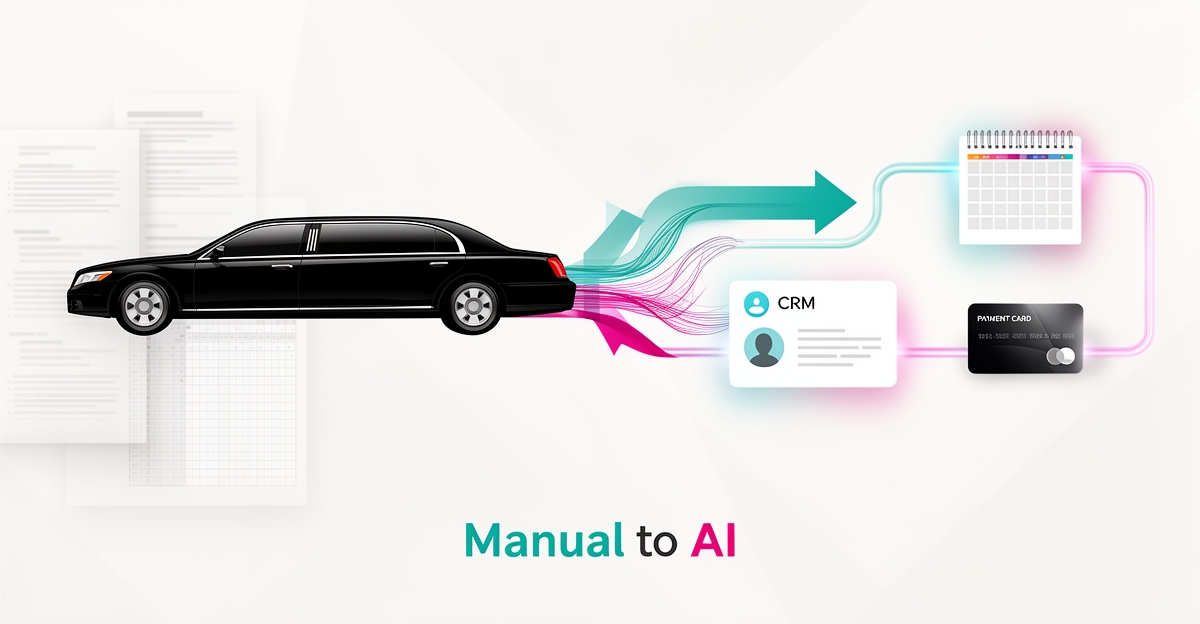
From Manual to AI: Transforming Limousine Service Booking Workflows
Key Facts
- At scale, AI request failures are typically driven by capacity limits like rate limits and concurrency caps — not model accuracy.
- Unoptimized AI workflows can see token usage grow several-fold as demand rises, driving up costs and stressing infrastructure.
- Agentic AI enables autonomous multi-step tasks across calendars, CRMs and payment systems — the core of an automated booking pipeline.
- The EU Artificial Intelligence Act entered into force on August 1, 2024, requiring human oversight for automated decisions involving personal data.
- Without guardrails, AI systems can consume unbounded capacity, turning efficiency gains into unpredictable expenses during peak demand.
- Optimizing existing infrastructure before adding new capacity prevents costly sprawl where idle resources sit alongside saturated ones.
Hire a team member that works 24/7 — for less than a part-time wage.
AI receptionists, SDRs, dispatchers and 99+ roles. Trained on your business, fully managed.
Not sure where to start? Ask our AI planner
The Manual Booking Bottleneck Costing Limousine Operators
Limousine operators still relying on paper forms and spreadsheets face a silent revenue drain that compounds with every booking attempt. Manual processes create missed calls when staff are overwhelmed, double bookings due to calendar sync delays, and payment delays from manual invoicing—each eroding customer trust and operational efficiency. These bottlenecks aren't just inconveniences; they represent systemic failures that scale poorly as demand grows, turning every successful booking into a race against human error.
Industry analyses of production AI systems consistently find that at scale, request failures are usually driven by capacity limits like rate limits or concurrency caps rather than model inaccuracies. For limousine services, this means simply moving from paper to a basic digital form doesn't eliminate the risk of missed opportunities when systems overload during peak demand. Without addressing the underlying workflow inefficiencies—such as fragmented data entry across tools or lack of real-time validation—operators merely digitize the same bottlenecks that caused failures in the first place.
The true cost of manual booking extends beyond lost reservations to include staff burnout from reactive firefighting and reputational damage from frustrated clients who switch to competitors offering seamless experiences. Heavy users of AI systems have seen token volumes grow several-fold, which signals how quickly unoptimized workflows strain infrastructure even before true automation begins. For limousine operators, this underscores that patching spreadsheets with basic online forms creates a false sense of progress while leaving critical failure points intact—like payment processing delays that trigger chargebacks or scheduling gaps that waste vehicle utilization.
To break this cycle, businesses must move beyond digitization to redesign workflows where AI agents handle end-to-end tasks: validating availability across calendars, enriching customer profiles from historical data, and triggering payment confirmation instantly upon booking completion. This approach transforms booking from a fragile human-dependent process into a resilient, scalable operation—provided the system is built with operational disciplines like visibility into usage and guardrails against unbounded retries. Only then can limousine services replace the anxiety of manual bottlenecks with the confidence of AI-driven reliability, turning every inquiry into a captured opportunity rather than a gamble.
Why Operational Excellence Beats Model Hype in Booking Automation
The true value of AI in booking automation isn't found in chasing the latest model benchmarks, but in building systems that run reliably at scale. As AI moves from experimental pilots into core workflows, the competitive advantage shifts from model power to operational excellence—specifically, the ability to manage visibility, control, utilization, and efficiency across agentic systems. This shift mirrors the early days of cloud computing, where programmability increased but so did operational complexity. For limousine services, this means a booking agent that can check calendars, update CRM records, and process payments must be engineered for stability, not just intelligence.
Four operational disciplines provide a practical framework for achieving this reliability. First, establishing visibility allows teams to trace usage and compute hours to specific workflows—such as a booking request triggering calendar sync and payment initiation—so they can link consumption to business impact. Second, enforcing control through rate limits and behavioral guardrails prevents runaway agents from consuming unlimited resources during peak demand. Third, optimizing utilization means auditing existing infrastructure before adding new capacity; many teams find idle resources masquerading as shortages. Finally, designing for efficiency at the application layer—refining prompts, routing logic, and data flow—reduces token waste and lowers failure rates. These disciplines transform AI from a fragile experiment into a dependable operational asset.
When applied to limousine booking, this approach unlocks the real value of agentic AI: autonomous coordination across calendars, customer databases, and payment gateways. Agentic systems can execute multi-step tasks like verifying vehicle availability, confirming client preferences, and securing deposits—all without human intervention. But this autonomy only delivers value when grounded in operational rigor. AIQ Labs helps limousine providers implement these disciplines through AI Workflow Builds that rebuild the one workflow costing you the most—your booking pipeline—while maintaining compliance with regulations like the EU AI Act, which requires human oversight for automated decisions involving personal data. The result isn't just faster bookings—it's a resilient, scalable system where AI handles the routine, and humans focus on exceptions and relationship-building. To begin mapping your booking workflow for AI readiness, start with a free strategy call to identify high-impact automation opportunities.
Building an Agentic Booking Pipeline With Guardrails and Compliance
Booking a limousine service traditionally involves juggling spreadsheets, calendars, and payment gateways—a process prone to delays, errors, and compliance gaps. AIQ Labs transforms this workflow by building agentic booking pipelines where AI agents autonomously manage multi-step bookings while enforcing rate limits, budget caps, and human oversight required by the EU AI Act and GDPR.
The system integrates with your existing tools—Google Calendar for availability checks, your customer database for profile verification, and Stripe for secure payments—all under an ownership model where you control the system, data, and future development. AI agents operate within strict guardrails: they check calendar slots, validate customer details, process deposits, and confirm bookings only when all conditions are met, preventing unbounded retries or loops that could spike costs or violate compliance. As industry research on production AI systems shows, failures at scale are typically driven by capacity limits like rate limits or concurrency caps, making these controls essential for reliability.
Human oversight is embedded at critical junctures—for example, flagging high-value bookings for manager approval or pausing automation if GDPR-sensitive data anomalies arise. This aligns with the EU AI Act's requirement that automation does not replace human accountability, especially when processing personal data like payment information and travel itineraries. By designing for efficiency at the application layer—optimizing prompts and routing—teams can reduce token usage and avoid the several-fold cost growth seen in heavy-user environments.
- Real-time visibility into usage and compute hours tied to specific booking workflows
- Automated audit trails for every AI action, supporting GDPR compliance
- Configurable escalation paths when AI confidence falls below thresholds
The result is a seamless, compliant booking experience where AI handles the routine—checking availability, updating CRM records, issuing invoices—while humans focus on exceptions and relationship-building. This operational discipline turns AI from an experimental tool into a reliable, scalable capability that eliminates manual bottlenecks without compromising safety or control. Ready to replace paper forms with an agentic booking pipeline you own? Start the two-minute Fit Check at https://aiqlabs.ai/apply to assess your workflow's readiness for AI transformation.
From Pilot to Production: Implementation Roadmap for Limousine Teams
Moving from pilot to production requires more than just technology—it demands a disciplined operational framework. For limousine teams, this means establishing clear visibility into how AI systems consume resources, ensuring every booking request is traceable to specific workflows and teams. Industry research on production AI consistently finds that failures at scale are typically driven by capacity limits, making attribution critical for preventing downtime during peak demand periods.
Enforcing controls and guardrails is equally vital to avoid unbounded token usage and cost overruns. Teams must implement rate limits, budget caps, and behavioral safeguards that stop runaway workflows—such as repeated calendar checks or payment retries—from disrupting core operations. Without these controls, AI systems can consume unlimited capacity, turning efficiency gains into unpredictable expenses. Optimizing infrastructure utilization before adding new supply ensures existing resources are used efficiently, preventing costly sprawl where idle resources sit alongside saturated ones.
Designing for efficiency at the application layer transforms how requests flow through the system. This includes refining prompts, optimizing routing across providers, and tuning for quality, latency, and cost—turning the application layer into a deliberate engineering environment. Finally, ensuring regulatory compliance means aligning with the EU AI Act's requirements for human oversight, transparency, and data protection, especially when processing personal booking and payment information. AIQ Labs supports this journey through phased, milestone-based implementation—whether that starts with an AI dispatcher or receptionist answering booking calls, or a full AI Operating System connecting your whole operation—helping teams operationalize AI with confidence and long-term scalability.
Still paying for 10+ subscriptions that don’t talk to each other?
We build custom AI systems you own outright. No vendor lock-in. Full control.
Not sure where to start? Ask our AI planner
Frequently Asked Questions
What's the main problem with just switching from paper forms to basic digital booking systems for limousine services?
Why do AI booking systems fail at scale, if not because of model errors?
What are the four operational disciplines that make AI booking systems reliable at scale?
How does AIQ Labs ensure compliance with regulations like the EU AI Act when automating limousine bookings?
What value can agentic AI unlock for limousine services through automated booking workflows?
What's the first step for a limousine company to assess if their booking workflow is ready for AI transformation?
From Bottlenecks to Booking Confidence
Moving from paper forms and spreadsheets to AI isn't about digitizing the same manual bottlenecks — it's about redesigning the booking workflow for reliability at scale. Limousine operators who stop patching calendars and start building agentic pipelines eliminate missed calls, double bookings, and payment delays while giving staff back from reactive firefighting. The real advantage comes from operational excellence: visibility into usage, guardrails against runaway retries, efficient application-layer design, and human oversight aligned with EU AI Act and GDPR requirements. When those disciplines are in place, AI can autonomously validate availability, enrich profiles, and confirm payments without sacrificing control or compliance. AIQ Labs helps limousine providers build these owned, integrated workflows — with 200+ multi-agent systems deployed — that connect calendars, customer databases, and payment gateways with production-grade reliability. Start mapping your workflow for AI readiness with the two-minute Fit Check at https://aiqlabs.ai/apply for a free strategy call to identify high-impact automation opportunities.
Make AI your competitive advantage — not just another tool.
Strategy, implementation and ongoing optimization. One partner, end to end.
Not sure where to start? Ask our AI planner