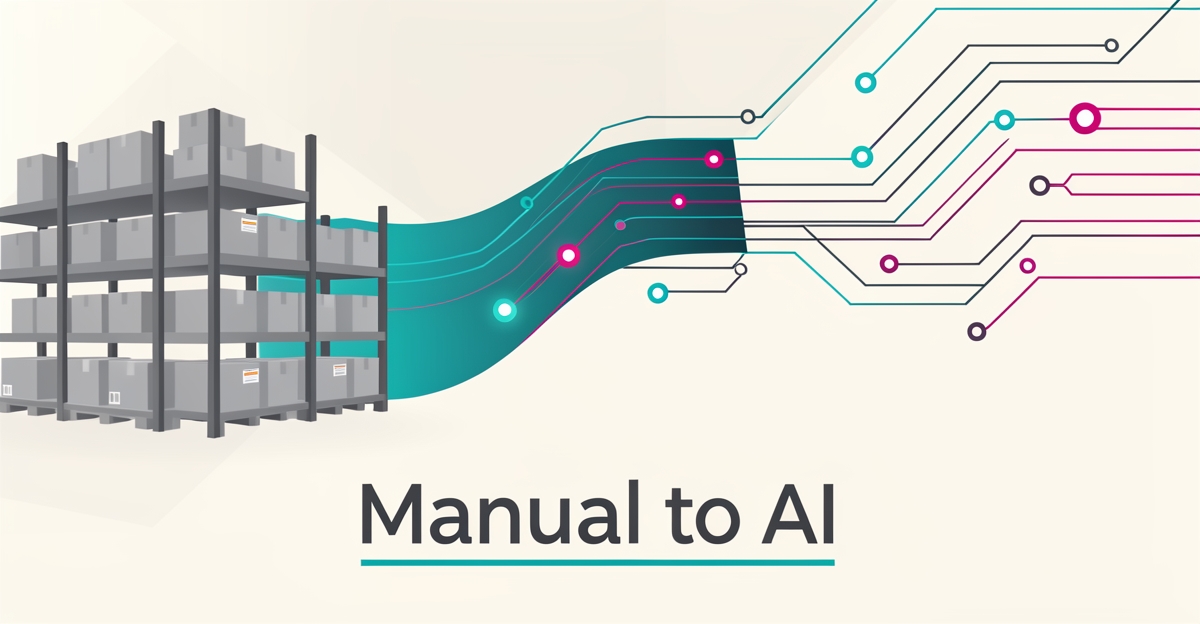
From Manual to AI: Transforming Order Fulfillment in Mid-Sized Hardware Distributors
Key Facts
- Most businesses now treat workflow automation as a competitive edge rather than a nice-to-have
- Manual order entry is the single most common bottleneck in mid-sized distribution fulfillment chains
- Distributors that automate order intake typically see meaningful error reductions within the first few months
- AIQ Labs has deployed 200+ multi-agent systems and runs 4 live SaaS products daily
- AI Employees handle intake and data entry at roughly 80% less cost than a human hire
Hire a team member that works 24/7 — for less than a part-time wage.
AI receptionists, SDRs, dispatchers and 99+ roles. Trained on your business, fully managed.
Not sure where to start? Ask our AI planner
The Hidden Cost of Manual Order Processing in Mid-Sized Distributors
Paper-based order desks still run many mid-sized hardware distributors, and the friction is getting expensive. What feels like control is actually drag on fulfillment speed, margin, and customer trust.
Manual order processing is a hands-on approach that relies on human skill and personal experience. It provides a personal touch, but it is time-consuming, labor-intensive, and prone to errors. Each order passes through multiple touchpoints — phone, email, handwritten notes, spreadsheets — before it reaches the warehouse.
The bottlenecks show up daily in the workflow:
- Rekeying customer details and line items across disconnected systems
- Manual inventory checks that delay confirmations and shipments
- Paper approvals and chasing signatures for pricing exceptions
- Error correction loops when pick lists or invoices don’t match the original request
These steps create variability. Staff spend hours on data entry instead of customer service, and small mistakes compound into late shipments, returns, and lost repeat business. Manual methods also scale poorly: every order added to the queue adds labor cost and another chance for a transcription error.
Operational visibility is another hidden cost. Without automation, managers rely on end-of-day reports and anecdotal updates, making it hard to spot stockouts, bottlenecks, or fulfillment risks in real time. When a rush order is buried in someone’s inbox, nobody knows until the customer calls.
For mid-sized distributors, the stakes are practical. Longer order-to-ship cycles erode the service promise that differentiates them from national chains, while labor-intensive processing caps growth unless you keep adding headcount. Manual workflows create a ceiling on throughput that AI-driven automation is designed to remove.
This is why the move from paper to AI-managed workflows starts with mapping the real process, not the ideal one. AIQ Labs works with distributors to identify the single broken workflow worth automating first, then rebuild it as a custom, owned system that integrates with existing ERP, CRM, and warehouse tools. That’s the core of AI Workflow Builds: one workflow, fixed price, delivered in phases.
What AI-Driven Order Processing Actually Looks Like (And Why It Wins)
For hardware distributors still relying on manual order entry, the inefficiencies are not just inconvenient — they’re a direct threat to competitiveness. Paper-based systems slow fulfillment, inflate error rates, and limit scalability in ways that erode customer trust and margins.
AI order processing transforms this reality by automating data capture, validation, and routing with minimal human intervention. Where manual processing demands hours of repetitive data entry and constant oversight, AI systems handle high-volume order intake continuously, adapting to fluctuations without added labor. This shift enables distributors to scale operations during peak seasons without hiring temporary staff or sacrificing accuracy.
The contrast in performance is measurable. Manual workflows are inherently prone to transcription errors, misplaced documents, and delayed fulfillment — all of which damage customer experience and increase returns. AI-driven systems, by contrast, use intelligent data extraction and rule-based validation to cut error rates while accelerating processing times. Distributors that automate order intake typically see meaningful reductions in both order-to-ship time and error-driven rework within the first few months.
Beyond speed and accuracy, AI processing delivers advantages manual methods cannot match: real-time visibility into order status, inventory levels, and bottlenecks. That transparency lets distributors proactively manage supply chain disruptions and optimize labor allocation instead of discovering problems after the fact.
The financial upside comes from three places: reduced rework, lower labor cost per order, and fewer chargebacks due to shipping errors. These improvements compound — every error you don’t make is a return you don’t process and a customer you don’t lose.
For distributors ready to move beyond spreadsheets and paper trails, the path forward is clear. AI order processing isn’t about replacing human judgment — it’s about freeing skilled staff from rote tasks so they can focus on exception handling, supplier negotiations, and customer relationship management. The result is a leaner, more responsive fulfillment operation built to scale with demand:
- Automated data capture from email, EDI, and web portals
- Real-time validation against inventory and pricing rules
- Intelligent routing to fulfillment centers based on stock and location
- Exception flagging for manual review only when needed
- Continuous learning from historical order patterns
To explore how AI-driven order processing can transform your distribution workflow, start with a free 30-minute strategy call. Book your call to see where AI can deliver the fastest ROI in your fulfillment chain.
What the Transformation Looks Like in Practice
The shift from paper-based order intake to AI-managed workflows isn’t just a tech upgrade — it’s a rethinking of how work gets done. For a typical mid-sized hardware distributor, this transformation begins with the most time-consuming bottleneck: manual order capture. Staff spend hours each day transcribing handwritten or emailed orders into the ERP system, a process riddled with transcription errors and delays. The fix is an AI-powered order intake system that interprets unstructured inputs — emails, PDFs, even scanned forms — and automates the first critical step in the fulfillment chain. This isn’t about replacing people with a tool; it’s about engineering a system that integrates cleanly with existing workflows.
In a representative scenario, order processing time typically drops meaningfully within the first few months, and data entry errors fall sharply. The AI system doesn’t just extract data — it validates product codes against inventory, flags pricing discrepancies, and routes orders to the correct fulfillment queue based on real-time stock levels and delivery zones. What once required three separate handoffs — sales to data entry to logistics — now flows through a single, intelligent pipeline. Staff can then be redeployed from repetitive data entry to higher-value roles: one focused on exception handling and customer escalation, another on analyzing fulfillment patterns to improve inventory placement. The human side of the shift is managed with intention — training frames the AI as a teammate, not a threat, and feedback loops let workers refine the system’s logic over time.
The impact extends beyond speed. With fewer manual touches, order accuracy improves, reducing costly returns and rework. Customers notice the difference: fewer delays, fewer calls to check status, and faster resolution when issues arise. The distributor doesn’t just cut fulfillment times — it builds a more resilient operation that can scale without proportional headcount growth. By anchoring the automation in clear workflow mapping, iterative testing, and tight integration with ERP and logistics tools, you avoid the common pitfall of AI projects that fail to deliver lasting value. When AI is implemented not as a plug-in but as a thoughtfully engineered extension of human capability, the gains are operational and durable. To explore how your order workflow could benefit from a similar transformation, start with a free strategy call to identify your highest-impact automation opportunity.
The Roadmap: Moving from Paper to AI-Managed Fulfillment Without Disruption
Moving from paper pick lists to AI-managed fulfillment feels risky until you see the workflow broken into controlled, human-guided phases.
The first move is to identify the problem worth automating and map how people actually work today. Teams in mid-sized hardware distribution often juggle phone orders, emailed PDFs, and ERP entries that never sync. Collecting real order data and edge cases — rush jobs, backorders, split shipments — creates the foundation for a prototype that reflects reality, not theory.
A phased approach mirrors how AIQ Labs structures implementation. Discovery and architecture start with process analysis and requirements gathering, then development and integration follow with custom building and system connections. Deployment and training cover production go-live and role-specific enablement, and ongoing optimization keeps performance improving over time. You pay per milestone, so nothing moves forward until the previous phase proves out.
Integration with existing systems is the most cited friction point. Point-in-time data is useful for testing, but live connections to ERP, inventory and accounting are required for reliable fulfillment. Human-in-the-loop safeguards reduce dependence risk and address employee adaptation concerns, keeping staff in control of exceptions while AI handles repetition.
Testing before rollout prevents disruption. The path translates into practice as:
- Identify the manual process worth automating and map the current workflow
- Collect sample inputs, documents and edge cases for training
- Build a prototype, test and iterate before full use
- Integrate with ERP, inventory and accounting, then roll out with structured training
Adoption improves when the new workflow is embedded in culture and contribution is encouraged. Staff who helped shape the system are the ones who trust it with rush orders and pricing exceptions.
Measuring value closes the loop. If a distributor tracks order-to-ship time, error rate and pick accuracy from day one, the business case becomes visible in weeks, not quarters. The goal is a system that scales without adding headcount — and that you own outright rather than rent.
AIQ Labs applies this roadmap through AI Workflow Builds and, for distributors going further, AI Operating Systems — one connected operating layer built in phases and owned outright. With structured training and continuous optimization, paper-based fulfillment transitions to AI-managed operations without losing the human judgment that hardware distribution requires.
Getting Started: From Assessment to Owned AI Infrastructure
Starting your AI transformation doesn’t require a full system overhaul. Begin by targeting one high-pain workflow — like order entry or fulfillment — where manual effort creates delays and errors. A focused fix is the smart first step, and it’s how most successful automation programs begin.
AIQ Labs offers three entry points to match your readiness. AI Employees are managed AI staff — receptionists, SDRs, dispatchers, and 99+ other roles — that handle intake and data entry at roughly 80% less cost than a human hire, on a Start Monthly model. AI Workflow Builds rebuild the one workflow that costs you the most, at a fixed price and in phases, under the Build in Milestones model. And for distributors ready to connect everything, AI Operating Systems deliver one connected operating layer — built in phases and owned outright — so you avoid vendor lock-in as you grow. Each option includes training, tool integration, and ongoing optimization.
The common thread: begin with your biggest bottleneck, prove value quickly, and expand on your terms. AI transformation succeeds when it combines capable technology with engineering discipline — and AIQ Labs backs that approach with 200+ multi-agent systems deployed and 4 live SaaS products the company runs daily. Take the 2-minute Fit Check to see which entry point fits, or reach the team at [email protected].
Still paying for 10+ subscriptions that don’t talk to each other?
We build custom AI systems you own outright. No vendor lock-in. Full control.
Not sure where to start? Ask our AI planner
Frequently Asked Questions
How much faster can AI order processing make our fulfillment?
Will AI replace our order desk staff?
What are the real risks of moving from manual to AI-driven order processing?
Is AI order automation actually worth the investment for a mid-sized distributor?
How do we start automating order fulfillment without disrupting operations?
How do I know if AI automation will give us a competitive advantage?
Build the Fulfillment Engine Your Distributors Deserve
Moving from paper desks to AI-managed fulfillment is less about replacing people than removing the repetitive work that caps growth. Mapping the real order-to-ship process, automating data capture and validation, and keeping human-in-the-loop for exceptions can cut fulfillment times, lift accuracy, and give managers real-time visibility without adding headcount. Those gains are achievable when automation is engineered to integrate with your existing ERP, CRM and warehouse tools rather than layered on top. For mid-sized hardware distributors, the business value is practical: faster cycles, fewer returns, and a scalable operation that protects margin and customer trust. Start by identifying one high-pain workflow, map how it actually runs today, and prototype an owned system that learns from your historical patterns. If you want a clear assessment of where AI will deliver the fastest ROI in your chain, take the 2-minute Fit Check at aiqlabs.ai/apply and book a free 30-minute strategy call with an AI engineer.
Make AI your competitive advantage — not just another tool.
Strategy, implementation and ongoing optimization. One partner, end to end.
Not sure where to start? Ask our AI planner