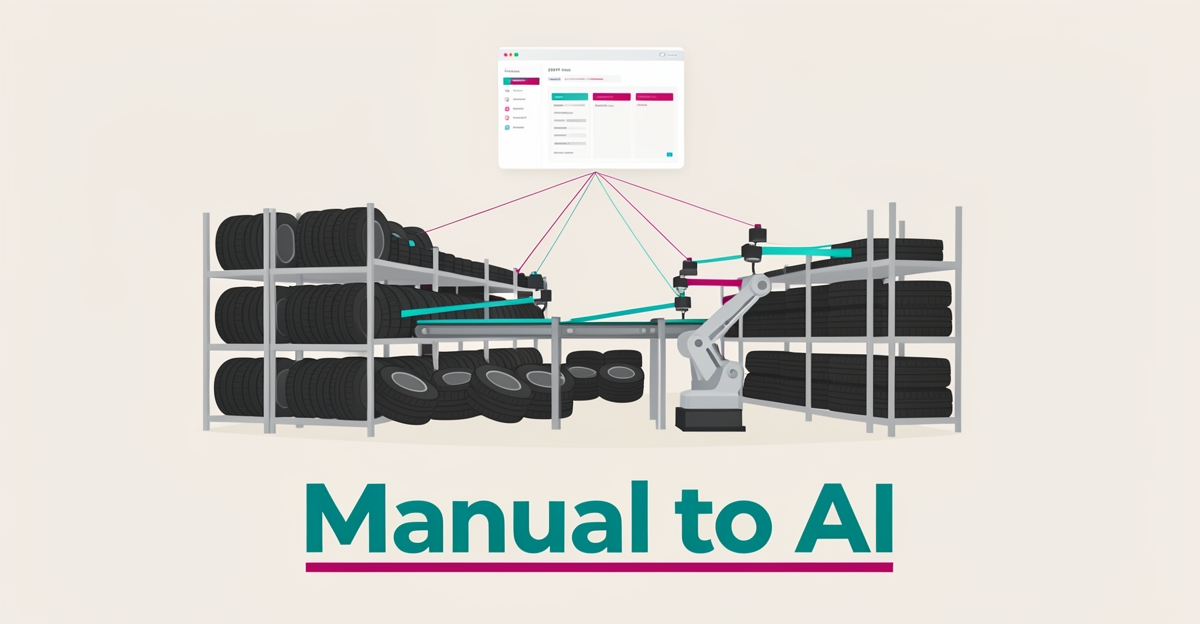
From Manual to AI: Transforming Order Fulfillment in Tire Distribution
Key Facts
- 43% of respondents reported order fulfillment processes as 'mostly or all manual' in industry research on warehouse automation
- AI-powered tire sidewall scanning is reported to reduce data and shipment errors by up to 96% based on vendor analysis from Scanflow
- Vendor data suggests warehouse throughput can increase by around 50% with AI tire sidewall scanning, cutting processing time from 20–30 seconds to under 3 seconds per tire per Scanflow's reported figures
- Labor costs are reported to decrease by roughly 30% through AI sidewall scanning due to reduced manual intervention as reported by Scanflow
- Audit preparation time is reported to fall by up to 60% with AI scanning via centralized, verifiable documentation per Scanflow findings
- AI demand forecasting is reported to reduce overstock situations by 15-25% while improving inventory turnover according to HumanAI analysis
- Automated fitment verification is reported to slash fitment-related returns by 80-90% through real-time tire compatibility validation per HumanAI research
Hire a team member that works 24/7 — for less than a part-time wage.
AI receptionists, SDRs, dispatchers and 99+ roles. Trained on your business, fully managed.
Not sure where to start? Ask our AI planner
The Hidden Cost of Manual Order Processing in Tire Distribution
Tire distributors operating with manual order processing face a cascade of hidden costs that erode profitability and customer trust. Handwritten invoices, manual data entry, and paper-based tracking create error-prone workflows where even small mistakes compound into significant financial losses. Industry research found that 43% of respondents reported their order fulfillment processes as "mostly or all manual," while 32% had mostly or fully manual storage functions with no automation plans—revealing widespread reliance on outdated methods.
These manual processes directly contribute to operational inefficiencies that impact the bottom line. Data entry errors are particularly costly when handling complex tire specifications like DOT codes, size, and brand details—mistakes that require time-consuming corrections and damage customer relationships. Without digital traceability, once tires leave the warehouse, resolving delivery disputes becomes nearly impossible due to the absence of verifiable handoff records. This lack of visibility also creates system mismatches between warehouses and ERP platforms, leading to inventory inaccuracies that trigger stockouts or overstock situations.
The financial impact extends beyond immediate correction costs. Manual storage and retrieval functions—relied upon by 30% of companies in the same study—slow down fulfillment cycles and increase labor hours per order. These inefficiencies accumulate in high-volume tire distribution, where processing thousands of SKUs daily amplifies the cost of every manual step. Businesses relying on manual order processing often experience delayed shipments, increased administrative overhead, and strained retailer relationships due to preventable errors.
Breaking free from this cycle requires addressing the root causes of manual dependency. Modern AI solutions eliminate manual typing by extracting data directly from tire sidewalls, creating real-time synchronization between warehouse operations and ERP systems. This approach not only reduces errors but also establishes the digital audit trails needed to resolve delivery disputes quickly and maintain compliance with state tire laws. For tire distributors still entrenched in manual processes, the hidden costs of inaction continue to grow with every order processed.
How AI Tire Sidewall Scanning Eliminates Manual Bottlenecks
The bottleneck in tire distribution begins long before the tire leaves the warehouse—it starts at the sidewall. Manual data entry of complex tire specifications—serial numbers, DOT codes, size, and load indices—creates a cascade of errors that ripple through order fulfillment. As Scanflow's analysis notes, these manual processes are prone to human mistakes, especially when handling thousands of SKUs across multiple brands and production dates, leading to mismatched inventory, delivery disputes, and traceability gaps once tires leave the facility.
AI-powered tire sidewall scanning eliminates this bottleneck by automating data extraction directly from the tire surface. High-resolution cameras capture multiple angles as tires pass through scanning stations, while deep learning models identify embossed details like manufacturer names, sizes (e.g., 205/55R16), load indices, and DOT codes without relying on barcodes or manual typing. Vendors in this space report error reductions of up to 96%, ensuring tire-level traceability and complete visibility across the distribution network. The technology is designed to integrate with existing WMS or ERP systems—including SAP, Oracle, Microsoft Dynamics, and Manhattan WMS—to automatically update stock counts, movement logs, and dispatch records in real time.
The operational impact can be immediate and measurable. Vendors report warehouse throughput increases of around 50% as processing time drops from 20–30 seconds per tire to under 3 seconds. Labor costs are reported to decrease by roughly 30% due to reduced manual intervention, while audit preparation time can fall by up to 60% through centralized, verifiable documentation. These improvements are typically achieved without proprietary hardware, allowing deployment across multiple warehouses and regions in weeks using mobile devices and existing infrastructure.
For tire distributors still relying on manual order entry—where industry research found 43% reporting fulfillment as "mostly or all manual"—this shift represents more than efficiency. It transforms a critical pain point into a source of real-time inventory accuracy, compliance readiness, and scalable operations. By removing the human bottleneck at the point of data capture, AI sidewall scanning lays the foundation for end-to-end automation in order fulfillment, dispatch, and delivery tracking. That's the kind of workflow AIQ Labs rebuilds through AI Workflow Builds—one connected system that eliminates errors and delays instead of patching them.
Beyond Scanning: AI Applications That Drive Profitability in Tire Distribution
AI is moving beyond simple scanning to unlock deeper profitability in tire distribution through intelligent applications that transform core business functions. Demand forecasting powered by AI analyzes seasonal patterns, vehicle registration data, and historical sales—vendors report overstock reductions of 15-25%, directly improving inventory turnover and cash flow. Dynamic pricing optimization continuously evaluates competitor rates, inventory levels, and market demand to adjust wholesale prices in real time, with reported margin gains of 3-8% without sacrificing competitiveness. Credit risk assessment leverages AI to evaluate payment histories and external data, with reported bad-debt reductions of 20-40% while speeding up approval workflows. Automated fitment verification ensures tire compatibility with vehicle specifications during order entry, with vendors reporting fitment-related return reductions of 80-90%. Together, these AI-driven capabilities create a more resilient, responsive, and profitable distribution operation—minimizing waste, maximizing revenue per transaction, and strengthening customer trust through precision and reliability. AIQ Labs integrates these intelligent functions into cohesive systems that work alongside existing ERP platforms, enabling tire distributors to automate complex decision-making without replacing their core infrastructure. This end-to-end approach transforms order fulfillment from a reactive, error-prone process into a proactive, data-driven engine for sustainable growth.
Implementing AI in Tire Distribution: A Practical Roadmap for SMBs
For tire wholesalers, the hardest part of AI adoption isn't the technology—it's knowing where to start. With 42% of warehouses in industry research operating with fewer than 100 employees and 24% of companies posting revenues under $10 million, most distributors can't afford a sweeping, high-risk transformation. The good news: they don't need one.
Step 1: Assess AI Readiness
Before investing in anything, conduct an honest readiness assessment. Evaluate your current technology stack, data infrastructure, and team capabilities. Many smaller wholesalers lack the data infrastructure needed for sophisticated AI applications, so this step prevents over-investing in the wrong solutions. This is where a structured approach matters—AIQ Labs begins every engagement with a 2-minute Fit Check and a free 30-minute strategy call, followed by a prioritized roadmap with clear milestones.
Step 2: Start with Standalone Systems
Resist the urge to automate everything at once. Begin with systems that deliver proven ROI without disrupting daily operations:
- Demand forecasting — AI models analyzing seasonal weather patterns and historical sales are reported to reduce overstock situations by 15-25% while preventing stockouts
- Credit risk assessment — AI evaluation of payment histories is reported to reduce bad debt by 20-40% while accelerating credit approvals
- Automated fitment verification — real-time validation during order entry is reported to cut fitment-related returns by 80-90%
These standalone systems integrate with existing processes without requiring major operational changes, making them ideal first candidates. If the bottleneck is people-dependent—order entry, dispatch coordination, customer follow-up—AI Employees can take those roles over as managed AI staff at a fraction of the cost of a human hire.
Step 3: Deploy Incrementally
Roll out solutions step-by-step to minimize disruption. This phased approach mirrors how successful implementations unfold: discovery and architecture first, then development and integration, followed by deployment and training, and finally ongoing optimization. It also de-risks the investment. Given that 82% of operations leaders in industry research weigh total cost of ownership and ROI heavily in automation decisions, and 64% prioritize integration with existing equipment, incremental deployment lets you prove value before expanding.
Step 4: Integrate with Existing ERP Tools
The final step is connecting AI to the systems you already run. Modern AI solutions sync in real time with platforms like SAP, Oracle, Microsoft Dynamics, and leading WMS software, automatically updating stock counts, movement logs, and dispatch records. This backend synchronization is what eliminates the manual data entry and system mismatches that plague manual operations—and it's why AIQ Labs builds custom systems designed for deep two-way integration rather than disconnected point tools. For distributors ready to connect everything—scanning, order entry, dispatch, inventory, reporting—AI Operating Systems delivers one connected operating layer, built in phases and owned outright.
Payment structure can also reduce risk. AIQ Labs offers three straightforward models: Start Monthly, Build in Milestones—where you pay per phase and keep everything built so far—or Own It Outright. No fake prices, no invented case-study numbers; real figures are provided in writing after an initial strategy call. See /pricing for how each model works.
One caution: don't stall at the pilot stage. Most organizations get stuck running limited trials that never scale. With structure, governance, and a clear roadmap, tire wholesalers can move from isolated pilots to AI embedded across the fulfillment operation—where the real competitive advantage lives.
Still paying for 10+ subscriptions that don’t talk to each other?
We build custom AI systems you own outright. No vendor lock-in. Full control.
Not sure where to start? Ask our AI planner
Frequently Asked Questions
How much can AI tire sidewall scanning reduce data and shipment errors in tire distribution?
What percentage of tire distributors still rely on mostly or fully manual order fulfillment processes?
Can AI solutions integrate with our existing ERP systems like SAP or Oracle?
What are the first steps for a small tire wholesaler looking to adopt AI without disrupting operations?
How much can AI-driven demand forecasting reduce overstock situations in tire distribution?
Is AI implementation in tire distribution too expensive for small businesses?
The Moment to Stop Paying for Manual Mistakes
Manual order processing in tire distribution isn’t just slow — it’s a compounding cost in errors, disputes, and lost trust that grows with every shipment. AI tire sidewall scanning removes the human bottleneck at data capture, with vendors reporting error reductions of up to 96% alongside real-time ERP sync, compliance-ready audit trails, and faster throughput without proprietary hardware. Beyond scanning, demand forecasting, dynamic pricing, credit risk assessment and fitment verification turn fulfillment from a reactive cost center into a proactive profit engine. For SMB wholesalers, the path isn’t a risky overhaul. It starts with an honest readiness check, a focused first workflow, and incremental rollout that proves ROI before scaling. AIQ Labs builds owned, integrated AI systems—whether that’s an AI Workflow Build for your costliest bottleneck, AI Employees for order entry and dispatch roles, or a full AI Operating System—that connect to SAP, Oracle, Microsoft Dynamics and leading WMS platforms, so you automate without replacing core infrastructure. If 43% of order fulfillment is still mostly or all manual according to industry research, the question is no longer if automation is viable, but how fast you can stop paying for the mistakes. Start the 2-minute Fit Check at aiqlabs.ai/apply for a free 30-minute strategy call to map your highest-ROI bottleneck, or reach the team directly at [email protected].
Make AI your competitive advantage — not just another tool.
Strategy, implementation and ongoing optimization. One partner, end to end.
Not sure where to start? Ask our AI planner