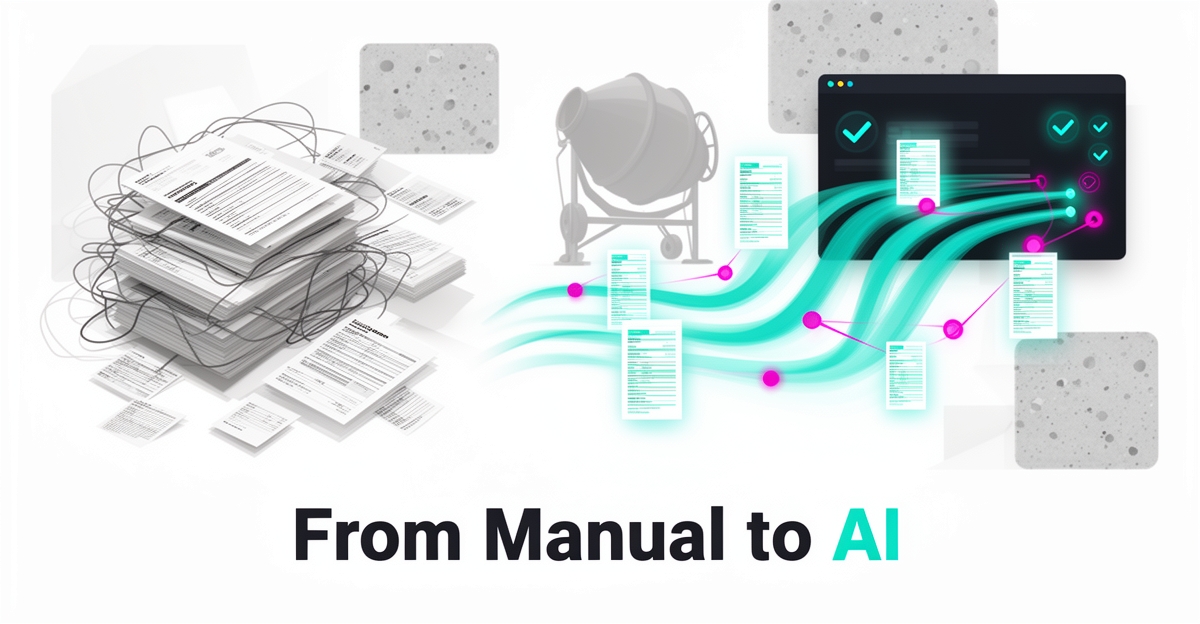
From Manual to AI: Transforming Order Processing in a Concrete Supplier
Key Facts
- As of late 2026, a majority of suppliers still process at least some orders by manual entry, which is slow and error-prone.
- AI document processing typically achieves high overall accuracy, with the highest accuracy on structured fields like dates, quantities, and customer IDs.
- Automated intake and validation can cut data-entry errors dramatically compared to manual re-keying.
- Teams reclaim significant time each week — often the equivalent of most of a full-time role — when AI handles order intake end-to-end.
- AI PO-to-SO automation is best suited to businesses receiving customer POs in varied formats.
- EDI handles only structured EDI data and requires a technical mapping project per partner.
- AI PO-to-SO automation can process unstructured POs and scale without adding headcount.
Hire a team member that works 24/7 — for less than a part-time wage.
AI receptionists, SDRs, dispatchers and 99+ roles. Trained on your business, fully managed.
Not sure where to start? Ask our AI planner
The Manual Order Bottleneck in Concrete Supply
Despite a decade of digital tools, manual order entry remains common across supply businesses as of late 2026 — a process that is slow, error-prone, and whose cost grows linearly with volume. For concrete suppliers juggling dozens of customer formats — emailed PDFs, scanned faxes, handwritten tickets — relying on people to re-key data creates a daily bottleneck that delays dispatch and invites costly mistakes.
Paper-based and email POs arrive in unpredictable layouts, forcing staff to hunt for line items, delivery dates, and mix specifications across inconsistent documents. Each manual touchpoint adds minutes per order and compounds error risk. AI document processing, by contrast, typically achieves high overall accuracy — with structured fields like dates and quantities often near-perfect — while cutting data-entry errors dramatically versus manual entry. When a single transposed digit sends the wrong slump to a job site, the supplier absorbs the rework, the trucking cost, and the reputational hit.
- Varied customer formats (PDF, email, scans) that resist standardization
- Manual re-keying that scales only by adding headcount
- Validation gaps where typos reach the plant unchecked
- Dispatch delays while clerks clarify ambiguous orders
EDI solves structure but demands a technical mapping project per partner and only works with EDI-capable customers, leaving the long tail of smaller contractors on paper. AI PO-to-SO automation, by contrast, reads unstructured POs, validates data in real time against ERP records, and posts sales orders automatically — scaling without per-partner setup. AIQ Labs builds these workflows through AI Workflow Builds that ingest messy inputs, enforce business rules, and hand off clean orders to the dispatch board, reclaiming dozens of staff hours every week that would otherwise vanish into data entry.
AI PO-to-SO Automation vs Manual vs EDI
Concrete suppliers live with a constant mix of order formats — emailed PDFs, scanned POs, handwritten notes, and the occasional EDI file. Choosing how to turn those purchase orders into sales orders determines speed, accuracy, and how far the team can scale without adding headcount.
Manual entry remains the default for many operations. It handles unstructured POs and requires no setup, but cost grows linearly with volume and accuracy stays low because of human error. Manual work is only practical for very low volumes or one-off, highly non-standard orders.
EDI delivers speed for structured, repeatable trade. EDI handles only structured EDI data and requires a technical mapping project per partner. Once live, it processes in seconds with high accuracy and scales without headcount, making it the gold standard for high-volume, ongoing relationships with large partners who already transact via EDI.
AI PO-to-SO automation bridges the gap for varied formats. It can process unstructured POs from email, PDF, and scans and scales without adding headcount. It reads the document, validates data in real time against your ERP, and posts the sales order automatically. Setup effort is low with no per-partner mapping, and it works with any customer.
Accuracy and capacity gains are measurable. AI document processing typically achieves high overall accuracy, with structured fields often near-perfect, and teams routinely reclaim a large share of the hours previously spent on data entry — frequently the equivalent of most of a full-time role.
For a concrete supplier moving from paper to AI, the practical choice is a hybrid:
- Use AI PO-to-SO automation for unstructured POs from varied customers and formats
- Set up EDI for high-volume, ongoing relationships with large partners who already transact via EDI
- Reserve manual entry for very low volumes or one-off, highly non-standard orders
This mix reflects how AIQ Labs approaches order intake, validation, and dispatch as a production-ready workflow. AI PO-to-SO automation is the best fit for businesses receiving customer POs in varied formats, while EDI suits structured, high-volume partners. The result is faster fulfillment, fewer errors, and capacity to grow without proportional staffing.
How AI Transforms Intake, Validation and Dispatch
For a concrete supplier, an order arriving by email as a scanned PDF at 6:45 a.m. no longer needs to sit in an inbox until someone types it in. AI-driven order processing reads the document, checks the details, and dispatches the load — often in seconds rather than minutes.
The workflow starts at intake. AI PO-to-SO automation reads unstructured purchase orders from email, PDF, and scanned images, extracting quantities, mix specifications, delivery windows, and site details without any per-partner setup. This matters because manual entry remains the default at many operations, and it is slow and error-prone. Unlike EDI, which handles only structured data and demands a technical mapping project for every partner, AI adapts to whatever format the customer sends.
Validation happens next, in real time. As each field is extracted, the system cross-checks it against live inventory, current pricing, and customer records before anything moves downstream. This validation layer is where accuracy gains compound. Discrepancies — a quantity that exceeds available batch capacity, a price that doesn't match the contract — get flagged for human review instead of silently flowing into a sales order.
Once validated, the workflow completes itself:
- The sales order posts automatically to the business system, no re-keying required.
- Warehouse and dispatch teams receive the order with all details already structured and confirmed.
- Exceptions route to staff with full context, so humans handle judgment calls, not typing.
- Every action is logged, creating an audit trail for compliance and dispute resolution.
The time savings are substantial. Teams implementing comparable AI document processing routinely reclaim dozens of hours every week — the equivalent of most of a full-time role redirected from data entry to customer service and operations. And because AI scales without adding headcount, a concrete supplier can absorb seasonal volume spikes or new contractor accounts without hiring.
The result is a dispatch board driven by validated data, not transcription — fewer short-loads, fewer pricing disputes, fewer trucks held at the gate waiting on a corrected order.
This is precisely the model AIQ Labs applies when rebuilding order workflows: custom, production-ready AI systems that handle intake, validation, and dispatch end-to-end, with full ownership and no vendor lock-in. For a supplier weighing its options, the guidance is straightforward — use AI for unstructured POs, reserve EDI for high-volume partners who already transact that way, and keep manual entry only for true one-offs.
Implementation Roadmap from Paper to Production AI
Moving from paper-based order processing to production AI doesn't happen in a single leap — it requires a structured rollout that respects existing operations while building toward full automation. Because manual entry remains common across the industry, a phased approach is essential for concrete suppliers handling varied purchase order formats.
Phase 1: Assess Order Mix and Prioritize
Start by cataloging every incoming order channel — email attachments, scanned PDFs, faxes, and any EDI feeds. AI PO-to-SO automation is the best fit for businesses receiving customer POs in varied formats, while EDI remains the gold standard for structured, high-volume, repeatable relationships. Map each channel to its volume, error rate, and processing time to identify the highest-impact starting point.
Phase 2: Deploy AI for Unstructured POs
Implement an AI-powered intake layer that reads unstructured purchase orders, validates data against inventory and pricing rules in real time, and posts sales orders automatically. AI document processing typically delivers far fewer data-entry errors than manual entry. This phase targets the bulk of non-EDI orders without requiring per-customer mapping projects.
Phase 3: Integrate with ERP and Dispatch Systems
Connect the AI layer bidirectionally to the existing ERP (SAP, NetSuite, or similar) and dispatch software so validated orders flow straight into production scheduling and logistics — eliminating the many hours of weekly manual data entry that plague disconnected systems.
Phase 4: Change Management and Continuous Optimization
Train counter staff and dispatchers on exception handling rather than data entry. Establish human-in-the-loop checkpoints for pricing anomalies or credit holds. Monitor accuracy, cycle time, and order-to-cash metrics weekly, then expand scope to returns, credits, and predictive inventory signals.
- Audit all order channels and classify by structure and volume
- Launch AI intake for unstructured POs with real-time validation
- Build bidirectional ERP and dispatch integration
- Shift staff to exception management and continuous improvement
AIQ Labs structures these phases as custom builds the client owns outright — no vendor lock-in — delivered through Start Monthly for rapid pilots or Build in Milestones for department-scale rollouts, with full code and agent ownership at every stage. Start with the 2-minute Fit Check to see which entry point fits your operation.
Still paying for 10+ subscriptions that don’t talk to each other?
We build custom AI systems you own outright. No vendor lock-in. Full control.
Not sure where to start? Ask our AI planner
Frequently Asked Questions
How much time can a concrete supplier realistically save each week by switching from manual order entry to AI-powered processing?
Is AI order processing accurate enough to replace manual entry for concrete suppliers dealing with handwritten tickets and scanned PDFs?
Do I need to set up EDI with every customer to benefit from AI order automation, or can it work with the varied formats we currently receive?
What happens if the AI makes a mistake — will incorrect orders still go to the plant and cause costly errors like wrong slump or delivery delays?
We already use EDI for our large customers — should we replace it with AI, or can the two work together in our order processing workflow?
Our team is worried about job losses — will implementing AI order processing mean we need to lay off clerks or reduce staff?
Turning Order Chaos into Competitive Advantage
The journey from manual order entry to AI-powered processing isn't just about saving time — it's about reclaiming capacity, reducing costly errors, and building a foundation for scalable growth. By automating unstructured POs with AI, preserving EDI for high-volume partners, and reserving manual entry only for true exceptions, concrete suppliers can transform a daily bottleneck into a streamlined, accurate workflow. The result? Fewer dispatch delays, stronger customer trust, and teams freed to focus on service instead of data re-entry. If you're ready to assess where your order process leaks value, start with the 2-minute Fit Check and a free 30-minute strategy call to map your biggest bottleneck — no obligation, just clarity on your path forward.
Make AI your competitive advantage — not just another tool.
Strategy, implementation and ongoing optimization. One partner, end to end.
Not sure where to start? Ask our AI planner