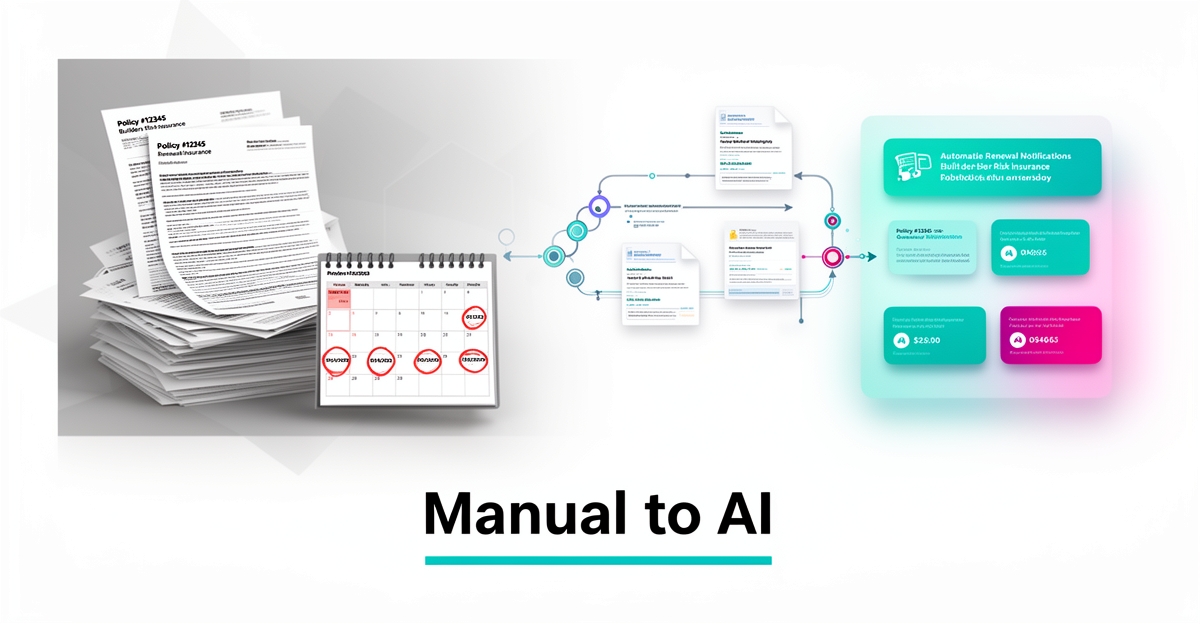
From Manual to AI: Transforming Policy Renewal Workflows in Builders Risk Insurance
Key Facts
- A typical builders risk renewal consumes roughly 45 minutes of combined staff time, according to widely cited industry estimates.
- At 2,000 annual renewals, that adds up to about 1,500 hours—close to one full-time employee chasing expirations.
- Agencies implementing renewal automation often report cutting manual renewal work by 60% or more.
- Industry surveys frequently cited in insurance coverage suggest around 35% of policyholders who switch carriers point to lack of proactive renewal contact.
- Structured renewal automation is commonly associated with retention improvements in the range of 5 to 10 percentage points.
- AI-based policy comparison can substantially reduce review time compared with manual comparison in operational settings.
Hire a team member that works 24/7 — for less than a part-time wage.
AI receptionists, SDRs, dispatchers and 99+ roles. Trained on your business, fully managed.
Not sure where to start? Ask our AI planner
The Hidden Cost of Manual Builders Risk Renewals
The hidden cost of manual builders risk renewals isn't just in the time spent—it's in the opportunities lost and the relationships frayed. Each renewal can consume 45 minutes or more of combined staff time across outreach, quoting, and follow-up, a figure that compounds quickly at scale. For an agency processing 2,000 renewals annually, that's roughly 1,500 hours—close to a full-time employee dedicated solely to chasing expirations. This burden pulls producers away from high-value advisory work and into repetitive, administrative tasks that don't leverage their expertise.
Beyond the direct labor cost, manual workflows create a silent revenue leak through missed renewals and avoidable churn. Industry surveys frequently cited in insurance coverage suggest that around 35% of personal lines policyholders who switched carriers cited lack of proactive contact as their reason for leaving—a process failure, not a product or price issue. When renewal outreach relies on manual triggers or sporadic follow-ups, policies slip through the cracks, especially during peak volumes. The result is not just lost premiums but eroded trust, as clients perceive inattention where none was intended. For builders risk, where policies often cover high-value, time-sensitive projects, these gaps can leave clients exposed and agents vulnerable to E&O risk.
The scalability problem is unavoidable: what works for 200 policies collapses at 2,000. Without automation, agencies face a choice between overextending staff or accepting preventable attrition. AI-driven renewal systems address this by handling expiration monitoring, personalized outreach, and follow-up sequencing at scale—freeing producers to focus on the conversations that truly require their judgment. Reducing manual renewal work substantially isn't just an efficiency gain; it's a retention safeguard. For agencies ready to reclaim staff time and close the renewal gap, AIQ Labs offers a path forward through targeted workflow builds that rebuild the renewal process from expiration to renewal—without replacing existing systems. To explore how this applies to your builders risk book, start with the 2-minute Fit Check and a free 30-minute strategy call to map your biggest bottleneck.
How AI Transforms the Renewal Lifecycle
AI-powered systems are redefining how insurers manage the renewal lifecycle by breaking it into four interconnected stages: expiration monitoring, automated outreach, quote generation with gap analysis, and follow-up sequencing. This workflow ensures no renewal slips through the cracks while reducing the manual burden on producers. Agencies implementing such automation often report cutting manual renewal work by 60% or more, freeing staff to focus on high-value client interactions. The system begins by continuously tracking expiration dates across the entire book of business, creating a prioritized queue based on renewal date, policy value, and client segment. At 90 days out—or a customized window—the AI triggers personalized outreach using the client's name, policy type, current coverage, and renewal date, avoiding generic templates that fail to engage. As the renewal date approaches, the system pulls current carrier rates, compares them against the existing policy, and flags coverage gaps or changes in the client's situation, delivering a one-page summary to the producer before any call. Non-responding clients receive sequenced touchpoints via email, SMS, or calendar invites, with the AI tracking responses and escalating non-responders to the producer queue before it's too late to re-shop the policy. This structured approach is commonly associated with retention improvements in the 5 to 10 percentage point range, with many agencies reaching payback within a few months of launch. AI agents in this space are widely reported to enhance data processing, enable personalization at scale, and automate the renewal lifecycle from collection to quote—while preserving the producer's role in complex, advisory conversations. AIQ Labs helps brokers implement these multi-agent workflows through AI Workflow Builds and managed AI Employees, ensuring integration with existing agency management systems without disrupting current operations. By automating repetitive tasks, brokers regain time to address life changes, high-value commercial accounts, and nuanced re-shopping conversations where human expertise remains essential. The result is a renewal process that is faster, more accurate, and deeply personalized—turning a traditional cost center into a strategic advantage for client retention and revenue growth.
Manual vs AI: Accuracy, Consistency and Scalability
Manual renewal work quietly erodes both margins and retention in builders risk. The process is labor-intensive, inconsistent, and difficult to scale when the book grows.
A typical renewal consumes roughly 45 minutes of combined staff time across outreach, quoting and follow-up. For an agency with 2,000 renewals per year that is about 1,500 hours annually—equivalent to one full-time position spent chasing renewals.
Manual processes rely on human attention to detail under tight timelines. In practice, accuracy suffers when discrepancies are missed, consistency varies by reviewer, and scalability breaks during peak volumes. Transparency also suffers without thorough documentation.
AI-based renewal workflows apply the same logic across every policy. Accuracy improves through structured data detection, consistency is enforced by standardized rules, and scalability is achieved by processing large volumes instantly. Operational comparisons of manual versus AI-based policy review consistently point to large reductions in review time when AI handles the comparison step.
The reliability gap translates directly to retention. Industry surveys frequently cited in insurance coverage suggest around 35% of personal lines policyholders who switched carriers said they were not contacted proactively at renewal. That is a process problem, not a price problem. Agencies implementing structured renewal automation commonly report retention improvements in the 5 to 10 percentage point range and significant reductions in manual renewal work.
AI does not remove producers from the process. It reallocates them. AI can fully automate the repetitive, data-heavy steps while humans retain advisory control for complex builders risk accounts.
AI can fully handle:
- Monitoring expiration dates across the entire book and building a prioritized renewal queue
- Sending personalized outreach emails and SMS reminders and tracking response status
- Generating renewal quotes, flagging coverage gaps, and updating policy status in the AMS
- Logging all outreach activity for compliance and E&O documentation
Humans still need to handle clients with major life changes, high-value commercial accounts where relationship matters, complicated re-shopping conversations with significant pricing changes, and any client who asks to speak directly.
This division is where producer time reallocation to high-value risk advisory becomes practical. With expiration monitoring, automated outreach and follow-up sequencing handled by AI, brokers can focus on coverage design, risk mitigation advice, and retention conversations that require judgment.
AIQ Labs helps brokers build full automation systems that reduce missed renewals and improve client retention by automating the lifecycle from expiration monitoring to follow-up sequencing, while keeping human expertise in the loop for complex decisions.
Implementing Renewal Automation Without Replacing Your AMS
Replacing your entire Agency Management System is not a prerequisite for automation. In fact, modern AI workflows are designed to sit on top of your existing infrastructure, pulling data from systems like Applied Epic, EZLynx, or HawkSoft to create a seamless renewal engine without the disruption of a full system migration.
The path to implementation follows five practical steps. First, connect your policy data; most AMS platforms support API connections or data exports that allow the AI to build a comprehensive renewal calendar. Second, define your outreach rules—determine whether clients receive notices at 90, 60, or 30 days, and specify the channel mix between email and SMS. Third, integrate your communication tools so messages appear to come directly from your producers rather than a generic system. Fourth, establish escalation protocols that automatically flag non-responders after 48 or 72 hours. Finally, launch with a pilot segment—perhaps 100 renewals over 30 days—before rolling out to your entire book. Agencies following this phased approach typically get a basic workflow operational within two to four weeks, with payback often arriving within the first few months.
However, builders risk insurance presents unique complexities that demand careful calibration. Unlike standardized personal lines, these commercial accounts often involve multiple stakeholders, layered coverage structures, and negotiated pricing. A common mistake is applying blanket automation to high-value commercial accounts without differentiation. Producers should maintain lead roles on accounts above certain thresholds while AI handles early-stage outreach and documentation.
Compliance requires equal attention. Every state maintains specific regulations regarding renewal notice timelines and required disclosures. Before launch, have someone versed in state insurance regulations review all message templates and timing rules to ensure adherence.
When implementing these systems, avoid these frequent pitfalls:
- Sending excessive touchpoints starting 120 days out, which triggers opt-outs
- Failing to write outcomes back to the AMS, creating dangerous data gaps
- Using generic templates instead of personalized messages referencing specific coverage details
- Neglecting to set escalation rules for non-responders before policies lapse
AIQ Labs specializes in building these integrated systems through deep API connections that preserve your existing tech stack while adding intelligent automation layers—delivered as a fixed-price, phased Workflow Build or as part of a broader AI Operating System you own outright. The goal is not to remove producers from the process but to ensure they focus on the complex risk advisory conversations that builders risk clients require. With roughly 35% of policyholders who switch carriers citing poor proactive communication in widely cited industry surveys, the cost of manual processes extends far beyond the 45 minutes of staff time each renewal can consume. By starting with a focused pilot and respecting the nuances of commercial lines, agencies can modernize their renewal workflows without replacing the systems that already work.
Still paying for 10+ subscriptions that don’t talk to each other?
We build custom AI systems you own outright. No vendor lock-in. Full control.
Not sure where to start? Ask our AI planner
Frequently Asked Questions
How much staff time is manual builders risk renewal really costing me?
Will automating renewals actually help me keep clients?
Do I have to replace my AMS to use AI for renewals?
What can AI handle and what still needs a producer?
How much manual work does AI actually remove?
What mistakes should I avoid when automating builders risk renewals?
Renewals Reimagined: Where AI Meets Advisory
The journey from manual to AI-driven policy renewal isn't just about saving time—it's about reclaiming strategic value. Automating expiration monitoring, personalized outreach, and follow-up sequencing frees producers from roughly 45 minutes of repetitive work per renewal, directly addressing the churn driven by poor proactive communication. For builders risk agencies, this means transforming a costly, error-prone process into a retention engine that improves accuracy, scalability, and client trust—all while keeping human expertise where it matters most. The path forward starts with pinpointing your specific bottleneck: take AIQ Labs' 2-minute Fit Check, then book a free 30-minute strategy call to map your renewal workflow and identify high-ROI automation opportunities that fit within your existing systems. Discover where AI can unlock your next level of growth.
Make AI your competitive advantage — not just another tool.
Strategy, implementation and ongoing optimization. One partner, end to end.
Not sure where to start? Ask our AI planner