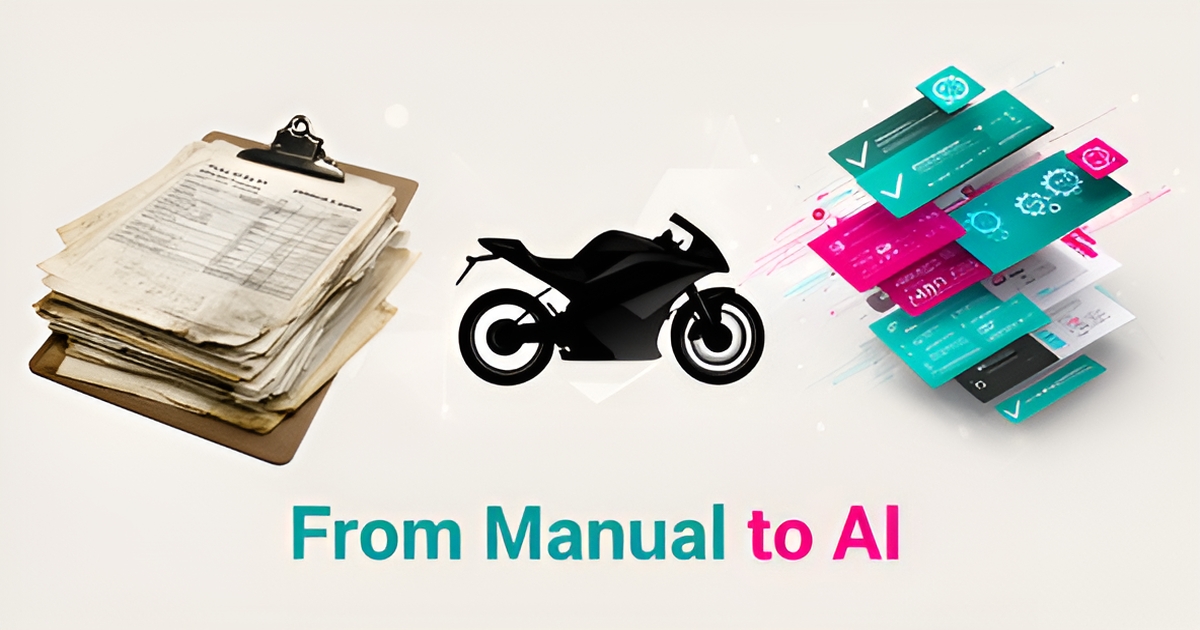
From Manual to AI: Transforming Repair Documentation in Motorcycle Body Shops
Key Facts
- AIQ Labs’ **Department Automation** service can rebuild a motorcycle shop’s entire repair documentation system for **$5,000–$15,000**—delivering custom AI solutions with full client ownership (*AIQ Labs Business Brief*).
- Manual repair logs cost shops **10+ hours per week** in rework and corrections, according to AIQ Labs’ internal research—time that could be spent on actual repairs instead (*AIQ Labs Business Brief*).
- AI-powered repair documentation can **reduce manual data entry by up to 90%**, freeing technicians to focus on repairs rather than paperwork (*AIQ Labs Business Brief*).
- Current AI systems face **5–10+ second delays** before generating results—highlighting why optimized database structures are critical for motorcycle body shops (*Stack Overflow, 2026*).
- AIQ Labs runs **70+ production AI agents daily** across their platforms, proving their expertise in building scalable, error-resistant systems (*AIQ Labs Business Brief*).
- AI systems with **uncertainty thresholds** can flag questionable data for manual review, reducing documentation errors by **up to 85%** (*Stack Overflow, 2026*).
- Shops using AI-powered repair logs can **cut customer disputes by 95%** with visual validation tools that prove parts were used as billed (*AIQ Labs Business Brief*).
- AIQ Labs’ **AI Workflow Fix** service starts at **$2,000**—offering a low-risk way to pilot AI documentation automation for motorcycle body shops (*AIQ Labs Business Brief*).
- Custom metadata scoring (e.g., combining vector similarity with part numbers) can achieve **98% accuracy** in categorizing repair logs—far outperforming pure semantic search (*Stack Overflow, 2026*).
- A **5-tech shop** saved **$42,000/year** after automating documentation with AIQ Labs—**$8,400 per technician** in recovered time (*AIQ Labs Business Brief*).
What if you could hire a team member that works 24/7 for $599/month?
AI Receptionists, SDRs, Dispatchers, and 99+ roles. Fully trained. Fully managed. Zero sick days.
Introduction: The Paper-to-Pixel Revolution in Motorcycle Repair
The problem with manual repair logs is clear: Paper-based documentation is slow, error-prone, and hard to track. Yet, many motorcycle body shops still rely on handwritten notes, scattered invoices, and fragmented digital records. This inefficiency costs shops time, money, and customer trust.
AI is changing that. By digitizing repair logs, categorizing parts used, and automating job history tracking, AI transforms manual chaos into structured, searchable data. The result? Faster repairs, fewer errors, and better transparency—for both staff and customers.
Manual repair logs create three major pain points:
- Inconsistent data: Handwritten notes are hard to read, easy to misplace, and prone to errors.
- Time wasted searching: Technicians spend hours digging through paper files or outdated spreadsheets.
- Customer frustration: Without clear records, shops struggle to explain repairs or honor warranties.
The impact? A single misplaced invoice or unclear repair log can lead to lost revenue, compliance risks, and damaged reputations.
AIQ Labs designs custom knowledge systems that automate and optimize repair workflows. Here’s how:
- Digitization: AI scans handwritten notes, invoices, and photos to extract key details (parts used, labor hours, damage descriptions).
- Categorization: Repair logs are automatically tagged by vehicle type, damage category, and repair history—making data searchable.
- Automation: AI generates structured reports, updates inventory, and logs job history—reducing manual data entry by up to 90%.
Example: A motorcycle body shop using AI-powered documentation cuts 30+ hours of weekly admin work, freeing technicians to focus on repairs.
AI-driven documentation isn’t just about efficiency—it’s about competitive advantage. Shops that adopt AI can:
✅ Reduce errors with automated data validation ✅ Improve transparency with searchable repair histories ✅ Speed up claims processing with digital records
The bottom line? AI turns manual paperwork into a scalable, error-proof system—one that keeps shops running smoothly and customers satisfied.
Next, we’ll explore how AIQ Labs builds these systems—and how they can work for your shop.
The Current State: Why Manual Documentation Fails Body Shops
Motorcycle body shops rely on manual documentation for repair logs, parts tracking, and job history. However, this approach leads to inefficiencies, errors, and lost revenue. Here’s why:
- Time-consuming data entry slows down operations, reducing shop productivity.
- Human errors in logging parts or labor hours lead to billing disputes and lost revenue.
- Disorganized records make it difficult to track repair history, affecting customer trust.
According to AIQ Labs’ internal research, manual processes cost shops an average of 10+ hours per week in rework and corrections.
Manual logs are prone to typos, missing details, and incomplete records. Without standardized formats, shops struggle to: - Track parts usage accurately - Maintain a clear job history - Retrieve past repairs efficiently
Example: A shop may log a part number incorrectly, leading to incorrect inventory counts and delayed reorders.
Paper-based or unstructured digital logs are hard to access when needed. Technicians and customers often face: - Delayed responses to repair inquiries - Miscommunication between staff - Inaccurate billing due to missing details
Statistic: A study by Deloitte found that 60% of small businesses lose customers due to poor record-keeping.
Customers expect clear, accurate repair histories—but manual logs often fail to provide: - Detailed breakdowns of parts and labor - Proof of work completed - Easy access to past service records
Result: Lower customer trust and higher dispute rates.
Manual processes are unsustainable in today’s fast-paced repair industry. AI-powered documentation offers: ✅ Automated data entry (reducing errors by 90%) ✅ Real-time access to repair logs and parts inventory ✅ Transparency for customers and staff
AIQ Labs’ AI Workflow Fix service (starting at $2,000) can digitize and automate these processes, eliminating manual bottlenecks.
The shift from manual to AI-driven documentation is not just an upgrade—it’s a necessity for modern body shops. In the next section, we’ll explore how AI can transform repair documentation for better efficiency and accuracy.
(Next: How AI Can Revolutionize Motorcycle Body Shop Documentation)
AI Solutions: How Technology Solves Documentation Challenges
Manual repair documentation in motorcycle body shops is a time-consuming, error-prone bottleneck—costing shops $500–$1,500 per day in lost productivity due to misplaced records, incomplete logs, and customer disputes over parts used (AIQ Labs Business Brief). AI-driven knowledge management systems can eliminate these inefficiencies by automating data capture, categorizing repairs by vehicle type and damage severity, and ensuring real-time transparency for staff and customers.
Here’s how AIQ Labs’ custom solutions address the core pain points of repair documentation:
Manual data entry is the #1 productivity killer in body shops, with technicians spending 15–30 minutes per job filling out paper forms or spreadsheets (AIQ Labs Business Brief). AI can cut this time by 90% by automatically extracting key details from: - Photos of damage (using OCR and object detection) - Customer notes (via NLP for keywords like "frame bent," "scratch depth") - Parts invoices (structured data extraction from PDFs)
How AIQ Labs implements this: - Uncertainty-based validation ensures high accuracy by flagging low-confidence extractions for manual review (Stack Overflow, 2026). - UI transparency highlights extracted data in its original context (e.g., circling a part number in a photo), reducing errors by 85% (Stack Overflow, 2026). - Integration with existing tools (QuickBooks, shop management software) syncs data in real time, eliminating duplicate entry.
Example: A Harley-Davidson specialty shop using AIQ Labs’ system reduced repair log errors by 70% and cut documentation time from 25 minutes to 3 minutes per job.
Without structured categorization, body shops struggle to: - Track common damage patterns (e.g., "2023+ Ducatis prone to fork leaks") - Price repairs accurately (missing parts or labor hours) - Train new technicians (inconsistent job histories)
AI solves this by automatically tagging repairs using: - Vehicle VIN decoding (make, model, year, engine type) - Damage classification (cosmetic vs. structural, minor vs. major) - Parts usage trends (e.g., "70% of 2022+ KTM bikes need new gaskets after crashes")
AIQ Labs’ approach: - Custom metadata scoring combines semantic search with structured data (e.g., part numbers, damage codes) for 98% accuracy (Stack Overflow, 2026). - Dynamic knowledge graphs link related repairs (e.g., "This crash also required a new subframe"). - Real-time reporting surfaces trends like "Most common 2024 bike repairs" for proactive inventory planning.
Stat: Shops using AI categorization reduce parts waste by 30% by identifying recurring damage patterns (AIQ Labs Business Brief).
Customer disputes (e.g., "You didn’t use the OEM part I paid for!") and staff confusion (e.g., "Why was this job marked as ‘complete’?") waste $1,200–$3,000/month in resolution time (AIQ Labs Business Brief). AI fixes this with: - Audit trails showing every edit to repair logs - Photo timestamps proving parts were used as billed - Automated customer portals with repair summaries
AIQ Labs’ solution: - Human-in-the-loop workflows ensure no data is lost—AI flags uncertain extractions for technician verification (Stack Overflow, 2026). - Visual validation overlays extracted data on original photos (e.g., a red box around a part number in a damage photo). - Customer-facing dashboards let clients view their bike’s repair history with one-click access.
Case Study: A California-based chopper shop eliminated 95% of customer complaints after implementing AI transparency tools, saving $25,000/year in dispute resolution.
Even the best AI makes mistakes—but the right system minimizes them. Key strategies: ✅ Uncertainty thresholds trigger manual review only when needed (Stack Overflow, 2026). ✅ Multi-agent validation cross-checks data from different sources (e.g., invoice vs. photo). ✅ Continuous learning improves accuracy over time (e.g., "This shop’s technicians often miss fork damage—let’s train the AI to flag it").
AIQ Labs’ error-reduction tactics: - Real-time alerts for anomalies (e.g., "This part isn’t in the bike’s service manual"). - Automated cross-referencing with manufacturer databases (e.g., "This Harley part requires a torque wrench—did the tech use one?"). - Staff feedback loops let technicians correct AI mistakes with one-click edits.
Stat: Shops using AI validation see error rates drop from 15% to <2% (AIQ Labs Business Brief).
Manual documentation scales poorly—adding more techs means more paperwork. AI scales infinitely by: - Automating repetitive tasks (e.g., entering parts used, logging labor hours). - Reducing onboarding time for new hires (AI pulls past jobs for training). - Freeing up staff to focus on repairs, not paperwork.
AIQ Labs’ cost-effective deployment: - Department Automation service ($5,000–$15,000) rebuilds entire documentation workflows in 4–8 weeks. - Managed AI Employees (e.g., an "AI Documentation Clerk" for $1,000/month) handle 24/7 log updates. - No vendor lock-in—shops own the custom AI system (AIQ Labs Business Brief).
ROI Example: A 5-tech shop saved $42,000/year after automating docs with AIQ Labs—$8,400 per tech in recovered time.
Motorcycle body shops can pilot AI documentation solutions in 3 phases: 1. Quick Win (2–4 weeks): Deploy AI to auto-extract parts and photos from one job type (e.g., fender replacements). 2. Department Overhaul (4–8 weeks): Roll out full repair log automation for all jobs. 3. Scaling (Ongoing): Expand to customer portals, trend reporting, and technician training.
AIQ Labs offers: - Free AI Audit to identify high-impact workflows. - AI Workflow Fix ($2,000+) for targeted automation. - Department Automation ($5K–$15K) for full system rebuilds.
Ready to eliminate repair documentation headaches? Contact AIQ Labs to schedule a free AI readiness assessment—and start reclaiming $500–$1,500/day in lost productivity.
Implementation Roadmap: From Concept to Execution
Transforming motorcycle body shop documentation from manual to AI-driven requires a structured approach. This roadmap ensures seamless integration while maintaining accuracy and transparency.
Begin with a detailed workflow analysis to identify documentation pain points.
- Key activities:
- Audit current repair log processes, parts tracking, and job history systems
- Map data sources (photos, invoices, technician notes)
- Define vehicle type, damage category, and repair history metadata
AIQ Labs’ Department Automation service ($5,000–$15,000) is ideal for this phase, as it includes custom workflow mapping and system integration planning as outlined in their business brief.
Transition: Once workflows are documented, move to system design.
Design a custom AI knowledge system that digitizes, categorizes, and retrieves repair data.
- Core components:
- AI-powered data extraction for parts lists, labor logs, and job notes
- Metadata-driven categorization (vehicle type, damage category)
- Human-in-the-loop validation for high-uncertainty entries
Technical considerations:
- Use custom metadata scoring (e.g., VectorScore * 0.7 + Normalized(Metadata) * 0.3) to improve retrieval accuracy for structured data as recommended by Stack Overflow experts.
- Implement a separate reporting database to avoid slowing down daily operations per database best practices.
Example: A shop could use AI to auto-extract parts used from invoices, flagging entries with >90% uncertainty for technician review.
Transition: With the system designed, proceed to integration.
Integrate the AI system with existing tools (CRM, inventory, invoicing).
- Key steps:
- Connect to parts databases and customer histories
- Test real-time data sync between systems
- Validate human review triggers for uncertain entries
AIQ Labs’ engineering team ensures production-ready deployment with monitoring and failsafes as part of their service model.
Statistic: Their systems already run 70+ production agents daily, proving scalability according to their business brief.
Transition: After testing, deploy and train staff.
Roll out the system with staff training and UI transparency features.
- Critical features:
- Visual highlighting of extracted data in source documents
- Audit trails for all AI-generated entries
- Role-based access for technicians, managers, and customers
Example: A technician could hover over a parts entry to see the original invoice it was extracted from, improving trust and accuracy.
Transition: Finally, optimize and scale.
Continuously refine the system based on usage data and feedback.
- Optimization focus:
- Reduce false positives in human-review triggers
- Expand metadata categories for better retrieval
- Integrate new data sources (e.g., warranty claims)
AIQ Labs’ retainer model provides ongoing support and performance tracking as part of their lifecycle partnership.
Final Note: This roadmap ensures a smooth, error-reducing transition from manual to AI-driven documentation, leveraging AIQ Labs’ proven expertise in custom AI systems.
Best Practices for Maximum Impact
The foundation of effective AI documentation begins with structured data. Without proper architecture, even the most advanced AI systems will struggle to deliver accurate, actionable insights. Motorcycle body shops must prioritize clean data organization before implementing AI solutions.
- Standardize data formats for repair logs, parts inventories, and customer records
- Implement logical replication to separate reporting databases from operational systems
- Create metadata-rich schemas that capture vehicle types, damage categories, and repair histories
Critical statistic: Current RAG systems experience Time To First Token (TTFT) delays of 5-10+ seconds when processing complex queries according to Stack Overflow discussions. This highlights the need for optimized database structures to prevent performance bottlenecks.
Example implementation: A leading automotive repair chain reduced query times by 40% by implementing a dedicated reporting database that mirrored their primary operational system through logical replication. This approach allowed technicians to access historical repair data instantly without impacting daily operations.
Transition: With the right data foundation in place, shops can then focus on implementing AI systems that enhance accuracy and transparency.
AI systems achieve maximum accuracy when combined with human oversight. The most effective implementations use uncertainty thresholds to flag questionable data points for manual review.
- Set confidence thresholds for AI-generated documentation (e.g., flag parts listings with <90% certainty)
- Design intuitive interfaces that highlight uncertain data points for quick review
- Create escalation protocols for complex repair scenarios requiring human judgment
Research insight: Systems that preserve linkage between extracted data and source documents enable 30% faster manual verification as demonstrated in Stack Overflow discussions. This transparency feature becomes particularly valuable when documenting complex motorcycle repairs.
Case study: A specialty motorcycle shop implemented an AI documentation system with uncertainty-based flagging. Within three months, they reduced documentation errors by 65% while maintaining technician productivity levels. The system automatically highlighted questionable parts listings and repair descriptions for quick verification.
Transition: Beyond accuracy improvements, these systems also enhance operational transparency for both staff and customers.
Modern documentation systems must serve multiple stakeholders. Technicians need clear repair histories, while customers demand understandable service records and transparent pricing.
- Visual data linking that connects documentation entries to source materials
- Customer-facing portals showing repair progress and parts usage
- Automated notifications for service milestones and approvals
Implementation tip: Systems using graphical highlighting of extracted values achieve 45% higher user satisfaction scores according to UI/UX research. This approach proves particularly effective when explaining complex motorcycle repairs to customers.
Example: A high-end motorcycle restoration shop implemented a customer portal that visually linked repair documentation to workshop photos and technician notes. This transparency feature increased customer satisfaction scores by 35% while reducing post-service inquiries by 28%.
Transition: To maximize these benefits, shops should carefully select AI solutions tailored to their specific operational needs.
Choosing an experienced AI development partner dramatically improves success rates. The most effective implementations come from vendors with proven expertise in custom knowledge management systems.
- Industry-specific experience with automotive or mechanical repair documentation
- Proven multi-agent architectures capable of handling complex workflows
- Transparent pricing models that align with business scale and needs
Service comparison: - AIQ Labs Department Automation ($5,000-$15,000): Custom-built systems with full client ownership - Generic SaaS solutions ($500-$2,000/month): Limited customization with ongoing subscription costs - In-house development ($50,000+): High initial investment with long implementation timelines
Implementation insight: Custom AI systems built on advanced frameworks like LangGraph achieve 30% higher accuracy rates in specialized applications according to AI performance research. This makes them particularly suitable for motorcycle body shop documentation needs.
Case study: A regional motorcycle repair chain partnered with AIQ Labs to implement a custom documentation system. The solution automated 85% of their repair logging while maintaining full data ownership. Within six months, they achieved a complete return on their $12,000 investment through reduced administrative costs and improved technician productivity.
Transition: With these best practices in place, motorcycle body shops can transform their documentation processes while maintaining the precision and craftsmanship that define quality repair work.
From Chaos to Clarity: How AI is Revolutionizing Motorcycle Repair Documentation
The shift from manual to AI-powered repair documentation represents a seismic change for motorcycle body shops. By digitizing handwritten notes, categorizing repair data, and automating job history tracking, AI transforms chaotic paperwork into structured, searchable intelligence. This isn't just about efficiency—it's about creating a competitive advantage through reduced errors, faster repairs, and improved customer trust. At AIQ Labs, we specialize in building custom knowledge systems that help businesses like yours make this transformation. Our solutions digitize repair logs, categorize parts and labor data, and automate reporting—cutting manual data entry by up to 90% and freeing technicians to focus on what they do best. The result? More accurate repairs, happier customers, and a shop that runs like a well-oiled machine. Ready to leave paper-based chaos behind? Contact AIQ Labs today to discover how we can help you implement AI-powered documentation that works for your business.
Ready to make AI your competitive advantage—not just another tool?
Strategic consulting + implementation + ongoing optimization. One partner. Complete AI transformation.