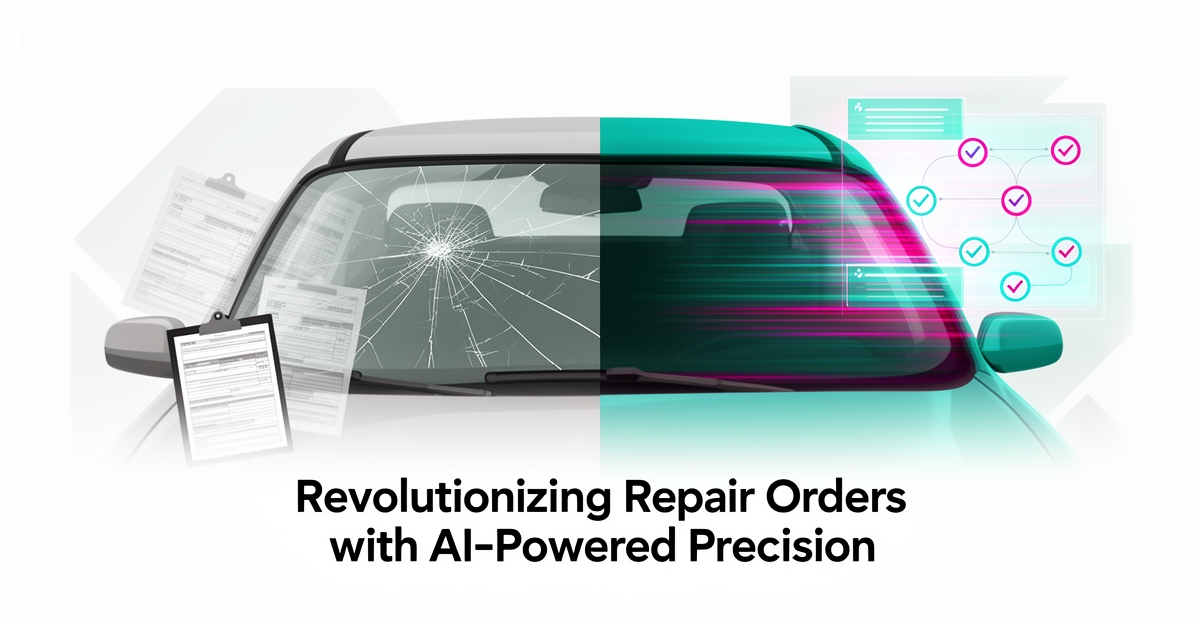
From Manual to AI: Transforming Repair Order Processing in Auto Glass Shops
Key Facts
- Major collision repairs like frame straightening can run $3,000–$10,000+, making every lost lead expensive
- AI receptionists solve the response-time problem with insurance-claim-aware intake, at a fraction of the cost of a human hire
- AI-assisted estimating tools can turn images of damaged vehicles into component-level estimate lines, compressing the assessment window
- Automated estimating can cut manual estimation time dramatically—often by most of the estimate-preparation effort—while improving consistency across shop locations
- Systematic post-repair review requests reliably increase review volume and lift average ratings by catching customers at peak satisfaction
- Door and quarter panel repairs often run $1,200–$4,000, so a single estimating error can wipe out the job's entire profit margin
- AI-powered intake captures vehicle and insurance details 24/7, turning missed after-hours calls into booked appointments
Hire a team member that works 24/7 — for less than a part-time wage.
AI receptionists, SDRs, dispatchers and 99+ roles. Trained on your business, fully managed.
Not sure where to start? Ask our AI planner
The Hidden Toll of Manual Repair Order Workflows
Manual intake, estimating and follow-up still drive most of the friction in a busy auto glass shop, and that friction is expensive when every repair order carries high stakes. A single delayed response can lose a claim to a competitor and erode the margin on work that ranges from minor to major collision repair.
Repair costs create a high-stakes environment from the first call. Typical industry figures put bumper repair and minor damage at roughly $500–$1,500, fender replacement at $800–$2,500, and door or quarter panel repair at $1,200–$4,000. Major work escalates quickly, with frame straightening and major collision often reaching $3,000–$10,000+ and full repaints $2,500–$10,000+.
When intake is manual, those numbers amplify risk. Staff juggle phone calls, insurance verification, photo requests and scheduling while the customer waits. Missed calls after an accident mean lost appointments, and slow estimating extends cycle time on jobs that already tie up bay space and parts inventory.
Estimating is a particular bottleneck. Manual measurements and parts lookups are time-consuming and error-prone, and errors on a $1,200–$4,000 repair can wipe out profit. AI-assisted estimating tools now turn images of damaged vehicles into component-level estimate lines, showing how automation can compress the assessment window.
Follow-up adds a third drag. Without automated prompts, shops rely on staff memory to chase approvals, parts orders and completion calls. Delays here reduce throughput and damage trust, especially when customers are already stressed post-accident.
The hidden costs show up across the workflow:
- Missed or slow first response that loses high-value jobs in the $3,000–$10,000+ range
- Manual data entry and re-keying between phone, shop management and insurance portals
- Inconsistent estimating that creates rework, supplement requests and margin erosion
- Delayed follow-up that lengthens repair cycles and reduces bay utilization
AI receptionists illustrate the cost of the status quo. Managed AI staff answer every call with insurance-claim-aware intake, capturing vehicle and insurance details 24/7 even when staff are unavailable—typically at around 80% less cost than a human hire.
For auto glass shops, the operational drag is not just hours lost. It is margin lost on high-value repairs and customer trust lost at the moment it matters most. Integrating AI into existing workflows can reduce human error, speed up order processing and improve transparency across intake, part ordering and follow-up. AIQ Labs builds production-ready AI systems that businesses own and control, with full customization for glass repair chains navigating these high-stakes processes—explore AI Workflow Builds to see how the one workflow that costs you the most gets rebuilt.
Capturing Every Lead with AI-Powered Intake
AI-powered receptionists are transforming how auto glass shops capture leads by ensuring no customer inquiry goes unanswered, regardless of time or staff availability. These systems operate 24/7, gathering critical details like vehicle information and insurance specifics the moment a call comes in, even outside regular business hours. This capability directly addresses a persistent industry challenge: delayed responses that cause potential customers to seek help elsewhere. Managed AI staff deliver insurance-claim-aware intake at a fraction of the cost of a full-time hire, helping shops prioritize high-value opportunities.
By intelligently routing calls based on urgency and insurance provider, AI receptionists streamline the booking process and reduce friction for customers in stressful post-accident situations. The system can instantly recognize when a caller mentions a specific carrier and flag that interaction for expedited handling, ensuring faster processing for claims that require timely coordination. This not only improves the likelihood of securing the repair job but also enhances the customer experience through prompt, knowledgeable engagement. Shops benefit from reduced administrative burden on staff, who can focus on in-shop repairs rather than fielding initial inquiries.
AI-powered intake ensures every lead is captured, qualified, and routed efficiently, turning missed calls into booked appointments. With natural language understanding and real-time data capture, these systems eliminate the gaps that occur during shift changes, lunch breaks, or after-hours emergencies. The result is a more responsive, professional front desk that operates continuously without fatigue or oversight. For auto glass shops aiming to maximize every opportunity, AI Employees provide a reliable, always-on foundation for smarter customer engagement and faster repair order initiation.
Accelerating Estimates with Computer Vision
Estimating vehicle damage has long been a manual bottleneck in auto glass shops, requiring technicians to spend significant time analyzing photos and referencing repair databases to generate accurate quotes. This process not only slows down customer intake but also introduces variability in estimates due to human interpretation and fatigue. AI-powered estimating tools are now transforming this workflow by using computer vision to analyze vehicle images and automatically generate component-level estimates, turning a time-consuming task into a near-instantaneous step.
Established estimating platforms in the collision and glass space now apply AI and proprietary historical data to turn images of damaged vehicles into detailed estimate lines, significantly improving both speed and accuracy. Computer-vision damage assessment tools similarly support faster decision-making, particularly in high-volume repair settings. These systems reduce estimation time from minutes or hours to seconds, allowing shops to move customers through intake faster and begin repairs sooner.
By automating damage assessment, AI estimating minimizes human error and ensures consistency across estimates, which is critical when dealing with insurance claims and customer expectations. The technology identifies specific parts needing repair or replacement—such as windshields, moldings, or adhesives—and pulls current pricing and labor data to build a comprehensive estimate. This level of detail helps avoid surprises during the repair process and builds trust with both customers and insurers.
- Cuts manual estimation effort dramatically, often by most of the estimate-preparation time
- Improves estimate accuracy through historical data integration
- Enables faster customer communication and approval workflows
- Supports consistent pricing across multiple shop locations
- Frees up technicians to focus on repairs rather than paperwork
For auto glass shops looking to streamline their repair order process, AI-powered estimating represents a foundational shift from reactive, manual workflows to proactive, data-driven operations. When integrated into a broader AI transformation strategy—such as AIQ Labs' custom workflow automation and managed AI staff—these tools become part of a seamless system that connects customer intake, estimating, parts ordering, and follow-up into a single intelligent flow. This end-to-end automation not only cuts operational costs but also enhances transparency and scalability, positioning shops to handle higher volumes without sacrificing quality or speed.
Automating Post-Repair Engagement and Reputation
Automated follow-up transforms one-time repairs into lasting relationships by ensuring every customer feels heard and valued long after the job is complete. AI-driven systems trigger personalized review requests immediately after service, capturing feedback at the moment of peak satisfaction while simultaneously routing any concerns to shop managers for private resolution before they reach public platforms. This dual approach prevents negative experiences from escalating and turns service recovery into opportunities for trust-building. Shops that implement this workflow consistently see measurable gains in review volume and average ratings, which directly impact visibility and conversion in local search results. Timely follow-up signals reliability and care, and that shows up in both reputation metrics and customer retention.
- Automated review requests sent within 24 hours of repair completion
- Private complaint routing to prevent public negative feedback
- Sentiment analysis to identify at-risk customers for proactive outreach
- Follow-up sequencing that balances persistence with respect for customer time
- Integration with CRM to trigger loyalty offers based on review scores
By embedding reputation management into the post-repair workflow, auto glass shops convert operational efficiency into long-term customer value. AIQ Labs supports this transformation through AI Employees that manage review campaigns and complaint triage as part of a fully owned, end-to-end automation system—ensuring shops maintain control over their customer interactions while benefiting from consistent, scalable engagement. The result is not just higher ratings, but a self-reinforcing cycle where positive experiences generate more reviews, which attract more customers, ultimately increasing lifetime value through repeat business and referrals. This systematic approach turns every repair into a reputation-building opportunity, protecting margins in a competitive market where trust is the ultimate differentiator.
Implementation Roadmap for Auto Glass Shops
Auto glass repair shops face mounting pressure to process repair orders faster while maintaining accuracy and customer satisfaction. Manual workflows create bottlenecks at every stage—from initial customer intake to part ordering and follow-up—leading to delays, errors, and missed opportunities. Integrating AI into these workflows transforms repair order processing by automating repetitive tasks, reducing human error, and enabling shops to handle more volume without adding staff.
A phased implementation approach minimizes disruption and builds confidence through early wins. Start with a targeted AI workflow fix—such as deploying an AI receptionist to handle 24/7 customer inquiries and capture vehicle and insurance details—addressing the industry's critical need for faster response times. Managed AI staff ensure no inquiry is missed, directly improving booking rates at a fraction of the cost of a human hire. Next, integrate AI-powered estimating tools that use computer vision to analyze damage images and generate preliminary estimates, improving accuracy and cutting estimation time significantly. Finally, automate reputation management by triggering immediate review requests post-repair, a strategy that reliably increases review volume and lifts average ratings.
Each phase should include clear milestones: assessment of current tools, custom integration with shop management systems, staff training on new workflows, and performance tracking. AIQ Labs' Build in Milestones model supports this approach—shops approve and pay for each phase as it ships, retaining everything built so far while maintaining control over customization and future development. This ensures production-ready systems that align with existing operations without vendor lock-in. Shops that want a single connected operating layer across intake, estimating, parts and follow-up can graduate to an AI Operating System, built in phases and owned outright.
- Assess current repair order workflow to identify manual bottlenecks
- Deploy AI receptionist for 24/7 customer intake and data capture
- Integrate AI estimating for faster, more accurate damage assessments
- Automate review requests to improve online reputation and customer trust
- Train staff and monitor performance for continuous optimization
By progressing through these phases, auto glass shops transform fragmented, manual processes into a cohesive, AI-driven system they own and control—reducing operational errors, speeding up order cycles, and creating a scalable foundation for long-term efficiency. Shops ready to begin can start with a two-minute Fit Check at aiqlabs.ai/apply for a free 30-minute strategy call to map their specific bottlenecks and identify high-ROI automation opportunities.
Still paying for 10+ subscriptions that don’t talk to each other?
We build custom AI systems you own outright. No vendor lock-in. Full control.
Not sure where to start? Ask our AI planner
Frequently Asked Questions
How much does an AI receptionist cost for an auto glass shop?
Can AI really create accurate repair estimates from photos?
What happens if I miss a call after hours or during busy periods?
Will AI work with my existing shop management software?
How does AI help with customer reviews and reputation management?
What's the ROI timeline for implementing AI in my auto glass shop?
Turning Repair Orders Into Revenue You Keep
Manual intake, estimating and follow-up are quietly eroding margin on every $500–$10,000+ repair, from missed calls and re-keying to inconsistent estimates and delayed approvals. AI changes that equation by making the front desk always-on, turning photos into component-level estimates in seconds, and automating post-repair engagement that protects reputation and drives repeat business. Shops that phase in an AI receptionist, computer-vision estimating, and automated review workflows see faster cycle times, higher bay utilization, and fewer supplement requests without adding headcount. The goal is not more software subscriptions, but a cohesive, owned system that connects intake to part ordering and follow-up under your control. AIQ Labs builds production-ready AI systems businesses own and control, with full customization for glass repair chains navigating these high-stakes processes. Start with a two-minute Fit Check at aiqlabs.ai/apply for a free 30-minute strategy call to map your biggest bottleneck and identify high-ROI automation opportunities, or email [email protected] with questions. Managed AI staff deliver insurance-claim-aware intake at a fraction of the cost of a human hire—typically around 80% less.
Make AI your competitive advantage — not just another tool.
Strategy, implementation and ongoing optimization. One partner, end to end.
Not sure where to start? Ask our AI planner