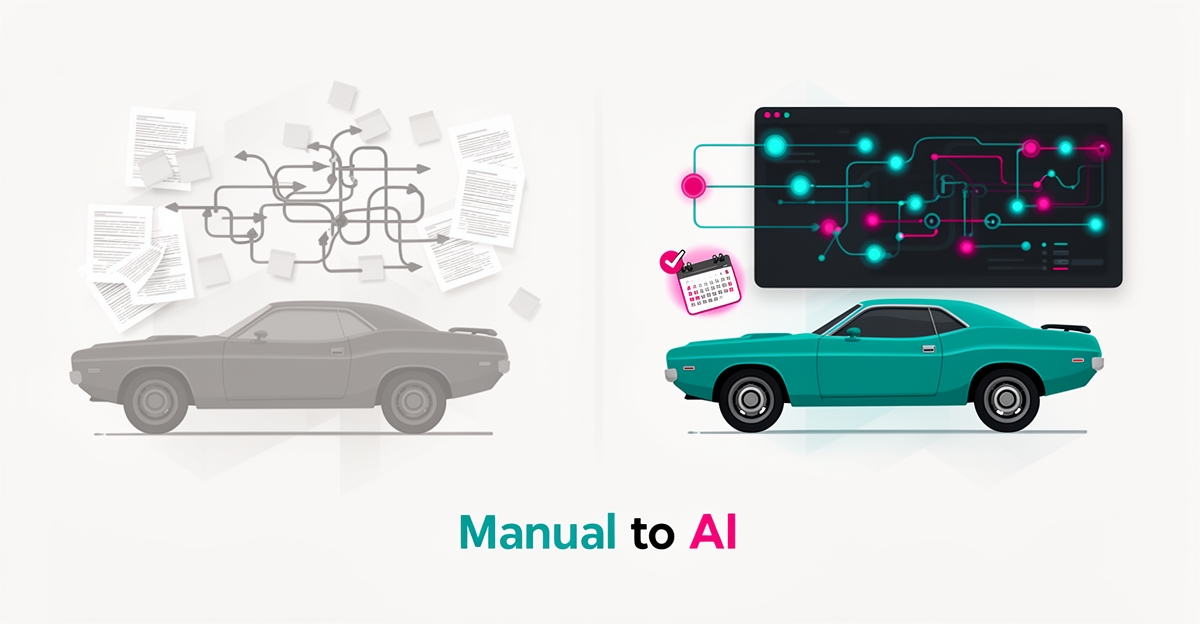
From Manual to AI: Transforming Sales Workflows at a Classic Car Dealership
Key Facts
- Industry analyses as of late 2026 consistently point to slow response times as the top reason online shoppers abandon a dealer before a conversation starts
- A large share of sales leads across the automotive sector never receive a second follow-up, according to widely cited dealership research
- Dealerships adopting AI lead qualification commonly report meaningfully higher showroom appointment rates and lead-to-sale conversions
- Automated follow-up responds in seconds rather than hours, keeping high-intent buyers engaged while enthusiasm is high
- Most dealerships surveyed in recent years say they plan to increase AI budgets, signalling a narrowing competitive window
- AIQ Labs has deployed 200+ multi-agent systems and runs 4 live SaaS products daily — the same infrastructure it builds for clients
Hire a team member that works 24/7 — for less than a part-time wage.
AI receptionists, SDRs, dispatchers and 99+ roles. Trained on your business, fully managed.
Not sure where to start? Ask our AI planner
When Paper Pipelines Cost You the Deal
Paper pipelines bleed opportunities at classic car dealerships. Leads scribbled on notepads get buried under service tickets or coffee rings. Callbacks vanish into voicemail limbo while buyers move on to more responsive sellers. Appointments slip through scheduling chaos—double-booked slots, forgotten follow-ups, and the slow erosion of trust before a single test drive happens.
This isn't just inefficiency; it's a revenue leak. Widely cited dealership research has found for years that a large share of salespeople never follow up on leads at all, turning warm prospects into cold statistics. Industry analyses consistently point to slow engagement as a leading reason online shoppers abandon a dealer before a conversation even begins. For specialty businesses like classic car dealerships—where relationships and timing drive six-figure sales—these gaps aren't operational quirks. They're missed connections that evaporate equity.
The cost compounds in silent ways. Sales teams waste hours chasing illegible notes or reconstructing conversations from memory. Managers spot trends too late, reacting to missed quarters instead of preventing them. High-intent buyers—those researching rare models or restoration specs—get funneled into generic follow-up cycles that ignore their urgency. When the average classic car sale hinges on nuanced buyer-seller alignment, manual workflows introduce friction where trust should accelerate. Each delayed callback isn't just a missed appointment; it's a signal that the dealership operates on yesterday's pace in today's market.
- Leads captured but never contacted due to lost or delayed follow-ups
- Appointments missed from manual scheduling errors or no-shows without recapture
- High-intent prospects disengaging during slow response windows
- Sales cycles extended by administrative drag instead of buyer readiness
- Revenue leakage from untreated leads that convert elsewhere
AIQ Labs sees this pattern across automotive clients: paper isn't preserving tradition—it's preserving inefficiency. The fix isn't abandoning the craft of classic car sales; it's removing the administrative drag that steals focus from what matters—matching the right vehicle with the right enthusiast at the right moment. When workflows stop leaking, closures start flowing.
Mapping the Workflow Before Automating It
Most classic car dealerships automate a broken process and call it transformation. Speed without clarity just moves the bottleneck faster, and the sales team pays the price in missed opportunities and frustrated buyers.
Mapping the workflow before automating it forces the dealership to document every touchpoint from first inquiry to deal close. That documentation exposes where leads stall — inquiry response, appointment booking, and the rep handoff — so automation targets real friction instead of adding technology on top of chaos.
A classic car operation typically runs on paper logs, spreadsheets, and memory. Without a map, it is impossible to see that inquiry response lags cause drop-off. Industry coverage of dealership engagement has long flagged slow response times as a major driver of online abandonment. The stall is measurable before any AI is introduced.
Lead follow-up is another common leak. Dealership research has repeatedly found that a large share of salespeople fail to follow up on leads. When the handoff from marketing to sales is undefined, high-intent prospects sit idle and the team loses control of the narrative.
Workflow mapping creates a shared baseline for the sales team and the automation design. At AIQ Labs, this discovery step is the core of every AI Workflow Build: segment leads by intent, sync touchpoints to CRM, and define clear ownership for each step.
The map should capture the current state in detail:
- How inquiries arrive across website, phone, social, and showroom, and who sees them first
- Average time to first response and who is responsible for appointment booking
- How qualified leads are scored, routed, and handed to a rep with context
- Where CRM data is entered manually and where it is lost between systems
With those points documented, automation can be designed to eliminate specific delays. Dealerships using AI-powered lead qualification commonly report higher showroom appointment rates and stronger lead-to-sale conversions. Those gains depend on a clean handoff, not just a chatbot.
Mapping also reveals data quality issues that undermine CRM synchronization. If lead source, vehicle interest, and conversation history are not consistently captured, even the best AI workflow will propagate bad data. Fixing the process first is what makes faster deal closures sustainable rather than a one-time bump.
The result is automation that respects how classic cars are sold — high-touch, relationship-driven, and detail-rich — while removing the manual steps that slow the team down.
AI-Powered Scheduling, Qualification, and Handoffs
The difference between a lead that converts and a lead that vanishes often comes down to minutes, not days—and at a classic car dealership running on paper logs and phone tag, those minutes get lost constantly. Three core automations change that.
The first is AI-driven lead qualification that engages every inquiry in real time, whether it arrives at 2 p.m. or 2 a.m. Instead of waiting for a salesperson to return a call, the system asks qualifying questions, gauges purchase intent, and personalizes responses on the spot. Dealerships adopting this approach commonly report higher showroom appointment rates and stronger lead-to-sale conversions.
The stakes are higher than most dealers realize. Slow engagement is a leading reason shoppers abandon a dealer online—yet a large share of salespeople never follow up on leads at all. An AI qualifier never forgets, never delays, and never lets a motivated buyer slip through the cracks.
The second automation eliminates phone tag entirely. Once a lead qualifies, the system offers available appointment slots and books directly into the dealership's calendar—no callbacks, no voicemail chains, no double-bookings. Automated follow-up responds in seconds rather than hours, which is often the difference between a booked appointment and a buyer who has already moved on.
The third piece is intelligent lead handoff. When a high-intent buyer is ready to talk numbers, the system routes them to the right salesperson with full context attached—every question asked, every preference stated, every vehicle viewed. The rep walks into the conversation informed, not starting from zero.
The contrast with the old manual approach is stark:
- Lead qualification: Manual callbacks and guesswork → real-time AI engagement with intent scoring
- Scheduling: Phone tag and paper calendars → instant, automated booking
- Handoffs: Warm body, cold context → right salesperson, full conversation history
This is the kind of transformation AIQ Labs builds for dealerships and service businesses—not a chatbot bolted onto a website, but a custom AI workflow trained on your sales process, integrated with your CRM and calendar, and owned by you outright. The result is a sales floor that responds in seconds, books without friction, and hands off with intelligence.
The Faster Close: Results and What They Mean
When a dealership replaces paper-based workflows with AI-driven processes, deals close meaningfully faster. That shift doesn't just save time—it fundamentally changes how quickly a rare vehicle moves from inquiry to sold.
This pattern doesn't exist in a vacuum. Across the automotive sector, dealerships adopting AI commonly report revenue uplift driven largely by faster, smarter engagement with buyers. When follow-up is automated and intelligent, the specific numbers vary by operation, but the direction is consistent: faster response times, higher conversions, and recovered dormant leads—prospects who would otherwise have gone cold.
Why does speed matter so much in a classic car context? Because inventory here isn't interchangeable. A 1967 Porsche 911S in a specific color with matching numbers isn't a commodity—it may be the only one a buyer finds this year. When that buyer reaches out and waits two days for a response, they don't just get impatient; they assume the car is already gone, or they find another. Slow engagement is a well-documented driver of online abandonment. In a market where every vehicle is unique, that abandonment isn't a lost sale—it's a lost relationship with a collector who may never return.
The compounding effect is where the real transformation lies. Consider what happens when speed-to-engagement improves across the entire sales cycle:
- AI-qualified leads reach the right salesperson instantly, with full context on the buyer's intent and history.
- Automated scheduling eliminates the back-and-forth that stalls momentum in high-emotion purchases.
- Follow-ups happen on time, every time—critical in an industry where many leads never receive a second contact at all.
- Emotional buyers stay engaged while enthusiasm is high, rather than cooling off during delays.
Classic car buyers don't purchase on specs alone. They're buying nostalgia, identity, a piece of history. That emotional window is narrow. A buyer who falls in love with a car on Monday may talk themselves out of it by Friday if the process feels slow or uncertain. A faster close isn't just an efficiency metric—it's the difference between capturing that emotional peak and losing it to hesitation.
AIQ Labs designs these transformations around that reality. The system doesn't just automate tasks; it preserves urgency. When a lead comes in, the workflow ensures immediate acknowledgment, rapid qualification, and seamless handoff to a human who can close while the buyer is still emotionally invested. For dealerships where every vehicle is one-of-one, that speed isn't a luxury—it's the margin between a sale and a story about the one that got away.
Your Roadmap from Manual to AI-Driven Sales
Translating a classic car dealership's leap from paper-based chaos to AI-driven precision into a repeatable playbook starts with one realization: you don't need to overhaul everything at once. In fact, trying to automate an entire sales floor on day one is the fastest route to stalled pilots and frustrated teams. The smarter path begins with workflow mapping—documenting exactly how leads arrive, where they stall, and which handoffs leak revenue. In an industry where many leads never receive a follow-up at all, the highest-friction touchpoint is usually the first one worth automating.
Start there. Automate lead response or appointment scheduling before touching inventory forecasting or dynamic pricing. Dealerships implementing AI-powered lead qualification commonly report higher showroom appointment rates and stronger lead-to-sale conversions, and automated follow-up responds in seconds rather than hours while recovering dormant leads. These aren't marginal gains—they compound quickly when your CRM, calendar, and communication channels sync without manual re-entry.
Yet technology alone won't close the gap. Change management and data quality are the twin obstacles that most often derail adoption. Sales reps need training to trust AI-qualified leads with heightened context, not suspicion. Your historical data needs cleaning before predictive models can optimize anything. This is where most internal projects stall, and where structured partnership matters. AIQ Labs offers three entry points for exactly this sequence: AI Employees for managed AI staff handling reception, lead qualification and scheduling at a fraction of the cost of a human hire, AI Workflow Builds to rebuild the one workflow that costs you the most at a fixed price, and AI Operating Systems for a single connected operating layer built in phases and owned outright. Each path embeds integration with existing tools and team training from day one, addressing the human and technical frictions simultaneously.
The roadmap holds regardless of your starting point:
- Map every workflow touchpoint before automating anything
- Automate the highest-friction step first—typically lead response or scheduling
- Integrate with your existing CRM and communication systems, not around them
- Train your team to work alongside AI, not compete with it
- Expand only after the first workflow proves measurable ROI
With most dealerships surveyed in recent years planning to increase AI budgets, the window for competitive differentiation is narrowing as of late 2026. The dealerships winning today aren't the ones with the biggest tech stacks—they're the ones that picked the right first workflow, fixed it completely, and scaled from there. Start with the bottleneck, not the blueprint.
Still paying for 10+ subscriptions that don’t talk to each other?
We build custom AI systems you own outright. No vendor lock-in. Full control.
Not sure where to start? Ask our AI planner
Frequently Asked Questions
How much faster can a classic car dealership close deals by switching from paper to AI-driven workflows?
Why do so many online shoppers abandon classic car dealerships, and what can AI do about it?
What's the first step a dealership should take before automating its sales workflow with AI?
Can AI really improve lead-to-sale conversions for specialty dealerships like classic car sellers?
How does AI improve the handoff between marketing and sales in a classic car dealership?
What does it cost to get started with AI sales workflow automation?
Keep the Craft, Lose the Drag
Paper pipelines don't preserve tradition in classic car sales, they preserve inefficiency. Mapping the workflow first exposes where leads stall — slow inquiry response, manual scheduling, and cold handoffs — and allows automation to target real friction instead of adding tech on top of chaos. With AI-driven qualification, instant booking, and intelligent handoffs with full context, dealerships close rare-inventory deals faster while protecting the high-touch, relationship-driven experience collectors expect. Speed matters because unique inventory can't wait for callbacks. The roadmap is repeatable: map touchpoints, automate the highest-friction step first, integrate with your existing CRM and calendar, train the team to work alongside AI, then scale after measurable ROI. With most dealerships planning to increase AI budgets, the competitive window is narrowing. Start the 2-minute Fit Check at aiqlabs.ai/apply, then book a free 30-minute strategy call to map your biggest bottleneck and identify a high-ROI automation opportunity, with no obligation.
Make AI your competitive advantage — not just another tool.
Strategy, implementation and ongoing optimization. One partner, end to end.
Not sure where to start? Ask our AI planner